
Translated material
How to become Schukin
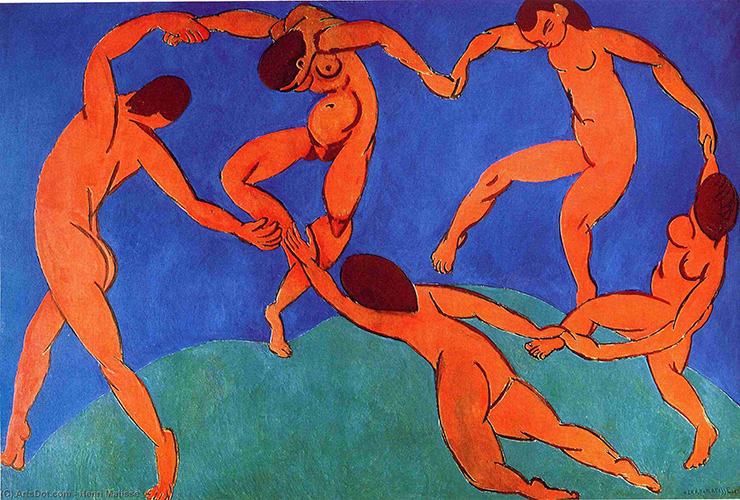
At the exhibition "Schukin. The biography of the collection ”, which recently took a great success in the PMM, many wondered: how did the legendary Schukin manage to be from hundreds of canvases shown to him by Parisian dealers, to choose those names and things that later sounded in history? Schukin was a very brave and stubborn person. “If the picture is shocking you, buy it,” the merchant loved to repeat this confident. Fascinated by his business, he showed and commented on his collection to members of the imperial family and poor young artists with the same heat.
Passion, sincere enthusiasm and perseverance are often no less effective tools in collecting than capital itself (and I know many examples of this). Well, taste, intuition, plenty and, first of all, a keen interest in art is formed through regular exercises. The reasons for the popularity of Schukin’s exhibition were not only in the number of masterpieces per square meter, but also in the fact that this exhibition showed: the private life of a simple person, absorbed by the passion for art and its collecting, could become a legend for the next generations and serve the formation of new aesthetics.
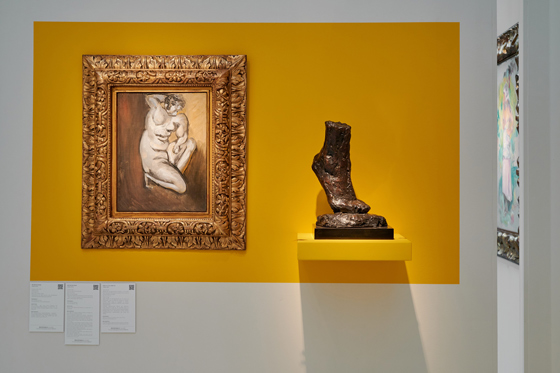 © Emmanuel Crooy Fragment of the stand Helene Bailly Gallery. In the photo - the works of Henri Matisse “kneeling naked” (1919) and “foot” (1952). Brafa 2020
In Russia, there is still an opinion that collecting is an activity for very rich. In fact, you can start forming your collection, having several thousand or even hundreds of euros. The main thing is to become interested in art and gathering, want to delve into and figure it out. Collecting fills life with new meanings, includes the private existence of a person in a vast cultural field. Search, study of the subject, the circle of communication enthusiastic (devoted) become a area of living interest. In addition, with the help of his collection, the collector, not being an artist at all, realizes himself creatively, embodies his vision of art. My little collection (even if these are only graphics and drawings) are my taste, my awareness and intuition: “I see this way.”
The main tool of the collector is his eye. First of all, there is a vision of museums: they give a voluminous idea of the history of art, introduce into context, and hone the taste. Here everything is divided into sections, classified and signed; The quality and authenticity of the exhibits is not in doubt.
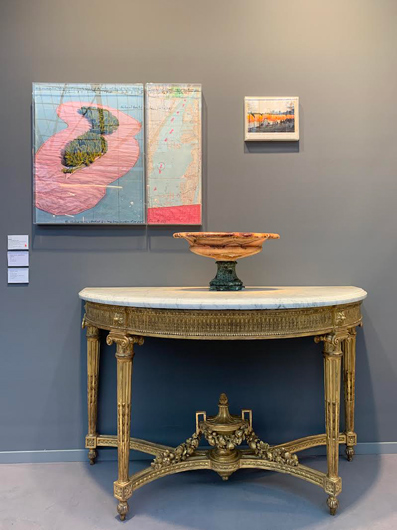 © Tamara Vekhova Fragment of the REPETTO GALLERY stand. The Roman Alabastra Vase (1600s), the console of the Parisian master Georges Jacob (the era of Louis XVI), the work of Christ "surrounded islands (Bay Bay, Bolshaya Miami, Florida)" (1983). Brafa 2020
However, to know the world of art and learn to navigate in it, determining your favorites and the field of interest, can be in another, parallel to the existing space, which has been studied little by the Russian public. We are talking about art fairs. And if the museum is a prepared territory marked with flags and signal lights for a visitor with any level of training, then art Yarmark is always a jump into unknown, wild and risky slalom among all kinds of eras, styles and genres presented in the most unexpected combinations. This is where you can and should use your intuition and learn to rely only on your own eye, “pump” competence and experience! The potential opportunity to become the owner of a favorite subject activates the most unexpected receptors, so the learning process becomes even more exciting and gambling.
Large, high-quality and interesting art fairs go almost all year round-in different cities and countries. For example, in the last decade of January in Brussels, the annual art fair Brafa , the oldest and one of the best in Europe, takes place: it is with this fair that the collector with a small budget can begin. I talked about her with Ekaterina de Roshambo Lemonad, her official representative in Russia.
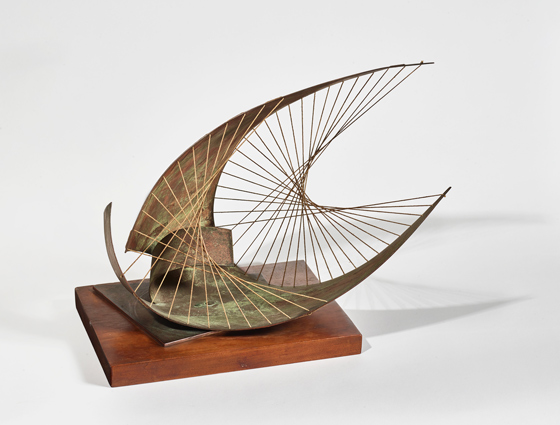 © Emmanuel Crooy Barbara Hepoort. String figure (Bird Kronshnop). 1956. Galerie Fleury. Brafa 2020
- How is Brafa different from other modern art fairs?
- Initially, Brafa was the legislator of eclecticism. Here and today you can meet anything: the skull of the prehistoric Patient Jurassic period, masterpieces of small ancient plasticity, modern sculpture, painting and graphics of famous artists, collection design from all continents and even large meteorite. In 2018, the sign work of Rubens was sold at Brafa , in 2016-the landscape of Kazimir Malevich. This year, five large fragments of the Berlin Wall were sold at the auction (the auction revenue amounted to 326,000 euros, this money went to charity).
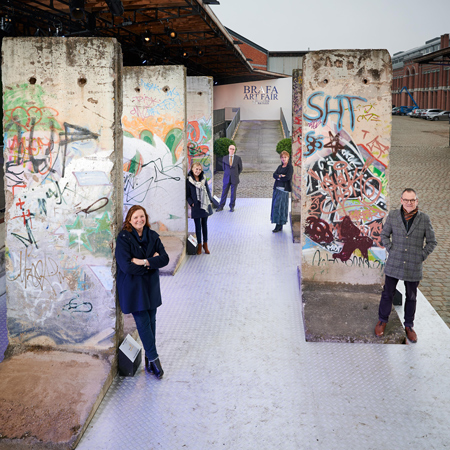 © Emmanuel Crooy Five fragments of the Berlin wall exhibited at the Brafa 2020 Fair charity auction
Often at fairs, art is represented by sections, according to periods and types. And Brafa was originally a special place where everything was exhibited: it was a special hobby of the Belgians - it was not without reason that the Belgian was the legendary vervordt, the legislator of fashion for eclecticism in architecture and design. Here, the aesthetics of stands plays a special role. Many of them are a fascinating mini-exhibition, for which famous architects and decorators are invited.
In addition, the correct size of the fair works for us. It is not too big, but by no means small. About 130 participating galleries. I advise you to lay it on her visit for two days, because it is impossible to walk for more than three to four hours in a row: an overdose of art comes.
The atmosphere here is very friendly: after all, some fairs are very snob, gallerymen look at visitors so that they are literally afraid to go to the stand, not to mention asking about anything. As for Brafa (and this is also a Belgian line) - you can come in, communicate, everyone will tell you and show you.
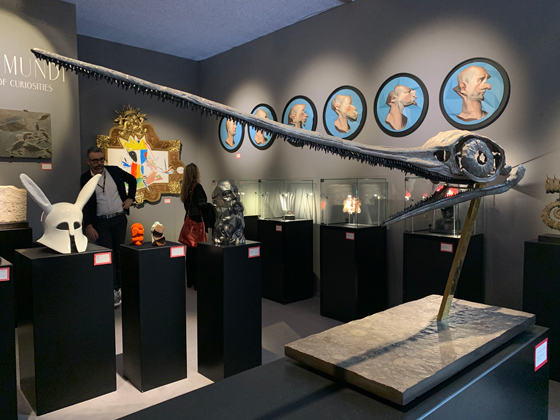 © Tamara Vakhova Eurhinosaurus Longirostris. Jurassic period (175–183 million years). The stand of the Gallery Theatrum Mundi. Brafa 2020
- This is very good, but tell me, please: if our reader is not a collector, but just an art lover, does it make sense for him to go to the fair? Will he be happy there?
-From the point of view of an amateur who is vividly interested in art and wants to learn to focus on the art market,-definitely yes: he will receive a lot of impressions. 14-18 countries participate in the fair. Even a professional, coming to a particular city, will not be able to go around as many galleries as it is represented here. It should also be taken into account that at Brafa , gallerymen try to present the best of the possible: they often collect the exposition for a year, do not exhibit and do not sell objects, preserving them for the fair. But to be honest: the galleryist is an idle visitor, not a buyer, is not at all interesting. Participation in the fair costs a lot of money, it is important for them not only to show, but also to sell their items - to “fight back”.
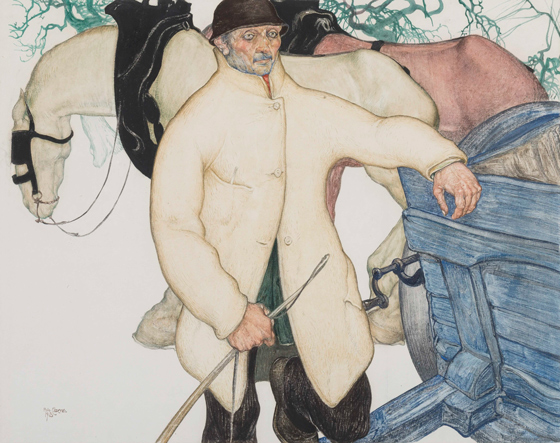 © Fabrice Debatty Anto Cart. Cab. 1918. Lancz Gallery. Brafa 2020
- And with what amount in your pocket can the guest of the fair feel like a potential buyer?
- In fact, even with a small budget you can show taste and imagination. For example, last year at the stand Galerie Maeght circulation subscriptions of Matisse or Juan Miro were sold for two or three thousand euros. It happens that for several hundred euros you can purchase a real artifact, something small, from Egyptian archeology. This year, at numerous stands representing tribal ART is primitive art (the colonial past of Belgium is affected), delightful African masks of the XIX century, small plastic and jewelry, which cost from 400 to 5000 euros. But the main thing at the fair is curiosity. If you are here, then behave more actively, ask, be interested. Do not be afraid to find out the price, because it may surprise, and it’s pleasant to surprise. At the art fair you will learn how to navigate, correlate the cost and quality. Recognizing the price, you can at the same time check yourself, your intuition.
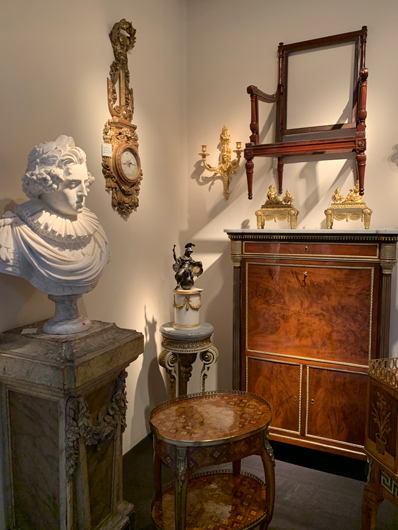 © Tamara Vakhova Fragment of the stand Galerie Berger. In the photo - the coffee table of the era of Louis XV - Louis XVI, secretary of the era of Louis XVI. Brafa 2020
- We regularly hear about loud scandals in the art market associated with fakes. What is the case with this at Brafa ? What are the authenticity of things, the accuracy of their dating and attributions?
-100 independent experts from all over the world, the so-called winding commission (from English to VET - "check, explore." - Ed. ), carefully inspect all 14 sections of the fair . After the stands are already mounted, everything is closed for two days, and a winding committee with laboratory equipment and an X-ray apparatus enters the fair. The exhibit causes doubts either immediately deleted or request additional information about it from the galleryist. It happens that the case ends with a request to change the attribution. Suppose a furniturer says: this is the XVIII century - but in fact it is the beginning of the XIX. Such experts really do not like.
Last year, Kristina Krasnyanskaya (Eritage Gallery, Moscow), the only Russian participant in the fair, came to Brafa for the first time. The members of the committee called the Pushkin Museum to get recommendations, since the material was not familiar with them.
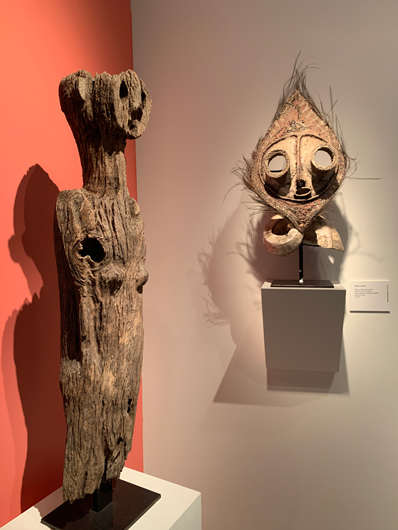 © Tamara Vekhova Fragment of the stand of the Gallery Serge Schoffel - Art Premier. Mask (Mali, XIX century). Brafa 2020
In addition to Provenance, experts are sure to watch the quality of restoration. If the thing is restored, there is an acceptable meaning when the work is considered genuine, and if it is exceeded, then everything is posted, that is, in fact rewritten. Such an item is immediately removed from the stand. Thus, Brafa zealously observes its reputation, and also acts as a kind of guarantor of security and the rights of the buyer, who should not encounter a fake or with a poor -quality work. Each antique fair should have a solid winding committee, and at the Fair of Modern Art-an independent expert artistic council that will not miss second-rate, third-rate work. However, some organizers of the fairs do not like the committee for the fact that at the last stage it scores a lot of things.
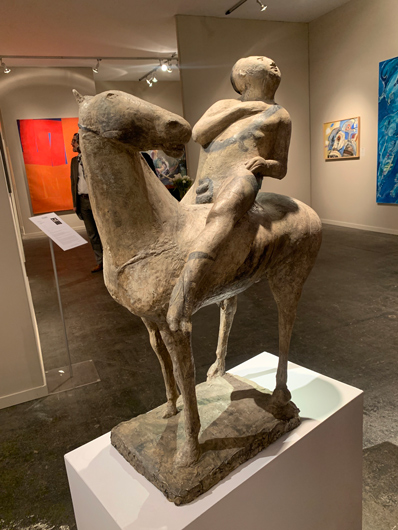 © Tamara Vakhova Marino. Rider. 1947. Die Gallery. Brafa 2020
- It turns out that at the fair it is safer to make purchases than in the same gallery, but in its native walls?
- That's right. If the gallery can “step aside” at home, then here her motivation disappears very quickly.
- Does it happen that museums buy their exhibits from you?
- Of course, constantly. Often, the gallerymen work closely with museums, and museum employees come here on the opening day to see the best they have.
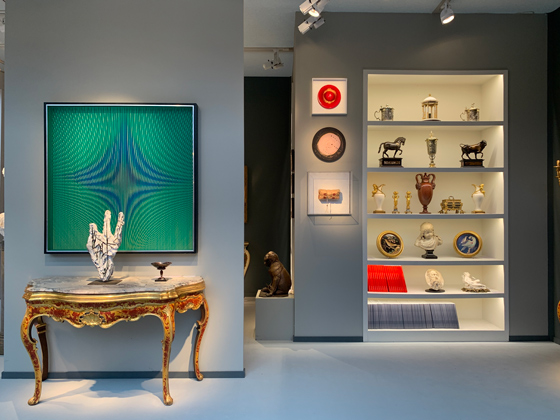 © Tamara Vakhova is one of the stands of the fair. Brafa 2020
- Fair in the modern sense - also an educational resource ...
- Yes, we have Brafa Art Talks is a lecture program where leading curators, collectors, restorers come and talk about their work. By the way, part of the lectures is removed and laid out on YouTube . We have curators from MOMA , the British Museum. This year, the famous theater director Robert Wilson, also a collector who told the history of his collection, came to us. Well, since in the same days the long -awaited exhibition of Van Eye “Optical Revolution” opened in the Ghent, its curators told a lot of interesting things about this to the artist. In addition, free excursions with curators, art historians, collectors are regularly taken in the fair. Having bought an input ticket to the exhibition, you can walk along the stands with such a group.