
Translated material
The “network of the Network” of the Stalinist USSR: how terrorists were created from Soviet engineers for the sake of popular unity
The public with a choir demanded the execution of the defendants, the process against whom marked the beginning of mass repressions.
On February 10, the court found guilty of the defendants in the case of the “network”, who were accused of planning terrorist attacks to seize power. The court found nine young people guilty of the creation of a left source organization. The defendants received from 6 to 18 years in prison.
The public and human rights activists did not recognize the court decision. Open letters in support of convicts were written by scientists, journalists, teachers, students, artists and not only. The main doubts about the justice of the process are caused by its procedural side, evidence and inconsistencies. In Russian history, there are examples of similar controversial processes that the state later recognized as referred.
We are talking about the events of the 1920s and the early 1930s: the affairs of the Donbass engineers, the Prompartia, the Labor Peasant Party and other fictional organizations. Scientific specialists were found guilty of subversive activities, sabotage, connections with white emigration and foreign politicians. In the perestroika years, all the defendants were completely rehabilitated.
Necessary enemies
The end of the 1920s and the early 1930s is the time of the establishment of the sole authorities of Joseph Stalin in the Soviet Union. A number of researchers characterize his rule as a post -revolutionary dictatorship.
The American historian-Soviet Robert Daniels wrote : "Stalin committed a counter-revolution, putting on revolutionary clothes on it." The same scientist characterized the post -revolutionary dictatorship as a special organization of power in the surviving serious shock to the country. Such regimes used the ideological devastation and unexpected desire of the majority of the people to return to apparent order and legitimate power.
Joseph Stalin never externally broke with the revolutionary tradition and previously proclaimed official ideology, Marxism-Leninism. Soviet propaganda represented the Stalinist policy not just the best development for the country. She was positioned as a continuation of the case of Vladimir Lenin and the only true option for the embodiment of Marxist ideas.
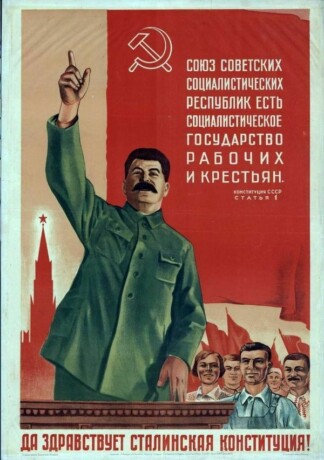
All “Stalin” was both “Leninsky” and “Marxist”. Therefore, any opposition and criticism of the regime was presented as an attack on the ideals of Marxism-Leninism sacred to the Soviet man. Stalin actively used this trick to strengthen personal power. His sophist statement is known: “As we move forward, to socialism, the resistance of the capitalist elements will increase, the class struggle will aggravate.” This thesis allowed the masses to explain the need for a repressive policy.
The Stalinist propaganda assured that the victory in the civil war did not give any guarantees from the counter -revolutionary revenge. Yes, Soviet society, in appearance, successfully implemented the plans of Stalin's industrialization. But these successes frowned with the envy of the capitalist foreign countries and the machinations of the internal counter -revolution, ”Soviet propagandists convinced the fellow citizens. Such enemies should be exposed, and the trials over them openly, with mandatory confessions and public repentance of the defendants.
The target is the intelligentsia
Different social and ethnic groups were “appointed” for the role of enemies in different years of the Stalin era: from wealthy peasants to the commanders of the Red Army, from the “rootless cosmopolitans” of Jews to state security officers. The first were representatives of the technical intelligentsia.
We must store and strengthen our economic and cultural heritage. This is the duty of the whole intelligentsia, not yet killed and not shot by the Bolsheviks. We must help them, and sincerely, by all means strive to restore the country now that they decided to end the destruction and move on to positive work.
Peter Polchinsky
In the late 1920s, the Stalin USSR began forced industrialization. For the success of this policy, thousands of professors, engineers and technical specialists were required. Most of them received education before the revolution. Many by the nature of the activity maintained close contacts with abroad. The communist ideas in this environment were indifferent. According to the data for 1930 , only 5% of specialists with higher education were in the Communist Party and only 7% could boast of a proletarian origin. But almost all the “bourgeois specialists” were loyal to the Bolsheviks, perceiving them with legal power.
Accelerated industrialization with its inflated pace and unrealized terms of execution led to various production accidents. “Old -regime” experts in such situations became comfortable scapegoats. Accidents received the status of sabotage, acts of wrecking and sabotage.
This was an important lever for rallying the masses around the young dictatorship. The theme of "wrecking" was actively engaged in Soviet journalists and proletarian poets. In 1928, Vladimir Mayakovsky wrote the poem “Pest” with the following lines: “Let the court determine the article. The guilty one would be taken by the target of the shooting range ... I am contempt and hatred under the roofs of engineering apartments. "
The forerunner of the Prompartia case in 1927-1928 was the Shakhty case. Its targets were specialists who worked in the coal industry of the Donetsk coal basin. Several dozen people were then sentenced to various punishments: from execution to conditional terms.
The Shakhty case did not turn out to be exemplary for the investigative and judicial authorities of the SSSP. Firstly, the Chekists did not quickly identify the "political side" of the case. At first, it was about ordinary accidents and acts of negligence in the work of the Donbass mines. Only in the middle of the investigation did several arrested “unexpectedly” spoke of their participation in “counter -revolution” and ties with abroad.
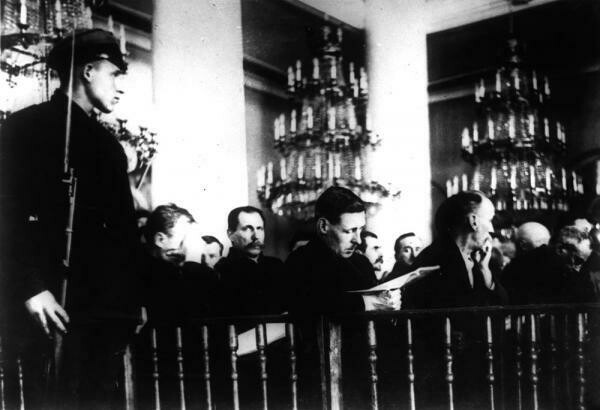
Secondly, at the final meeting on May 18, 1928 in Moscow, prosecutors gathered too much a group of accused: 53 people. Not with all of them, the Chekists managed to "work" properly. Most of the defendants either refused to plead guilty, or found themselves guilty only partially. Thirdly, almost all the persons involved in Shakhtinsky's business held low positions. It was impossible to write off any large-scale miscalculations of the Stalinist industrialization on them.
Fourth, among the defendants were specialists from Germany, who worked in the USSR, at that time an important partner of the Soviet state. This led to a diplomatic scandal. Under external pressure, the Soviet side forcedly abandoned the real terms of imprisonment for the German defendants.
Party for living and dead
The Shakhty business, with all the miscalculations of its organizers, signaled the imaginary of the wrecking among the “bourgeois specialists”. It gave proper vigilance to the miners of Donbass in the search for the hidden counter -revolutionaries. In early 1930, reports of allegedly new sabotage machinations began to come from the south-east of Ukraine. The time has come for a loud business.
Judging the intelligentsia, people brought up under the old regime, because they condemn Soviet power, on the basis of all that I had to hear from my many acquaintances, the Bolsheviks should have destroyed all the educated people.
Vladimir Ipatiev
In the spring and autumn in Moscow, Leningrad and other Soviet cities, several dozen technical specialists were arrested. Among them were those who held responsible positions in the allied economic structures. Among them is the Trumsteprotechnical Physician Leonid Ramzin, production technologist Nikolai Charnovsky, mechanical engineer Alexander Fedotov. The arrested people were united not only by work in the Supreme Economic Council (the highest council of the national economy; the state economic management body in the 1920s and 1930s) and a successful scientific career. All of them received education and achieved the first merits in pre -revolutionary Russia. Many often went on business trips abroad.
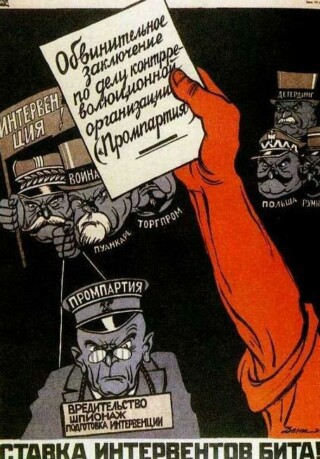
Experts were accused of membership in the "industrial party" - related to Russian emigration of an subversive organization. In absentia, the Chekists recorded several more figures for the Soviet science of that time for the Soviet science. In absentia - because it was in 1930 under the investigation that objective circumstances interfered with them.
In 1928, mining engineer Lazar Rabinovich was sentenced to six years in prison in the Shakhty case. His colleague Sergei Khrennikov in December 1929 died under arrest under mysterious circumstances. In the same year, in the out -of -court order “For wrecking”, the Chekists shot engineer and economist Peter Palchinsky. But state security still used their surname in the formed case. It was easier for the deceased to attribute guilt for the invented crimes.
Boltun Ramzin and interrogation game
The whole thing of the Prompassa rested on the confessions of one person - the physicist of Leonid Ramzin. The successful scientist-inventor “broke” already during the first interrogation.
Ramzin regularly confirmed everything that he was offered by the investigators of the OGPU (the united main political administration; the official name of the USSR state security in 1923-1934). According to him, in the country since the mid-1920s, there was a certain anti-communist “engineering center”. In 1927, Ramzin himself entered there. The number of participants in the “center” grew, it was transformed into an “industrial party”. After the arrests of the already deceased Khrennikov with Palchinsky, her chairman was chosen by Ramzin. The "party" was supposedly represented an extensive organization with branches in different cities and a number of two thousand people.
The scientist did not just agree to take the blame for non -existent crimes and stipulate specific colleagues. On September 21, Ramzin announced the Soviet regime of all "bourgeois specialists." According to his technical intelligentsia, the idea of an anti -Soviet coup d'etat was impressed.
One of the initial reasons for the creation of a counter -revolutionary engineering organization is primarily political moods in the ranks of old engineering, usually fluctuated within the borders from the cadet (“cadets”, constitutional democrats - the right -winging party in pre -revolutionary Russia) to extreme right, monarchical beliefs. Thus, according to its political appearance, old engineering in its mass did not accept the Soviet system and principles of the Communist Party.
Leonid Ramzin
These “confessions” were especially valuable for the Chekists. It turned out that it was not about the group of sabotageists, but about a full -fledged political party, which was about to force power to seize power. And Ramzin did not think to stop in his revelations. On September 23, the “conspirator” told investigators about the financing of the Prompartia by the governments of Great Britain, France and Poland. On October 1, he announced the contacts of the organization with the right opposition within the CPSU (b) and the virtual “Labor Peasant Party”. October 15-27 -on the connections of their associates in the imaginary party with Russian emigration, espionage and sabotage activities.
The latter was unusual. For example, the “members of the Prompartia” engineers Larichev and Strizhov designed the Tuapse raid - so that later, from the words of Ramzin, it could “be used as a marine base for the English military vessels”. The USSR and other “Prompartians” and developing economic development plans, working on projects of specific structures or collecting data on industries, harmed the same way.
Attempts without weapons
Probably, in the Prompartia case, the OGPU officers pursued their corporate interests. Along with the main area, the “terrorist activity” of the party was investigated. According to the Chekists, the Party militants were ordered to eliminate the highest leadership of the USSR at the right time.
About the "exposure of terrorists", the chief of the OGPU Vyacheslav Menzhinsky personally informed Joseph Stalin in a memorandum. This was supposed to increase the value of the state security organs in the eyes of the Soviet dictator, pathologically afraid of attempts and conspiracies. True, in response, Stalin praised the Chekists more for success in exposing the connections of the Prompartia with the West and the White Emigration.
On October 1, 1930, engineer Yevgeny Jewish, one of the many whom Ramzin stated, spoke about the "militants of the industrial party." Jewish described in detail the non -existent “combat organization”. He called her “members” by name, set out their plans, told about imaginary connections with the opposition inside the CPSU (b).
So, the pest I am now indisputable
After all, I myself signed a recognition of my
You can't say now that the accusation is absurd
The decision is now not yours.
Alexander Fedotov
However, in the protocols of the interrogation of the engineer there is nothing about the most important things for any terrorist group. Jewish did not say anything about the existing armament, nor about military training, nor about the plans of a particular operation. Say, it was assumed that at the right time, Ramzin would give the order, give out weapons and “militants” will perform.
The testimonies of Jewish were supplemented by the stories of other “militants of the industrial party”, the arrested Sergey Smirnov, during an interrogation on October 16, claimed that in June 1930, Jewish personally gave him the accomplice Alexander Bulashevich Bomb and a pistol.
Smirnov and Bulashevich were supposed to kill Joseph Stalin at the opening of the 16th Congress of the CPSU (b). But the partners first lost each other in the crowd, and then Smirnov "did not rise to Comrade Stalin." An imaginary attempt did not take place. The Jews, according to Smirnov,, after the "failure" scolded him and took the bomb with the gun. Only one or the other at the time of arrest was found in Jewish.
Save a braided life
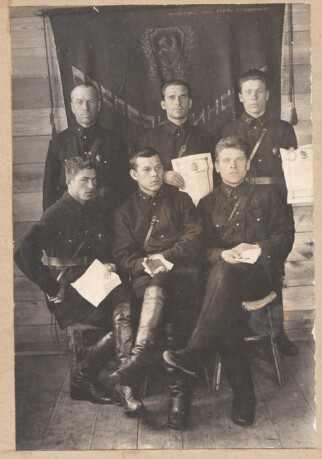
Most of the other arrested confirmed all accusations against them, even the most absurd and ridiculous. Many, like Ramzin and Jewish, enriched the investigative affairs with fresh surnames. This was followed by new arrests, new interrogations and names of new attackers. Units tried to protest against the actions of the OGPU.
Most of the arrested were already middle -aged people, accustomed to mental work and a comfortable life. They were broken by the very stay in the well -known building on the Moscow Lubyanka. Many were worried about the fate of loved ones. From a complaint to the prosecutor’s office of the arrested engineer Sergei Krause, it is known that at least one of the Prompartians, Sergei Predotchensky, had several family members at once. In such circumstances, a non -existent guilt could have seemed the best way out.
The coincidence or not, but it was precisely the testimonies of the pretensky that became one of the most informative in the case of the Prompartia. This engineer admitted to the leadership of the “combat organization”, listed the Chekists several dozen names of “subordinates” and spoke about the planned murders of several Soviet figures at once.
A letter to Krause against the general background is noteworthy and other details. The engineer perhaps the only one complained that he was considered guilty even "before the beginning of the investigation, by an unfounded stipulate." The author characterized himself as a loyal citizen of the USSR, not involved in any conspiracies. Krause also hinted at torture, mentioning that the OGPU has “means of influence that are capable of [force] to admit” in any things. He directly wrote that an ordinary engineer is not at all a persistent fighter for the idea, and "for preserving life, even if he was braided, is ready for anything." But Krause himself, apparently, did not stipulate himself and did not.
Crause's thoughts confirm the memories of engineer Fedor Ryazanov. He lived until the 1970s and left written evidence about him. Ryazanov mentioned such pressure measures as regular confrontation with already “recognized” acquaintances and staging the arrest of his wife. According to him, the Chekists gave serious concessions in the regime for those who were cooperation. Such prisoners were given to receive parcels from the will and did not even lock the doors of the chambers.
During one of the interrogations [investigator] Protasov said that we should write about the wrecking organization. I replied that no wrecking organization was included in any wrecking and this statement is unfounded. "How did not come in if [o] GPU claims this, and [o] GPU is never mistaken." It blew up, and I replied: “What [o] GPU is the Pope, which, too, can never be wrong? I can also say that you were part of such an organization. ”
Фёдор Рязанов
Некоторые «промпартийцы» не признавали лишь отдельные пункты обвинений. Часто отрицались факты получения из-за границы крупных денежных средств, о которых раньше утверждал Рамзин. Некоторые в ответ пытались сами оговорить «председателя партии». Рамзин даже писал записки с вежливыми просьбами «устранить противоречия» — «в наших общих интересах».
Чекистам — слава, саботажникам — смерть
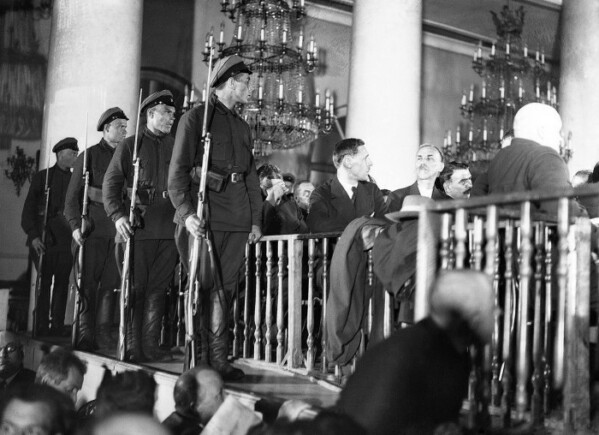
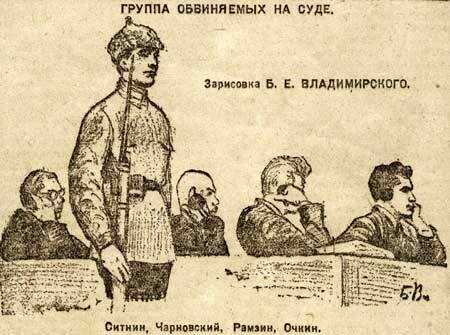
Кульминацией дела «Промпартии» стал процесс 25 ноября-7 декабря 1930 года. На нём судили всего восьмерых человек, якобы высшее партийное руководство: Леонида Рамзина, Ивана Калинникова, Виктора Ларичева, Николая Чарновского, Александра Федотова, Сергея Куприянова, Владимира Очкина и Ксенофонта Ситнина.
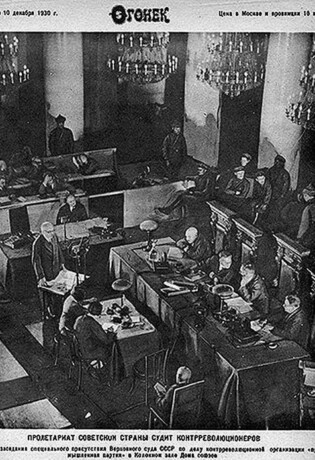
Дело рассматривал особый состав Верховного суда СССР под председательством Андрея Вышинского, бывшего меньшевика и одного из архитекторов сталинских репрессий. Обвинителями выступали Николай Крыленко и Владимир Фридберг. Оба в 1930-х годах прославились как усердные исполнители репрессивной политики. Её жертвами потом стали и они сами: Крыленко и Фридберга расстреляли в 1938 году.
Процесс «Промпартии» больше напоминал отрепетированный спектакль. Не было никаких вещественных доказательств вины подсудимых: образцов оружия, планов диверсий или терактов, партийных манифестов, иных документов, образцов символики. Обвинитель Крыленко подчёркивал , что «лучшей уликой при всех обстоятельствах является всё же сознание подсудимых». Те действительно сознавались во всём. А их адвокаты не защищали своих клиентов, а выражали своё «возмущение и протест» от тех «ужасов», что те готовили для страны.
Суд над «восьмёркой» «Промпартии» стал одним из первых событий в СССР, запечатлённым в звуковой кинохронике. В 2018 году уникальные кадры стали основой для документального фильма «Процесс» режиссёра Юрия Лозницы.
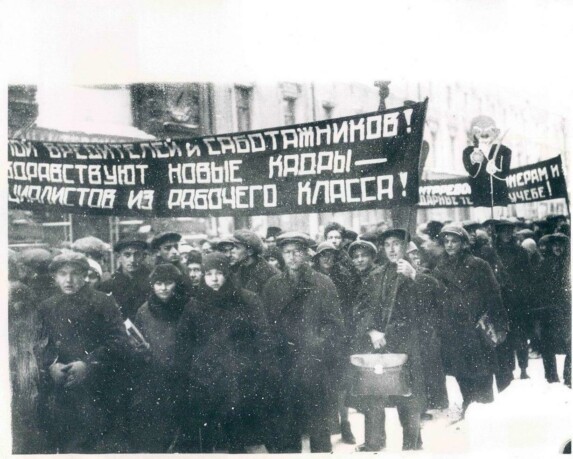
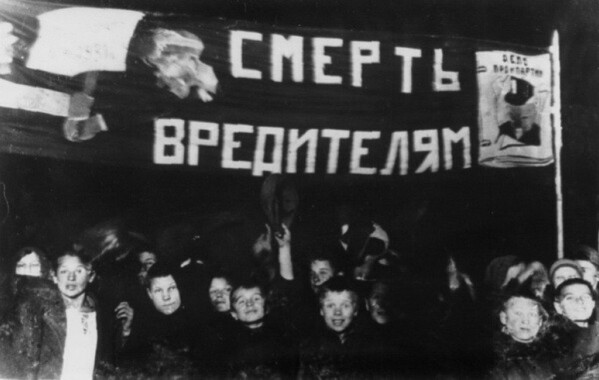
Важной деталью процесса служила его открытость. Из радио и газет миллионы советских граждан уже заранее знали о «вине» арестованных инженеров. В дни судебных заседаний в Москве проходили многочисленные митинги под лозунгами «Расстрелять!», «Слава ОГПУ!», «Долой вредителей и саботажников!», «Смерть агентам Пуанкаре!» (Раймон Пуанкаре — крупный французский политик начала 20 века, в разное время президент и премьер-министр республики).
Высшему руководству СССР десятками поступали письма трудящихся с просьбами расстрелять подсудимых. Активизацией «революционного сознания» пользовались на заводах, фабриках и в колхозах. Под лозунгами «борьбы с вредителями» рабочим и колхозникам увеличивали планы, заставляли покупать облигации госзайма или сдавать «излишки» продуктов.
Милосердие по-советски
Во время суда всё-таки происходили досадные для обвинения накладки. Так, Рамзин, отвечая на вопрос прокурора, неожиданно честно ответил , что о количестве «ячеек» «партии» он узнал уже из материалов дела.
Только на заседании выяснилось, что два крупных банкира царских времён, Павел Рябушинский и Александр Вышнеградский, скончались в эмиграции в 1924 и 1925 годах. Но по материалам дела оба в 1926-1929 годах помогали «Промпартии» наводить мосты с зарубежными покровителями. В новом правительстве покойным Рябушинскому и Вышнеградскому заговорщики уже якобы приготовили портфели министров внутренних дел и финансов.
Свидетели выступали порой с самыми абсурдными обвинениями . В вину учёным вменялись строительство новых фабрик (в то время как надо было лучше использовать мощности имеющихся) и установка в зданиях межэтажных перекрытий из железобетона (достаточно было бы и деревянных). Один из выступающих обвинил «Промпартию» во вредительском осушении болот — чтобы «интервентам и белогвардейцам» было проще наступать.
На эти и другие несуразности никто не думал обращать внимания. Пятерых (Рамзина, Ларичева, Чарновского, Калинникова и Федотова) приговорили к «высшей мере», трёх остальных — к 10 годам лишения свободы. Центральный исполнительный комитет СССР, номинально высший орган власти, распорядился смягчить приговоры. Расстрелы заменили на тюремное заключение.
Трудность процесса заключалась в том, что он был лишен так называемых «объективных доказательств». Под объективными доказательствами наука уголовного процесса и права понимает такие доказательства, которые не опираются на личные объяснения и показания подсудимых. В этом процессе наоборот всё опиралось на объяснения самих подсудимых, самих обвиняемых, поэтому и встала величайшая загадка, — почему обвиняемые сознаются.
Андрей Вышинский
Судьба Рамзина сложилась лучше, чем у остальных подсудимых. Он не попал в лагеря, а продолжил свои работы по теплотехнике в закрытом конструкторском бюро. В 1936 году Рамзина освободили окончательно.Он построил успешную карьеру. Учёный за разработку первого советского прямоточного котла стал лауреатом Сталинской премии и кавалером орденов Ленина и Трудового Красного Знамени. Однако после дела «Промпартии» никакие заслуги и награды не могли спасти репутацию Рамзина среди коллег.
Историк науки Владимир Гвоздецкий писал : «Чем больше официальные власти отмечали Рамзина – тоже своего рода садизм, – тем больше неприязни и презрения он видел в глазах сослуживцев. Научная общественность сторонилась его, многие отворачивались и не подавали руки. Когда по настоянию Кремля Рамзина выдвинули в члены-корреспонденты Академии наук, то при тайном голосовании он получил 24 голоса „против“ и только один – „за“».
Рамзин умер своей смертью в 1948-м. Никто из других обвиняемых на декабрьском процессе 1930 года до того времени не дожил. Почти все они умерли в заключении.
Непохожие судьбы
Трудно сказать, сколько всего людей попало в тюрьмы и изоляторы ОГПУ по делу «Промпартии». Один Рамзин перечислил на допросах около 200 фамилий. Десятками людей оговаривали те же Евреинов, и Предтеченский.
Если брать в расчёт данные из докладной записки замначальника госбезопасности Генриха Ягоды, то арестовать могли до двух тысяч человек. Одного из них, профессора Петра Осадчего, задержали прямо во время суда над «руководством Промпартии». Перед этим учёный дал свидетельские показания против Рамзина и его «соратников».
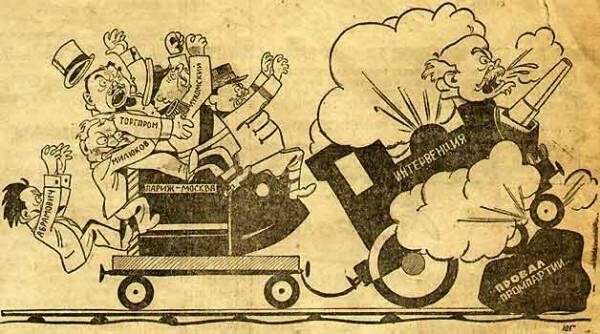
Большое количество задержанных позволило раздробить дело на несколько мелких. Отдельно разбирались «отраслевые» группы: тех, кто «вредил» Советскому Союзу в отведённых сферах экономики или готовил теракты. Многим особые коллегии ОГПУ, прообразы будущих «троек» НКВД, вынесли приговоры во внесудебном порядке. Судьбы некоторых неизвестны до сих пор.
Участь подозреваемых в одном и том же оказывалась совершенно разной. Например, инженера Евреинова, координатора мифических покушений на Сталина, расстреляли без суда в 1931 году. А другого «боевика», энергетика Николая Доллежаля, в 1932 году выпустили на свободу. Учёный вернулся к своей прежней деятельности. Доллежаль стал одним из основоположников отечественной ядерной физики и скончался уже в постсоветской России в 101-летнем возрасте.
Вместе с учёными-технарями стать жертвой «дела Промпартии» мог и один из крупнейших советских историков — Евгений Тарле. Якобы его «заговорщиики» хотели сделать министром иностранных дел. Тарле повезло: в 1931 году его во внесудебном порядке «всего лишь» отправили в ссылку в Казахстан.
Правдоруба Краузе в 1932 году реабилитировали после попытки самоубийства. Он вернулся к занятиям наукой — по иронии, в то же самое бюро, что и Рамзин. В 1938 году Краузе снова арестовали по обвинению в контрреволюционной деятельности и позже расстреляли .
«Дело Промпартии», как и аналогичные процессы против учёных и инженеров в СССР, меркнет на фоне последовавших в 1930-е годы событий. Однако именно в ходе преследования «старой интеллигенции» чекисты получили полезный опыт фабрикации политических дел. Он им пригодился во время «чисток» в высшем командном составе РККА, уничтожении «старых большевиков», православного духовенства и репрессиях против своих же коллег.
Сталинское руководство избавилось от лишних людей, хранивших память о дореволюционной России. А народные массы были мобилизованы для поиска и уничтожения новых мифических врагов.
Мы, нижеподписавшиеся студенты, выступаем против смягчения приговора над обвиняемыми Промпартии. [...]
ЦИК основывается на том, что СССР не так жесток и мстителен и не кровожадная страна. Но тем самым они [вредители] могут и будут продолжать начатое дело до конца. Это изменение намеченного приговора даст колоссальное воодушевление капиталистическим странам, пытавшимся сделать СССР рабами капитала.
из коллективного письма саратовских студентов советскому руководству
The article was created by a participant in the authors league. About how she works and how to join there is described in this material .
Special_button block is not available#истории #ссср #репрессии #лонгриды #лигаавторов