
Translated material
The formula of the organic theater
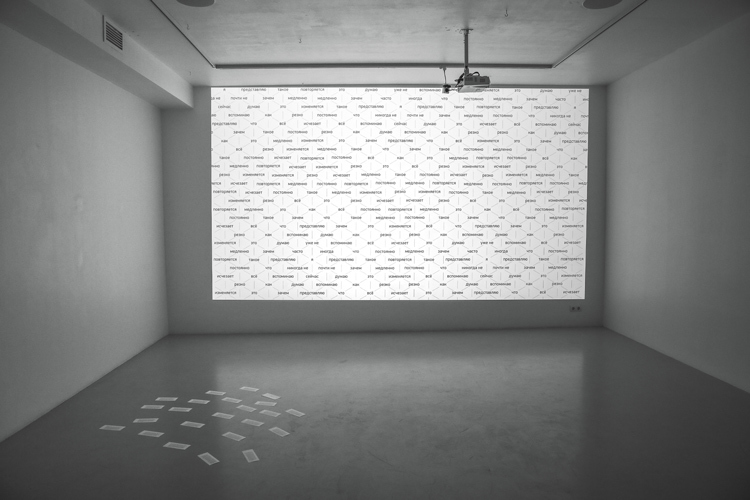
The premiere of the "Accident" " Postr theater" took place in the center of the multimedia of the Russian Museum. The performance that was lucky to see me was given in the spaces of the Petersburg Gallery Anna Nova . In this case, it was not a figure of speech - the time and place was played in the performance quite strongly. It turned out that the two-level platform of the gallery easily integrates into the symbolic series of the performance, in addition, Anna Nova is one of the few places in St. Petersburg, where they systematically work with Science-Art 'OM, and “chance” was made in this genre.
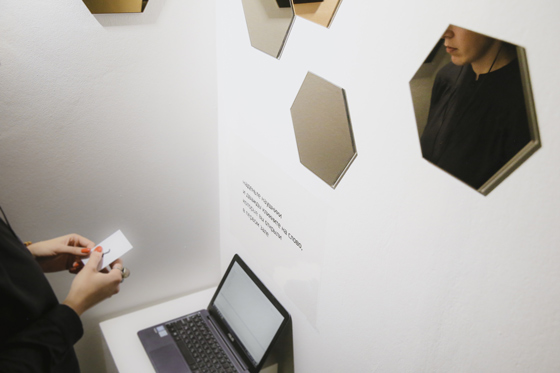
The installation part of the exhibition of Anastasia Potemkina , who took place in the gallery during the premiere days, against which the start of the start of the performance was waiting, looked like a decoration, composed specifically for “chance”. In the conditional lobby-the first exhibition hall of the gallery-a series of mirrors with “carbon” hexagons and formulas applied to them, the very HC1-C2H-C3H-NH2 , which most of us can not read, but as a sign of organic matter as a single-moraine as E = MC2 -as a marker of the theory of relativity. All this turned out to be the very help: it is these formulas that are found in those who became the basis for the performance of the popular science books of the biologist and the popularizer of the science of Alexander Markov “The Evolution of Man” and “Birth of difficulty”, which tell about the birth of life as a chemical phenomenon, about the first stages of evolution. The main thing that the author of the play, playwright Ekaterina Augustenyak found in them, is Markov’s attempt to clearly explain the purposefulness of evolutionary processes, growing from completely random mutations. Markov does this on the example of the transformation of a random set of letters into a given sentence, and Ekaterina Augustenyak inverts the mental experiment-metaphor, trying to compare the processes of abiogenesis and evolution with the laws of life and art.
 © Anastasia Blur
In the lobby, you will be offered to approach the computer keyboard in order to answer the question “How did you become a person?” The step seems to be formal (it would be logical to offer to answer the same question after the performance, but this does not happen), but suitable for preparing the audience for actions, “turn it on” it. On the next monitor, the answers of the viewers of the previous performance of “accident” are crawling with credits - mostly attempts to joke. The most detailed of them - "When mom, educating, said:" I want you to become a person. "
The “accident” is interactive from beginning to end, so, talking about the performance, it is impossible to do without spoilers.
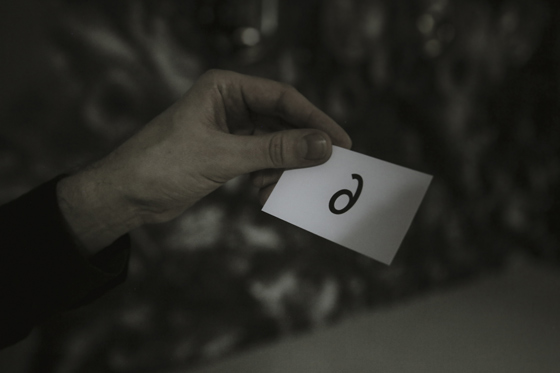
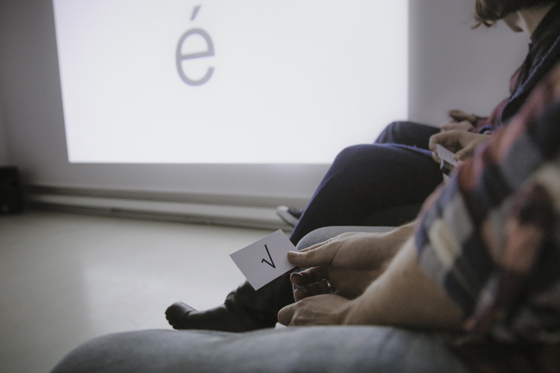
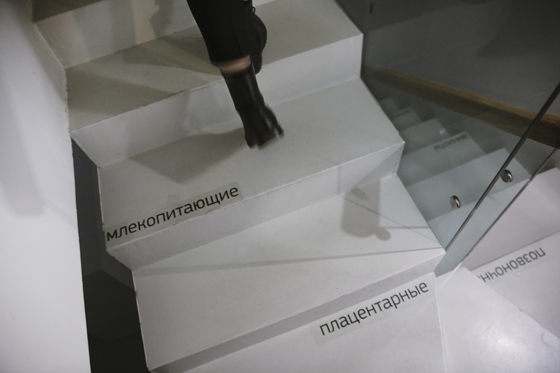
At the entrance to the first hall, each viewer receives a card with the image of a unique symbol and instructions - seeing his symbol on the screen of the random sequences generator (the first video projection on the wall), it should approach the mouse and draw a cursor of the opposite screen (second video projection) to one of the image nodes imitating the structure of organic matter. A word will appear in the nodes that becomes the audience’s ID - it needs to be remembered and go to the next hall. While the next viewer rises to the second level of the gallery, the remaining on the first listens to the fragment of the text of Ekaterina Augustenyak, the fragment, which is translated through the speakers, the fragment sounds, the key word of which is the ID of the audience who left the hall. He is slandered by the scenes in the microphone Protagonist of the " POST Theater" Alena Starostina. When the turn comes to your sign, you approach the mouse, generate your word- id and go out. Climbing the stairs, clinging to the steps scattered along the steps with words from the vocabulary of the evolutionary biologist. On the site between the floors is a computer with headphones, where Alexander Markov himself reads in accordance with your ID , designed only for you, a short fragment of the lecture on evolution.
Communication is indirect and direct, hidden and open - thoughtful and light, it seems the most reliable component of the performance, despite the elements of chance and unpredictability present in it.
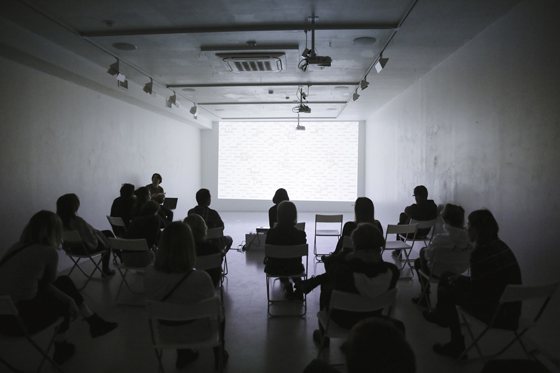
Having reached the second hall, you hear in the performance of Ivan Nikolaev the final of the last fragment of the text of the play, which you heard below, and after a small pause completely - “your own”, attached to your ID , that is, provoked to the appearance in the audience space of the play with your click of the mouse.
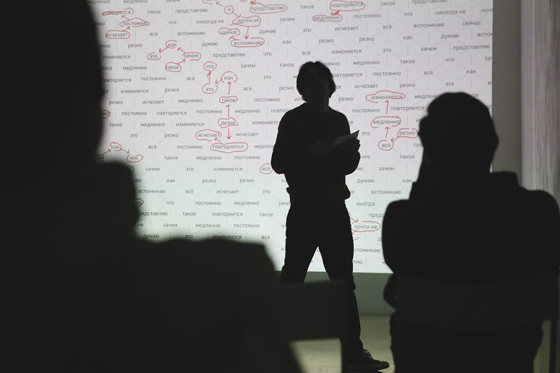
The next viewer arrives (their total number is limited by twenty -two) - the action is repeated. In the third projection, in a slightly altered form, the structure of words and lines is displayed that arose at the lower level - but here, in between pronouncing fragments of the play that are folded into a monologue, Ivan Nikolaev draws on the third screen (broadcasting a video projector from its tablet) of the connection between words. Thus, he sets the sequence of words, and you expect a coherent sentence. But it turns out an abracadabra, although the lexical set is significant, he himself is asked to make a significant statement (“I”, “slowly”, “almost no”, “sometimes”, “sometimes”, “I remember”, “changes”, “what”, “why”, “why”).
 © Anastasia Blur
The more precisely the description of the performance, the more scrupulous the description of the directorial decision of Andrei Slepukhin. Here it is the sum of three solutions - spatial, multimedia and communicative. The latter is the most important, everything is subordinated to him in the play: communication between two performers, between performers and multimedia, between multimedia, devices and space, between the devices themselves, between all these and spectators. Communication is indirect and direct, hidden and open - thoughtful and light, it seems the most reliable component of the performance, despite the elements of chance and unpredictability present in it. In a strange way, not being essentially substantial, it is communication that plays a meaning -forming role: it holds the rhythm of the performance, creates stress by the very fact of interactive, directs and regulates the movement of the audience, and changes their status. The viewer may not notice the moments of sending SMS or starting programs - communication occurs on top of all this, as if in its pure form, like a spirit. As an evolution that has no other purpose, except for the preservation and distortion of information, inconspicuous DNA.
 © Anastasia Blur
Drama accompanies action. Monologists of heroes are not even similar to bursts, but to sobs of consciousness. Imagine that you are sitting in the Philharmonic, not captured by musical matter, and your thoughts flow in your own way, far from the chair, scene and orchestra. Either you read non-fiction, and your imagination is not directed by the artist’s skillful hand on a journey through unfinished worlds, does not follow the plots of the plot. Sometimes in the popular science book there are places where your consciousness, clinging to the bit of the suddenly shown information, goes further on its own, compares the scientific picture of the world with the household, personal, social, production, interpreting this bit in its own way. Or just surprised. So reads the scientific “Broad circle of readers”, to which it is intended. And the reader really wants to share this surprise. Ekaterina Augustenyak - shares.
 © Anastasia Blur
The text of the play grows organically - or at least gives the impression of almost zerflexive. Perhaps its key dignity and subtlety-in this restraint, in the fact that he does not depart from his task: to convey the sensations of a person reading a complex scientific-popular text, but continuing to live in his universe with the usual ideas and guidelines. It is neutral, does not go astray into confession, plot -cleaning, dramatization and other “humanization”. It remains a strictly documentary stream of consciousness.
“Accident” may seem a prelude to the much warmer, almost family “OPSU DNA” by Ekaterina Augustenyak, noted on “Lyubimovka”, by a by -product of interaction with scientific. But, as for me, in the "chance" of truth and organics much more.
 © Anastasia Blur
An emotional note will sound in the final of the performance. Alena Starostina goes to the public, becomes behind the chairs, reads the text grown on the third screen by the joint efforts of the audience and Ivan Nikolaev - several non -exposure. After each passage, the screen size decreases exponentially to the size of the pixel. The font is becoming less and less readable, the screen goes to the point and completely goes out. Then he begins to praise - as if the only window is slamming into the world.
Spectators create a random structure, the actor deliberately connects the words inscribed in it into a possible sequence - but there is no sense. Now his possibility disappears completely, never realized: the birth of complexity, the birth of life did not happen.
 © Anastasia Blur
At my performance was one extra - the twenty -third in a row - the viewer. After the limit of the read -off fragments of the play was exhausted, Ivan Nikolaev took out a pack of delayed cheat sheets and chose the already read text from them. It turned out to be the most sensitive fragment of the play - it should appear in it, but the word “death” was intentionally stuck. At this moment, something catharsical happened-an accident that was not provided for by the playwright and director.
At the exit from the “accident”, the audience is handed out by three times folded sheets and envelopes - homework. On the sheet is an organic structure. In the envelope there are tiny signs with the words “I”, “slowly”, “almost no”, “sometimes”, “I remember”, “changes”, “what”, “why”, “why” ... you can try to build your own play.