
Translated material
Instead of a review
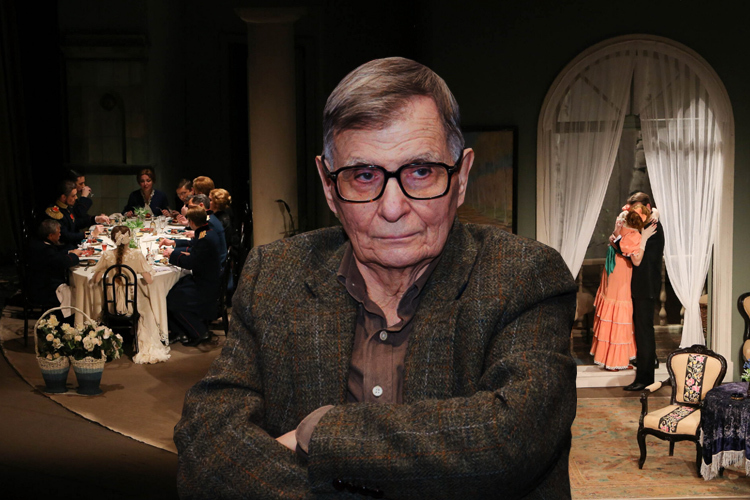
Last week, the Gorky Moscow Art Theater showed a long-announced by the artistic director Eduard Boyakov Prime Minister-the reconstruction of the Three Sisters Vladimir Nemirovich-Danchenko, dedicated to the 80th anniversary of the legendary production. One of the spectators of the performance was Alexei Bartoshevich , who stores the memory of the original of the “three sisters” Nemirovich-Danchenko, who saw the light in 1940. At the request of colta.ru, the outstanding Russian theater expert responded to the prime minister with a detailed letter to the editor of the "theater" section Dmitry Renansky, who, with the permission of the author, publishes the full.
Dear Dima,
All that I thought about the very idea of reconstruction in the drama theater, that is, about its fundamental impossibility, is presented in the recent material of the “St. Petersburg Theater Journal” precisely about the future “three sisters”. Something on this score is repeated on TV , even in a very cut-out form.
The fact that I saw at the Moscow Art Theater named after Gorky, in fact, there is nothing to say. The impression of a well -intentioned dead man, carefully made by the mummy. Weak actors, nothing is hidden behind the accurately copied pattern, is empty. That's all that can be said about the performance adopted by the public with sincere enthusiasm. She probably does not need any other Chekhov - and this is the whole thing. (I do not think that the triumphant technique is explained only by the premiere of the premiere.) In the “empty space” in the head of the Dead Theater, Peter Brook perfectly explains why the general public likes the theater where the classics play “like in good old days”. Boredom, which inevitably overtakes the audience of a dead theater, contains a source of special pleasure: it is associated with a pleasant sense of the duty of duty.
Attracted by loud advertising, the audience stuffed the halls to capacity to join the last word of the first -relief culture.
At the same time, I did not join those who deny the very right of the Doronin Moscow Moscow Art Theater (and so far he remains quite Doroninsky - in style, a circle of ideas and the composition of the public) for the experience of such a sense. Actors accustomed to Polyakov’s drama are difficult to approach Chekhov, even so rusticly perceived. But, perhaps, some professional benefit for them in this heroic, but hopeless venture still exists.
Therefore, when asked whether it was necessary to “take up the weapon” (Plekhanov about the events of December 1905), I am not ready to answer the hard “no”.
I do not tell me the names of the directors who were called the reconstruction (Valentin Klementyev and Mikhail Kabanov.- Ed .)-which, of course, is no reconstruction, and not only because of the low level of the performance of this idea, but most importantly, as already mentioned, because of its fundamental impossible.
If this is not a reconstruction, then what is it?
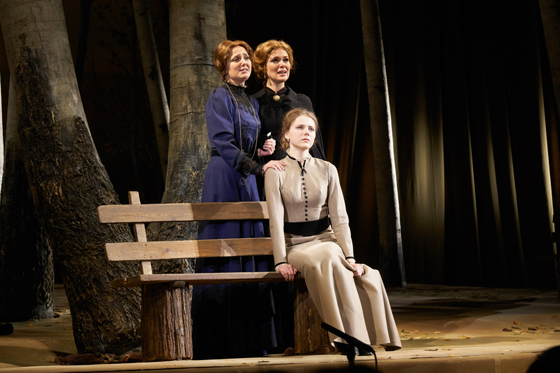 © Dmitry Korobeinikov / TASS Reconstruction "Three Sisters", Moscow Art Theater. Gorky, 2020
Very soon, after the first triumphs of the young art theater, when Glory about it began to spread in Russia, performances made, as declared in the posters, according to the Moscow Art Theater and in the accurately copied design of Moscow original, appeared in several provincial cities. It is easy to imagine how much, with all the zeal of copywriters, provincial tracing paper was far from the original. In such a inevitably empty copying, then they did not see anything reprehensible, and the provincial public really liked it - attracted by loud advertising, the audience stuffed the halls to capture to join the last word of the pioneer culture.
What would I do on the site of the heads of the Moscow Art Theater on Tversky? I would rewrite the poster of the “three sisters”, remove the word “reconstruction” from it and, having acted according to the example above, would compose something like “the play exactly reproduces the mise-en-scenes of the 1940 production and is executed in the genuine decorations of that time.”
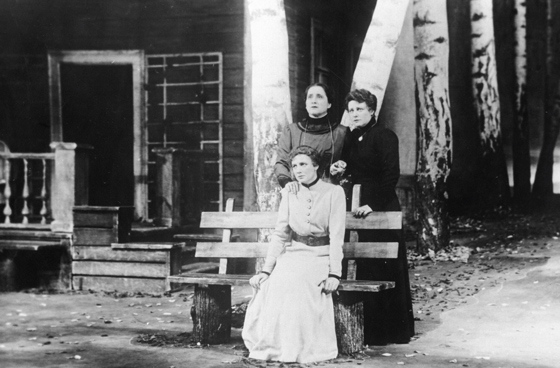 © Aleksandrov / RIA Novosti "Three Sisters" by Vladimir Nemirovich-Danchenko, 1940
Both would be pure truth. Especially the second. On the stage of Gorky’s Moscow Art Theater, the preserved genuine decorations of Vladimir Vladimirovich Dmitriev, made for the great performance of Nemirovich-Danchenko, are miraculously preserved. Without a doubt, this is the best, only genuine of all that you will see on the stage. If we perceive the amazing work of the scenographer as an addition to the Dmitriev’s exhibition, which had just opened in the space of the “workshop of Peter Fomenko”, then there is nothing to argue about at all. Only, perhaps, one thing: at the exhibition next to sketches and layouts, dates of their creation are set, which cannot be done on the stage. And it is a pity: knowing about a series of magnificent metamorphoses, through which Dmitriev’s art passed through his short life, you can be sure that, he live longer - well, not eighty, but at least forty years old - he would see Chekhov’s world in a completely different way than in 1940.
I myself do not know what I just wrote-a private letter or something like a review.
Hello,
Your Ab