
Translated material
The disease is not for sale
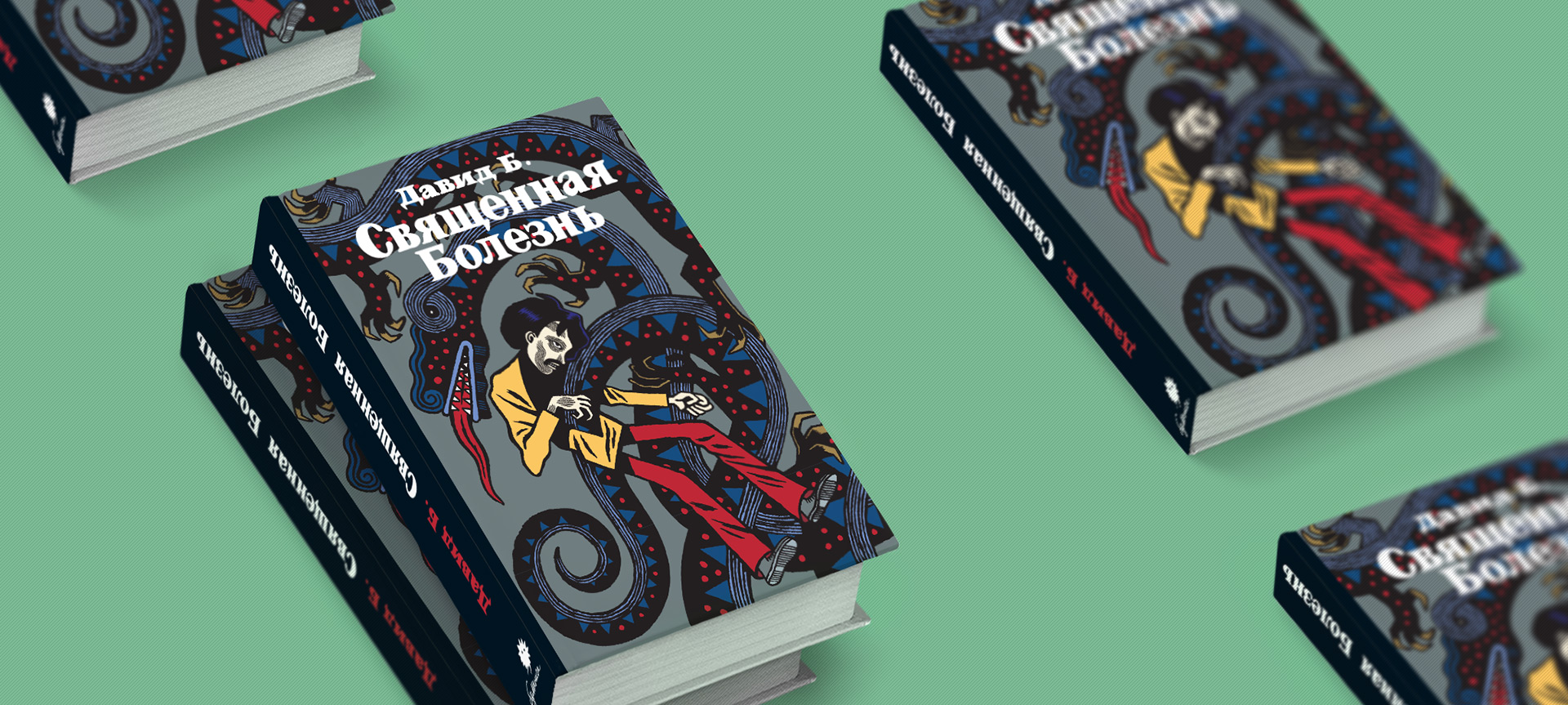
The Publishing House of Bumpniga published a reprint of the cult comic book David B. "Holy disease." This is the story of the author’s childhood, about his family and about the epilepsy of his older brother. For the Western world, this book was the discovery, a cult comic book that destroyed the wall of silence around another diagnosis. In Russia, we have to break through two walls: we are still trying to come to terms with the fact that comics are also books
“When I saw this book, it struck me completely, because you open it and just stunned from the images, from how it can all be imagined and drawn,” says publisher Dmitry Yakovlev.
The "sacred disease" of David B. He first picked up at the book fair in Frankfurt. And only four years later he decided on her publication in Russia.
“Then no one needed it - what, a comic book about epilepsy? For whom is this at all? Well, no. And large publishers were considered low to the comic book form. When some of them still bought the rights to a couple of popular comics, they proudly declared them “graphic novels”. In fact, a comic book is a comic. In general, I went to the publishers for about two years and offered them to buy a “sacred illness” from the French, but no one, of course, took it, and therefore I decided to publish myself. For me personally, this is a very important story, because before that I, of course, was engaged in comics, but in small collections and Zin, and here - Bach! - 380 pages and such a complex graphic project. "
David B. Graphics are really impressive: many details are intertwined with each other, the world of bizarrely drawn spirits flow from one turn to another, from the world of boyish fantasies - into reality. Brothers' children's games in the war are combined with the historical paintings of two world wars and another, with Algeria. The author seems to show a family album, combining children's memories with the real facts from the life of his grandfathers and great -grandfathers. Their constant struggle for life, for a place in society, the desire to get out of poverty is equal to the passion with which David’s parents in any way tend to cure his older brother, Jean-Cristopher, from epilepsy.
In the 60s, this disease was not as well studied as now, so the family had to face aggression and rejection in society: the neighbors did not want to live next to the epilept, their children considered Jean-Cristofa crazy and refused to play with him. However, since then little has changed.
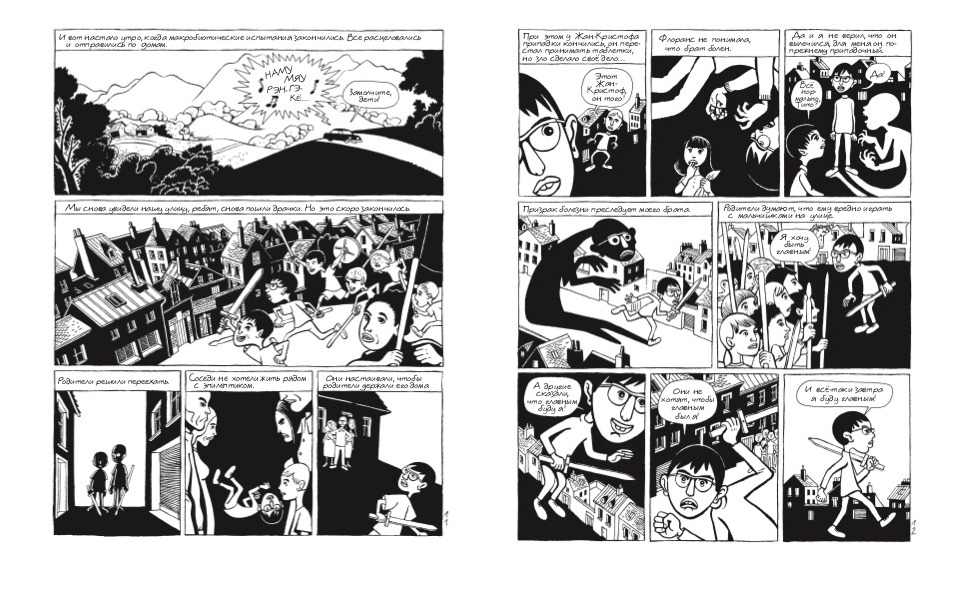 Illustrations from the book by David B. “Holy Disease” Photo: provided by the Publishing House “Bumpnig”
“The stigmatization of epilepsy is still strong in our society, because the attack as a whole looks rather creepy,” says the neurologist and epileptologist Artem Sharkov. “At the same time, for most, the ideas about epilepsy are built on its severe forms: those that we see in series and cinema.”
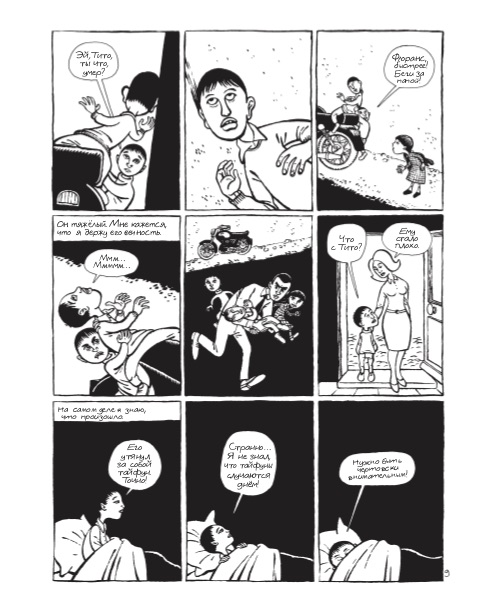 Illustrations from the book by David B. “Holy Disease” Photo: provided by the Publishing House “Bumpnig”
“But the attacks may look completely different. This can be, for example, both the tension of the whole body with twitching and affect only one part of the body. Or manifest themselves with fading. Or, conversely, with hypermotor manifestations, when a person, for example, jumps up, begins to run in circles and scream with fear. In the case of the hero of the comic book, this is focal structural epilepsy, we see in the graphics a characteristic tonic tension of the hand and grimace with the abduction of the eyes to the right. At the same time, at the beginning of the book, the author notes that the brother had the same freezing. This suggests that the disease is developing, that is, attacks can intensify, change. ”
If in the middle and even at the end of the last century the doctors did not have enough equipment for diagnosis, now there are no problems with this. There is another - society has no information. Parents continue to lead the children to doctors and healers, as dad and mother of Jean-Cristofa did in the book sixty years ago. From epilepsy heals the Japanese guru, good as a cat, and at the same time a European surgeon, similar to Frankenstein. Just collect the roots of burdock for a special diet! Nowadays, there are also enough “specialists” who use dubious methods of treatment - for example, exclusively with the help of “healthy” diet and dietary supplements. With some types of epilepsy, a diet, of course, is necessary, but not for everyone, there are five species for a minute. Up to 70% of them can be controlled by therapy, the rest can be cured surgically or with a diet, hormones, gene therapy and other medical recommendations. How many know about this? No. In Russia, few people know how to provide even banal help to a person who is in an epileptic seizure.
Spoiler: No need to climb to a person with your fingers in his mouth, try to immobilize him or lament loudly with horror. Put something soft under your head, make sure that it will not hit anything, and after an attack, turn it on its side so that the saliva flows out and it became easier to breathe.
In the comic book, the seizures of Jean-Cristopheus cause him more and more injuries as the disease progresses and he grows up. If the boy or brother could easily pick up and quickly carry away, then an adult guy, especially a man who falls in a public place and writhes in convulsions, attracts attention, moreover, he can harm himself or to others. David honestly talks about his emotions to his brother: from excitement and anxiety to the desire to get rid of Jean-Cristopher at the particularly complex moments of their life together.
The comic was a real discovery for illustrators, designers, intellectuals, who were generally ready to talk about problems in society in graphic form. At the same time, due to the very stigmatization of epilepsy, the general public did not appreciate the comic book.
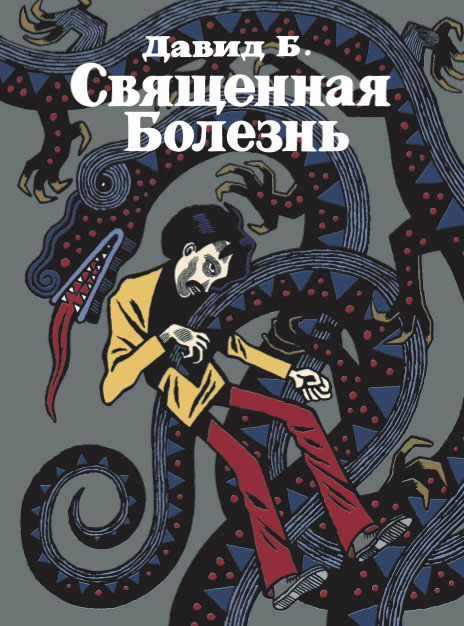 Cover of the book of David B. “Holy Disease” Photo: provided by the Publishing House Bumpniga
“Perhaps the problem is the name,” says Dmitry Yakovlev. - That is, not everyone wants to buy a book in the name of which there is a word “disease”. We worked with an amazing translator, Olga Kustova, unfortunately, she is no longer alive. She taught a course in Smolny about comics, worked a lot with French literature, translated Verlaine's fields, Guillaume Apolliner, Romain Gary. We often talked with her that it was better to publish this, including from a commercial point of view, so when I came to her with this book, she said: “Very cool, but what will you do about it?” In general, if you translate the name of the comic book L'Sension du Haut Mal from French literally, it sounds like “the ascent of a big evil”, and at the same time, Haut Mal denotes “strong epileptic seizure”. We also thought that epilepsy is often called “devilish” or “sacred” disease, because she has such a reputation. Well, many famous, even brilliant people hurt her. Therefore, we consulted with Olga and decided to translate the name like this. Although in the USA they did not steam at all and from afar with the word “epileptic” on the cover. ”
The unpopularity of comics on complex topics is no longer as obvious as nine years ago, when the book of David B. only went out of print. Boomfest and other regional comics festivals for a long time and painstakingly introduced the audience with the best illustrators. Strange, oddly enough, contributed to the scandal with the swastika in Maus, Arta Spiegelman and the statements of the Minister of Culture at the largest Moscow book fair that “comics read only morons” contributed. But it is still difficult for an ordinary reader to talk about death, sex, illness, violence in the family, about people with a different skin color and sexual orientation. Especially in the comic. It is funny that David B. In his history, too, has the moment with internal censorship, about the drinking grandmother, in which he, as the author, leaves the narrative and as if asking: “How to talk about it? Is it appropriate to mention only the moment when she completely lost control, or should I tell us which grandmother was before? ” Sometimes the graphics speaks with us more accurately and stronger than the text. Sometimes even as we cannot talk to each other, but we must.
You never know what can become an intermediary between a person and his adoption of illness, death, and the bodies of another. Maybe it will be a popular science film or series, an article on the Internet or (About Horror!) Comic. Dmitry Yakovlev even believes that he does not have an educational mission, he "simply publishes those books in which graphics and history likes." In which there is a person-different: with autism, HIV-positive, refugee, with epilepsy. Someone else, to whom we can feel empathy through his story about the family, about feelings, just learning a little more about his disease or position in society. Perhaps you can defeat stigmatization only by removing the layer behind the layer of old crusts of prejudices: yes, it hurts. So alive.
Books Literature Epilepsy