
Translated material
Santoku: One for all!
The dream of stringing housewives about one universal knife “for all occasions” came true prosaic and everyday at the end of the past twentieth century.
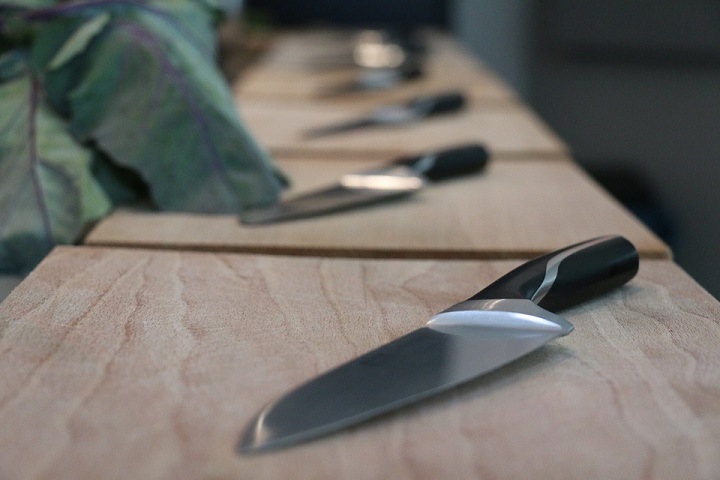
The kitchen knife Santoku , which is translated from Japanese means “three applications”, quickly gained popularity in Asia, Europe and both Americas. Russian lovers to cook at home did not ignore him.
Universal for a metropolis
Universal kitchen knives with blades of 160-200 mm long in their historical homeland are called Santoku-Botyo or Bunka-Botya. Their popularity was promoted by several factors at once, which developed almost simultaneously.
During the urbanization of Japan, the bulk of the inhabitants gradually moved to small apartments of multi -storey "humanities" of modern megacities. Career aspirations and the need to create a material basis for the future respectable life entailed late marriages and even later childbearing. For decades, ragless townspeople lived alone or with companions, focusing in home food on semi -finished products, purchased cooking and quick cooking dishes.
For such citizens, a new culinary tradition was quickly formed. Its slogan was the motto “Fast, convenient, tasty”, and the main sign was a boom of food products that require minimal processing to turn into compact home kitchens into delicious and inexpensive dishes. Manufacturers of all kinds of cooking electrical appliances, such as kitchen combines, multicooks, deep -frying and electric drums, did not lag behind.
However, even in such a mechanized kitchen for a knife there is still a lot of work. Cut the fish fillet or chicken breasts in the salad, chop the vegetables in the hot ... All these needs of the resident of the metropolis quite successfully satisfied only one knife, convenient, high -quality and universal, - Santoku.
He appeared in post -war Japan under the influence of a European gastronomic tradition as a special knife for cutting meat. Santoku in its original form is already manufactured today by the company Tojiro as part of the Japanese F-698 and HamMered Finish F-1112 series. But by the end of the twentieth century, this kitchen knife turned into a universal cutting tool of small households. Modernized versions of this classic with laminated blades and cutting layers of steel VG10 TOGIRO produces as part of the WA-URUSH (FD-647), Shippu (FD-597) and Zen (FD-567).
Three applications
What bribed the townspeople of Japan, and later the whole world of Santoku? First of all, high versatility. This is a kind of multi-fan multitule, which perfectly copes with meat cutting, fish cutting, and vegetable shinkling.
The basic techniques of operation with a knife can be reduced to three techniques. The amplitude cut off from a piece of lumps of various lengths and thicknesses with a fairly long blade with a hue or in the opposite direction is called a cut. If a short blade separates the slices with a falling vertical movement down, then this is a cabin. Combined technology, when the blade makes reciprocating chopping movements, calls the shirt. Each of these techniques has several varieties of execution, taking into account the properties and sizes of the original product, as well as the required geometry of pieces and pieces from it: long slices, narrow stripes, straws, cubes, rings, etc. The task of a universal knife is to effectively adapt to any work technique, issuing a uniform cutting of the required shape and size at the output.
A wide blade of Santoku cuts small pieces very well. Yes, it is not very suitable for the manufacture of long and thin slides, but you can buy a ready -made cutting of gastronomy of the required size today in most stores. But the kitchen knife Santoku is almost perfectly adapted for shinkling and cutting products in the conditions of a limited working space of modern mini-wools. For full operation, a fairly round board with a diameter of only 200 - 250 mm. It should fit tightly to the table without sliding and swinging.
Another condition for effective work is the severity of the blade. The weakly reduced line of the blade simplifies its high -quality editing and sharpening, which can be performed by any qualitative tool: musat, water stone and all kinds of sharpeners. This knife is very unpretentious in leaving and forgives the owner of small flaws in the technique of maintaining severity, which determines the many years of popularity of the F-301, F-303, F-331 budget series from Togjiro. Sharp equipment and cutting boards can also be purchased on the website of Togzhiro https://www.tojiro.ru/ where a rich assortment of original and high -quality kitchen products from Japan is available for lovers.
The knife during cutting is held with the thumb and forefinger by the base of the blade, and other fingers fix the handle in the palm of the hand. Such a grip of the handle of Santoku provides reliable holding the knife with the palm of the palm, and the accurate orientation of the blade in various methods of cutting products, and reduces the load on the palm of the cook. And, therefore, it helps the cook quickly cook delicious and healthy dishes!
Handyman
Unlike specialized professional knives of restaurant workshops and cooking, a kitchen knife Santoku in a regular kitchen is able to replace a whole arsenal of cooking tools. He can do everything: chop, tire and cut. And not only! Its with a wide blade, like a spatula, is convenient to overload the cut from a cutting board into a pan or pan. You can put garlic or ginger with a blade with a blade directly on a cutting board. The butt will help to quickly discourage a piece of meat on the frying.
Experienced users sharpen the blade to Santoku on different angles. The area of the blade at the tip is made more subtle for delicate tasks for thin slices and shirt. Part of the butt, on the contrary, is hidden on a larger angle: this section “along the teeth” is cutting cartilage and small seeds.
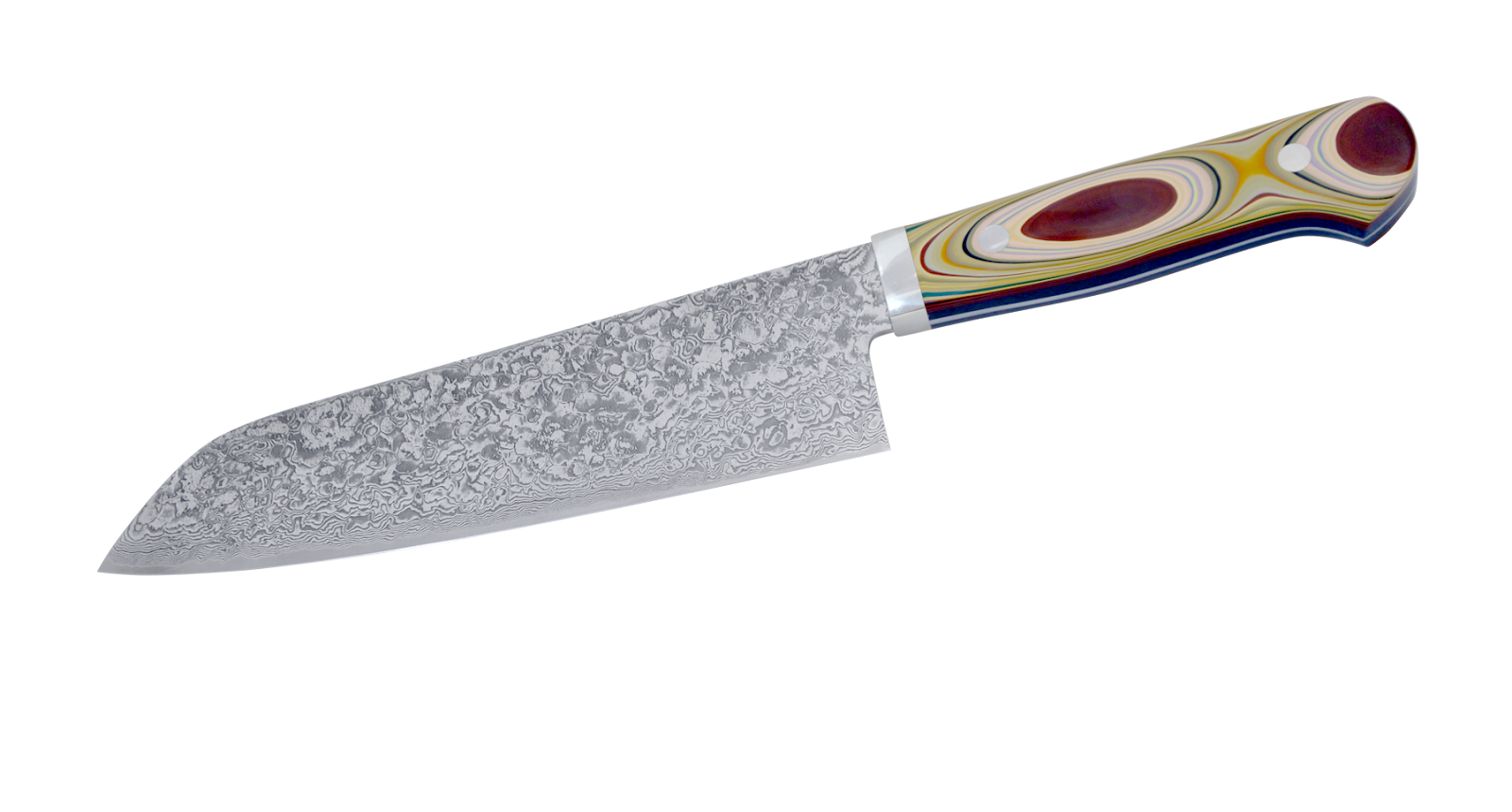
Comfortable and practical knives Santoku has stepped beyond Japan and are now produced everywhere. But on truly leadership positions of quality and functionality, Japanese manufacturers firmly settled, the most famous of which is the company Togjiro. It is especially necessary to highlight its F-659 model Pro Damascus, which in recent years has gathered a large number of prestigious national and international prizes for innovative design and quality and have become a kind of industry canon in the production of this knife.
But other kitchen knives Santuu from Togjiro are distinguished by a truly advanced combination of high-tech materials, the excellent quality of hardening and sharpening of blades, excellent ergonomics, as well as a magnificent level of finishes, as on FF-SA180 and FF-SA181 Flagmanship models. Blades from modern high -carbon stainless steels in linings made of art laminate, a proprietary process of five -stage sharpening and refinement of cutting edge, cooperation in the development of models with leading world experts in professional and amateur culinary - all this together forms the recognizable appearance of a first -class universal kitchen knife from Tujiro, a genuine leader National Knocking Industry of Japan.
To avoid disappointment from a non -functional copy, to purchase a real kitchen knife Santoku, as well as the means for its maintenance and cutting boards follows a solid distributor of real Japanese knives. Such as the company Togjiro. In the show rooms of specialized stores, experienced consultants will meet you. A quick purchase through the website tojiro.ru is possible. Tojiro does everything so that you feel the joy of working with a high -class tool, which is the main assistant of the cook in home kitchen!