
Translated material
Economists offer, following the example of the United States, to pay each Russian ten thousand rubles to fight the epidemic
The authorities do not like the idea yet
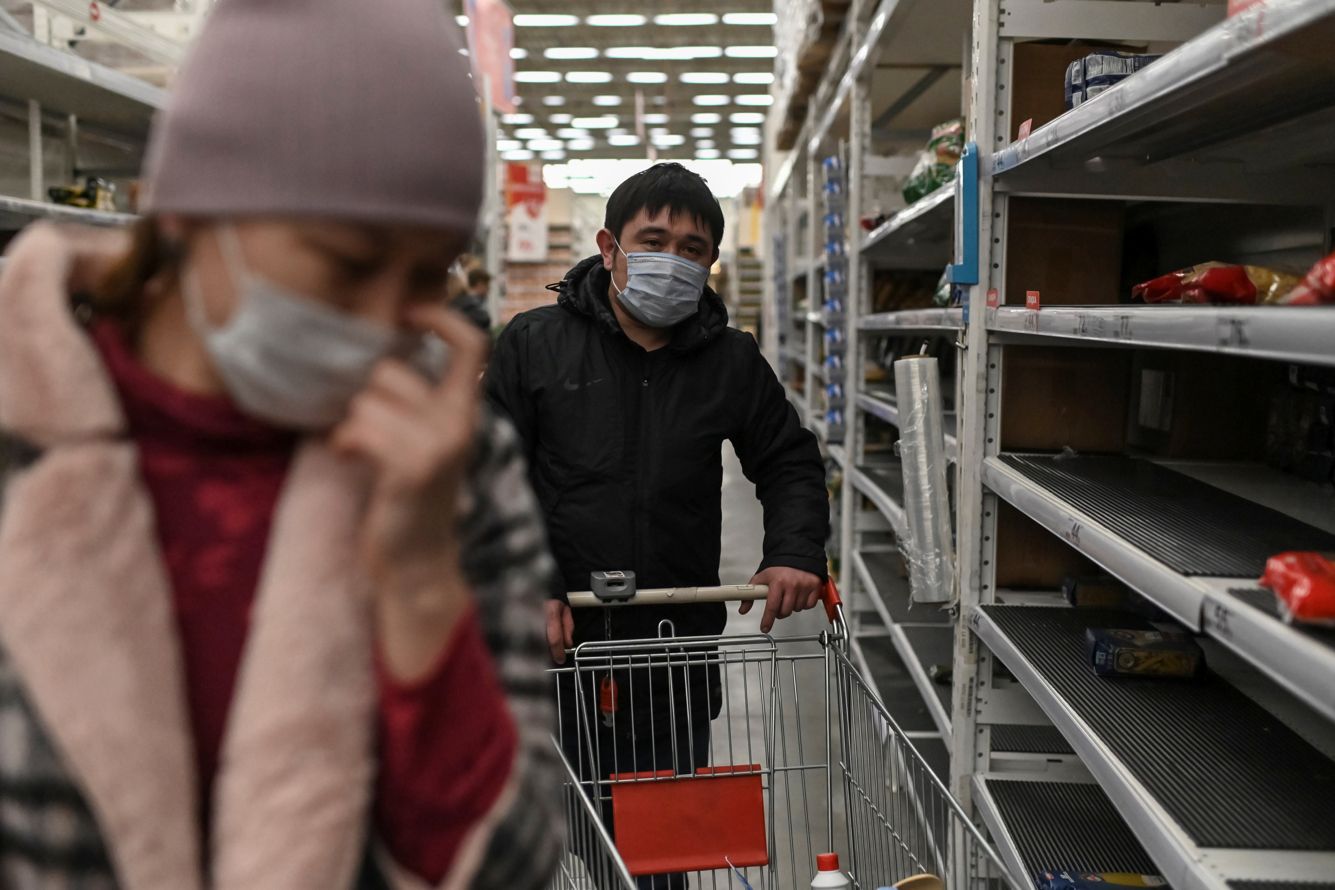
In the United States, where strict measures to contain the coronavirus epidemic are introduced, they discuss a non -standard tool for supporting the population and the economy: a one -time issue of 1000 or more dollars to each adult resident of the country, regardless of its income. Several Asian countries and territories took the same measures. These emergency payments, in the opinion of the ECCONS , can become a rehearsal of the implementation of “unconditional basic income” - the long -discussed concept of the new social policy. In Russia, the discussion of this tool is still purely theoretical. So, the Central Bank has already opposed - according to the bank’s leadership, Russia has enough standard measures to fight the crisis caused by the epidemic. "Medusa" figured out what the unconditional payments are good and whether Russia is needed.
What is basic income?
Initially, this is a political concept according to which each citizen has the right to part of the country's national wealth and can receive it in the form of a “social loan”. Ideally, the system looks like this:
- Payment should not depend on the income and contribution of a citizen to the economy.
- To receive income, no certificates and confirmations of status are needed, except for a certificate of citizenship.
- Payment must be personified; The recipient is every specific person, not a household.
- The income should be paid with strict frequency, for example, monthly.
If you do not go into political and philosophical concepts, the basic income can be considered as the simplest and most effective tool for social support and the fight against poverty, as well as support for consumer demand. It does not require any separate bureaucratic system, and therefore exceptionally cheap.
The theoretical disadvantages of the concept are obvious: this is not only a system of redistribution from the rich to the poor, but, possibly, from those who want to work, to those who do not want to contribute to production. Therefore, in those few cases when the governments tried to introduce a concept in practice, their actions caused the resistance of some citizens.
How can payments help with an epidemic? What states are going to pay?
The main field for the experiment with unconditional payments has become the United States. The idea proposed by the head of the Treasury by Steven Mnuchin was widely supported by economists and politicians - both by democrats and the Republicans. The famous economist Gregory Manku, who was adviser to President George Bush Jr., wrote about the benefits of payments; Advisor to Barack Obama Jason Furman agreed with him. The option with payments of thousands of dollars to each adult and 500 are discussed - to each child. If it is necessary to send money, it will be possible to repeat (which will make it closer to the ideal concept of basic income; but, probably, payments will still remain a temporary measure).
Arguments in favor of payments are simple:
- There is no time to find out who really needs help; You need to help all those in need as quickly as possible. You just need to send checks to all citizens by mail without asking them any evidence of the plight.
- It is necessary to support the falling consumer demand. All other methods of budget and financial incentives - from tax holidays to “ quantitative mitigation ” are not as effective here as the distribution of money. It is assumed that citizens (especially those in need) will immediately spend a significant part of the issued funds.
- During the epidemic, you should not wait for the distribution of money to increase inflation. Payments are simply equalized by a drop in demand caused by a forced change in the consumer behavior of people. Perhaps payments will not help completely restore production, but will definitely save the real ones.
- In the conditions of the epidemic, the government and congressmen should not be embarrassed by the fact that payments will require an increase in US public debt. An emergency situation requires non -trivial solutions.
Similar measures are considered by the countries of Asia and the Pacific basin. However, their programs are not so radical: either payments are very small (as in Thailand, where the idea was not supported by the majority of the population), or they are limited by individual groups of the population, for example, pensioners, as in Australia.
And what about Russia?
Konstantin Sonin, professor of Chicago University, wrote about the need for such payments in Russia. In his opinion, the government must pay every citizen of Russia 10 thousand rubles, which will require budget costs of 1-1.5 trillion rubles. Money can be taken at the National Welfare Fund (FNB), where more than 8 trillion rubles were accumulated by February 2020. Money entered the fund due to the seizure of overprovements from the sale of oil. Now, part of the funds will go to cover the budget deficit formed due to falling oil prices, and part to maintain the ruble exchange rate according to a complex scheme . But there is a lot of money in the FNB, and anti -crisis expenses are what this fund was created for.
However, the idea has already been rejected by the financial authorities. On March 20, the head of the Central Bank, Elvira Nabiullina, said that the population does not need direct payments, since the government and its bank have enough ordinary tools to maintain the economy and the needy part of the population.
Judging by the statements of Nabiullina, the Central Bank is still valid based on the fact that the increase in the growth of the economy will not be too deep, and the main short-term risk is to accelerate the growth of inflation (primarily due to the devaluation of the ruble caused by the drop in oil prices). True, inflation will be restrained by quarantine and closing during an epidemic of many businesses, Nabiullina said. But payments to the population of more than trillion rubles do not contribute to the fight against inflation. Due to the risk of inflation, the Central Bank did not dare to lower the key rate on March 20 to make rubles cheaper and affordable for banks, enterprises and citizens. There is no need for such support of the economy, because the Central Bank does not expect a deep fall in production and the growth of unemployment.
According to Sonin, the optimism of the authorities looks strange: it is likely that the Russian economy is waiting for a recession : the negative consequences of quarantine, the fall in oil prices and the global crisis cannot be compensated by budget expenses on the support of the economy and citizens (so far it is planned to spend 300 billion rubles from the budget). In addition, citizens will lose a significant part of the real income due to the devaluation of the ruble.
In the case of a full -scale crisis, the government will have to increase the amounts allocated to support. They will have to be taken from the FNB, although this will require the refusal of the budget rule prohibiting the money of the fund if it contains an amount of less than 7% of GDP. And therefore, direct payments to the population are a more effective and quick way to support the population and the economy than traditional industrial and social policy, Sonin concludes.
Dmitry Kuznets