
Translated material
"Vultures" and cases. The CEC prepares a "popular vote"
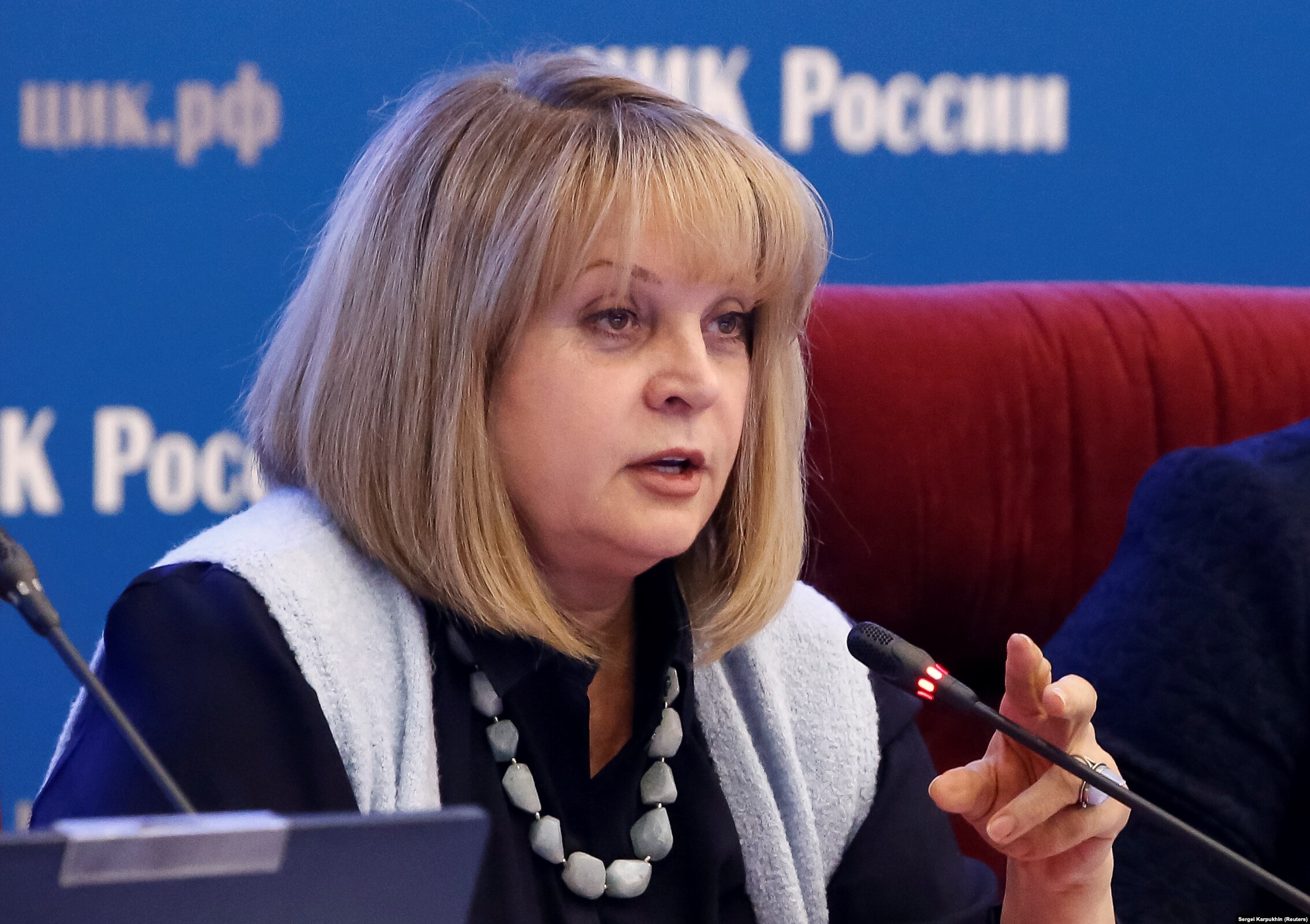
All-Russian vote on amendments to the Constitution, appointed by Decree of the President of Russia on April 22, can be postponed to June due to the pandemic of coronavirus. This was reported by Vedomosti with reference to three sources close to the presidential administration. The Central Electoral Commission has already approved the voting procedure, while the head of the CEC Ella Pamfilova spoke quite emotionally about the upcoming work of observers on it . And linguists note the illiteracy of the formulation of the question to which the voting participants will be answered.
“I want to say about this: we really need observers, not overseers. Observers who will primarily defend the rights guaranteed by the Constitution, including regarding the human right who comes to vote. (...) And not the warders who have other goals,” said the Chairman of the CEC at a meeting of the commission.
Pamfilova believes that the main task of observers is to prevent and prevent abuses, "which could lubricate or discredit the voting process." The overseer comes to the site in order to “wait for a vulture, even sometimes provoke a particular violation,” she said. "(So that) to fix it (violation) in order to then trumpet at all venues, conducting certain pseudo -research and extrapolating and thinking some non -existent facts, that provides a large front of work both inside and at international sites," the Interfax agency quotes the Pamfilov.
Any observers, of course, should be peculiar by guard dogs in the service of voter interests
Members of the Central Election Commission always respond very painfully to criticism of criticism, notes Stanislav Andreichuk , a member of the Council of Movement in Protection of Voter Rights. This, apparently, explains the “preventive” attack of Pamfilova on observers on the vote, which is still unknown when it takes place.
-It often seems to members of the CEC that really someone there is deliberately provoking, trying to bring the commission to an aggressive reaction and, thus, “hypeite”. It is clear that even if this happens, this is the smallest of the problems of Russian elections. Because it is extremely rare. And by and large, any observers, of course, should be peculiar patrol dogs in the service of voter interests. They should look as close as possible and try to figure out any situation, even if they have minimal doubts. From an observer who has no doubt who does not try to figure out what is happening, there is no benefit. But we understand that, most likely, the election commissions are much more comfortable working with such observers. Probably, in many ways, this is why now the order is introduced by which only the Public Chamber can be directed to the sites: in fact, a monopoly on public observation is introduced. More requirements for media representatives who can get to polling stations are complicated even more. That is, the procedure is becoming more and more closed so that, God forbid, no criticism sounds.
Such attacks on observers arise, in fact, in every election campaign. And every year they arise more and more often, more precisely, all earlier and earlier - at the earlier stages of election campaigns, in this case, the campaign to conduct this vote is not clear what to call it ... Naturally, the current composition of the CEC that has been working since 2016 has already developed a certain reflex to the word "observer". CEC members have a certain story of relationships with observers and a certain level of irritability. It is clear that the voting organizers have long been without illusions and understand how the vote will take place and what claims can be presented to them. In fact, they have already created the maximum number of obstacles so that some complaints are presented with them.
- Will the Voice movement try to send their observers to this vote? After all, many doubt his legitimacy.
- If we talk about the Voice movement, then we have two types of observations. This is a long -term observation that we have already begun, which is in several dozen regions, where we have long -term observers. We launched our site "Map of Violations", where any citizen can send a message about what seems to him a violation. And after moderation, it falls into public access so that the media, the same election commissions and other citizens can get acquainted with it. As for the voting day, we have not made this decision so far. So far, we do not fully understand how accreditation of media representatives will occur. We do not fully understand how the direction of voters will take place, because there is no position from the Public Chamber. And the Public Chamber begins to say in some regions that they are not still equipped with them. Therefore, we are a question related to observation on the day of voting, so far we have hung up for ourselves. Of course, we will try to observe anyway - we have members of the commission who will work on this day. This is by no means legitimization of voting. In general, observation was never legitimizing the results. Rather, on the contrary: the lack of observation contributes to this much more - if there are serious violations on the vote, but no one saw them, no one recorded, no one told others, ”says Stanislav Andreichuk.
At the end of last week, a sample of voting on constitutional amendments appeared on the network at the end of last week. The question in it is formulated as follows: "Do you approve of changes to the Constitution of the Russian Federation?" Reply is proposed "yes" or "no."
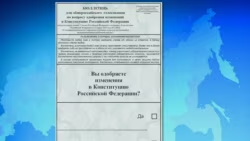
To assess the literacy of the formulation of the issue of Radio Freedom asked the linguist, a specialist in speech culture, spelling, language norm and variability, deputy director for the scientific work of the Russian Language Institute named after Vinogradov Elena Shmelev .
- Is it possible to consider the formulation from the point of view of the Russian language - "you approve of changes to the Constitution of the Russian Federation"?
We could not cope with the cases. No approval. This is not in Russian
- Of course not! But this does not surprise at all, because, in fact, almost all changes, all these additives are formulated extremely illiterate into the constitution. It is clear that it is meant - "do you approve of changes to the Constitution of the Russian Federation." That's how it would be right. And "Changes to the Constitution" is an impossible design. Or it would be necessary to say, in extreme cases, "changes in the constitution." Here they simply could not cope with the cases. There is no approval, they simply could not cope. As if foreigners wrote, foreign agents (laughs). Because it is not in Russian.
“But still, maybe you can somehow justify such a wording?” I often have to deal with the fact that some norms are not so obsolete, but new norms arise. Which at first look illiterate, and then fixed. Even dictionaries. Literacy wins the literacy ...
- Yes, I understand. But here the situation is not like that. It is clear why it happened - conversational speech was used. When we talk, we often use incomplete structures. But this is a question in the official document! Therefore, the transfer of such incomplete conversational structures, of course, is completely unacceptable. This is not suitable for an official document.
There is another funny trick - the squares "yes" and "no". And there is a well -known property of Russian speech: we often begin with "no" consent. We very often insert this "no" just in case of consent. Therefore, everyone has already joked: " - You do not approve of amendments? - Yes, I approve. - No, I approve." There is a joke about the crow who held the cheese. And she was asked: "Are you for Putin?" She screamed: "Yes!" The cheese fell. Then she thinks: “And if I said no, then what's the difference - would the cheese fall?!” So here.
- We, journalists, are far from sinless in terms of literacy in the Russian language. Recently, you have to write a lot about constitutional amendments. How is it right-to accept amendments to the Constitution? Or accept amendments to the Constitution?
There is a joke about the crow who held the cheese. And she was asked: "Are you for Putin?" She screamed: "Yes!" The cheese fell. Then she thinks: “And if I said no, then what's the difference - would the cheese fall?!”
-I like “K” more, but still “in” this is not a mistake. At least grammatically this design is correct. But simply, of course, when such a “in” - this immediately shows that we very much get into the text. "B" is a greater implementation inward. Maybe this just shows such a subconscious feeling of our legislators. In general, the language of laws is monstrous. Our institute tried to work a lot with this. We tried to rule the laws, write our own examinations, but this is not adopted at all. In particular, these amendments are very illiterate.
-Can you give some examples?
- This is the famous amendment, in which God with the ancestors. There is an analysis of the remarkable philologist Mikhail Epstein from the University of Emory , who simply made out how this stringing the genitive cases leads to perfect incomprehensibility - who is responsible for what, who is for whom. There is complete inconsistency. In itself, this amendment is meaningless precisely because it is terribly written in Russian.
-Do you and your philologists turn to you and your colleagues for help when you need to formulate a legislative act?
- Not now. The fact is that at first the State Duma really had such an idea that they had some kind of linguistic examination. And they wanted to work with us, to cooperate. And although this is a big free work for our employees, we were ready. And the different laws that we sent us, we tried to rule, wrote our comments. But then we saw that they were accepted in the same form in which they were. In part, it seems to me that this is even such a conscious thing that the laws are written very opaque. So that you can interpret many points differently. Maybe this is generally such a feature of the legal language ... It seems to us that it is necessary that the laws from the point of view of the user be written so that everything is clear and clearly. But maybe it’s good for someone that they are written in such a way that you can interpret in favor of whom you need.
- But after all, it is very difficult to formulate an article in the law so that everything is provided, all the nuances. One design is layered on another. Maybe, after all, first of all, this is the matter?
Continuity cannot be conveyed, because continuity is what is transmitted from the ancestors to descendants
- Of course, it is difficult. No one says that it is simple, but I have a feeling that they are not very trying. We have real examples. Say, the Law "On Language", which the Institute of the Russian Language concerns directly, is the Law on the State Language of the Russian Federation. We ruled him a lot. Something still managed to defend in due time, some completely meaningless formulations. But, in fact, it is still unreasonable, therefore it does not work. Because it is absolutely pointless when the law says: "prohibit the use of foreign words in the event of their Russian analogues." And in this phrase there is a foreign word. This is a completely non -working law, in particular, precisely because it is very poorly formulated, ”said Elena Shmeleva, deputy director for scientific work of the Russian Language Institute.
The amendment mentioned by Elena Shmeleva, criticized by Mikhail Epstein, sounds like this: "The Russian Federation, united by a thousand -year history, preserving the memory of the ancestors who conveyed the ideals and faith in God, as well as the continuity of the development of the Russian state, recognizes the historically established state unity." Mikhail Epstein indicates that, according to this formulation, "historically united recognizes his historical unity." As they say, oil oil. In addition, Mikhail Epstein notes, continuity cannot be conveyed, because continuity is the transmission, what is transmitted from the ancestors to descendants. Epstein published his post on Facebook on illiteracy of the formulation of the amendments on "continuity" when the amendments were still discussed. However, in the law adopted by the State Duma, not a single word was changed in this amendment.
-

Andrey Sharogradsky
International Radio Offer Freedom. Author and host of the information and analytical digest, podcast "Time of Freedom"