
Translated material
"War and Peace" in the Japanese way
Alexander Meshcheryakov about the novel by Kaga Otokhiko "Capital in the Fire"
Why do we know so little about the life of totalitarian Japan of the 1930-1940s, and by acquiring well-being, we lose literature? At the request of Gorky, Japanist Alexander Meshcheryakov talks about the epic novel by Kaga Otochiko “Capital on the Fire”, a book about living and dead people who lived in Tokyo times of militarism and imperialism.Kaga Otokhiko. The capital is in fire. SPb.: Hyperion, 2020. Translation from Japanese A. Belyaev, A. Kostyrkin, A. Meshcheryakova and others.
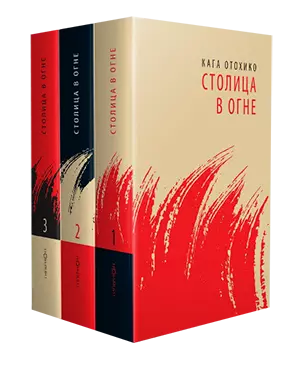 This wonderful novel received in Japan all conceivable and inconceivable literary awards. I have no doubt that in Russia they will read it with great interest. And because it is brilliant literature, and because Kaga talks about that Japan that is known in our country. This is not the same Japan in which people courtly bow to each other under Sakura with a view of Fuji and compose heartbreaking poems.
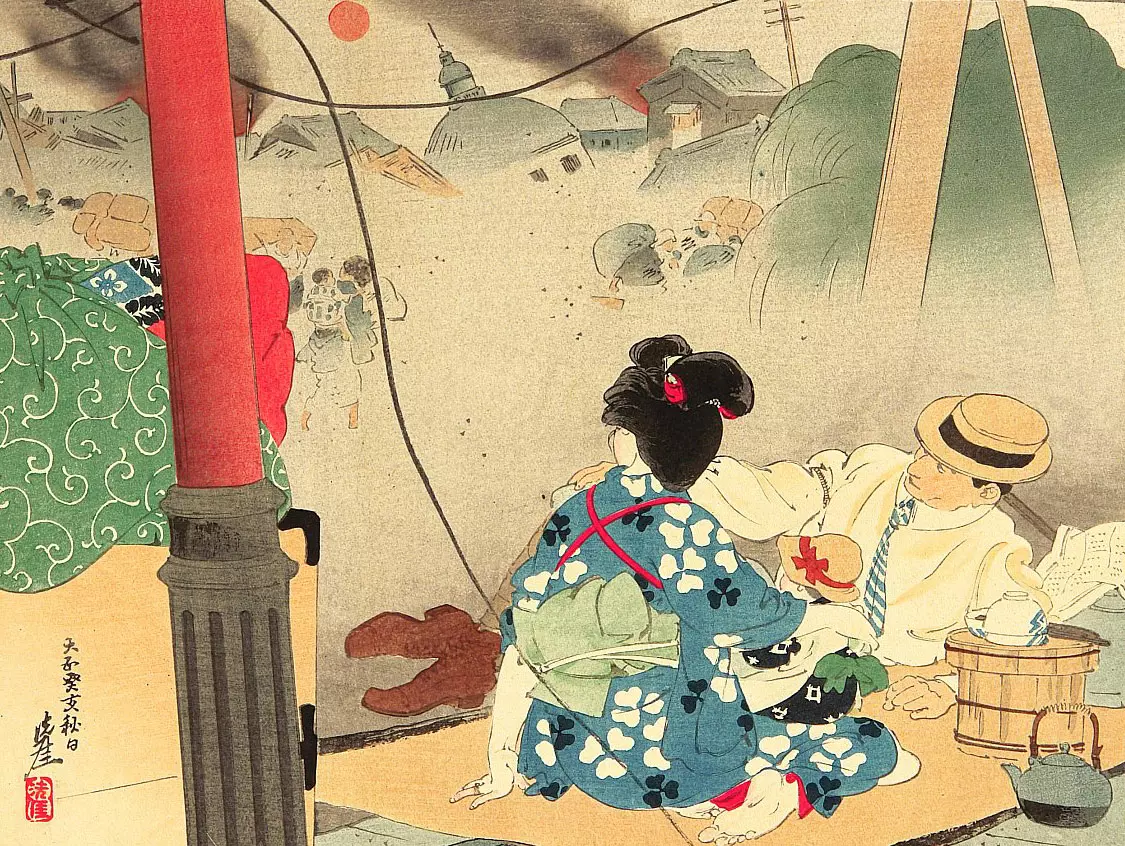
The action of the novel takes place in 1935-1947-when Japan in the revolutionary broke with its past. Under the influence of Western ideas about great power, she refused to consider herself a small island country and began to build an empire. This process began at the end of the 19th century, when Japan attacked China and took away Taiwan from him. Then she attacked Russia and took her southern Sakhalin from her. Then she joined Korea and finally became a mainland empire. But it was in the 1930s that it became a truly militaristic and totalitarian country.
The historical events of that time were well studied by historians. After familiarizing themselves with their labors, it is difficult to get rid of the impression that the decisions that were then made by politicians are a chain of adventures that had no chance of success. So it was actually. Already firmly stuck in the Chinese war (began in 1937), in 1941, Japan declared war on America and England and began to fight with a half of the world. The historian knows what happened later - this is his “wisdom” and the advantage over contemporaries of events. History is some kind of science. But she deals with either “historical figures” or with human masses, operates with large numbers and has no time to be distracted by a “small” person. And then literature comes to her help.
The world of Kaga Otochiko is inhabited by “little” people, each of whom has a name. These people live in their turbulent time and do not know what will happen to them later, their relatives, with their country. They are accomplices in history, its spy and captives. This novel is about living people who do not know that they live in a totalitarian country. They are involved in a power field that politicians create, but, besides politics, they have a lot of worries. They grow children, fall in love, quarrel, put up, live, get sick, die. In other words, they have a "personal history." It is superimposed on a “big” story that is happening in the “Great Japanese Empire”. Involvement in the “large” history of “ordinary” people gives it multidimensionality and multi -color. Kaga Otokhiko gave “little” people the right to speech, and these people speak in different voices, they look at the world with different eyes, at the same events they respond with different echoes. This is such a symphonic multi -nakedness from which not a single sound cannot be removed. As one of the characters of Andrei Platonov said: "Without me, the people are incomplete."
Platonov had in mind that people are not a bunch of units indistinguishable from each other, but a collection of individuals, each of which is a naive. If you look at earthly people from some star, they all seem the same. To see a person’s uniqueness, you need to look at him from somewhere better. Kaga Otokhiko does just that. In his education, he is a psychiatrist, the method of which is the case - to peer into each person with a refuge. To peer, talk and understand how he works is to help him. Kaga belongs to the galaxy of doctors, from which wonderful writers came out. Among the most famous Russian writers are the names of Chekhov and Bulgakov. Among the Japanese, I can recall Mori Ogai and Abe Kobo. However, most of the current doctors do not treat a person, but a disease, and such a doctor is difficult to become a good writer. In the best case, he will be able to write a medical history.
 At times, I get into the hands of the work of Western (primarily American) researchers of the late USSR. Quite often, they cause me a rejection, because these books give the impression that the USSR was inhabited by a disgusting party elite and the opposing noble dissidents, and all other people were transported. But I myself lived in those days, did not belong to either the party elite or the dissidents, but could not call my life dull. She does not seem like this to me now. I read good books, fell in love, played basketball, traveled on a note, drank with friends, composed scientific articles and books, engaged in artistic translations, wrote poetry and prose. When reading the work of domestic (and not only domestic) researchers of Japan, the totalitarian period may also have the impression of the hopeless life of the Japanese of that time. Kaga Otokhiko hates the militarists and the secret police with all his heart, he sees the abominations of nationalism, great -power is alien to him, but he shows that a person’s life consists of a variety of components, in which there is a place for a variety of feelings. The moon, as you know, has two sides - visible and invisible. Everyone sees visible, but not everyone can see the invisible.
The heroes of the “capital in the fire” experience strong feelings, real passions. They love and hate for real. Now people experiencing such feelings are becoming less and less. The modern “middle” Japanese lives a city life, this life is predictable and is similar to the schedule of electric trains or a television program, it has a lot of familiar, but few accidents and unforeseen, and therefore strong emotions. Of course, no one canceled natural disasters and death as such, but in the current Japanese life there is no place for real poverty, there is no starvation and fear in it for the fact that tomorrow you will be arrested or taken away. And this is a great conquest, which should always be remembered. This applies not only to Japan, but also to many other "prosperous" countries. Yes, such a society is safe, but for the writer (in any case, the writer of the previous formation) it is boring. You have to pay for everything. By acquiring well -being, we lose literature. So if the writer wants to find extraordinary people and plunge into the world of strong feelings, he is forced to write about past times. Or compose science fiction like a fairy tale about Harry Potter.
Universal compulsory education, unification of the lifestyle, the disappearance of dialects and dialects, the pressure of the media, the transformation of people into “Office Plankton” lead to the fact that modern cities and modern people become similar to each other. Such people want predictability, not adventures. The modern world gives rise to few eccentrics, and this impoverishes it. One of the main characters of the novel, Riche, is quite worthy of the rank of eccentric - it is impossible to predict what he will do the next minute. This doctor and the veteran of the Japanese-Russian war are excellently operating, drinks with taste, walks with women, lies with inspiration, acting, repenting, having skill and character to cut out appendicitis, makes it when sensible, and when absurd inventions, becomes a morphine ... and causes a deepest sympathy.
Among the characters of Japanese literature, there are not many who fall into the Western literary encyclopedias. The Japanese writers themselves get there, but the characters they invented - rarely. They live in their inner world, do not expose their feelings. Japanese writers love to place the hero in a closed space and observe what will happen to him. That is exactly what Abe Kobo did in his famous novel “Woman in the Sands”. It is difficult to bring such characters to the category of "heroes". Riche, of course, is worthy to be in the encyclopedia. Life next to such a person is not a gift, but I personally are comforting to know that there are such people or at least there. But in addition to Richey, the novel has many extraordinary characters that the writer pulled by the sleeve from the crowd. There are clerks, entrepreneurs, military, fishermen, housewives, children, Christians, militarists, communists, cripples, killers ... Their experiences and actions form an intricate and burning brew, from which it is impossible to tear themselves away.
 In the history of Japanese literature, a few long novels that the European will call successful. It somehow happened that the literary genius of the Japanese people feels better in small forms. In this regard, the “capital in the fire” is knocked out of the general row. Of the entire huge array of Japanese literature, Kaga has only a medieval “Tale of Genji” by Murasaki Sikibu with his predecessor. As for the Western literature, then there is a lot more. Here, the Fleber with Stendhal, and Thomas Mann, and Tolstoy and Dostoevsky get into the idols. Their aesthetic and moral ideas of Kaga are attached to Japanese realities. It turns out organically.
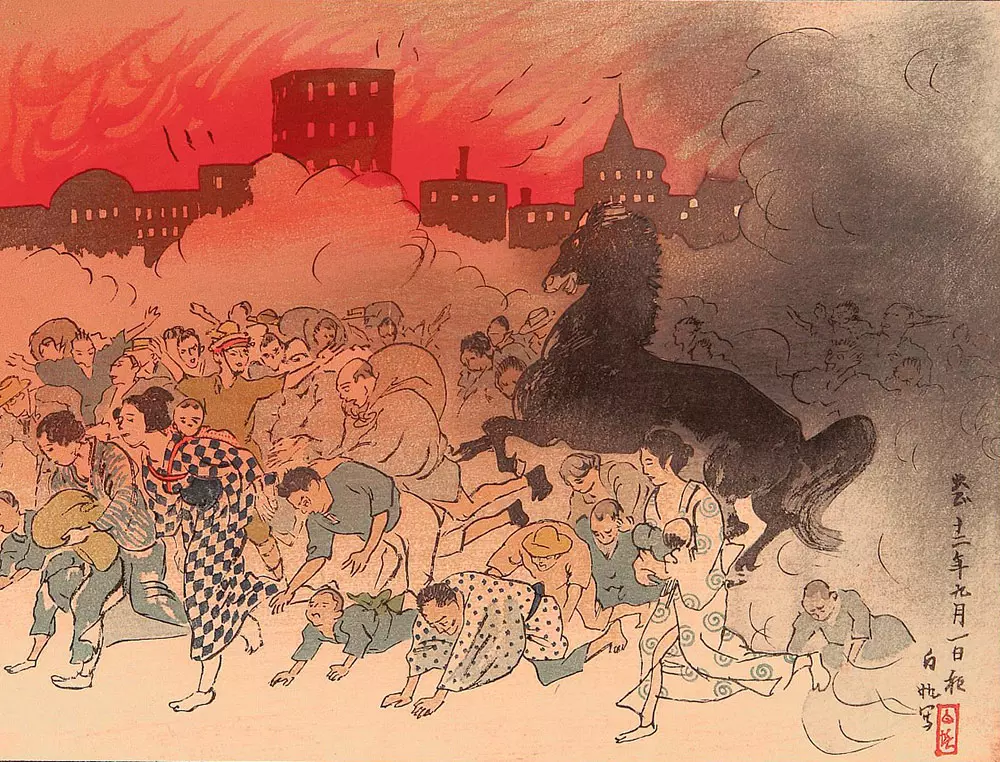
There is no main character in the novel who would act on each page. On each page there is only Tokyo. Therefore, it can be called the main character, therefore it is the “capital” that was carried out in the title of the novel. The fate of this huge city, emerging from the fate of millions of people, gives the entire narrative an epic scope. In the twentieth century, the city burned twice in fire. In 1923, he was destroyed by an earthquake accompanied by terrible fires, in 1945 he burned from American bombing. But Tokyo was invariably revived from the ashes. Therefore, this is a novel not only about people, but also about the city of hopes that defeat death.
“Capital in the fire” is “war and peace” in a Japanese way. One could call a novel like this: "Peace and war." It begins with the nostalgic descriptions of the life of a peaceful Tokyo, but then the time becomes tougher and worse - after the rebellion of the Mlad flocks, the country is rapidly rolling to the total war, thunderstorm electricity accumulates in the air. It gives the feelings of the characters a charge of despondency, and love, which is said so much in the novel, turns into a destructive passion from creative power.
In today's Russia, German and Soviet totalitarian experience is remembered on occasion, but Japanese experience usually falls out of consciousness. The point of view common in Japan is that the Japanese people were deceived by the dishonest and vile military. That is, the Japanese people appear in the image of the victim. But this is only partly true. The characters of the “capital in fire” indicate a sincere animation of too many “simple” Japanese militaristic, imperial and nationalist emotions. The Japanese Christian Church (and the author reflects a lot about Christianity) was also animated at that time not by the ideas of the world, but by the idea of a “sacred war”. The main slogan of the era is "one hundred million hearts are beating like one." The life of those few characters whose heart was beating in a different rhythm was full of difficulties, humiliation and dangers. Kaga describes a world in which almost all boys dream of becoming military. But such a world is doomed, because military people know how to destroy, but do not know how to build. Therefore, Tokyo in which the heroes of the novel live was destroyed.
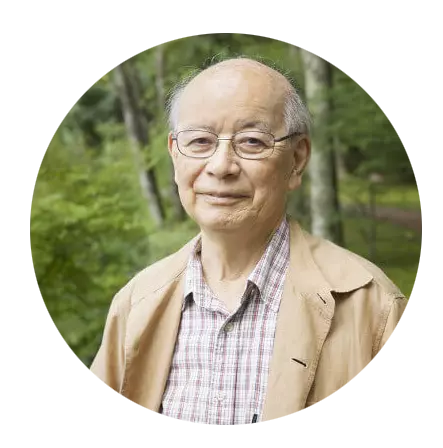 Kaga Otokhiko
In the public consciousness of present -day Russia, the “complex of the victim” is also strong: we, they say, suffered the most in that terrible war. Probably, the way it is, but at the same time at times it is forgotten about the suffering of other peoples. In this sense, reading the “capital in fire” will be a discovery for many Russian readers. This reader remembers the tragedy of Hiroshima and Nagasaki, but few people know that when bombing Tokyo on March 10, 1945, more than 100 thousand people died in fire in one night. The war is terrible for everyone - both for the winners and for the vanquished. Now in the world there are again more politicians who, with pleasure, rattle weapons (including nuclear). I would like them to read the “capital in the fire” and at least think a little. True, there are not so many hopes for this - they are too busy with other things. But I still hope that at least for one of the "simple" people "capital in the fire" will serve as a lesson, and the forgotten ideas of pacifism will germinate again.
Roman Kaga is traditional and modernist at the same time. In some parts of the book, the author acts as an inveterate realist and photographically accurately depicts reality. He is a meticulous person. The history of his baptism may be evidenced. In his autobiography, Kaga said that Catholicism had long been interested in him, but he did not find time and effort to accept baptism. In the process of writing a novel, he needed to describe the scene of baptism. But how can I understand the feelings of the person that he experiences during the sacrament? He asked himself. It was then that he immediately went to the temple and was baptized.
In other parts of the novel, the author uses the method of “stream of consciousness”, which spills into the real “sea of unconscious”. Dreams and visions are a significant layer of text. The characters then lead a first -person story, otherwise suddenly, without delay, they begin to look at themselves with other people's eyes. At times, Kaga shamelessly leads the reader by the nose of the detective writer. It is not without reason that Kag is also among his teachers of Dostoevsky. You can talk for a long time about the ability of Kaga to change the rhythm of the narrative and about the literary techniques that he masterfully uses. But for me it is more important that from this set of techniques, real literature is obtained by itself. Real art is always a miracle. I love to watch the work of magicians. On their ideas, I do not get tired of surprising and fall into sweet childhood delight. And I don't want to know the secrets of the artist at all. For if you find out the secret, the miracle disappears.
 Kaga Otochiko knows how to surprise the reader, and for this I am grateful to him from the heart. And how he managed to create a miracle is the tenth business. Once, the members of the POSI lured at their meeting of Alexander Blok. After listening to their reasoning that literature is primarily the amount of techniques, the block said: everything you say is very interesting and, probably, even true, but the writer is harmful to the writer. I would also add: it is harmful not only to the writer, but also to the reader. Writers are different. I more like those for which the “reception” serves only as a means to tell something important.
Russian classical literature praised a lot and scolded a lot for its preaching component. Now such a point of view has spread very much that there is no place in the literature, that such an approach is the property of the distant past. That is, the writer is offered to become an “objective” scientist and abandon his personality - for the purity of the experiment. It seems to me that Kaga Otochiko has a different opinion. He is not afraid to put the responsibility for the totalitarian past to the "Japanese people". He is not afraid of reproaches in his “backwardness” from the trends of time, when literature is increasingly listed in the category of Entertainment. The epic novel is usually called in Japan "Roman River." Kaga floats along this river against the current. In Japanese society, where conformism took its roots even deeper than in others, swimming against the current is great courage. But, floating against the current, he strives for the source.
With his approaches to the life and death of Kag, he claims that he is aware of his writing as a mission. Let this be an “outdated” opinion, but it carries a humanistic charge. I think that Kaga Otochiko feels his life as a mission. Therefore, it does not get tired of fighting for the abolition of the death penalty (and in Japan it is not canceled), so he continues to advise in a psychiatric clinic, so he wrote what he wrote.