
Translated material
A neighbor on quarantine
How in Kazakhstan a state of emergency is arranged, which was introduced to fight coronavirus
The first case of coronavirus in Kazakhstan was recorded on March 13, but the country was preparing for its appearance in advance, since the end of January, when a 72-hour visa-free visa was canceled for China citizens, and sanitary and epidemiological control was strengthened on the borders.
All February, the republic methodically canceled or limited flights first with China, and then with all other countries in which outbreaks of coronavirus began (Russia was not included in this list). At the same time, the first sick (he appeared in Almaty) was allegedly predicted in advance on the basis of “mathematical modeling”, about which the chief sanitary doctor of the country, gyandarbek Bekshin, mentioned in a not very successful wording. “According to our forecast, somewhere from March 11–16 we should have coronavirus in the country,” he said and left his post in less than a week (officially-at his own request).
Just two days after the appearance of the first infected in the country, a state of emergency was introduced. Kazakhstan gave everyone for less than a day to free departure from the country and entering it (with the exception of entering citizens and leaving foreigners). From seven o'clock in the morning of March 16, all borders were closed, all buses and trains were stopped (a little later blocked and air traffic). At lunch on central television channels, the president of the country Kasim-Zhomart Tokaev spoke, who announced that he was closing all the power levers.
It should be noted that in Kazakhstan there is a security council, headed by former President Nursultan Nazarbayev, who should solve such issues, but Elbasy appeared on the radars only in the area of March 20, when in the form of a written statement on his website he suggested that businessmen and ordinary people throw himself into the Fund for Coronavirus. This gave rise to a huge number of speculations on how the current relationship of the Kazakhstan “tandem” was arranged, however, at least $ 41 million were collected in the fund by businessmen for several days (although no one still understands how to spend them - there is no mechanism).
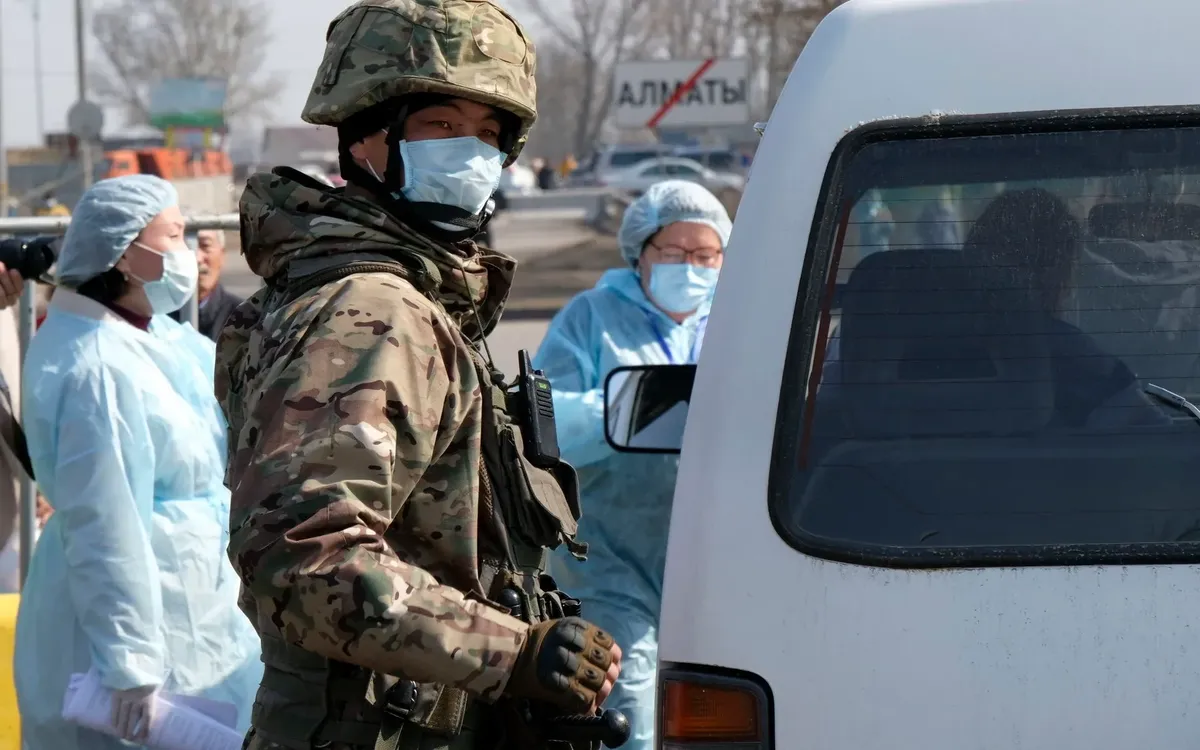
Since March 19, two capitals were quarantined-Nur-Sultan and Almaty, where all cases of infection Covid-19 were originally recorded. On roads from the cities, checkpoints were installed, additional forces of military personnel of the internal troops pulled off the cities. Video movements of the columns on the Web caused a large discussion, but it is important to clarify that none of the authorities worked out to somehow comment on, which only pumped up the already tense atmosphere.
Moreover, on March 18, in the steppes of East Kazakhstan, the Ministry of Defense pulled the tank part to the exercises, which immediately led to fakes that these tanks lead to Astana in order to perform a coup.
Almost nothing has changed inside the cities on quarantine during the first days: cafes, parks, beauty salons worked (despite the recommendations to close), public transport. The authorities, with the assistance of sanitary services, blocked houses in which the foci of infection were identified: later the blocking managed to narrow up to specific entrances. Until the midnight on March 22, it was allowed to leave everyone from blocked cities (to enter - only through inspection, including doctors). After that, Almaty and Nur Sultan were completely cut off from the rest of the cities.
On March 26, quarantine was tightened: in two cities, they announced the closure of all establishments and enterprises from March 30, except for state bodies, shops, pharmacies, utilities and media (and only television, whose corresponding tasks for leaving the house) were included in the list). For any walks around the city without a strictly defined goal, the authorities promise to fine; More than three people in one place are prohibited officially; All festivities were canceled, including the future parade of Victory and Easter (Orthodox suggested celebrating it online).
The movement of public transport will be minimized. In fact, this means the introduction of the “commandant hour” regime, although the authorities deny this particular wording.
Other cities of the country have not yet been quarantined, although Koronavirus began its procession in the republic. The next in line for closing, probably there is a millionaire city Shymkent, there have already begun to build checkpoints. Checkpoints also appear in other cities, but the decision on quarantine is left to the local authorities (one of the instructions, quarantine can be introduced if at least five cases are recorded in the region). Now 137 cases are recorded in Kazakhstan, 48 of them in Almaty and 69 in Nur Sultan, in Shymkent-two cases of infection, in Karaganda-four, in several regions-one or three cases.
On the evening of March 26, the first patient with coronavirus died in Kazakhstan. At the same time, her coronavirus was diagnosed after death, before that, a 64-year-old resident of the village of Kosshy lay in the hospital for a day, and before that she was not hospitalized by different ambulances for three more days. The Kazakh authorities did not write off the patient's death on related diseases, and after confirming the cause of death, even emergency briefing for the media.
Information for the media is submitted in regular mode. The official speaker of Koronavirus, President Tokaev appointed the Minister of Information Dauren Abaev. It acts once a day, however, reports of new sick are entered the tapes of news agencies constantly, which is why the Kazakhstanis creates that the disease is not developing as much as in other countries. At the same time, according to the emergency regime, when it is strengthened in power, there is the right to request media texts for preliminary censorship, but so far the governing bodies prudently avoid this.
But ordinary people should now filter the published information, since under violation during the emergency mode related to the spread of inaccurate information, anything can be understood. A fresh example occurred in the city of Aktobe border with Russia: a resident of the city of Lyla Islamova wrote in social networks that she violated voluntary quarantine. She was immediately detained and on March 27 was given three days of arrest (the prosecutor asked for thirty days).
The nuance is that Islamova’s quarantine was not needed, since she last went abroad more than two months ago.
The emergency mode will last in Kazakhstan until April 15, but President Tokaev almost immediately made it clear that he would probably extend it for some time.