
Translated material
"Mongolian triangle"
How the Uzbeks smoke coronavirus
It smelled as if someone had set fire to the paper and locked the door and windows. But the four women who were sitting in the service office at the passport table in one of the sleeping areas of Tashkent were asked not to open the door. “We are afraid of the coronavirus,” said one, a burly dark -haired lady of about forty years old, from morning to evening, helping dozens of people fill out profiles for passports and metrics. As most of Uzbek officials and civil servants, sensing an independent press, she refused to introduce herself. - "Isryk kills him."
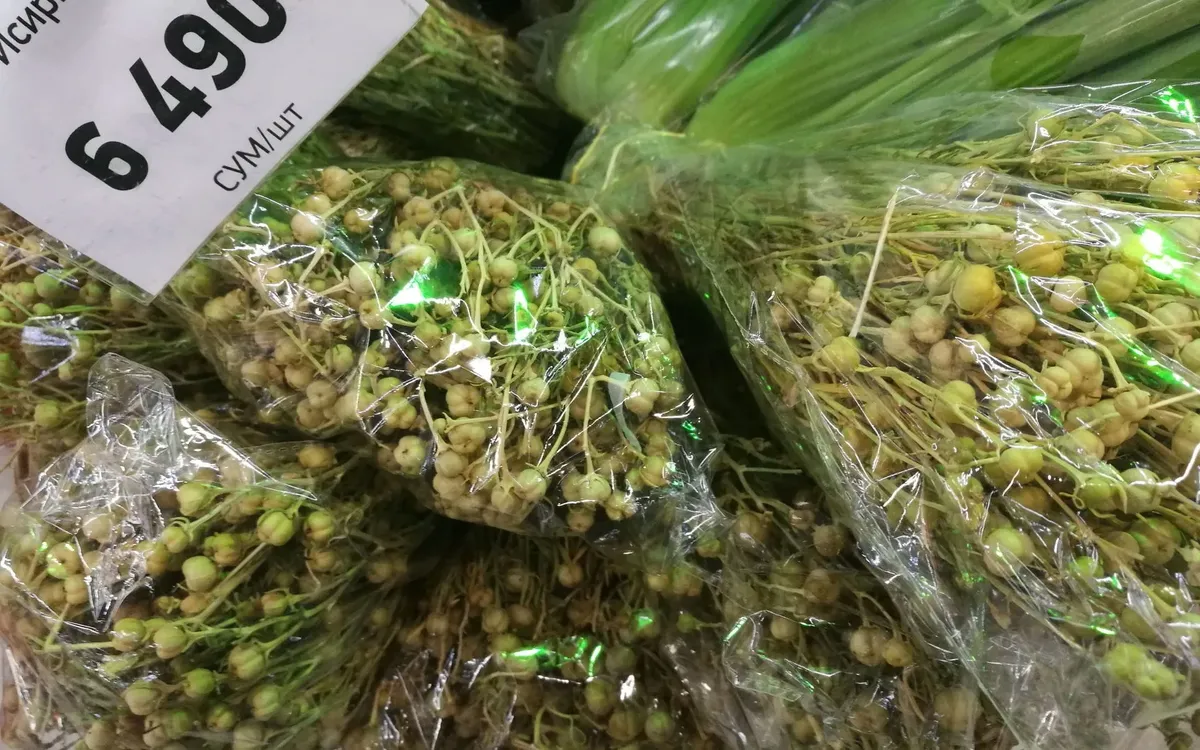
Familiar as Garmala, Syrian ruta or burial ground, Isryk or Isirik - a nondescript weed grass that does not eat cattle, but are very appreciated by residents of Central Asia, India and the Middle East. Bunches of dry isryk, yellow or light green, with brittle leaves and gear-like with boxes containing a dozen small bitter seeds, are everywhere sold on bazaars.
In pharmacies, it is available in crushed form in small packages worth less than the dollar. On the packaging it is written that the Isryk is used to “prevent airborne infection, influenza, colds, as well as against home insects”, it is recommended to simply “put the grass on a heat-resistant stand and set fire”.
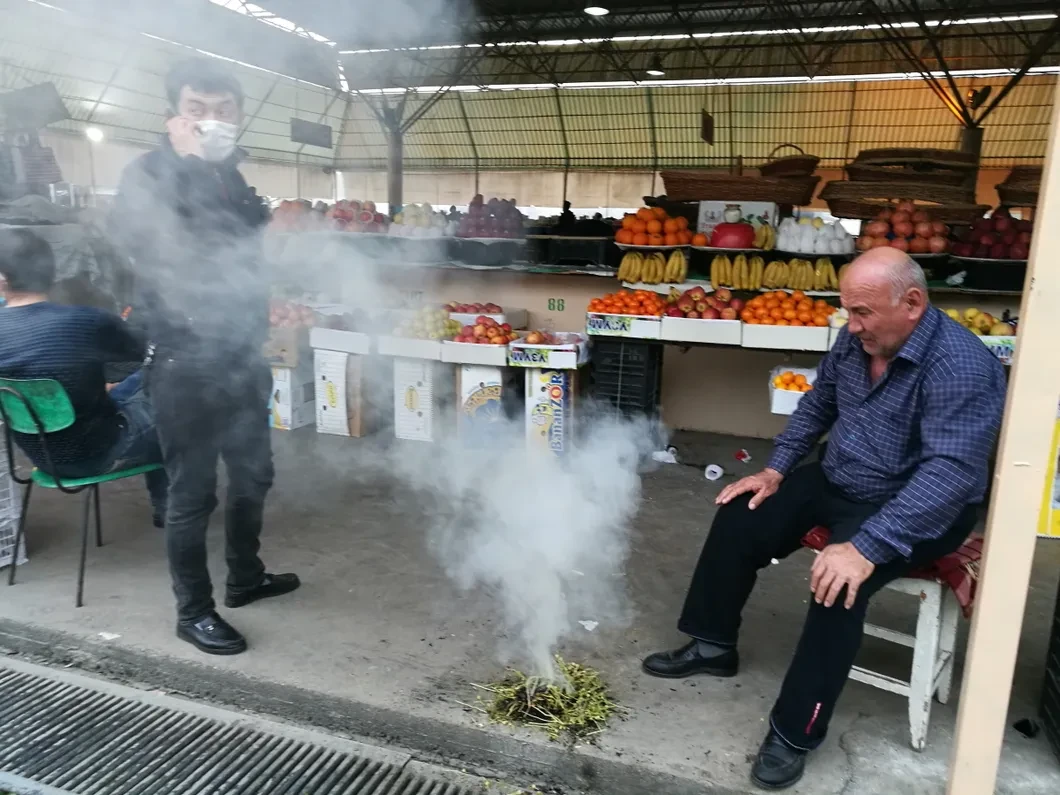
One of the most unusual spectacles for foreigners on the streets and bazaars of Uzbekistan are the poor, pooping colanders or tin banks with a smoking Isryk almost to the faces of passers -by. Passers -by are bought away from them with a trifle, sometimes frowning with displeasure. But many consider the smoke itself healing.
The Isryk, rich in alkaloids, possibly part of Soma or Haoma, hallucinogenic sacred drinking of the ancient Aryans described in Indian Vedas and Zoroastrian Avesta. The Central Asian Sufi stupefied themselves as its wax to achieve a religious trance.
The titan of the Muslim revival of Abu Ali Ibn Sina born under Bukhara, he is also Avicenna, whose “canon of medical science” was taught in medieval Europe, recommended Isrik as anti -inflammatory, analgesic and diuretic.
In modern Uzbekistan, Isrykom is fumigated with premises and patients, especially respiratory diseases. Grandmothers burn him in front of the grandchildren, the organized wedding guards are in front of the newlyweds, and the newcomers hang a ligament of an Isrik above the door - to drive away evil spirits.
And although the Uzbek Ministry of Health stated in early March that “there are no scientific studies indicating that the spark is killing a new coronavirus,” many Uzbeks sacredly believe in the cleansing benefit of fencing.
Then the visiting expert suggested that the fumigation of the Isrykom explains the absence of cases of coronavirus in Uzbekistan.
“There are a number of countries included in the so -called“ Mongol triangle ”, which are now not covered by coronavirus. We thought for a long time about the reasons: maybe dry air and a special climate or Isryk-grass, which has been used from ancient times in Central Asia to protect and disinfect, ”Mikhail Favorov, Deputy General Director for Science of the International Waccine International Institute for Vaccines at the United Nations on March 13.
But literally two days later the first case of infection was identified, and by March 30, 145 infected Covid-19 were discovered, the Ministry of Health said.
Two died - in Namangan, in the overpopulated Ferghana Valley, a woman of 72 years old died on March 27, but a heart attack was called the cause of death. The man who died on March 28 was not informed of details.
Measures against
Up to 10 years in prison, the Uzbek President Shavkat Mirziyoev promised “persons who threaten the health and life of those around you in quarantine conditions”.
He is a quip of officials for the failure of measures to ban large clusters of people. He was especially furious by a resident of the Ferghana Valley, who returned from Hajj and organized a “pompous event” for 120 people.
“The result is except her, the infection was detected by 4 members of her family. How much more was infected is not yet known, ”Mirziyoyev said on March 26.
In a country with a population of 33 million people, air traffic and any transport communication were closed, except for cargo. The penalty for being on the street without a mask is 1,115,000 soums, about $ 100.
The main imam of Tashkent Nuriddin Kholiknazarov called people who do not wear masks, "traitors" of their families and their homeland.
Most of the stores are closed, but there is no product panic - only the Basket retail chain has limited the sale of buckwheat two kilos in her arms. There is no shortage of masks either - the power of the textile industry is affected, which in recent years processes most of the cotton grown in the country.
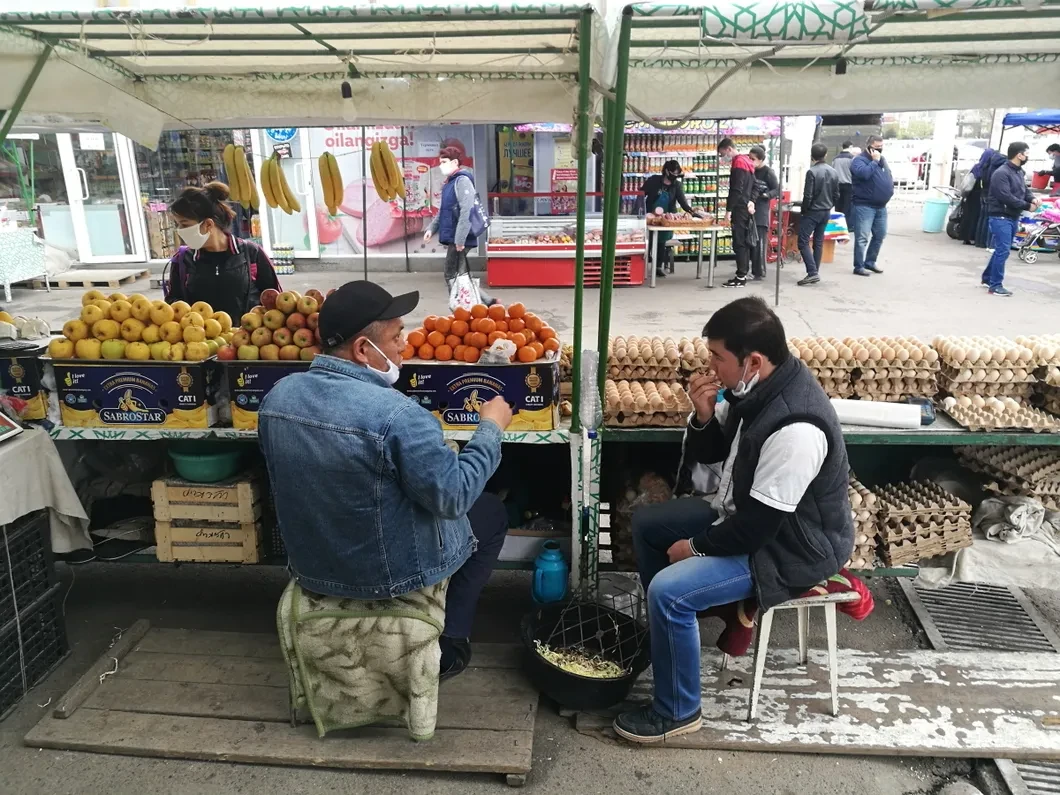
On the streets of Tashkent, fewer people have become noticeable. Even children playing in the yards wear masks. Traffic jams disappeared, the air became cleaner. Cars of the National Guard drive through the streets, notifying through the loudspeakers in Uzbek and Russian about the need to stay at home.
The authorities banned Friday prayers in mosques, and the spiritual administration of Muslims published fatwas or establishment, according to which only close relatives, obliged to wear masks and gloves, may be present at the funeral.
The Ministry of Health announced the construction of 10 new hospitals for coronavirus patients, and several existing buildings are used for two-week quarantine thousands of people who returned from abroad.
But the hand punishing in Uzbekistan stops the giving hand - a source in the Ministry of Health told the “new” that relatives often “redeems” people from quarantine, supposedly “negotiating” with the police guarding the building.
The authorities also reassured medical workers - each infected will receive compensation of 100 million soums ($ 10,500), and a monthly allowance of up to 25 million soums ($ 2600) will be accrued for working with patients.
Since Friday, in public places the principle of “not to gather for more than three” has been operating, and the inhabitants of Uzbekistan are ordered not to leave the house “without extreme necessity” like the purchase of food or medicine.
The most famous Uzbek - billionaire Alisher Usmanov in Russia, was also self -isolated in Tashkent.
“Of course, the pandemic of coronavirus affects the business, as, unfortunately, to the entire world economy,” Usmanov told the Russian Forbes Russian publication. - “Entrepreneurs have not only assets, but also obligations. The virus itself and the information wave that shakes the markets are dangerous for them. ”
Entrepreneurs obediently closed the enterprises, but murder murmurly - the pandemic threatens with ruin.
“No one reimburses the losses, does not reduce the rental,” the owner of the new computer components in the center of Tashkent, on the condition of anonymity, told “New” on the condition of anonymity. - "The goods hung in China, I sent people to their homes, soon there will be nothing to eat."
Monar Council
“Coronavirus pandemic is a test sent by the Almighty to all humanity,” said Shavkat Mirziyoyev on March 27. “If our people rally, will follow all the recommendations, the instructions of the doctors, will not leave their homes without life in the quarantine period, will turn to doctors in a timely manner at the first signs of the disease, without hiding this fact, we will definitely defeat this disease!”
Neither the President nor his ministers mentioned Isryk - unlike the nearest neighbor.
The Turkmen leader Gurbanguly Berdymukhammedov, the former deputy minister of health and the author of works on Turkmen herbs, recommended that the Isryku was fumigating as a means of prevention.
“Our wise ancestors firmly followed the traditions: fumigation of Garmala smoke during important events, whether it is moving to a new house, marriage, and also when infectious diseases occurred at certain times,” Berdimuhamedov said on March 13.
Uzbeks burn
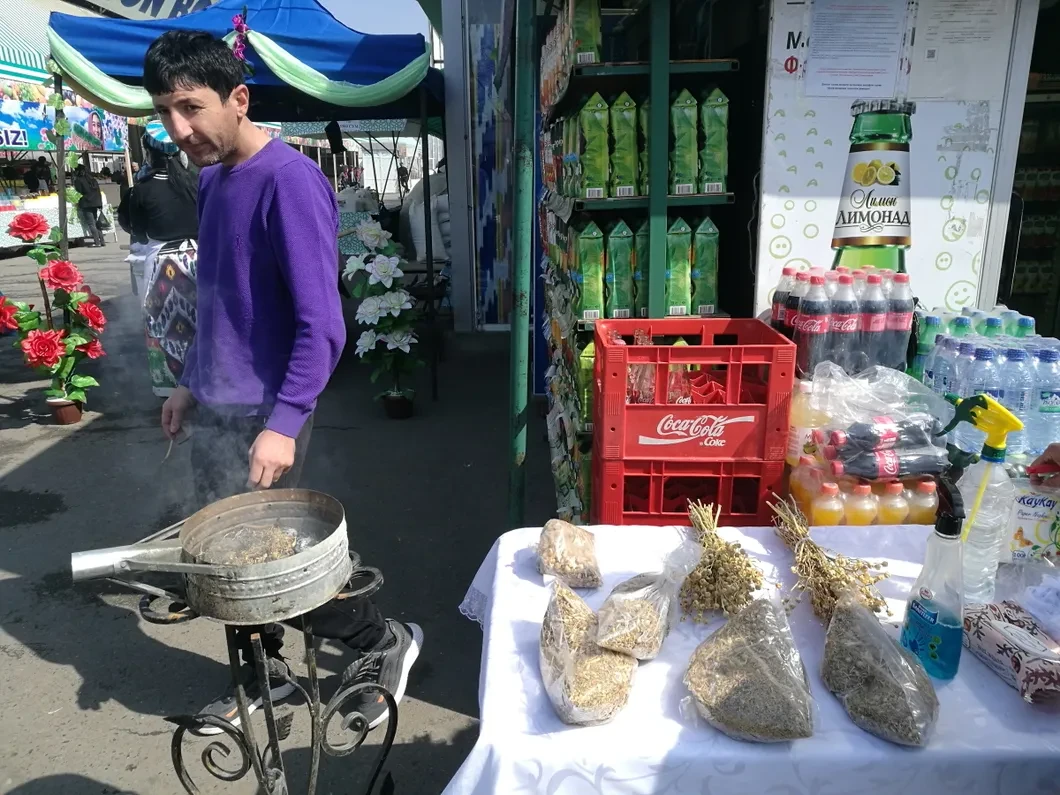
Starting from mid -March, on the Tashkent bazaars, the Isryk bundle bundle in tin fringes or right on the floor near the counter, and the sellers are suitable for a couple of seconds to immerse their heads into sweet, caustic smoke. In banks, government agencies and police branches, premises are fumigated for them, many housewives burn him at home, and not in every pharmacy to get him.
“There is no left. Generally, ”the pharmacist dilshod Karimov mints. - "It helps!"
Isryk has become the subject of first necessity - and part of charity distributions.
In the Samarkand region, the local philanthropist distributed 50 tons of flour - and 15,000 Isryk packages, and in the foothorn town of Angren Tashkent region on the eve of Novruz, the Persian New Year, at the entrance to the bazaur was handed Isryk and food bags.
But some Uzbeks dismiss the healing forces of Isryk and believe in their religious or national invulnerability.
“This is a quanel ,” Bakhtiyar, a strong black -bearded resident of Tashkent with a white scum, is sure, which issues a “namazhon” in it reading the prayer, “
“Allah sent him, Muslims do not die from him. Did you hear at least one Muslim to die in China? "
“We are the strongest,” the former history teacher Shhrat Alimov is convinced. “All epidemics passed through our Silk Road, we have the best immunity.”
The local conditions - namely the coming heat - are attributed to an early deliverance from the epidemic.
“Coronavirus will not linger in us,” the professor Khun.uz. quotes a researcher at the Institute of Virology, Professor Khun.uz.
- “He will pass. If we tolerate 10 days, then after the air temperature reaches 25-30 degrees, the virus will have no chance. ”
Mansur Mirovalev, especially for the "new",
Tashkent