
Translated material
Heavy
Cycle " Disaster Medicine "
Heavy.
A study of how many patients with coronavirus can save Russian medicine
Project team, 30 March 2020
The official number of Russians infected with coronavirus is still small. But if European and American statistics apply to Russia, it turns out that with any scenario of the development of the epidemic, the load on the resuscitation department of Russian hospitals will exceed their power.
As we thought
- The article contains the results of constructing theoretical models of development of the coronavirus epidemic that are not forecasts. The models do not take into account transport relations between the regions of Russia and the difference in population density in the country.
Model parameters:
A. The beginning of the epidemic is March 2, 2020, when the first sick in Moscow was revealed.
B. entry infected into Russia - according to the calculations of the “project”, 32 people. per day. According to Rospotrebnadzor, out of 1036 infected, starting from the first identified patient, on March 2, and on March 27, 80% brought the virus from abroad).
B. The population of Russia is 146.7 million people, according to Rosstat.
G. starting on March 30 (the closure of the borders of Russia according to the government of the government of March 28 ), the entry of infected are accepted for 1 person per day.
D. Epidemiological parameters - a model of Basel University.
To assess the number of Ivl devices in the regions of Russia, information was used by regional administrations located in the regional media.
Data on the population of Russia by regions are taken on January 1, 2019 from data sets posted in EMISS (Fedstsat.ru).
To assess the prospects for filling the hospital capacities in the further development of the coronavirus epidemic, information was used about the number of beds by regions of Russia for 2018, posted in the collection "Healthcare in Russia 2019" by Rosstat.
The share of filled hospital beds was estimated taking into account the statistics of coronavirus incidence and hospitalization of such patients in the United States: 20% of coronavirus can be needed and up to 5% of the sick need intensive care, including resuscitation .
The models described in the text do not take into account the possible improvement of medical technologies for the treatment of patients with coronavirus infection. For example, on March 27, the former Minister of Health of Russia, and now the head of the Federal Biological Agency of Veronika Skvortsova said that the FMM has developed a device that allows the use of one IVL apparatus “for two or four patients”, and that the agency can “produce up to 200 thousand of these devices per month”. The introduction of such a device seems doubtful - earlier all leading medical organizations, for example, the United States categorically opposed this practice. On March 28, the Federation of anesthesiologists and resuscitators of Russia also acted “categorically against”, since such a device cannot provide each patient with ventilation with the parameters necessary, can harm some of the patients on one apparatus and puts the doctors “under attack in the legal sense”. Therefore, such a scenario is not taken into account in the calculations of the “project”.
How many Russians can get covid-19
As of March 30, Russia was at the beginning of the fourth dozen countries of the world in terms of the number of coronavirus - 1836 people. A little compared to the leaders, but the number of cases starting on March 16 grows with a similar pace, according to the analysis of the “project” based on the data of Rospotrebnadzor and the World Health Organization (WHO).
The dynamics of the spread of the virus in Russia is comparable to other countries
The increase in weeks
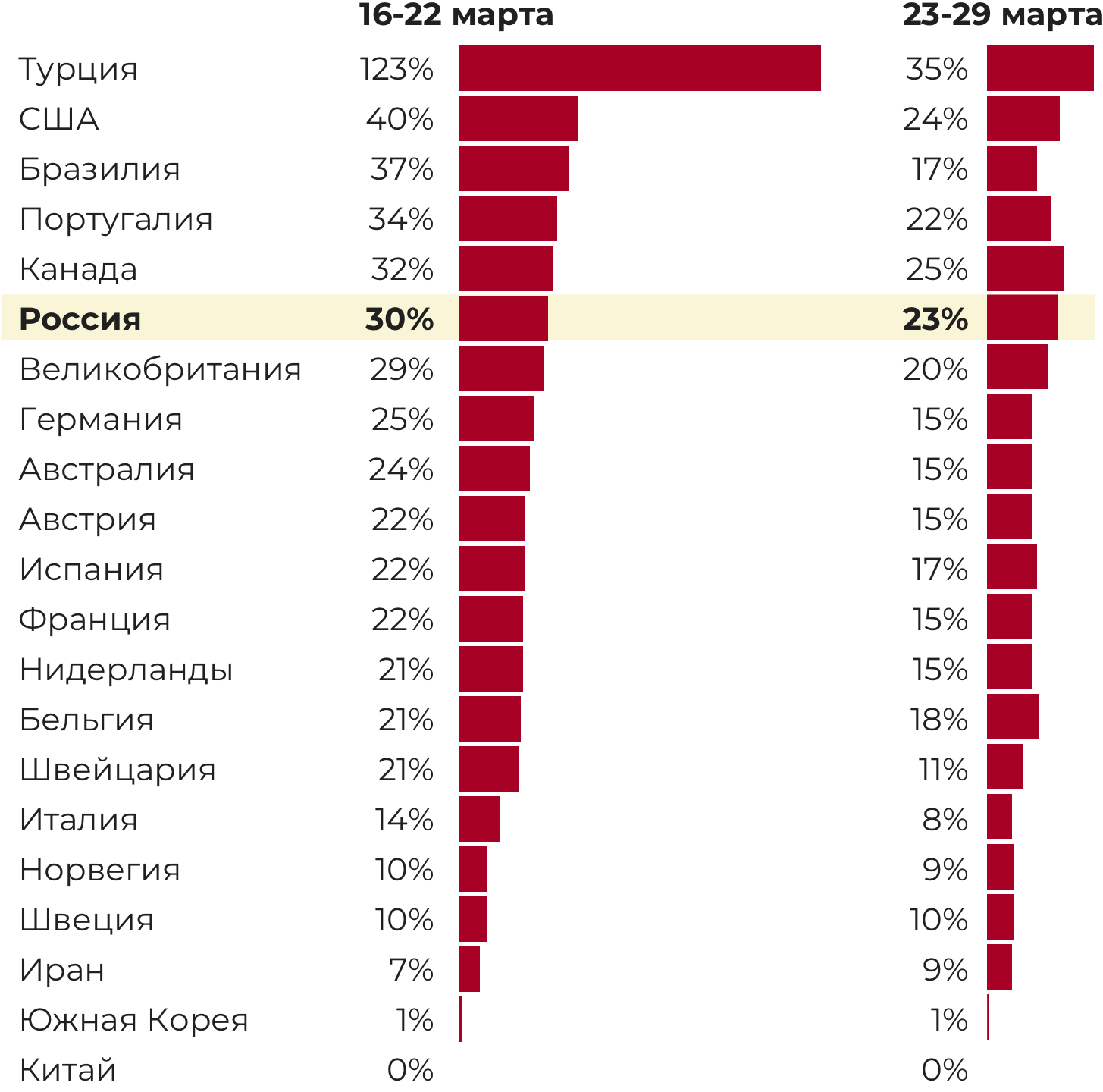
Source: Database of the Information about the Covid-19 University of Jones Hopkins
Why is there so few sick in Russia? One of the explanations is a small influx infected from abroad, lower than in Europe, the mobility of the population, says the professor of the department of differential equations and management theory and the Department of Technical Cybernetics of the Samara University, the author of mathematical models in biological systems Elena Shchepakina. Another explanation is the shortcomings of the infected ones: the Ministry of Health recommended that the doctors make a cadial -reir of a test only if a patient with symptoms of a respiratory disease arrived from other countries where there are already patients, or was “in close contact” with already ill.
It is too early to build accurate forecasts of incidence growth. “There are very effective models of the spread of viral and infectious diseases, tested on tuberculosis, HIV, Ebola virus. But the duration of the coronavirus epidemic is still too small to clarify the model and to determine the numerical values of its parameters, ”says Elena Shchepakina, a professor, the author of mathematical models of biological systems.
Nevertheless, today there are dozens of forecasts for the COVID-19, based on the basic model of the spread of diseases (SIR), the changes of three groups within the population are calculated: susceptible to infection, infected and “eliminated”-recovered either dead, and its modifications of Seiir, which takes into account the incubation period.
Russia fits, for example, in models with simulators open to the public, developed by the professor of the Institute of Clinical Epidemiology and Applied Biometry University of Tubingen University , Martin Eichner and the Research Group Richard Necher from the University of Basel, despite the relatively small number of those who are also taken into account, for example, the population density of the country is not taken into account. Both models are applicable to Russia, since their conclusions correspond to the current indicators of the epidemic in our country. In particular, with the level of limiting contacts by 20%, the reduction of passenger traffic by 10-30%, depending on the type of transport, was informed on March 20 by the Department of Transport of Moscow, the Necher model demonstrates today's indicators of the epidemic in Russia, the Eicherner model says that there should be 2.5 thousand people.
Upon maintaining this level of restriction, the number of cases in Russia could reach 1 million people by mid -June. However, since March 30, the situation should change: in Moscow, which accounts for 66% of the sick in Russia, unofficial quarantine has been introduced. It is still impossible to evaluate exactly how much it will reduce the contacts, but, apparently, by at least 60%, the city hall of the city announced such a reduction in passenger traffic in the Moscow metro after March 28.
According to the Model of the University of Basel, with this scenario, the number of ills will remain at a level of less than 10 thousand people. But as soon as the quarantine is again softened to 20% of the contact restrictions, the incidence will begin to grow again. If, for example, weaken quarantine in two months, then in September the level of the same million patients will be reached.
According to coronavirus statistics in the USA - US Department of Health and Human Services/Centers for Disease Control and Prevention, 20% need to be hospitalized and 5% of the diseases need intense therapy, including the use of artificial ventilation devices (Ivl). For Russia, if it is based on the models of Eichner and the University of Basel, if it had not been introduced by hard quarantine, this would mean the need for intensive care for 50 thousand patients in June. With harsh quarantine for two months and subsequent softening to 20%restriction of contacts-in the fall.
What are the resources of Russian hospitals and how much are they enough for different scenarios of the development of the situation?
How Russian hospitals are equipped in comparison with the global level
The organization of economic cooperation and development (OECD) conducts statistics on the state of healthcare systems in 36 member countries of this organization and some countries cooperating with it, including Russia). In the OECD data, Russia ranks third in terms of the number of beds per capita: only Japan and South Korea are ahead. They have 13.1 and 12.3 beds per 1 thousand people, respectively, in Russia - 8.1, in the fourth and fifth places of Germany - 8, and Austria - 7.4, according to the OECD for 2017.
However, in the case of Russia, beds are in the literal sense of the word bed. In terms of equipment - for example, devices for KT and MRI - Russia in 28th place with a dramatic margin from leaders: 14 CT devices per 1 million people in Russia and 111 in Japan, according to data for 2018; 5 MRI installations for 1 million people in Russia and 55 in Japan.
The number of seats in the intensive care units and equipment in them does not lead the OECD, as well as Rosstat, who collects this data from hospitals, but does not publish. However, it is these places that should provide treatment with the most severe patients with coronavirus - those who experience respiratory failure and need artificial ventilation of the lungs. How many such patients are Russian hospitals ready to accept?
Whether Russian hospitals are equipped with intensive careers
In total, in Russian hospitals 1 million 172 thousand beds, according to Rosstat for 2018. These include resuscitation. They mean beds equipped with a set of equipment for resuscitation and intensive care, including IVL devices.
In Russia, there is a norm regarding the number of such hospital places. According to the order of the Ministry of Health of Russia from 2012 - “On the approval of the procedure for the provision of medical care to the adult population according to the profile“ Anesthesiology and resuscitation ”, the number of intensive careers should be at least 3% in medium -sized hospitals (only 200 - 400 beds), at least 5% in large ones (with a total of more than 400), and at least six beds in hospitals less than 200 beds. Thus, the number of resuscitation beds should be at least 3% of the total bed fund is at least 35 thousand in the country's scale.
In practice, there are much less. For example, the Institute of Physiopulmonology and Infectious Diseases of the Ministry of Health estimated their number of only 12 thousand - three times less than normal.
The number of intensive care beds in Russia is three times less than normal
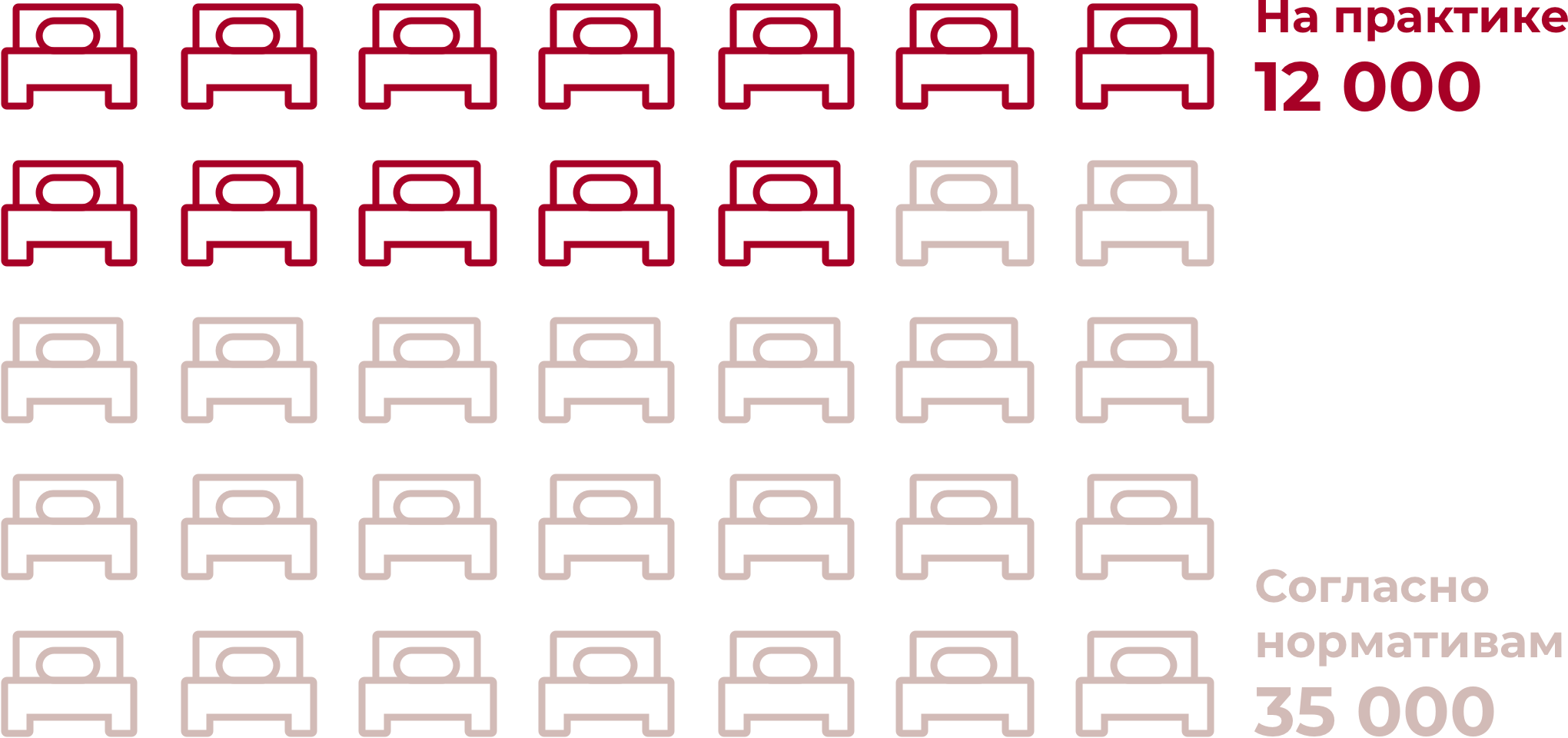
Source: Rosstat, Institute of Physiopulmonology and Infectious Diseases of the Ministry of Health
The project managed to find data on the number of resuscitation beds in 23 regions. Published in collections about the state of health of the population or in orders on the distribution of bed fund for hospitals issued by regional Ministry of Health. Data for Chechnya and the Bryansk region for 2015 and 2016, for other regions-for 2017-2019. Only Moscow reached the standard of 3% 2.5 thousand resuscitation beds by 78.3 thousand, Kalmykia, Altai and Komi. The remaining regions are significantly lower than the standard. In the Kaluga region of resuscitation beds - in general, only 0.5% of the total.
Amazingly, the authorities are well aware of the lack of resuscitation in the country. In 2018, Roszdravnadzor declared a lack of intensive care beds during the peak of the incidence of SARS and influenza. And in 2013, the government of St. Petersburg issued a very eloquent order with the following words:
“The departments of anesthesiology and resuscitation is hospitalized by 4.0-4.5% of patients from the number of entering the institution, which is 3-4 times less than in other countries of the world. At the same time, at least 20-30% of the medical and preventive institutions in emergency and urgent indications are in a threatening state of state and need to use intensive care and resuscitation measures. Legal mortality in sudden hospitals reaches 50%. 53-57% of patients from among the dying are dying outside the ORT-intensive care and intensive care unit, without proper intensive care. Almost all patients who are on IVL for more than 2-3 days develop nosocomial pneumonia or severe sepsis. The issues of preoperative preparation and maintenance of patients in the nearest postoperative period have not been optimally resolved in any hospital working in the ambulance system. The possibilities of anesthesiological support in most medical facilities do not meet modern requirements. The bed fund, organizational forms, the standard structure of the OIT, their material and technical support do not meet the requirements of the order of the Ministry of Health and Social Development of 13.04.2011 N315n “On approval of the procedure for the provision of anesthetic and resuscitation assistance to an adult”.
From the "Health Development Program for St. Petersburg until 2020"
The total number of beds in the hospitals of St. Petersburg has only been reduced since then-by 9%. Data of the collection "Health in Russia 2019" by Rosstat.
This did not prevent the governor of St. Petersburg Alexander Beglov in mid -March to say that the city was “ready for the peak of pandemia” - a quote for Kommersant.
How many are actually Ivl devices in Russia and are they good
There should be more individual ventilation devices in hospitals than resuscitation beds. The same order of the Ministry of Health from 2012 determines the standard of equipment of intensive care units by IVL devices and other equipment. For each resuscitation ward of six beds, seven stationary IVLs are relied on, two transport - to move patients around the hospital. The standard also includes equipping with manual “Ivl apparatuses” - these are pumps that imitate the breath “mouth in the mouth” when providing first aid - there should be three pieces per six beds.
Thus, the number of Ivl devices in the region should be at least 1.5 times more than the number of resuscitation beds. With the norm of the Ministry of Health for resuscitation beds - at least 3% of the total number of beds - this means that in Russian hospitals there should be more than 52 thousand devices.
Official statistics on the number of Ivl do not exist. The federal authorities with the beginning of the epidemic conducted their own calculations: Deputy Prime Minister Tatyana Golikova said that in Russia 40 thousand IVL devices. This is 3.4% of the total number of beds in Russia, and more than 12 thousand devices are not enough before the norms of the Ministry of Health. This is a total deficit of 23%, but in some regions it is much larger.
Starting from the end of February, at meetings dedicated to coronavirus, the authorities of the regions began to report the results of the calculation of capacities. It turned out that in practice only in units of regions, the number of IL devices exceeds 4.5% of the total number of beds: in Moscow, Khanty -Mansi Autonomous Okrug, Samara, Penza, Kalmykia, the Amur Region; Close to this level in St. Petersburg, Karelia, Tatarstan, Kirov, Ulyanovsk region. In all the rest, the deficiency is up to two -time or more. In the Krasnodar Territory, for example, with this calculation there are more than 800 devices, in Bashkiria - more than 380, in the Belgorod region - more than 240.
Areas with the largest deficiency of Ivl devices
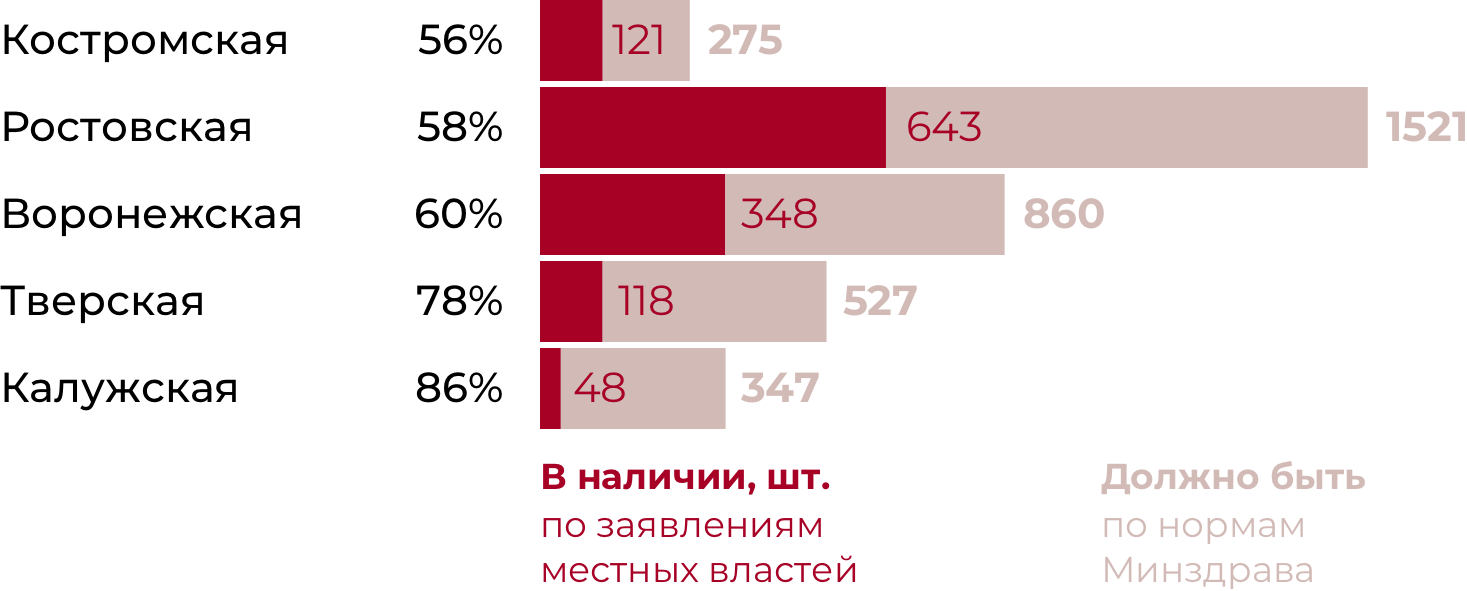
Source: Rosstat, information of regions about the number of Ivl apparatuses
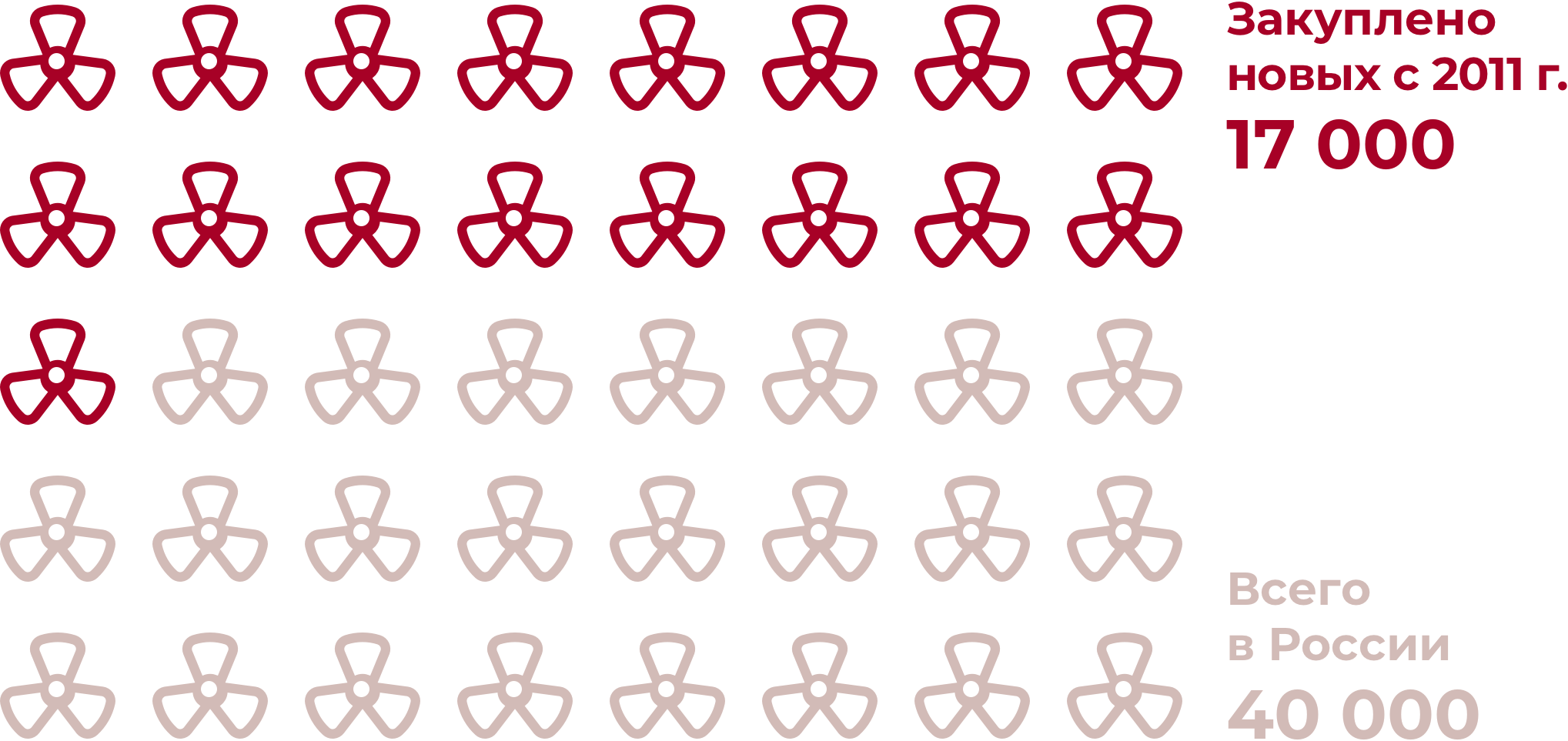
Is it possible to be sure that all devices falling into statistics are in working condition? Since 2011, almost 17 thousand devices were purchased in Russia by the publication of public procurement contracts, according to the results of the analysis of the “project” of these contracts on the website of the Accending.gov.ru accounting chamber, this is 42% of the total IVL Park in the country. Accordingly, the remaining devices for more than nine years. This is not the deadline for operation - it all depends on the model, but components can require more frequent replacement. For example, the oxygen sensor in the American model Puritan Bennett, which is common in Russia, is to replace once every two years. The general condition of the park is unknown, the President of the Federation of anesthesiologists and resuscitators of Russia Konstantin Lebedinsky told Project, regional Ministry of Health may know this.
58% of the devices of the filage for more than nine years
Source: Accounts Chamber
Thus, now in Russian hospitals one IVL device accounts for 30 patients, and more than half of these devices are quite old. With coronavirus, if you rely on American statistics, every fourth hospitalized is needed.
This means that as soon as in Russia the number of coronavirus patients will reach 800 thousand people, and the number of hospitalized - 160 thousand, the devices in hospitals will end.
What regions can not cope with the epidemic with different scenarios of the development of the situation
The number of 800 thousand cases is not fantasy. Most of the models proceed from the fact that the epidemic will develop until most of the population gets ill, according to the models of Eichner, the group of Basel University, the Imperial College of London and others. The load on the hospital depends on how long this process will stretch. The Institute of Public Health of Harvard University has developed an assessment of the load on hospitals depending on the number of those who have sick relative to the population and the period during which they will get sick. With all scenarios, most Russian regions have a chance to not cope with the epidemic.
With the rapid development of the epidemic - within three months with the capture of 20% of the population - in all regions of Russia, for which there is data on the amount of Ivl does not have enough IVL devices even for patients with coronavirus, not counting all other patients in need of them. 40% of all beds in all hospitals will be occupied by infected coronavirus.
If the epidemic will unfold within six months, then even with the most modest load of 20% of the sick adult population, patients with coronavirus will occupy an average fifth of all beds in Russian hospitals. In most regions, resuscitation facilities will be exhausted. Only in some regions - for example, the Samara, Penza, Amur regions, Khanty -Mansi Autonomous Okrug, Tyu - the existing IVL devices will be enough for everyone.
При заболеваемости в 40% взрослого населения в течение полугода ИВЛ не хватит во всех регионах, причем в большинстве на каждый аппарат будут претендовать двое-трое нуждающихся в нем больных.
Мы применили эту методику к регионам России со следующими параметрами:
— Оценивается нагрузка на больницы при заболеваемости коронавирусом 20%, 40% и 60% населения старше 19 лет (исходя из разбиения Росстатом жителей России на возрастные группы)
— 20% заболевших в возрасте от 20 до 64 лет и 30% заболевших в возрасте 65 лет и старше нуждаются в госпитализации (по статистике больных коронавирусом в США)
— 5% заболевших в возрасте от 20 до 64 лет и 8% заболевших в возрасте 65 лет и старше нуждаются в ИВЛ (по статистике больных коронавирусом в США)
Сценарии заполнения больниц в регионах России
Процент загруженности коек при разном количестве заболевших
При расчете учитывались параметры, рекомендованные российским больницам нагрузки на период пандемии гриппа 2019-2020 года: оборот койки — четыре пациента в месяц , согласно информации, обнаруженной «Проектом» в приказе Министерства здравоохранения Республики Башкортостан.
Источник: Росстат, сведения регионов о количестве аппаратов ИВЛ
Спасение ситуации поручено другу Владимира Путина
Расчет, приведенный «Проектом», уже знаком регионам: по тому же принципу (доля заболевших от населения, доля госпитализированных, потребность в ИВЛ исходя из числа госпитализированных) они считают нагрузку на больницы в периоды эпидемии гриппа. О том, что будут дополнительные закупки аппаратов, начиная с конца февраля стали заявлять администрации в ряде регионов. В Воронежской области, например, собрались купить 18 аппаратов, в Самарской — 16, в Карелии — пять.
Правительство выделило 7,5 млрд рублей на закупку 5,7 тыс. ИВЛ до конца 2020 года. Это поможет или уже помогло в первую очередь богатым регионам.
«Как главный анестезиолог-реаниматолог Москвы ответственно могу сказать, что у нас в Москве 2500 реанимационных коек, что парк анестезиологической и дыхательной аппаратуры — около 5 тыс. единиц, что Москва среагировала быстрее всех и выкупила все, что было на российском рынке», — заявил , например, главврач «коронавирусной» клиники в московской Коммунарке Денис Проценко.
Введение режима повышенной готовности освободило власти от обязанности проводить закупки на основе конкурса. 19 марта Минфин разрешил проводить все закупки «любых товаров, работ, услуг, требуемых в связи с введением режима повышенной готовности» у единственного поставщика. В случае с ИВЛ закупки разрешили проводить еще и со 100% предоплатой, хотя список товаров и услуг, за которые обычно по госконтрактам можно полностью платить авансом — закрытый, и ИВЛ туда не входят.
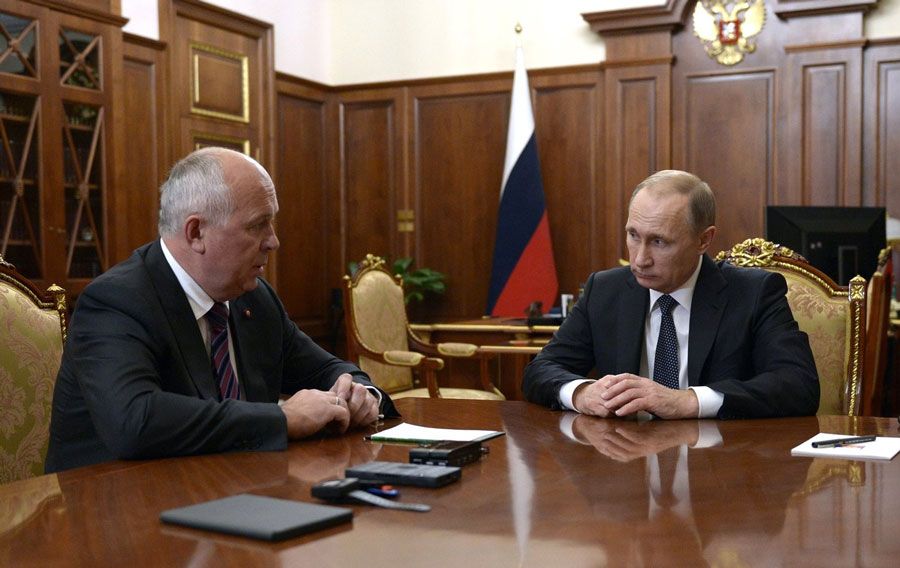
Уже 21 марта единственным поставщиком аппаратов ИВЛ и ЭКМО (экстракорпоральной мембранной оксигенации) был назначен «Ростех» — заказ получила «дочка» «Ростеха», Концерн «Радиоэлектронные технологии», госкорпорация во главе со старинным другом президента Сергеем Чемезовым. На максимально льготных условиях — без конкурсных процедур, без обеспечения, со 100% предоплатой, без гарантий по контракту . В контракте, который еще не подписан, будут предусмотрены гарантии по объемам, качеству и срокам поставки, сообщил «Проекту» «Ростех».
In the epicenter.
Podcast about how Russian doctors fight the coronavirus epidemic
Author - Sonya Groysmanredor - Elizaveta Surnatevazvukorezhiser - Alexei Zelensky Supervision - Anastasia Samokhina