
Translated material
"The mask will not protect from the algorithm." The developer of the Moscow system of smart cameras - about surveillance during quarantine
The pandemic gave the authorities the grounds for the full program to expand digital surveillance of citizens. On behalf of Mikhail Mishustin, the Ministry of Communications , on behalf of the quarantine violators, the geolocation of cell phones, and in Moscow, from day to day, a “smart control system” should earn with the use of hundreds of thousands of cameras working on the basis of the technology of the Russian company NTECHLAB. NTECHLAB co -founder Alexander Kabakov told The Bell as a system of smart chambers of the company installed in Moscow and other cities around the world will allow you to form black lists for the time of quarantine, to inform the authorities about the exit of people over 65 and fix the handshakes.
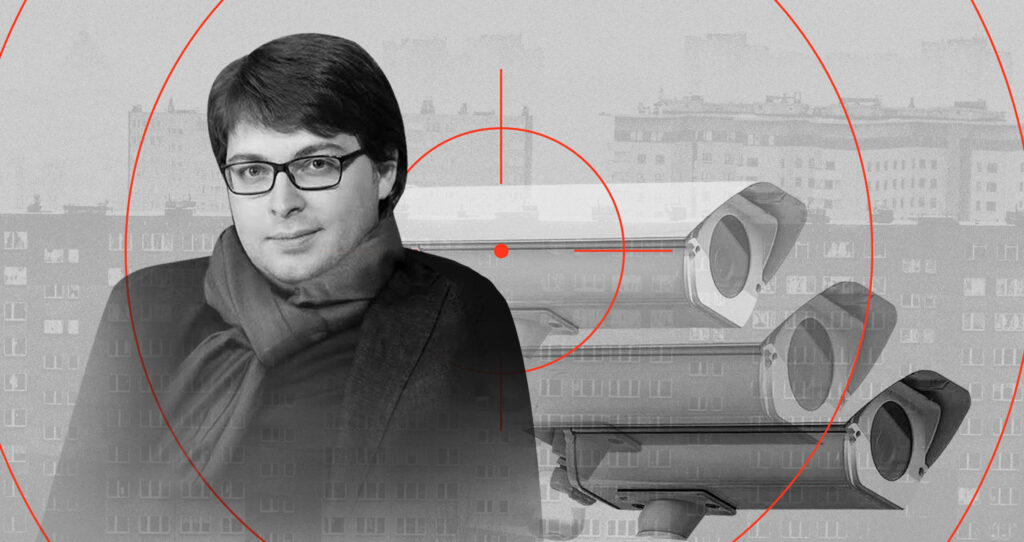
- From the first cases of the epidemic, the Moscow authorities began to identify patients who violated quarantine with the help of smart chambers. How does this work?
- How the FindFace technology works and what the city does with it is two different things. Our technology for recognizing faces allows you to create black lists for a time of quarantine and then track whether these people appear in front of the cameras. This is the basic thing that all smart cameras in Moscow can be able to be able to today, according to the city authorities, 105 thousand such cameras have been established in the city. - approx. The Bell].
Then this system can be configured differently. For example, it allows you to identify the age of people, and it can be configured in such a way that it sends the Alerta if a person over 65 leaves the house. There are other areas for work: for example, track contacts. If two people appear in the frame together and one of them was infected, then the virus could change further.
If you look at what was done in China, then there the facial recognition systems advanced further, they can determine people by silhouettes. That is, the technology allows you to watch where people go, even if the faces are not visible, look with whom they contacted, and determine if there are people on the street.
We now have some similar solutions, but they are not implemented - for example, a detector of actions that allows you to recognize quite a lot of different things that a person in the frame does, one of them is a handshake.
- Sergey Sobyanin said that the largest person recognition system is working in Moscow. How many smart cameras are there in the city and how many blind areas have many?
- The question is better to address, of course, to Moscow, and indeed, why talk about blind zones so that people violate self -isolation. Today, according to the fact that the city says, 105 thousand video surveillance cameras with person recognition are connected in Moscow. That is, in general, this system with a large coating - it exactly is covered by all houses, and this is more than half of the total number of all tracking cameras in Moscow.
- You talked about the recognition of silhouettes in China. After the start of the epidemic, they learned to recognize faces in medical masks there. Do you know how?
- Our algorithm is quite accurate and works well with the overlap. Its main task was originally determined by criminals. Therefore, glasses, mustache, beard and other things that are used for disguise, it recognizes well. It is clear that now people put on masks not because they are criminals, but because they resort to reasonable protection measures. But the algorithm still has high accuracy, and the chambers on which the system is now installed give a big probability that the face in the mask will be recognized. We already had stories when people in motorcycle helmets were recognized, so the mask is unlikely to work to protect against the algorithm.
- Do the time of day, weather and all sorts of other side factors affect recognition?
- In general, these are completely unlikely factors for the algorithm, the mask is a much more serious obstacle.
- In order for the system to recognize people, there must be a database with their photos and data. Where do they come from?
- Again, the question is not to us. We are a supplier of person recognition technology for the city, and we do not have access to internal processes and servers. We put software, and then the question to the Department of Information Technology (DIT) Moscow, how they use it. Where they get data and photos, we do not know. But we can assume that there are databases from the police, now they are actively collecting additional information, for example, Rospotrebnadzor and other bodies.
- In the system, which is now being built for the supervision of self -isolating Moscow, not only the tracking cameras, but also geodata from communication operators will be involved. How could this system theoretically work?
- Obviously, geodata from operators is a very powerful tool. The cameras are not everywhere, and without the operator date to track movements will be almost impossible. On the other hand, geodata has a problem: they determine the movements of the smartphone. But he is still not as personalized as the face. The phone can be turned off, you can take it from a friend, you can go outside without a phone. The face of the house will not work. Therefore, recognition of persons is still a key point. Operator data can be used for the bulk of the population, and persons recognition for malicious violators.
And one more important point: using a mobile date, it is more difficult to verify the contacts of people. Relatively speaking, how many mobile phones are determined in one entrance? Many. It turns out that if an infected person is found in geodan, almost everyone needs to be checked. But then you can just send everyone without the help of technology for testing. And the recognition of persons helps to determine with whom the infected was, where and with whom he went and who is more likely to be infected.
- That is, geodata - a mass measure, and the recognition of faces is point?
- I think that both technologies should be used massively. You do not know which person is a malicious quarantine violator. And you need to look after all the cameras to understand if a person goes and where he goes. Both technologies of each other complement and minimize the opportunity to violate quarantine and spread the virus further.
And the more technological capabilities, such as the same definition by silhouettes, the better. If this is repeated in the future, and we will have more analysts, then it will be possible to do more precisely the quarantine itself, send fewer people for isolation. And in the future, these measures should not be taken to close everyone to the houses, but, conversely, in order to limit as few people as possible in moving. Technologies will allow you to better identify infected and more precisely determine the circle of their contacts and potentially infected people. If you know exactly who is infected, then you do not need to isolate the whole area.
- That is, again, the classic choice between safety and privacy?
- The issue of privacy here probably has a place to be. But let's look at China and Europe: in China, a video analyst works in full, but in Italy this is not. We all see the results. A huge number of sick and dead, the inability to localize the spread of infection is such a result.
We already understand what is needed in order to respond more efficiently and faster to such things. For example, to create a video analytics complex and a system that allows you to clearly describe the circle where the person was, with whom he communicated and so on. And it’s not even about conscious violations - just people may not remember where they were and to whom they sting their hands, with whom they talked, which button they pressed. And technology allows you to track all this. And, if, for example, we understand that a person went into the entrance, we can understand who else went there in the next few hours. The virus in the air lasts three hours, on the surfaces - much longer. And we can build hypotheses and quite accurately determine who it would be worth checking.
China's experience shows that quarantine works. Therefore, for the future: the more precisely we will understand what the person did, the less there will be a chance to get a new pandemic.
- But there is a risk that this system, which very accurately determines who, what, when and where he did, and after quarantine will not leave us a chance of privacy?
- The question about privacy is generally meaningless. Smartphones are already collecting an extremely large number of data about you. And the only question here is that who has access to them. And in general, I don’t understand what is dangerous in if the cameras in the entrance will determine whether a person pressed the elevator button - is this a secret information that violates the right to privacy? I think no.