
Translated material
"Allegedly not the incident accident"

In the infectious and information tsunami, a message was almost lost about the unexpected breakthrough of the dam under construction, the Beloporozhsky hydroelectric power station on the Kem River, which was discovered on March 22 and photographed on the video. The leaders of the CSM construction company, requested by journalists, confirmed the fact of the accident - a spontaneous breakthrough of the dam of the dam, while the Nordhydro company - the customer of construction - confirmed that "we ourselves disassembled the unreliable plot of the Soviet dam to sort out." Despite such informational inconsistencies, an incident with an allegedly did not incur an accident was quickly furious, apparently, in order not to disturb the high patrons and international sponsors of this microscopic megaproject. Now the construction can be forced, despite quarantine, creating that significant risks for the population.
The cost of the entire budgetary part of the five-year "federal target program of socio-economic development of Karelia" is 9 billion rubles. That is, instead of investments in hospitals, repairing buildings, bridges, stadiums and roads, residents of the region, as part of electricity tariffs, will gradually pay for the construction of the “great international significance” facility, but completely microscopic benefits for the republic and country
The Beloporozhskaya Malaya hydroelectric power station is worthy of the title “The Greater Small Hydroelectric Power Station in Russia” (I hope you all remember the meme that “Soviet microcalcels are the largest in the world”). At the beginning of the century, the young company Nordhydro appeared in the north-west and took up the repair of old small hydroelectric power stations in Karelia-a case is incentive, useful to someone, but clearly not very monetary and not PR. They worked enthusiastically, commissioned half a dozen abandoned small stations in Karelia, went to other regions and even began design on the tributaries of the Lower Tunguska station for the needs of the Evenki villages. In general, they really tried to do something useful. But somewhere by 2015, in the fashionable topic of “renewable energy sources” (VIE) in Karelia they decided to participate in the new BRICS development bank, the Eurasian Bank of Development, the Russian Direct Investment Fund - the Chinese Investment Fund, the large Chinese company Sininoek and another half a dozen organizations with loud names and a craving for PR. And now, with the money of the Bank Brik, the subsidiary of Nordhydro -White Threshold, together with Karel Stroy Mechanization “The Fourth Year”, is completing the “Beloporozhskaya hydroelectric power station” on the Kem River in Soviet times. "The largest construction of Karelia", "The BRICS - breakthrough in the field of renewable reinforced concrete", "Solving the problem of energy deficit of Karelia" - the fanfares are trumpeted.
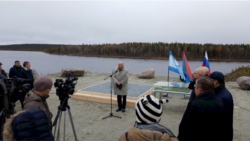
Are these "small hydroelectric power stations" are so progressive and fateful for the development of the North-West of Russia? If you drown out fanfares - what is the meaning of this construction?
To begin with, in the list of renewables supported by the state there are not one but two of the same small hydroelectric power stations of the same name: Beloporozhskaya hydroelectric power stations-1 and Beloporozhskaya hydroelectric power station with a capacity of 24.5 MW each. This is due to the fact that until February 2020, according to the rules adopted in Russia , “Malaya hydroelectric power stations” are considered in Russia and only stations with a capacity of up to 25 mW could receive increased payments guaranteed by the state. In many countries of the world, such restrictions are established to exclude the "large hydroelectric power stations" destructive for nature from "climatic" state support programs of renewable renewals. However, the statistics published recently Unido shows that in the case of avoiding greenhouse gas emissions, there is almost no sense from small hydroelectric power stations - they make up less than 3% of the installed power of the revenge built in the world and their share is rapidly falling. Therefore, in Russia, most of the state support once intended for small hydroelectric power stations was redistributed in favor of wind and solar stations.
Where did Nordhydro come from at once two such hydroelectric power stations? And this is a pure dexterity of the hands - two groups of generators installed on two parts of the same dams issued for two different “small hydroelectric power stations” and, contrary to the established rules, received guarantees of state support. Apparently, this innocent fraud was not interested in us alone, since one of the first affairs of the new government of Russia was the release of the Decree dated 03.02.2020 No. 76 The only meaning of which is the meaning of which is to insistence from deprivation of privileges this single small Beloporozhsky power station for 50 MW. If we take into account that the head of the Cemetine in the summer of 2019 was observed by the head of the Council of Security of Patrushev, then such a zeal of the government ceases to surprise. Surprising the price of the issue.
The station is small, but gold. If back in 2016, the Brix Bank estimated the cost of the project at 161 million dollars, then at the end of 2019 Russian officials counted one third more - 12 billion rubles. It is officially recognized that the most expensive in the country is the cost of creating “VIE” - 174 thousand rubles per kilowatts of the installed capacity, but with a simple division of the number of investments into power, you will see that the real price of kilowatts is 240,000 thousand rubles. With this money it was possible to build twice or three times more windmills or solar power plants.
But maybe the Beloporozhsky hydroelectric power station producing 230 million kilowatt hours a year is a solution to the energy problems of Karelia? Where there! In 2019, consumption in Karelia amounted to about 8 billion kilowatt hours and new hydroelectric power stations are able to close 3% of this need. In the same 2019, the united energy system of the North-West, supplying Karelia, worked with a surplus and produced 112 billion kilowatt hours. Accordingly, the new object will give this increase of 0.2%.
At the same time, the cost of the entire budgetary part of the five-year "federal target program of socio-economic development of Karelia" is 9 billion rubles. That is, instead of investments in hospitals, building repairs, bridges, stadiums and roads, residents of the region, as part of electricity tariffs, will gradually pay for the construction of the “enormous international significance” facility, but completely microscopic benefits for the republic and the country.
And what damage from the construction of these hydroelectric power stations we simply do not know. In past years, the Beloporozhskaya hydroelectric power station has repeatedly caused protests of the population and objections of specialists . Actually, therefore, then it was built only by 25%. In propaganda publications, a new project compared to its Soviet forerunners looks good: the Nordhydro specialists reduced the dam level and “saved” the historical village of Panozero from flooding. And for unfortunate fish, this dam will not change anything radically - both on top and downstream, the Kem River has long been blocked by other hydroelectric power stations. But I would like to see an official independent assessment of environmental impacts. The coalition of the river without borders entered into correspondence with the Brix Bank in search of materials from the environmental assessment of projects of the Beloporozh hydroelectric power station and the minutes of the hearings on it. But, despite the four -fold promises of "clarify everything" and did not receive anything. In the presentations of Nordhydro, such documents are not at all occurred. Apparently, the Bank Brix financed the facility that has not passed the environmental assessment of influences according to international standards, which, frankly, is drawn to the international scandal.
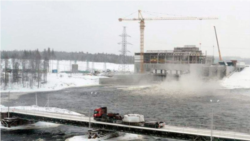
The construction, which according to the initial plan was supposed to end in 2018 chronically delayed. Meanwhile, for the breakdown of the company's terms, those who have concluded the “renewable power supply agreement” must pay considerable fines and they often seek objective reasons to avoid these fines ... And this unexpected “breakthrough of the dam” happened.
The part of the dam was damaged, which was built in the Soviet years, and its gradual washing workers allegedly observed for two weeks. (By the way, hello from the shores of Kemi of the company RusHydro and the governor of the Kemerovo region Tsivilev to the audience to finish the Soviet skeleton of the Krapivinsky hydroelectric complex on the Tom River. If the Soviet monster collapses, the city of Kemerovo is waiting for a cardinal architectural update). Fortunately, this accident is apparently small and, according to the authorities - valuable equipment has survived. But the incident will force to transfer to an even later term the start of the hydroelectric power station, to which they prominly promised to collect "finance ministers of all BRICS countries."
I really want to hope that they will not begin to force this propyed micro-building of the century, so that, despite the pandemic, to be in time for the 100th anniversary of Karelia. Throughout the world of construction site and other infrastructure in remote areas are now stopped. This is due to the fact that the staff working on a shift method is able to bring an infection to distant local settlements, where there are few opportunities to provide quick and qualified assistance in the event of a coronavirus outbreak. Meanwhile, judging by the reports, no one has yet stopped the construction of the GESNA Kemi. The Government of Karelia, despite the harsh measures to isolate citizens, kindly proposed to organizations of the construction, housing and communal and electric grid industry to substantiate the need to continue work during the introduced quarantine. " That is, it is likely that the "priority" construction will continue, increasing infectious risks. Interestingly, what do residents of Kemsky district think about this, to whom their new head Dmitry Petrov for several days forbade not only the trade in "extra goods" but also weddings, funerals and commemoration?
Evgeny Simonov - coordinator of the International Coalition "River without Borders"
The "Opinion" expressed in the heading of the point of view may not coincide with the position of the editorial office