
Translated material
"Demons of love climbed into me"
Interview with Slava Mogatin
In Russia, he is remembered as a writer and journalist, for the West Slava Mogutin, first of all, an artist, and he himself, judging by Instagram, defines himself as an “author and activist”. Who was Glory Mogutin who was and who became? The Gorky Quirrer-Reducer Konstantin Kropotkin met in Berlin and talked with one of the key characters in Russian counterulture in the early 1990s.  - Can I go to "you"? Firstly, because “glory”, and secondly, we are almost the same age.
- Yes, sure.
-If I call you a “gay writer”, or, in modern language, “Quirr-writer”, how will you react to this?
-At the time when I was engaged in literature and journalism in Russian, the main thing for me was to go beyond the scope of a certain context, subjectivity of any kind. I was published in the mainstream publications, and this was an attempt to step over the barriers of sexual minorities. My message has always been united by people, regardless of their sexuality, gender, religion.
-That is, you wanted to make gay literature part of the mainstream?
-At that time, there were no such concepts as “gay literature”, “gay culture”. In Russia there was an intellectual desert in terms of what I did. All my heroes, literary, journalistic, were very little published in Russia and were practically inaccessible to the mass reader.
At that time [the beginning of the 1990s-approx. KK] I worked in the publishing house "Verb." This is probably the first publishing house to publish books that can be attributed to the "gay literature."
The situation with the “Giovanni Room” James Baldwin was indicative. As far as I remember, several printing houses refused to print a novel because of his homosexuality. As a result, the “room” was printed in Riga. The circulation was colossal, they sold something about a million copies. It was an absolute bestseller.
- What do you have to do with the Russian translation of Baldwin's book?
- She came out with my preface. Several books in the “verb” were prepared by me as an editor. I wrote preface and comments.
My main project was two volumes of Yevgeny Kharitonov, which took almost two years. This book was published in Russia, and then was transferred to German, English. I was recently reprinted in Russian.
- Judging by those foreign authors whose publication you related to Russia are close to you. Am I right?
- Yes. I got acquainted with the work of Ginzberg, Burrose and Kerouac, when I just began to engage in journalism. But at the same time, I was very impressed by Jean and Georges Batay, French authors.
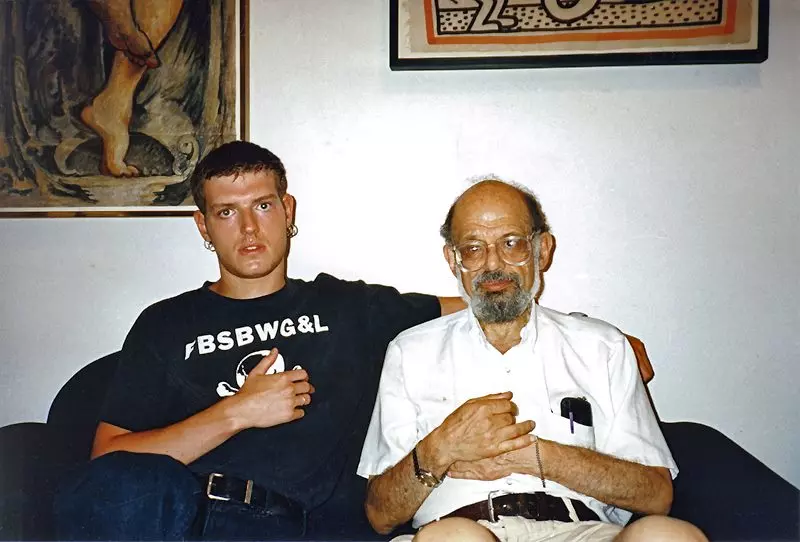 Glory Mogutin and Allen Ginzberg, 1995
- In my opinion, they are characterized by emphasized fixation on the "I", on the expression of personal will. Is it important to you?
- Yes, for me this is an important point. All my work is autobiographical until a certain point. When I began to write poetry and act as a poet, it was impossible to talk about homosexuality from a personal point of view. It was always “they”, in the third person. I was probably the first person [in Russia - approx. KK] , who, under his own name, published memoirs - fiction based on his own life. I think this was the main reason why such a reaction arose among the mass reader. It was amazing; I never thought that I would be published in the most interesting publications for me.
-As you yourself said, in the early 1990s you tried to introduce gay literature into a wide literary everyday life. Then translated authors began to appear, you wrote yourself. Why did not other gay writers (writers-open gays), equally strong in the voice, equally bright in terms of self-expression? Why did not tradition arise?
- I don't know. It is difficult for me to be objective. I do not follow either Russian literature or the Russian press. I have not been in Russia for fifteen years. All my ties with Russian literature are Kolonna Publishing House Dmitry Volchek and his own Mitin magazine. By the way, a selection of my new texts was published there recently, in Russian and English. These are poems. I still continue to write them.
I have not written in Russian for fifteen years, but the last two or three years I started again so as not to forget the language. Now I am preparing a bilingual book called "Youth of Satan." This, as always, is very autobiographical and very personally. One of my texts is called “BC love climbed into me” ( laughs ). This is a constant topic in my art, and in my verses, and in journalism.
- Which?
- The dialectic of love and hatred, religion and nihilism.
 - Your friendship with Eduard Limonov is legendary [Conversation with Mogatin took place a few days before Limonov’s death, he died on 17.03.2020 at the age of 77. - approx. KK] . Is it possible to say that you were at the origins of National Bolshevism?
- I have never been a member of the party, I did not have a party card.
- But he was sympathetic.
- I always treated Limonov as a romantic character. I am interested in his trajectory: from the representative of bohemia to the dissident, to the international playboy. For me, all these are the pages of the same book. I do not perceive it as a politician.
- For you, is this the evolution of a romantic hero?
- In some senses, the hero, in some - anti -Hero. I can’t say that Bolshevism is cute in one form or another. I'm not a politician. As an artist, you can achieve much more than when you go to the barricades and shout with Megafon.
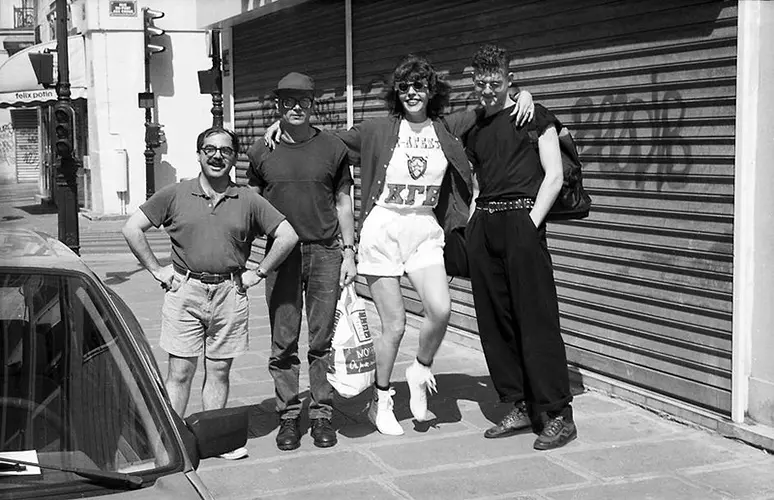 Eduard Limonov with Natalia Medvedeva, Yaroslav Mogatin and Mark Cohen, editor -in -chief L'yIot International
His poetry, his books is what is important to me. I will never criticize his political position, because everyone has the right to their own views. I always looked at him from aesthetic position.
- And what is related to you?
- At that time he was Panku. This is a person who has always been in opposition to the mainstream, to the system. This is very pretty to me. I consider myself an anarchist. I do not believe in politics or politicians.
- It doesn’t matter through which magnifiers to look, political or aesthetic, the National Bolsheviks is a curious formation. She is very literary. There was Limonov ...
- Dugin was, there was Letov.
- ... and the current figure is noticeable in Russian literature, Zakhar Prilepin, is also a former national bureaucrat. Where did they, in your opinion, come from this literary centricity?
“I think thanks to Limonov and his charisma.” Objectively speaking, in modern Russian culture there are very few characters that could be equal to it inpirility, in productivity. The main thing is that a person is not afraid to resist the system and can say things that others do not allow himself. It stood out even in the emigrant diaspora, the party is very conservative. What he wrote was revolutionary. He wrote in a language, which then practically did not exist.
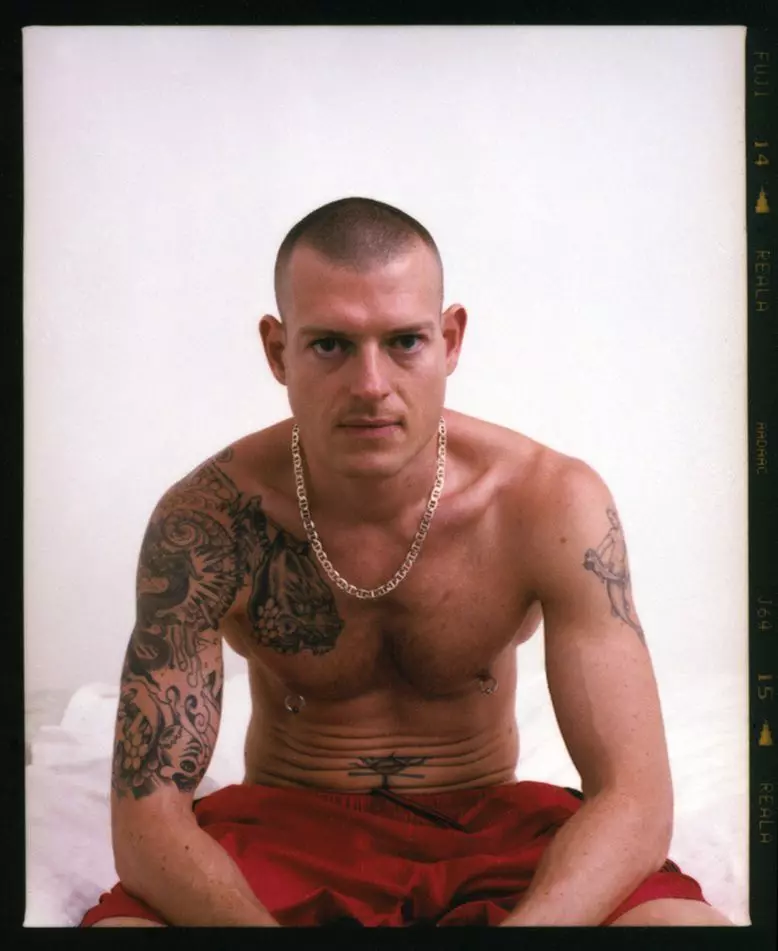 Glory Mogutin
- Inevitable question. The famous Gay Sex scene in the novel “Is I-Edichka”-a real or invented Limonov’s experience? What do you think?
-I asked him about this in several interviews, and he somehow went around it. I would not be very surprised if it were real experience, but at the same time I have no evidence for either for. In that, his main force as a writer: he could write something that many consider to be a shocking fact by this time. The power of the writer is that people remember the episode from his book.
-Is there any impoverishment of poetics that the complex author is reduced to only one gay-sex scene in New York forty years ago?
- This is a hypocrisy. This is the trend of Russian culture - to reduce everything to the marginal level. They did the same with me. I had an article "How I stole in Paris." And it was an Ommage to Jean to Zhenya. I stole in the places that he described. And this article is still given as evidence of my marginality. I wrote several dozen or even hundreds of articles before I left Russia, but they remember this very article and a couple of others. Remember the scandal. And no one remembers the good that I did.
 - Have you retained Russian citizenship?
- This is a very delicate question. I never registered at the Russian Consulate in New York. My passport is expired, but I did not refuse my Russian citizenship. The consulate in New York is complete ***. I think if I go to Russia ... By the way, I am negotiating about the exhibition in Moscow. I think this will be a small retrospective of the works that I have done over the past 15 years. I never sat in one place and did not spit in the ceiling.
-In the early 1990s in Russia, you proposed another, emphasized the personal perspective: I am gay, I love so, I think so. Then this was the contrast of all the outdated Soviet. Now the USSR is a long -standing past, but in this message, “I am gay, and this is also good”, the protest potential has still been preserved. In Russia, this is still a public challenge, but a couple of decades have already passed. Doesn't it surprise you?
- No, this does not surprise me, given the general political and cultural climate in Russia. I can say to myself that I am a pragmatic pessimist. I have no illusions about the change of regime in Russia, the change of those established mechanisms of the authorities that have developed over the past 25 years.
- Power power, but there seems to be the support of society.
- In all interviews, I say that Russia is not homophilic than other countries. All this is just a policy that is imposed on top. If you look at different totalitarian regimes at different times in different countries, you can see that homophobia has always been used as a tool for repression. Gays and lesbians have always been steamers of society.
When I tried to conclude the first Gay Brak in Russia [in 1994-approx. KK] , then in the West it was perceived with incredible enthusiasm, and in Russia, persecution was unleashed. I was called an "agent of Western special services, porn and drug business." Some absurd accusations.
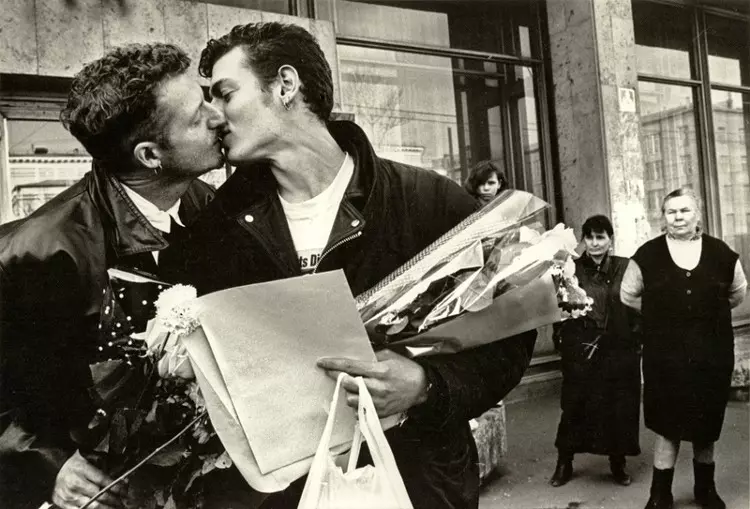 Glory Mogutin and artist Robert Filippini outside the Palace of Brace -On -Building No. 4, Moscow, April 12, 1994
- Why did you need this marriage? What did you want to say that?
- It was an action that was supposed to show the position of gays.
- Make gays visible?
- Absolutely. At that time there were no gays who would speak in the first person.
-The West, unlike Russia, has greatly changed gay emancipation over the past decades. Now Quir-people are more noticeable in the Western mainstream, including literary. Do you like such evolution?
- Any openness, any steps in terms of equality are good.
- Doesn't it seem to you that in the West to sympathize with gays it has become just commercially beneficial?
- This trend began with Stonevoll riots [1969 - approx. KK] , and last year it turned into something monstrous. I was ashamed to be gay.
- Why? Due to the excess of rainbow parades in the West due to the fifty anniversary of Stonewell?
“I do not feel like a part of the gay-Maynstream.” It seems to me that my task is to get out of this ghetto, and not to create barriers.
- Why barriers? Gays are visible, they arrange parades that everyone looks at, which they show on all channels. What way out do you offer? Where?
- This is due to the idea of sexuality. For example, in the Arab world there is no homosexuality, but you can *** with beautiful guys for money or for free simply because they have small access to the opposite sex. In Morocco, I had a wonderful experience with people who did not consider themselves gays, but at the same time practiced gay sex. And in Russia the same way. They do not want gay parades of Western format, but at the same time I had many experiments with guys who would never admit that they are gays.
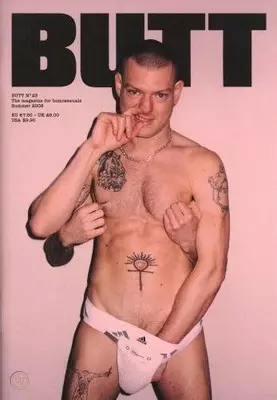 “Have you been to gay parades in the West?”
-I try to leave New York during the Pride.
“But did you go to them before?”
- As a photographer of course. In the first years in New York, it was important to me. It was an unprecedented experience that I wanted to document. My journalism ended in Russian, but continues in photography. Most of my works can be called photojournalism.
-Would you now go to the gay parade in Russia, where is such an action still part of the protest against the establishment?
-I think that being an artist is more important than wearing some political posters. What I am doing now as an artist and an English -language journalist are always connected with the desire to jump over cultural barriers. I think that gay parades turned into a cliche that I am not interested in either aesthetic or from a political point of view. This is related to the consumerism. I do not think that this is related to rights, to ideas.
- But in Russia still has.
-I can say that I am still gay activist, but what I do in art is much more important. This is the possibility of dialogue with people of absolutely opposite views.
 - As far as I know, you call yourself a patriot of Russia.
- Yes, especially when you see all this Russophobia in the press, especially in America about Russian intervention in the elections. My friends who have known me for 25 years, ask how I actually feel about it. I always answer that I am proud, that I am from Russia, and I am unpleasant to see how my country is doused with mud about some unproven things.
I do not hide my views. If I had not been an American citizen, then I would not have the right to criticize the country that gave me political asylum. But I had such an opportunity after I became a citizen in 2011.
- Why did you become them?
- By that time I had lived in America for more than ten years.
- Was it just more convenient?
- Absolutely. Before that I had constant problems with visas.
- In Russian sources, two reasons for your departure from Russia in 1995 are given. The accusation of inciting interethnic growth in connection with an article about Chechnya is one reason. Another reason is an interview with Boris Moiseev about Komsomol gays and the charges of the distribution of pornography with him.
- I was accused of hooliganism. This is the same article on which Pussy Riot was convicted.
- On what basis did the American authorities provide asylum? Driven gay?
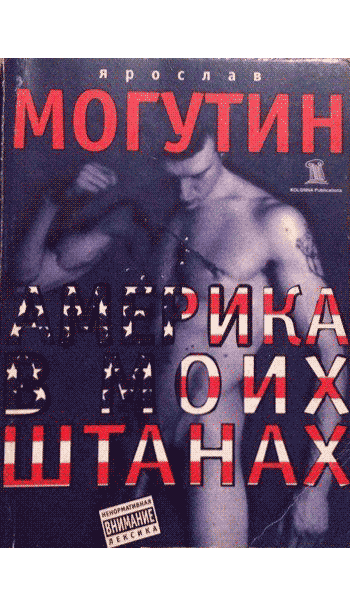 - persecuted gay and persecuted journalist. Several international organizations made my defense. My folder with documents for political shelter was more than 600 pages that had to be collected, translated, notarized. At that time, Yeltsin and Clinton were best friends. Russia was considered a democratic country and the United States did not accept Russian refugees. Thanks to my business, later, especially in recent years, many gays from Russia have received asylum. I even helped someone, because I myself remember how I felt after moving. I was a complete outcast, an outsider. It is monstrous, which is now happening in Russia with gay laws.
“Nevertheless, you want to go there.”
- That is why it is important for me to go there. For me, this is more important than participating in gay parades.
“Do you want to come and say“ I am gay ”?
- I do not need to talk about it specially, because I never hid it. Everyone knows this.
- Yes, but an open gay, for which homosexuality is an important topic, can come to Russia, and it will only be asked about the “beautiful”, “high” - about art, and “dirty” words like “homosexuality” will not take into their mouths. Are you ready for public conversations of this kind?
- Of course, if people ask me such questions, then I will not refuse. But, I think, it will be a waste of mine and their time.
- You said that, being in the USA, you wanted to survive what was not available to you in Russia. What did you participate in porn as a creative unit?
- For me it was a moment of liberation - both bodily and spiritual. Liberation from prejudices and stereotypes. I always had complexes imposed by my parents. My father, when he was drunk, told his friends: “My daughter is a beauty, but the fool and my son are smart, but the freak.”
- Has porn helped you?
- Yes. I wrote in detail about this in my verses.
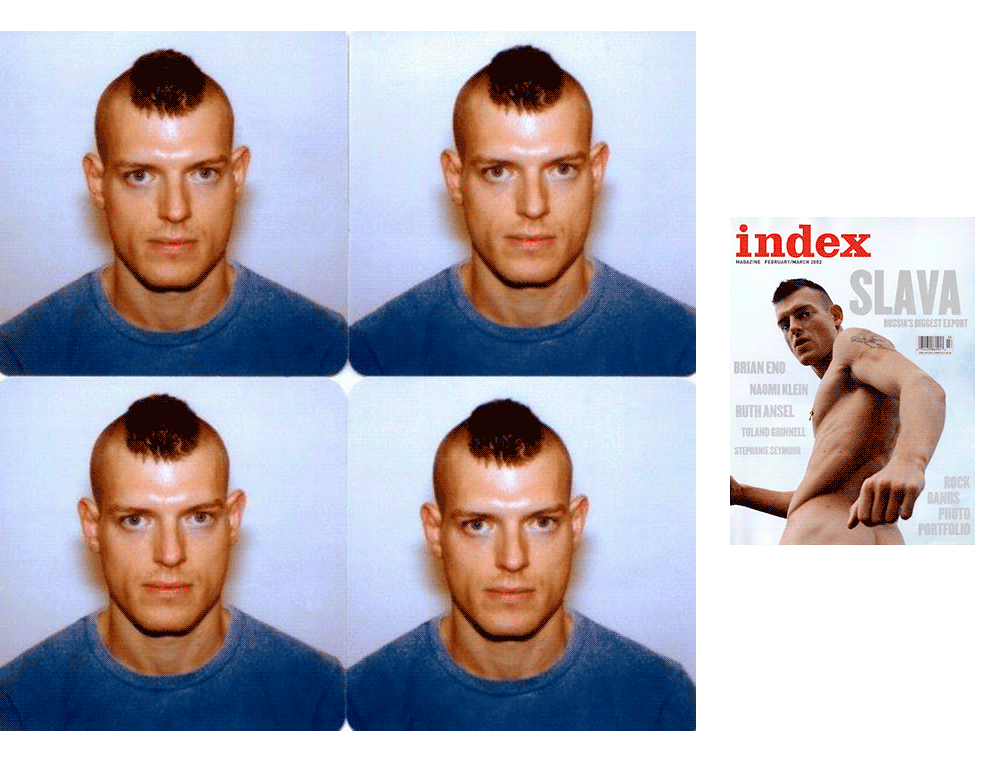 I was an absolute exhibitionist. For me, this was a question not of money or glory, but a question of personal satisfaction. I arrived in New York when I was 21 years old, and was photographed for ten years naked. This was part of my art education. It was something that could not be expected from me as a gay activist and a dissident-lawyer.
-Now it is more or less obvious that sex is a policy. This follows the conclusion that porn is a policy. Do you agree? Porn can be a policy?
- Absolutely. Especially now. There is a marginalization of human nature and sexuality. In the press, sexophobia is imposed in social networks. “We have no sex on Instagram” ( laughs ).
- Judging by your Instagram, according to your last exhibition in Berlin, a naked male body, homosexuality is your main interest. Is there a conscious restriction in this? The world is more than the world of men.
- I spent most of my life in homosexual relations, but I had a relationship with girls, women, and in Russia, and in America. Now, by the way, I have a heartrend. For the past nine months we have been living together [ She is a transgender man. - approx. KK ]. The last book that I published in America is called Bros and Brosethines, “Brothers and ...”. How will the female version of the "brother" be?
- Don't know. "Brazuha"?
- ( laughs ) you can call the exhibition in Moscow and call it. There are many women. This is a book that is based on my journal filming in recent years. There are transsexuals.
When it comes to some stereotypes, cliches, a gay cliche, homophobic cliches-this is still cliche. Gay parades is a cliche. My task is to tell my art about some marginal things universally, using a language accessible to everyone. This is what I have been doing for the past 25 years when I left Russia.
Recently, in an interview, I was asked what I achieved after leaving. Я ответил, что имел много разных опытов, я их не только прожил, но записал, задокументировал как поэт, как художник, как журналист. В отличие от моей поэзии, фотографии не нуждаются в переводе. Я много ездил по миру со своими работами. Это было бы невозможно, если бы я остался в России и по-прежнему писал по-русски.