
Translated material
+300% in alcohol, -30% in clothes: how quarantine affected electronic trading
It would seem that hard quarantine is an ideal time for e-commerce. At the request of The Bell, RetailCRM, serving 2.5 thousand online stores with a total revenue of more than 100 billion rubles a year, studied the sales of its customers. Conclusions are disappointing. Here is what the co -founder of RetailCRM says Dmitry Borozdin.

As thought and what happened
The vast majority of RetailCRM customers are small and medium -sized businesses. There is a bignyak (for example, “Your House”, Re: Store and “Refrigerator.ru”), but we decided not to include it in the study. In total, we studied more than 600 online stores, taking as a basis their impersonal data. In February, their total revenue amounted to 7 billion rubles.
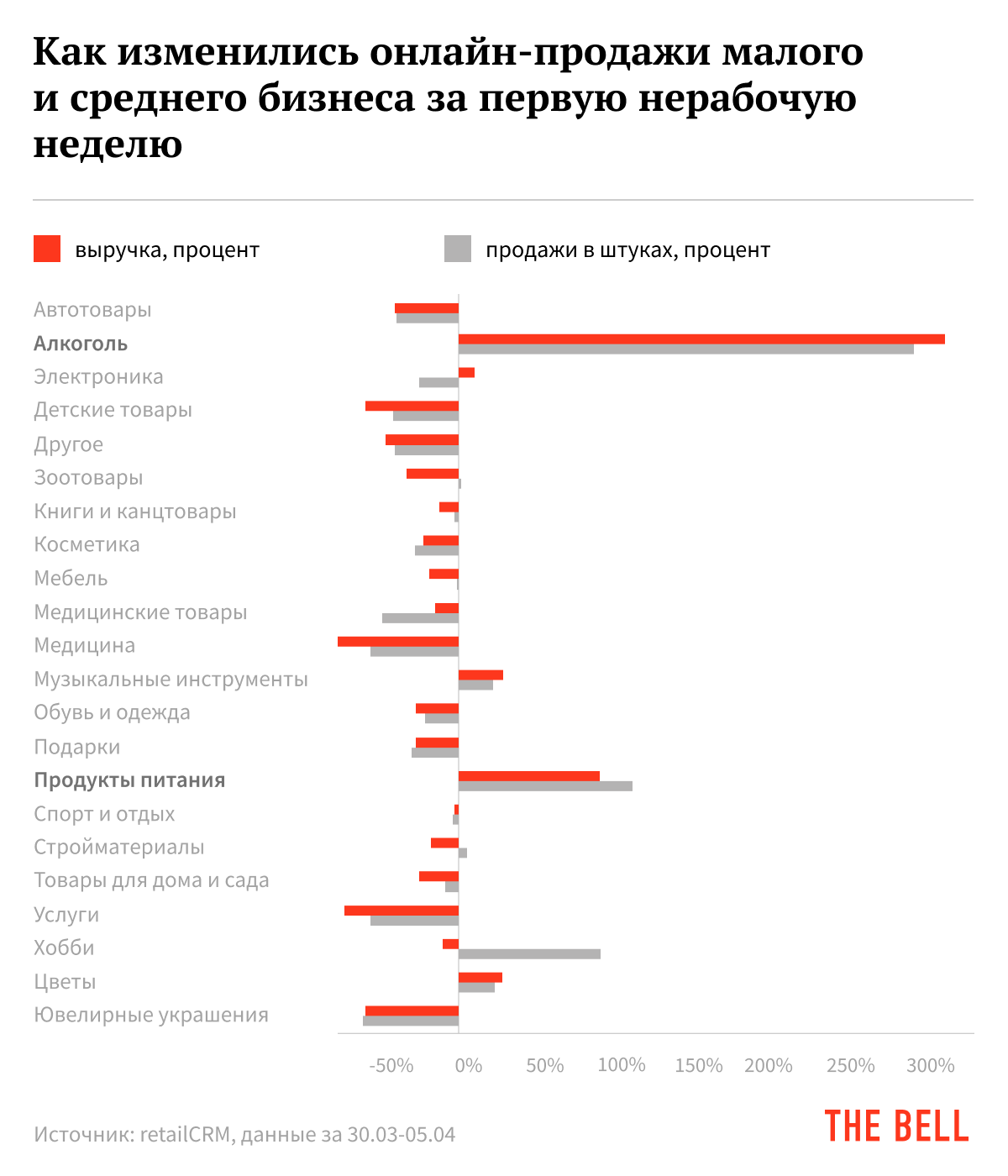
The graph below shows sales deviations in the first week of quarantine from the pre -crisis level. As a zero week, we chose the first week of February, then we took the data in ten weeks (from the first February to the first April for 2019) to take into account the seasonality in different niches. Then they calculated the coefficients and made a model with the forecast: what could be the first week of April in 2020 in an ideal world that does not know the coronavirus. The last pre-crisis week was taken for the forecast base-on March 9, the movement began due to the collapse of the ruble.
The main thing about e-commerce on quarantine
As you can see, many sank. Car goods - by 40%, jewelry - by 60%, services - by 70%.
The main beneficiaries are alcohol sellers. They increased sales by 316%. This is interesting - given that it is formally impossible to sell alcohol online in Russia. But most companies do this legally: use the Click & Collect model. The buyer does not make the purchase online, but only reserves the goods, for which he must come to the store, where the purchase will actually be.
Of course, food has grown - by almost 100%.
An interesting situation with flowers. Having self -speaking, people continue to celebrate the holidays. Ordinary flower shops are almost inaccessible, and on the Internet you can easily order a bouquet. Online sales grew by almost 30%.
The hobby segment has grown among orders - by almost 100%. But in money, he fell by 9.2%. Obviously, demand switched to cheaper goods. No one will buy an ATV right now. Another thing is board games.
In fact, the growth record holder is now not alcohol, but information products: courses, lectures, etc. They have grown by more than 400%. But we did not include them in the table, since we do not have a lot of such customers.
Quarantine business: how to save your business in a crisis
On April 14, Bellclub will hold another online meeting dedicated to new economic realities. This time we will talk with entrepreneurs about how to survive quarantine and economic crisis.
Our guests:
- Anastasia Tatulova, founder of the Anderson family cafe network
- Boris Dyakonov, co -founder of the bank for entrepreneurs "Point" and the Accounting Service "Button"
- Mikhail Tokovinin, founder of AmoCRM
- Alexey Fedorov, managing partner of the 220 Volt group of companies, head of the CCP electronic trading committee
Time: April 14 at 19:00. Registration is here .
What problems is solved by business
The worst of all is now a classic network unproductive retailers. Even if they have a good e-commerce, all the same, sales revenue online is on average no more than 10%. The more outlets, the harder the situation. One of our largest customers complains of an avalanche -like decrease in revenue. We have to fight for survival, although the company has annual revenue - more than $ 1 billion. Or see how Sportmaster shakes.
Read also the largest retail network "Sportmaster" in Russia temporarily closes stores
Small business is simpler, but also hard. In my opinion, it is important for small and medium -sized companies to start using social networks more actively. You can sell not only through Instagram. VKontakte and Facebook also have tools. It is necessary to be mastered in messengers.
A simple example: a small workshop at the house, which makes copies of keys and repairs clothes. How can she digest? Get a request from the client on social networks or in WhatsApp, send a courier, pick up a thing, repair, return it back.
Where to get couriers? Most of our customers work with SDEK. But there are many options. Until the fact that now taxi services are adding delivery service, this is a very cool case. At one time, we connected RE for our client Re: Store Gett delivery: you could get a new iPhone model two hours after the purchase. Then it was For Fun, now - an urgent thing.
Another example: in my area in Moscow there is a Dobryninsky products store. After the introduction of quarantine, announcements appeared on the doors of the entrances soon: “Delivery of products to the house”. Even if the store does not have a normal customer base, this is not a reason to give up.
The main thing is that now you need to understand: when the pandemic has just begun, the demand for primary necessity like buckwheat and toilet paper has sharply increased. But the longer a person sits at home, the more he wants to diversify his consumption. This is a chance.
Many now ran to marketplaces, there are already huge lines for connection: managers do not have time to process all applications. I want to say about this trend separately.
- marketplaces - solution or problem?
Markets are sold to small and medium -sized businesses as a magic tablet: come - and all your problems will be resolved. It sounds beautiful, but does not work for everyone. For online stores with their audience, with their niche, marketplaces can be a dangerous trap.
Our customers in Western Europe suffer from Amazon. They come to us with pain: “Help, our online store has 70–80% of sales through Amazon. He stands very expensive for us and twists his hands. " In Russia, Wildberries acts as Amazon. He forces the stores connected to him to hold unprofitable promotions for them. In fact, business has to be traded in minus. If one channel gives you 70–80% of sales, consider that your business no longer belongs to you.
There is another danger - in addition to imposed discounts. Imagine that you have found a unique product and sell it well through the marketplace. After some time, the marketplace bigdat will notice that the goods are popular. And the marketplace will begin to sell the same thing on its own, and even with a lower price. At the same time, your product in the issuance, of course, will stand below. And all, goodbye.
However, I do not want to say that marketplaces are an absolute evil. If you are a manufacturer, if you have your own brand, of course you need to go there. A good example is Blue Sleep mattresses. They are not so scary for them - they have a recognizable brand. But the rest is better to be more attentive.
What will happen to the business after quarantine
Amazing things are happening now. We have offices in four cities of Russia. Colleagues from the regional branches tell how they are already able to write off in messengers and agree to buy with businesses who previously offered to call the phone or come to the office. Rutinization of online purchases occurs. Yes, through pain, but still now everyone comes to models that will continue to be replicated and move progress.
Of course, many small and medium -sized companies will not survive this crisis. Those who survive will wipe. Many of the businessmen will turn into self -employed: there are no employees, there is work - already not bad. Unfortunately, there are very little chance that other small businesses will come to the vacant places after the crisis. Most likely, the share of marketplaces will grow. There will be less competition.