Date
Author
Евгения Мурина; Евгения Иванова; Сергей Маркелов; Полина Ефимова
Source

Preserved copy
Translated material
"The confusion will be long." How to study on quarantine without the Internet
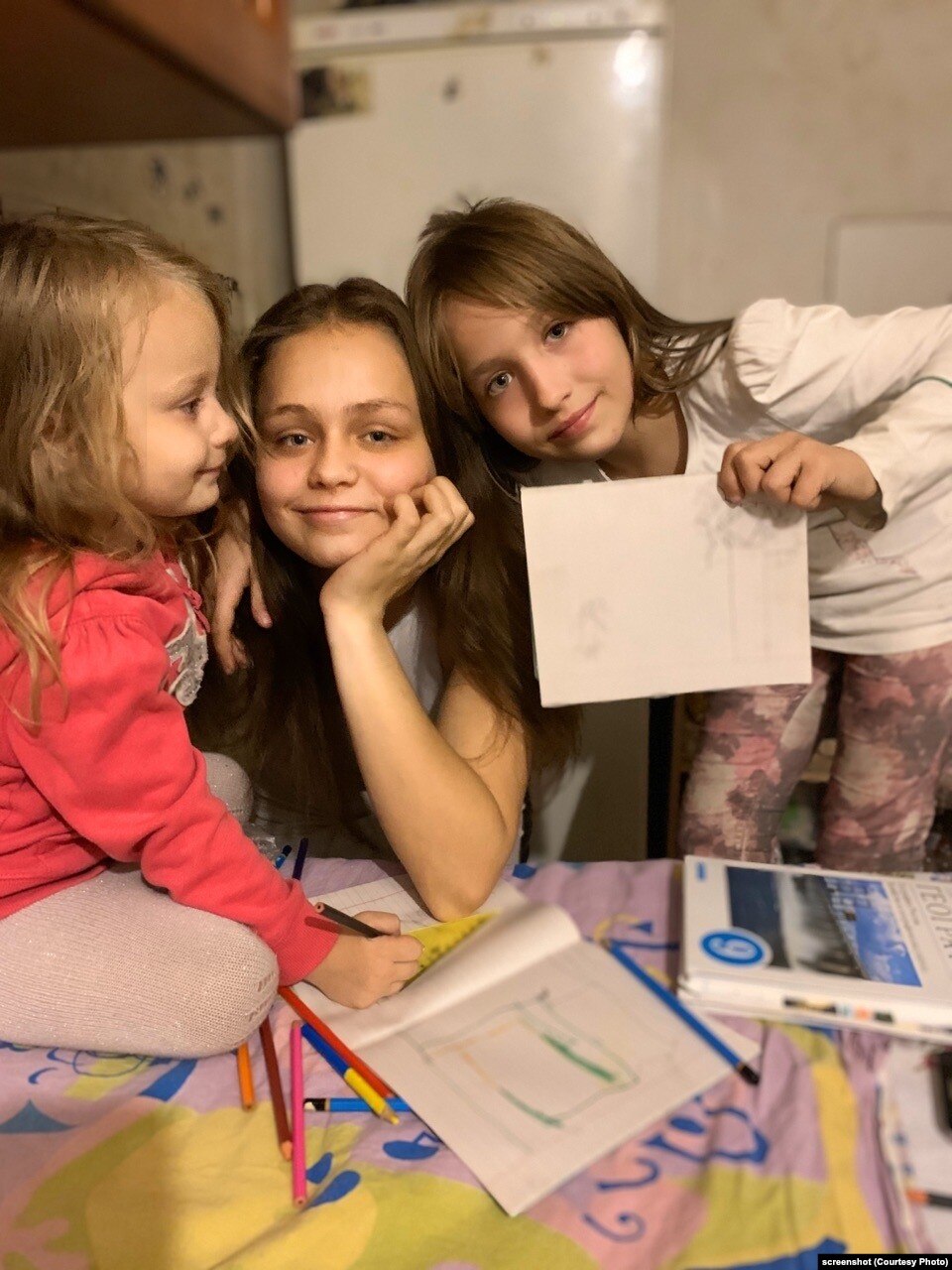
Russian schools in connection with the Pandemia of Coronavirus switched to distance learning. Educational platforms do not withstand the load, there are no computers in families, and in remote villages - the Internet and mobile communications, the correspondents of the Sever. Realiy found out.
Karelia: "Leave the notebooks in the store"
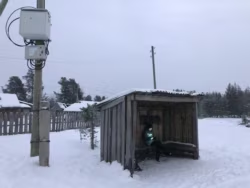
The village of Panozero in the north of Karelia is cut off by a wide river with a ferry crossing that does not work in the off -season. In the center of the village of Bakery, two stores, a rail hangs next to the store, into which they hit in a fire. In the morning, "in bread days", a hunched grandmother with sleds goes to the store - it is, of course, for bread. Here, to the store, now children bring homework. They will not be able to study by video communication: there is no connection in the panozer at all, a booth with the only Wi-Fi-blessing in the village is located next to the school.
-We now have a class teacher or one of the teachers comes to the house of each child, they just came on the weekend and gave a task for each subject for ten days, even in physical education. They said that if something is not clear, call teachers to home. Notebooks with completed tasks were told to leave in the store. It is not clear how this will happen further, ”says Irina Boltromyuk, the head of the Panozersky post office.
Tasks need to take pictures and send photos to teachers
Residents of another distant Karelian village of Nyukha fought a year ago against the optimization of schools in their village. They defended school. The holidays in children due to quarantine began on March 19, during the period of self-isolation, children in Nyuhch were offered to study at home on their own-teachers now exchange homework with children by e-mail or through social networks. The daughter of Svetlana Popova, the first "house" received through "VKontakte" on April 6.
- We do not have one that the teacher was told through Skype, there is no technical equipment for this. The daughter is studying herself, I check. They said, if something is not clear, to write in VK or call. Tasks need to take pictures and send photos to teachers, says Svetlana.
In mathematics of her daughter, the teacher sent a video tutorial. According to the music, the girl needs to learn Oleg Gazmanov’s song “Immortal Regiment” - the teacher attached a video clip to the song to the task. Assignment of visual arts: to draw a drawing for the song of Gazmanov or to the 75th anniversary of the Victory in the Great Patriotic War.
In some Karelian villages, distance learning began long before quarantine - for technical reasons. For example, in Suoecks, the school was closed in 2018: “A teacher sends tasks through e -mail, because they have the Internet only through phones, there is no wifa,” says Anna Vlasova , the older sister of the schoolgirl.
In the village of Simonov-Navolok, back in February, it simply collapsed a suspended bridge through which the children went to school.
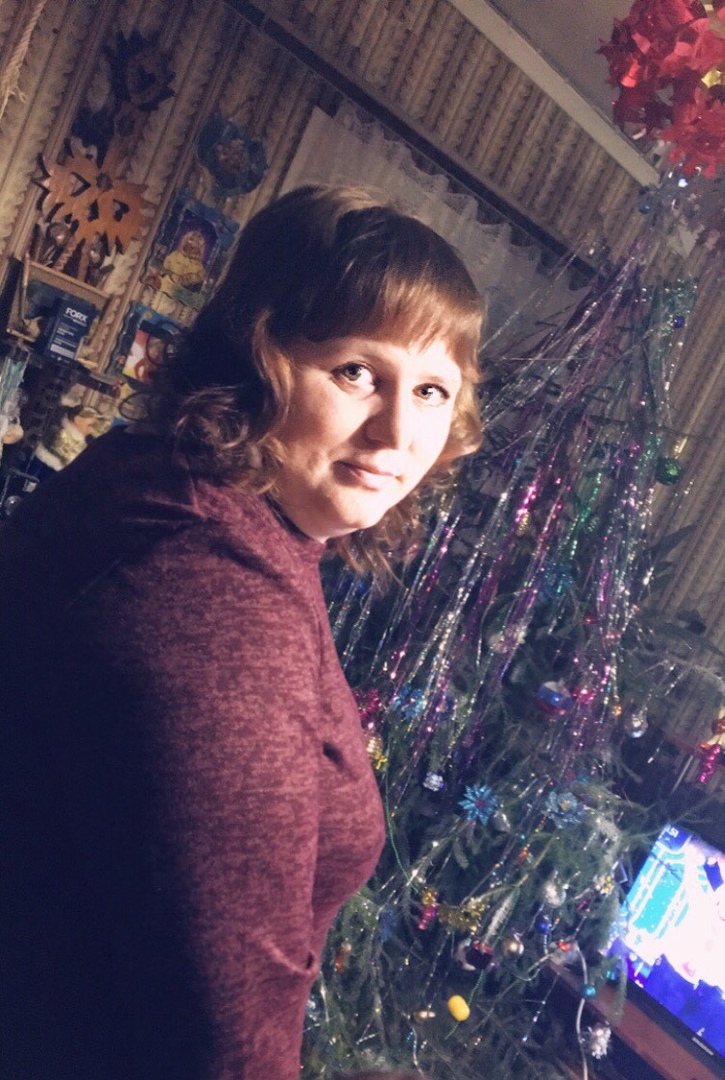
“When they announced the coronavirus and everyone began to do lessons at home, we were already prepared,” says Svetlana Zinkueva , the mother of three daughters, two of whom are schoolgirls. - Now teachers on the phone are sending girls to the girls with SSMESSKS, and through social networks they give tasks. Although they say that this is distance learning, I think the teacher should include a computer and see a student, and this is an SMS learning. But we do not always have the Internet, often there is no connection in the village.
Kaliningrad: "Today we have not dined - we do not have time"
In the Kaliningrad region, about 20% of children do not have access to the Internet - in remote villages, as well as in coastal and border cities. According to the Minister of Education Svetlana Trosenova, the tasks will be organized for such children: "In the old fashioned way, tasks are given on the leaves. But it is not very clear how to be with a feedback."
To understand how and when I should do lessons, it took me a lot of time
There is an Internet in the regional center, but even there, they did not really hoped to go to distance learning. In fact, in a week it was necessary to master the new technique of teaching children. At the same time, a preliminary understanding of how the system will work only on Sunday evening and only among teachers.
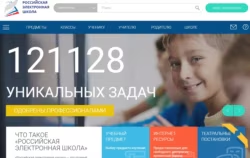
Children on Monday morning had neither a schedule, no objects, nor tasks. The teachers on the holidays were invited to compose remote tasks, and where to attach them, they left them at their discretion. As a result, students of the same class in various subjects work on different Internet sites: in the Electronic Journal, Foxford, Yaclass, school digital program, Sberbank, Russian Electronic School.
“In principle, you can understand all this, of course,” says the seven -grader Veronika Tsareva . - But only to understand how and when I should do lessons, it took me a lot of time. I can’t imagine what the young men are like: if the parents are at work, then they will never figure out anything.
In fact, there was no study on Monday. The sites collapsed, the teachers could not reach the online conference, the lessons were broken.
- We have a mathematician aged. She just does not know how to do it. As a result, he just writes to us tasks. How do I study the new topic on my own? I had had problems with mathematics before that, now it’s generally a complete zero, ”Veronica is worried.
Send me photos of their scribbles
Teachers also did not get used to the end in the new system. The Russian language teacher Natalia Drozdova asks children to send answers in the Word document. And parents against - children will be lost in the skill of writing.
- I say that nothing terrible will happen, because how will I check the photographed sheet? What, I still have to master the photo editor in order to make notes? - Drozdova argues. - Some families, in principle, have no computer. Do not purchase as unnecessary, enough phones. No one knew that this could happen. And so, they send me photos of their scribbles. Someone will photograph well, but someone is lubricated, as it is specially. Maybe the camera is not very. Well, what should I do about it?
The load on first -graders is even higher than on high school students, and it falls on the shoulders of the parents.
- I myself work on the remote, until the second child grows up. I need a computer, but I never could pick it up. My work stopped completely, I was left without earnings, ”says Larisa Fursa , mother of first -grader Sofia. - My memory is already clogged on my phone, because we should shoot and send teachers on the video. Including physical education. And we have two more additional mugs: modeling and singing. And here is the process of creating the Filimonovsky toy, we must also shoot the quilting of "do-re-mi". My wiber is torn, I do not have time to read messages.
Gemini Sophia and Daria Terza study in the same class. They had one computer at home, and it turned out that the lesson had to be divided in half: each studied not 40, but 20 minutes. “We did not have time,” says Sofya. Parents had to buy an additional computer. And since the shops are closed, this has become a real problem, Daria adds: "Parents went for 120 km to buy a computer with hands."
All teachers work on different platforms, besides, I have six students. I'm hanging
Valentina Poroshina is the mother of ten children. Of these are six schoolchildren. The youngest is a first grader, the eldest is a graduate. Because of the pandemic, all children are now sitting at home. For study in a two -room apartment, one room and kitchen are allocated. In the second room, the smallest are watching cartoons.
Two gadgets for the whole family. The priority was given to two six -graders: "They still have the most difficult program." According to Poroshina, in two days her already difficult life has become more complicated to the limit.
- For example, today we did not have lunch. I just don't have time. We have a closed courtyard, so in the evening I kicked out the children out into the street so that at least something could be done around the house, ”says Poroshina. She is very grateful to the eldest daughter, who began to help with her first -grader, but it really cannot be divided into one computer. - This is a nightmare, of course. I get confused in all these passwords and logins. All teachers work on different platforms, besides, I have six students. I'm hanging.
Vologda: "Everything is smooth in words"
In the Vologda region, children have been sitting home from March 18, including on vacation from 23 to 29 on March. On the eve of the transition to distance learning, parental chats covered panic.
- We have three children (grade 2, 5, 7), one, how should they share it (and there is no money to buy others)? Yes, and the Internet is only mobile, and even it constantly hangs. We are both at work, to come and help our children be able to study. How can they independently figure it out and most importantly - self -organize at home, without adults, in a two -room small -sized apartment? - They write in one of the groups of the city of the Great Ustyug.
Judging by the comments, many parents faced such problems.
“Everything is smooth in words, but in fact nothing is thought out,” comments on a resident of Veliky Ustyug Irina Shepelina Announcement of the head of the Department of the Vologda Oblast on the transfer of children to distance learning.
There are many families where there is not even a computer
Svetlana, the mother of three children from the Great Ustyug, says that officials are not interested in the conditions in which children were:
- It seems to me that they do not care. There are many families where there is not even a computer, and no one wonders how they will study. I have three children, everyone needs the Internet for classes, ”said Svetlana to the North. Reali website.
- But what about teachers who understand that many students do not have the opportunity to study remotely, but cannot help? The soul is torn, - the technology teacher Lyudmila Kabakova is upset.
The residents of the Great Ustyug District were asked to be patience and promised that those who do not have the Internet would be reported by phone. Parents are in response to be interested in what this remote education is then: "In your opinion, is this normal?"
Parents and children were told that training would be organized through the Foxford website, but in the Vologda region it constantly “hung” - apparently, the portal was not designed for such a load. In the best case, schoolchildren simply receive tasks in electronic diaries.
Arkhangelsk: "Teachers are blocked"
In the Arkhangelsk region, the authorities transferred all responsibility for organizing the educational process to schools.
Teachers in VKontakte began to be blocked due to the large number of messages sent to them
“We are sending recommendations for transition to distance learning forms to schools, on the basis of which a regulatory framework is created in schools, an algorithm for transition to distance learning is created. Through electronic journals, electronic textbooks, we recommend using electronic educational resources, most of which are free,” said the Minister of Education of the Arkhangelsk Region Oleg Polukhin.
However, these recommendations of the school cannot fulfill. Educational platforms do not withstand the loads - both the Russian Electronic School recommended by the Ministry of Education, and the rest.
- "Diary.ru" collapsed. The subject teachers send homework with attached files and links (if any). We send homework to teachers in personal messages through the VKontakte social network or by e-mail because VKontakte teachers began to be blocked due to the large number of messages sent to them, ”says Nelly Druzhinin from Arkhangelsk, whose child is in the fifth grade.
- We use Diary.ru at school, but it often freezes. "Jacques.ru" - unfortunately, a paid resource, but the platform is good, children like it. At the moment, social networks are very helpful, because the connection is very bad, ”said Galina Rusakova , teacher of the Yasnenskaya secondary school No. 7 of the Pinezhsky district. - The school day is both the teacher and the child lasts almost the whole day. The load is very large. But we do not lose heart, try, support each other. It helps a lot that we live in a small village, at school 250 students, we know all each other. So far, everything seems to work.
We transmit training materials for these children through a social teacher
In the village of Uemsky, Primorsky district of the Arkhangelsk region, more than half of high school students cannot be engaged in remotely.
“500 people are studying at our school, of which 200 primary school students have the Internet, the rest of the guys have a problem with electronic education,” says Ilya Tyurin , director of the Uemskaya secondary school. - In elementary school, we have now organized two experimental classes that are trained by the zoom. The educational platform "Diary.ru", which involves laying out tasks, cannot be used - it is faulty for two days. Teachers have to duplicate tasks: they call parents on the phone personally or put out tasks in groups. Then teachers receive confirmation from parents that the child received a task and is engaged. There is not enough equipment. It is also difficult with those students who have no access to electronic resources at all. We pass training materials for these guys through a social teacher who goes to their home, since parents sometimes do not get in touch.
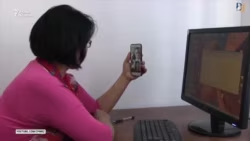
Assessments of the effectiveness of distance learning are diametrically vary, and there is little time at a distance at a distance. On the one hand, this is convenient, on the other hand, infrastructure and technical problems that are not resolved at the level of regions and individual families.
"What to do to children and teachers if there is no Internet in the village (or the Internet is very weak), but study remotely?" - says Tatyana Galasheva , teacher of the Yasnenskaya secondary school No. 7 of the Pinezhsky district. “Oh, just to report ... But in reality, as in the old days, there is a list of homework,” said Galina Severnyuk , a resident of Arkhangelsk.
Others admit that to be able to study online in the 21st century is already a necessity: “Probably, we are simply afraid of something new, and the children, it seems to me, is not all, but very many will figure it out. Of course, this scares parents,” Julia Butorina wrote in the “Online Vologda” group.
- And we tried today, and we liked it. Interesting, convenient. And in elementary school, volumes are not so large as to make a tragedy out of this. But the likelihood of hanging sites due to overload is strained, ”Elena Pronicheva shares the experience of Vologzhanka.
Remote education gradually developed in Russia and before quarantine-parents transferred children to online schools voluntarily and in the hope of the best result. Problems with the mass transition from offline to online Director General "Diary.ru" Gabriel Levy explains the attempt to reproduce the usual learning processes without any adaptation:
- As an example, some schools require children to send them videos of completed tasks in physical education or poems learned by heart. Others - try to lead all lessons on Skype or Zum, with the living presence of children from the computer. But there is no need for all this, because modern technologies allow you to organize the process in a completely new way, more efficiently, ”says Levy. - Teachers can issue materials and tasks for independent study, so that children perform them at a pace and mode convenient for them. To test knowledge, you can use simulators or test designers. But it is better to organize project work and team discussions through a class/working group chat. The same tool can be used for individual communication of the teacher with children or parents.
Psychologist T Amara Poltava believes that children are ready for new forms of learning - they are more adaptive, advanced and easily trained.
The teacher does not receive feedback, and without it it is difficult to get a return from the student
- They can perfectly switch to distance learning. It only needs a little more time, since children do not perceive training via the Internet as a lesson and there is no motivation to study via the Internet, ”says Poltava. - In order to create motivation, you need a teacher who is now even more difficult than children. Among the teachers are many age -related ones who are with a computer to "you". Teachers have a program that is adjusted to live communication, and now it has to be adapted online. The teacher does not receive feedback, and without it it is difficult to get a return from the student. The teacher does not understand whether educational information comes to the child or not. No one expected that everyone would have to switch to distance learning so quickly. The confusion will last a long time. This is not so simple - take and switch to distance learning at once, "by click".