
Translated material
A new anti -crisis package of government, who is behind the bookmakers from Fonbet and how Emoji help on quarantine
Most of the state support for trillion rubles will go to large business
The government finishes work on a new anti -crisis package of 1 trillion rubles. It should be published on Thursday, but Forbes has already recognized the main details of the plan. Small and medium -sized businesses should not be counted on it - as The Bell predicted , there are no fundamentally new measures to support it in the package, and most of the money will get large companies, from which they will demand to maintain employment in return.
- In total, the new package involves the allocation of about 520 billion rubles from the budget and another 430 billion for the state -owned law on the state guarantee on business loans, Forbes said, citing three sources. This coincides with the figure named last week sources of Bloomberg.
- The state guarantees for the recipient can essentially be equated with live cheap money - under them you can guaranteed to receive a bank loan on the most favorable terms, since banks for such loans do not need to create reserves. This tool was actively used in the crisis of 2008-2009-the commission, chaired by Deputy Prime Minister Igor Shuvalov, issued large companies of state guarantee for hundreds of billions of rubles.
Most of the second package will go to support a large business , today said The Bell is one of the federal officials. The most complete state support will be received by companies that will be included in the list of system -forming (it has already been expanded from 200 to 646 companies, but now they are being reviewed). Most of the trillion will go to:
- Subsidizing 6% of the loan rate for the year system -forming enterprises and the provision of state guarantee of 50%. Only those companies that save jobs will receive support;
- reducing the amount of security for state contracts and increasing advance payments for public procurement to 50% of the contract amount;
- support for industries (construction, air transportation, automobile and light industry);
- Support for import substitution programs in industry.
About 300 billion rubles are planned to be allocated to support the population :
- The state can allocate 153 billion in May and in June to injured organizations for the payment of wages - however, again in the amount of not the actual salary, but one minimum wage per employed;
- Another 130 billion, in addition to already allocated money, can go to salary lending for medium and large enterprises.
The most modest part of the package - about 100 billion rubles - is intended for small and medium -sized businesses :
- 20 billion rubles may be used to ensure that the companies receive a deferral for six months to pay insurance premiums (applies to companies in the affected industries);
- 67 billion - to expand the list of injured industries and include non -food goods in their number of trade;
- The state plans to allocate up to 20 billion rubles to provide shopping centers for taxes and insurance premiums for six months.
It is a lot or little
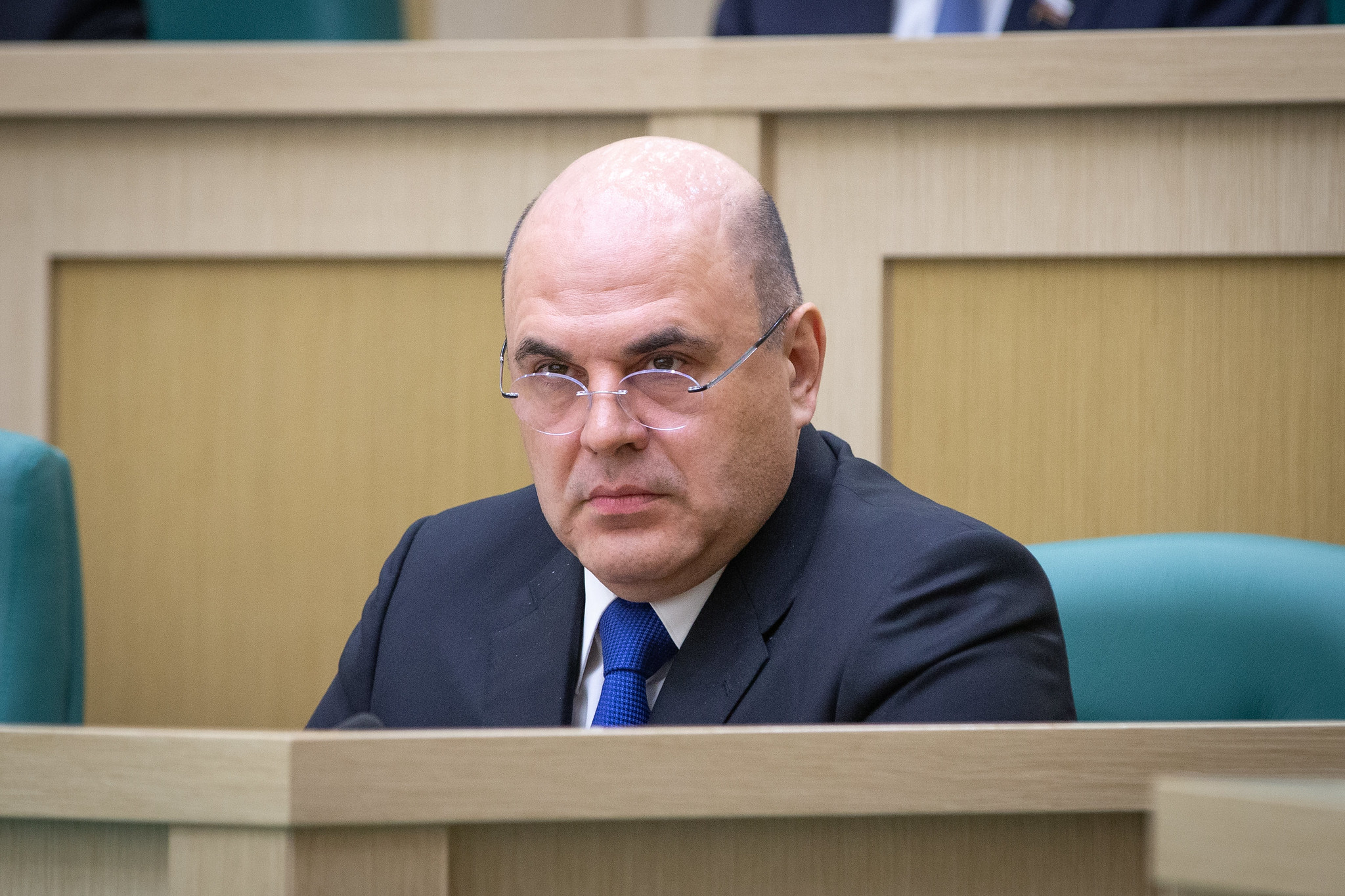
On April 14, President Vladimir Putin said that the authorities will allocate 1.2% of GDP to combat the economic consequences from coronavirus, that is, a little more than 1.3 trillion rubles. About the same amount was previously called Mikhail Mishustin, saying that such expenses are reserved for the fight against coronavirus and support for the economy.
How economists evaluate it
The government is inclined to provide the widest support to large enterprises, focusing on their contribution to the economy and high employment, but in the logic of the development of the current crisis, this strategy will most likely be erroneous, the leading Russian economists wrote in the Koronakrisis-2020 report : what will be and what to do, prepared by the Liberal Mission Foundation.
Unlike small and medium -sized businesses, large companies have reserves and can restructure debts, the authors of the report note. And the position of “strong companies will pass” the position chosen by the government, does not increase the crisis, but reduces the readiness of the business to use its own reserves - the huge number of companies for survival still does not have enough, the authors of the report wrote.
The state reacts slowly and marginalizes small and medium -sized businesses, not recognizing it an important part of the economy, was written in the report by the professor of Higher School of Economics Oleg Vyugin: “This is such a cynical position: small business, self -employed, IPSHNI have come from nowhere, will go nowhere, but will also return from there.”
What am I to me?
The measures proposed by the state will not be enough to overcome the crisis even taking into account the additional trillion-according to the authors of the report, in order to prevent the economy into depression due to the coronavirus epidemic, Russia must allocate 4-10 trillion rubles to its support-that is, up to 10% of GDP, as most Western countries do.
MONEY
The worst crisis since the Great Depression
The forecast for the development of the crisis from the International Monetary Fund, published today, coincided with the worst expectations of Russian economists, which were written by The Bell. The IMF has been waiting for the worst recession since the Great Depression of the early 30s: in an updated forecast-the fall of the global economy by 3%, Russian-by 5.5%, at the level of other developing countries in Europe and Latin America. Next year in Russia, it is possible to restore growth up to 3.5% against modest 1.3% in 2019. There is only one good forecast - unemployment in the country, according to the IMF, will grow slightly - from 4.6% to 4.9%.
Buckwheat went out of fashion
But there is good news: not even a month has passed after the first raids of stocking Russians to grocery stores, as the jailing demand for buckwheat has ceased in the country, Nielsen research company found out. Instead of it, agricultural and hygiene purity and hygiene were the products: in the first week of March, sales of gender washing products increased by 98%, wet napkins - by 51%, soap - by 50%. The demand for sanitizers remains record, the sales of which have grown five times, and for skin antiseptics - 30 times.
Exclusive
The owner who cannot be called: who is behind the bookmaker "Fonbet"
In the light of new plans for the state support of business, a place in the list of system -forming companies is gaining special value. The main sensation in the first version of the list, published in early April, was the Fonbet bookmaker. In the second version, it will no longer be, and the Herbal Prosecutor General’s Office investigate the history of its hit. The Bell special corner Irina Pankratova conducted its investigation and found among the shareholders of Fonbet, about which other bookmakers either do not know or refuse to talk, a partner of the family of businessman Sergei Lalakin, known in the 90s as a leader of one of the powerful Podolsk organized crime groups in the Moscow Region.
Partners The Bell
"Changes are normal!"
Do you want to turn your hobby into a profitable business with an audience of 6 million people? Do you dream of falling into the rating of the highest paid influons according to Forbes magazine? In a joint project "Russian norms!" and chivas - "Changes are norms!" - We tell the stories of people who have repeatedly changed their lives and themselves in accordance with new realities. The heroes of the new issue are Natalia and Murad Osmann, the creators of the Followmeto project (“Follow me”). They call themselves “grandparents Instagram” and tell how a random photograph sent them to the rating of the highest paid Forbes influentiers. Watch the interview on the Channel “Russian Norms!”, And you can read the abbreviated version on The Bell website .
Coronavirus Daily
The first 20,000
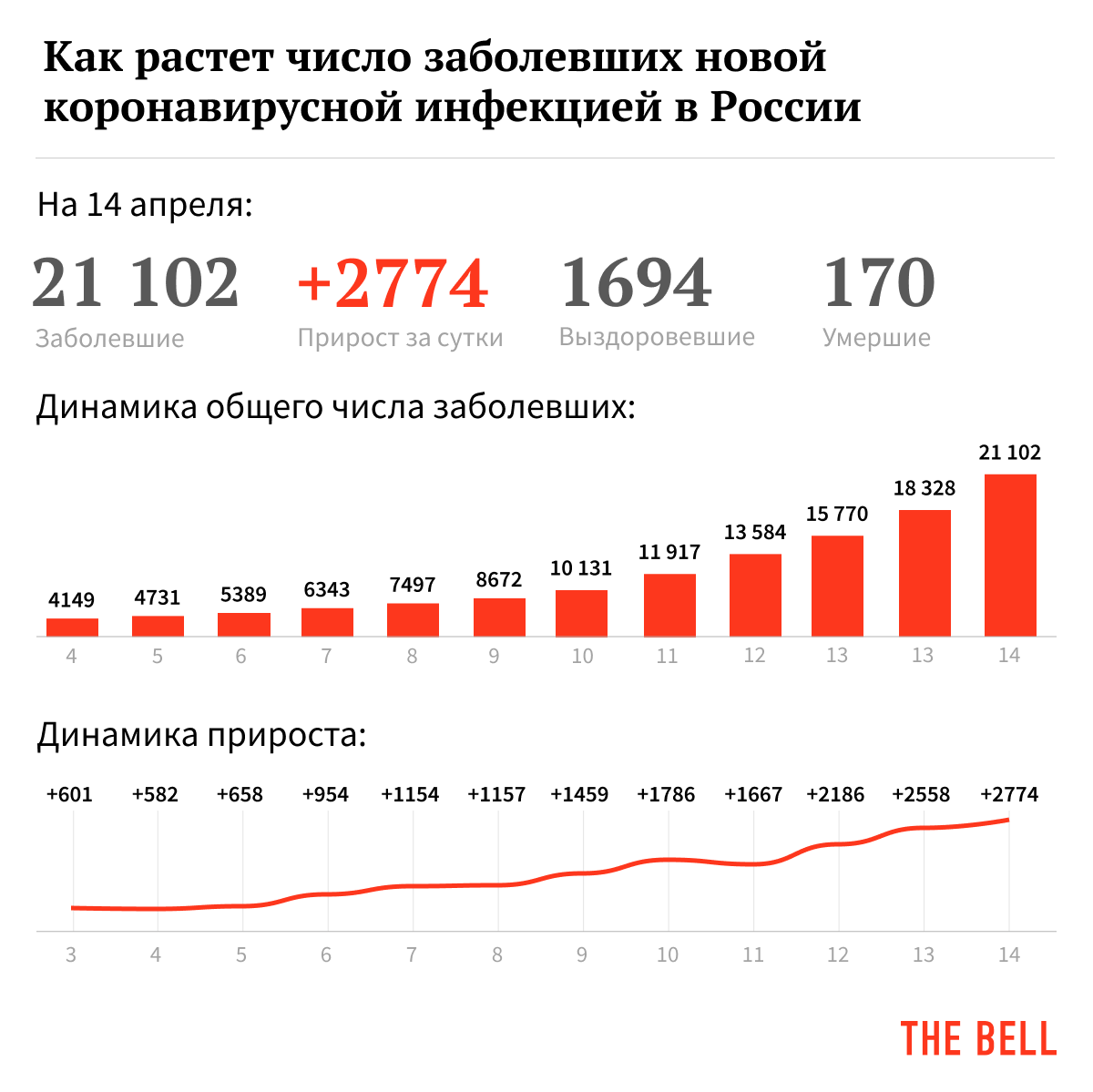
The epidemic in Russia continues to develop in growing. Today we have passed the mark of 20 thousand sick - and the doubling of the number of cases occurred in just four days.
- Moscow is preparing for the first day of life on a checkpoint - from Wednesday, April 15, receiving digital pass for movement around the city will become mandatory. Whether the system will be able to work normally, it is not clear - in the early days the city hall’s website worked with interruptions, the hot line on which the pass can be made by phone is clearly overloaded , and the system for checking the passes of taxiists is redid on the run .
- The police have already warned that from this day it would be checked by passing from all those entering Moscow - including by cars with Moscow numbers. Moreover, cars without passes will be recorded by road cameras - and the car owner will receive a fine of 5,000 rubles for each travel under the camera without a pass.
- One of the most experienced and reputable investment banners of the country - the former head of Deutsche Bank in Russia Igor Lozhevsky, died from coronavirus infection.
- The Bell and Levada Lab (the Levada Center Research Laboratory) studied how the coronavirus epidemic changes working processes and lifestyle. At the individual level, the load increased and the salary fell, at the level of companies - confidence between counterparties has decreased. The work of only 7% of respondents has not changed in any way.
Other most important news about the development of the epidemic in Russia and in the world - read in our daily digest.
PRACTICE
How emoji help during the epidemic
Despite the fact that people began to actively correspond with colleagues, being in the self -insulation mode of the house, not all messages can replace real lively communication among office coolers: with virtual communication, 93% of non -verbal signals are lost. You can compensate for them in correspondence only with the help of Emoji - therefore, during quarantine, earlier emotion in working correspondence become a harsh necessity, researchers from the British Chichester University say .
How quarantine helps people communicate more
WSJ notes the paradoxical effect of the isolation era: quarantine during the epidemic prompts neighbors to communicate more with each other, and old friends and relatives - reunite. This effect has a simple explanation: people have less opportunities for random interactions - so that the long -resulting relationships are deepened. At the same time, people now need social ties more than ever: a recent study of the University of Massachusetts showed that after a 10-hour social isolation, a person experiences a similarity in force, as after 10-hour starvation, the need for food.