
Translated material
Chronicles of Moscow isolation
How Muscovites lived the first day with digital passes

Since April 15, in Moscow and the Moscow Region, the capacity began to operate. Propes with a QR code, necessary for traveling or for personal purposes, can be issued on the website mos.ru, through SMS or by phone, download it to your phone or print. Police, the Russian Guard and the Ministry of Emergencies have the right to check them. On the first day after the introduction of passes, Medusa correspondents went to see how the capital lives in a new, unusual regime for itself.
The morning of the first day after the introduction of passes was marked primarily by the accumulation of people near the Moscow metro stations. In the morning, the peak officers of the police checked the passenger travel passes literally for all passengers. Photos of giant queues near the metro were filled with social networks. At the same time, only at 10:55, an explanation from the press service appeared on the website of the Moscow head of the Ministry of Internal Affairs: “From April 15, on the territory of the Moscow metro, police officers check the presence of special digital passengers at the entrance to the metro station. In this regard, difficulties in the passage of citizens are possible. If possible, plan the time of your trip in advance, in the event of an accumulation of citizens, follow the established distance. Without extreme need, do not leave your home. Do not forget to make special digital passes in advance. ”
Mayor Sergei Sobyanin called these lines “critical” and actually assigned responsibility for their creation at the capital's Central Internal Affairs Directorate. “He talked with the head of the Central Internal Affairs Directorate, asked to organize work in such a way that further checks did not lead to mass accumulation of people,” he wrote on his VKontakte page. In turn, the press secretary of President Vladimir Putin Dmitry Peskov assured that no one would punish the police for the creation of queues, and the queues appeared as a result of the initial non-discipline of Muscovites who did not want to self-invoice. Speaking digital passes continued near individual metro stations until the evening.
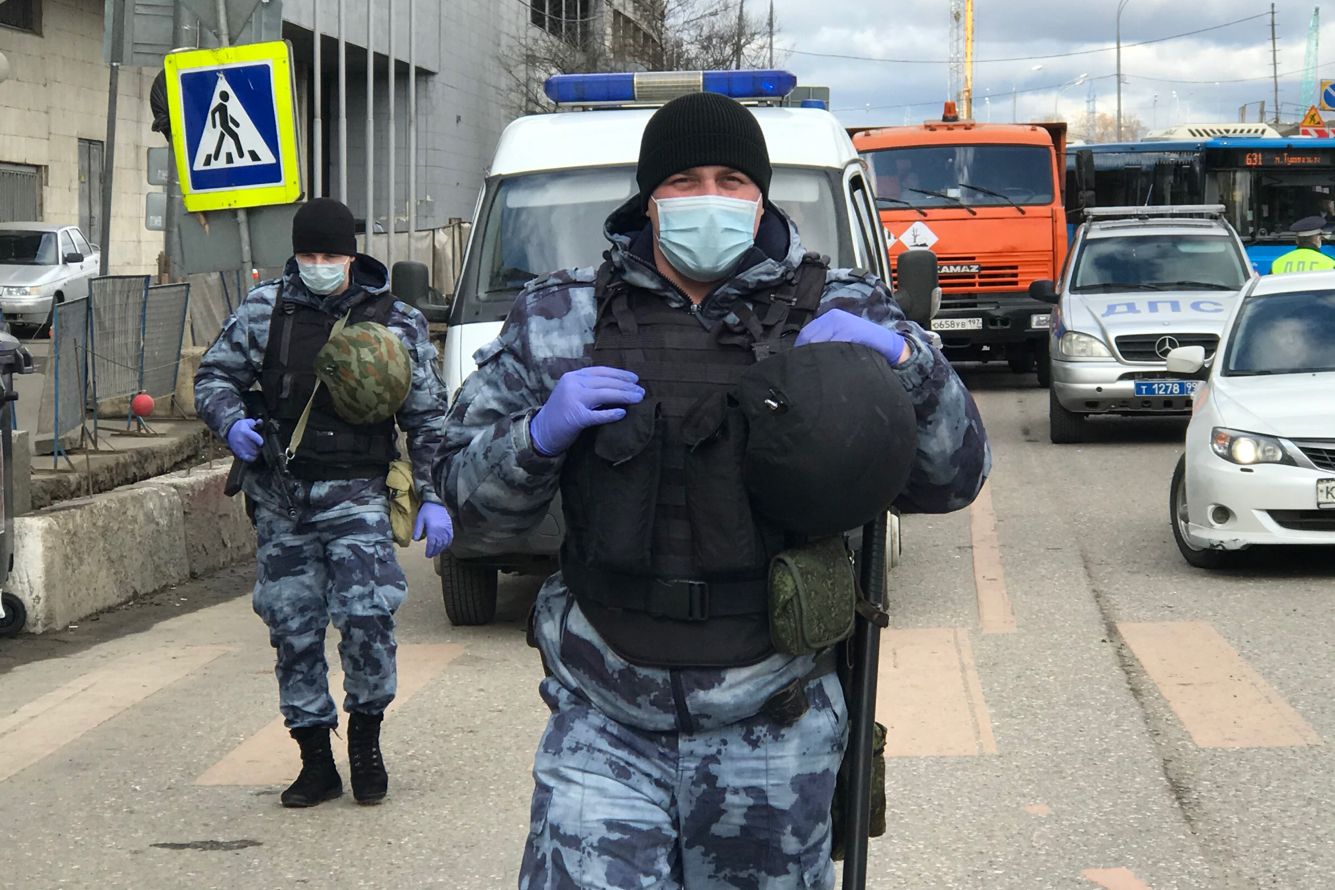
In social networks and on the website of RBC it was reported that difficulties arose at the entrances to Moscow. Many citizens were late for work due to the fact that the employees of the traffic police on duty at the MKAD posts and checked the presence of passes narrowed the transport flow to one lane, which caused traffic jams. At the entrances from the Novorizhsky and Volokolamsk highway, we noticed buses of the cynological service, as well as OMON employees with machine guns, masks and gloves. Neither dogs nor riot police participated in the checks of passes.
By noon, Moscow could definitely be called an extinct city. Cars evenly filled the main highways, including boulevard, garden and third rings. Most of the stream was made up of cars with Moscow numbers - apparently, the owners of the Moscow Regions decided on the first day not to take risks or did not have time to get a pass. All strips at the intersection of MKAD and radial routes became free by this time - almost no one was checked. It seemed that the police were trying to let everyone into the capital, so that their colleagues at other posts, closer to the center, were to hold and scatter a stream.
We observed an active check of passes at the intersection points with the third ring - 2-3 patrol cars worked there: several police outfits, all in masks and gloves. The congress from the third ring to the Bolshaya Tula Street was completely narrowed to one lane, checked almost every car. They stopped cars at the Belarusian station and on the area of three stations, where, in addition to the traffic police outfit, five riot police officers were seen in long green respirators who make them similar to tropical birds with batons.

The most dense check of cars in the center, according to our observations, was carried out in the area of Arbat Square and the Cathedral of Christ the Savior - there the police stopped every second car, preferring expensive foreign cars and old domestic cars. At the same time, no more than 20 seconds were spent on each car: it seems that not all inspectors were checked with the base of gallows on their devices (as it should work in the ideal), but preferred to believe the drivers for the word or limit themselves to a warning on the first day. As the BAZA project reported , not all Moscow police officers have been given out smartphones for scanning digital passes.
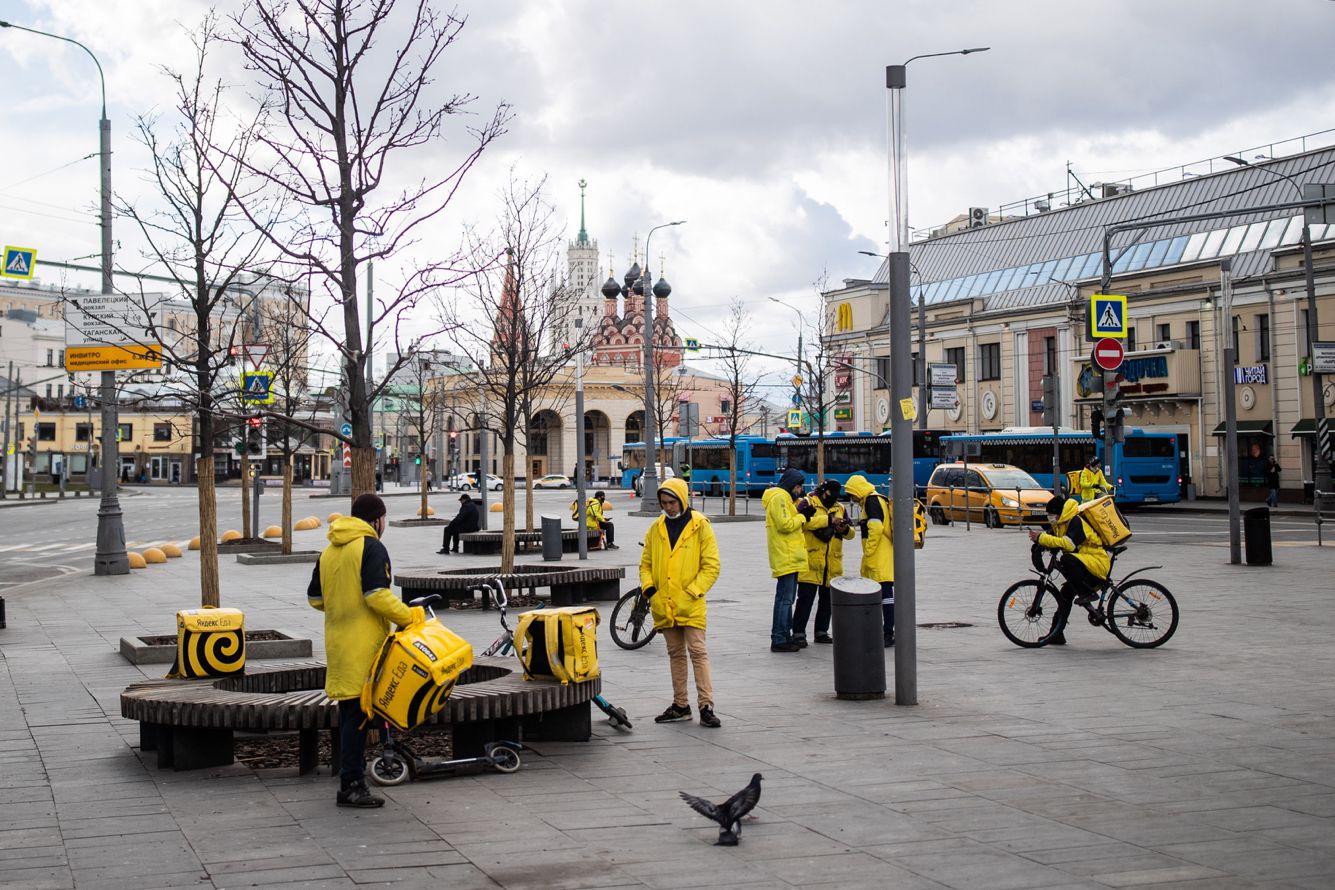
Unlike transport, a pedestrian flow - especially in the center of Moscow - almost dried up. There is nowhere to go: cafes and restaurants are closed, parks, boulevards and platforms are surrounded by barriers. Most pedestrians are couriers on scooters and on foot. Near the old Arbat, the PPS car was on duty, loudly reminding the citizens about the need to sit at home. Manezhnaya Square patrolled the three police officers, they did not stop rare passers -by. In the section of Tverskaya Street from the State Duma building to Pushkinskaya Square, the Medusa correspondent met two police officers who had observed rare citizens from a distance, without demanding documents from them. The area of the patriarchal ponds almost died out, but a police KAMAZ was on duty at the pond itself.
At the same time, in the center of Moscow there was a clear and unexpected activity of road and seasonal workers, as well as employees of Mosvodokanal. We observed work on the painting and washing of the borders, on checking sewer systems. There was a feeling that the absence of people on the streets began to improve the capital for Moscow services with a long -awaited reason and hit citizens by the time they exit self -isolation. Near the Patriarchal Pond, in a fenced square, several people in an orange uniform concentrated the metal fence concentrated. The senior group in response to the question of the "Medusa", whether the improvement work has been allowed now, replied that he did not know, and returned to work.
Not far from the Triumphal Square, near the cafe “Purchase Bread” (openly, as it sells baking off the darkness), sellers smoked. One of them said that from last week it has become much less, and the share of delivery orders also did not increase. “The offices in the center were closed, but now you won’t leave the house, that's all,” his colleague said. At the entrance to the Mayakovskaya metro, three police officers condescendingly watched a man with a child and a scooter: formally, walks with children are prohibited. However, no one prevented the Muscovite to go down the subway and go home.
In sleeping areas and on the outskirts of Moscow it was very little bitter. Near the entrance to the Novokosino metro station, a police patrol was on duty with two people in masks. They stopped an elderly man on a bicycle and demanded an electronic pass. The cyclist did not have this. "I'm going around the district, I am taking medicines to a relative!" - the man explained to the police. The patrol remained satisfied with the explanation, and the cyclist continued his way. But the Patrol correspondent checked the documents of the Medusa correspondent thoughtfully. The officer, who introduced himself as the deputy chief of the department Afanasyev, was not satisfied with the press card and asked to present a “certificate”. The editorial assignment completely arranged it.

In the city of Reutov, in the near Moscow Region, people met only near the main transport hubs, near the metro and near the platform of suburban trains. The CPC controller at Reutovo station told the Medusa correspondent that he heard about the introduction of electronic passes for a trip in public transport in Moscow and the Moscow Region. “But we cannot check them, only the police. She is not here yet, ”he spread his hands.
In Reutov, the employees of the Russian Guard were also noticed, who were on duty near the add -on grocery stores. The largest cluster of the inhabitants was also discovered there - they all went shopping. However, the Russian Guard watched them without leaving the cars. Nobody checked the passes with anyone.
At the same time, all the passers-by with whom the Medusa correspondent spoke, just had a pass with a QR code with them. “Of course, there is a pass, but how would I get into the center differently? I don’t know about the queue - I left the house closer to dinner, there were no queues, ”Muscovite Marina told Meduza near the Pushkinskaya metro station. “In principle, it is not so difficult to get this QR code, but there is a problem-you need to enter a lot of data, the system is constantly flying out,” the man complained near the Medvedkovo metro station, who did not want to call “Meduz” of his name. -Well, if there was some single code like SNILS for receiving a pass. But if you seriously fight the virus, then these are half measures. In my native region - Bashkiria - people from stops are chasing the police. It is necessary to close the metro then. ”
Andrey Pertsev , Maxim Solopov , Alexey Yablokov