
Translated material
The origin (almost) in total
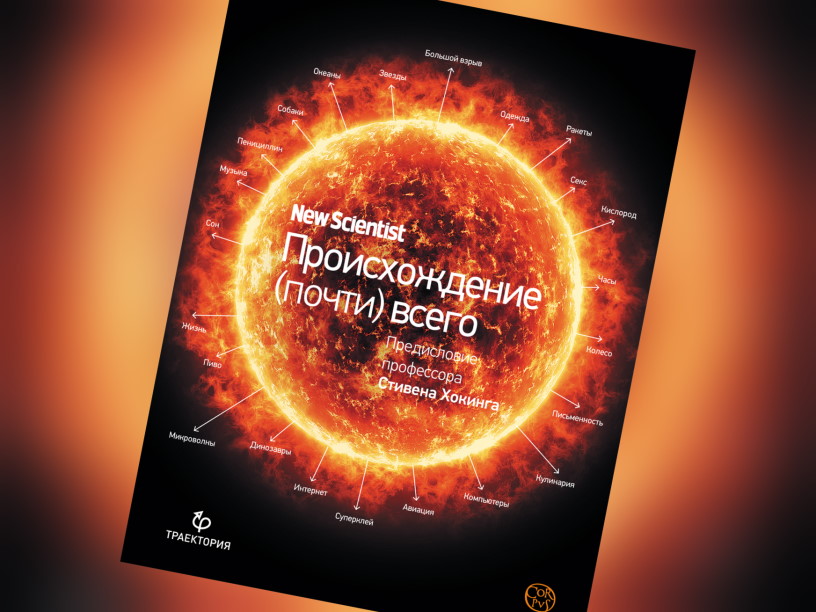
Corpus Publishing House represents Graham Lawutan's book “Origin (almost) of all” (translation by Anastasia Brodotskaya).
“The origin (almost)” is an instructive and bright book of the editor of the New Scientist magazine Graham Lauton. The preface to her was written by Stephen Hawking. Each story is equipped with magnificent infographics. It really tells about the origin of almost everything - our universe, the planet, life, civilization, knowledge, many inventions that have firmly entered the life of a modern person (toilet paper, keyboard, the Internet). The author not only frantically expands the horizon of the reader, but does not allow to get bored for a second. For example, did you know that one chemist was seriously engaged in a scientific study of the issue, where does the fluff come from in the navel?
“When I just began to make a list of everything that should be included in this book, something seemed obvious to me-for example, it was clear that it was impossible to do without a large explosion, the origin of life and the evolution of man. Another rich source of ideas was the emergence of human civilization. Fifteen thousand years ago, our ancestors were nomadic hunters-gatherers, and now we live in houses, buy food in supermarkets and travel around the world by cars. How did it happen? However, not everything was so unambiguous, and I am grateful to my brilliant colleagues from the New Scientist magazine and John Murray publishers for some eccentric proposals - among my beloved zero, soil and personal hygiene. For a long list of ideas that did not enter here, for example, the origin of the cricket and cake-shirt. Maybe someday I will write “The origin (almost) of everything else”, ”says the author of the book.
We offer you a fragment of Graham Lawton's story about the origin of chemical elements.
Imagine that when you are a year old, you received a rather strange gift - an ampoule with hydrogen. A year later, a little helium was presented to you, a year later - a piece of lithium. On the day of adulthood - at twenty -one years - you have become the happy owner of Scandium. For the fortieth anniversary, they received a piece of crystalline zirconium. If you survive up to ninety -two, get uranium. But for the collection to become complete, you will have to stretch much longer. Namely - up to one hundred and eighteen.
That is how much we know chemical elements - a colorful mixed of solid bodies, liquids and gases, metals and non -metals, rare and common, useful and not very. All this is the building material of chemistry and life. But where did they all come from?
The simplest answer is as a result of a large explosion. But he will not satisfy us, since the explosion itself gave rise to only three lightest elements - hydrogen, helium and a little lithium. But what about the rest?
For a complete answer, you need to know what the atoms consist of, as well as own the basics of arithmetic. The easiest atom is hydrogen, it consists of one proton and one electron. The following complexity are deeries and tritius, which are hydrogen with the addition of one or two neutrons. Then there is helium, he has only two. Then - lithium, he has three. Common sense suggests that large elements can be done if you fuse together small. That is how they are formed.
Large compression
But everything is not so simple. Such reactions are difficult, because in order to fuse two cores, a lot of energy is needed. Astronomical temperatures are required - at least ten million degrees. There are only two places in the universe in the Universe: immediately after the large explosion and inside the stars.
The first phase of the creation of elements (primary nucleosynthesis) began immediately after a large explosion. For a hundredth fraction of a second, protons, neutrons and electrons arose from the fire ball. After a few seconds, protons with neutrons began to unite, since the colossal energy of the fire ball laamed them together with the so -called strong interaction. These nucleosynthesis reactions formed the deeri nuclei, which were used with other protons, forming stable helium nuclei.
But by the time helium appeared, the temperature fell so low that further nucleosynthesis could no longer go the right pace. Perhaps a little lithium arose, but nothing more heavier. Nucleosynthesis ended, barely starting.
Very heavy metals
Elements are heavier than uranium on Earth became known only in the early 1940s, when chemists created plutonium and Neptunius as a result of bombing of uranium neutron. After that, another 24 transuranic elements were synthesized in the laboratories. The heaviest of them is Oganeson, the 118th element. Often it is believed that all transuranic elements are completely artificial, but this is not so. They are created in supernova explosions, like ordinary heavy elements. However, they are unstable and tend to break up quickly. Those that have arisen naturally from the moment of the formation of the solar system have long completely broken up, and therefore are not found outside the earth's laboratories.
About 377,000 years later, everything resumed. The temperature fell to about 3000 degrees - it became cool enough to exist atoms. The nuclei of hydrogen and helium selected free electrons to form the first complete atoms - elements number 1 and 2.
They still make up more than 99 % of the visible part of the universe, but still these are not its only components. To create heavier and more interesting elements, stars were required. The star arises when a large mass of gas is compressed under its own weight. From compression, the temperature in its center grows, and in the end nucleosynthesis begins. The first reaction goes at about 10 million degrees - this is the synthesis of hydrogen nuclei, of which, until they end, helium forms.
Nonal synthesis
What will happen next, depends on the mass of the star. If it is very small, the synthesis stops, and the nucleus of the star simply turns into a white dwarf. But if the star is eight or more than the sun than the sun, the synthesis will continue. Helia nuclei are connected and form the beryllium (4th element), and it still interacts with helium and forms carbon and oxygen. In the bowels of the most massive stars, it is so hot that carbon and oxygen are fused further-and more severe elements are obtained up to iron (26th). After this, the reaction stops, since the iron of all elements has the most stable core and, under such conditions, does not burn in anything. But in the outer layers of the star there are other nuclear reactions with the capture of neutrons, so that the nuclei of even heavier elements are gradually built up to the bismuth (83rd).
When iron accumulates in the bowels of the star, its days are numbered. It can no longer produce energy with nucleosynthesis, and gravity continues to compress its core, increasing the temperature to billions of degrees. The center of the star suddenly collapses, the outer layers fall inside, and then fly apart, and the substance of the star spreads in space - an explosion of supernova occurs. This explosion gives rise to a stream of neutrons, creating even heavier elements up to Uranus (92nd), the most heavy natural element found on Earth, and even harder. Supernovova throws far from the space of different garbage, which is then part of the stars and planets of the next generations, including ours.
Only three elements cannot boast of star origin - lithium, beryllium and boron. Their nuclei are unstable and during reactions in the bowels of the stars are immediately spent. They are rare, but all their meager existing reserves (except for the lithium that remained after the large explosion), as it is believed, arose thanks to cosmic rays - a rather large nuclei that move through outer space at high speeds. Their energy is so high that when they encounter other atoms, the nuclei are divided into smaller fragments.
So, not counting artificial elements, all atoms on Earth are either the result of a large explosion, or fragments of long -dead stars, or cosmic rays. And when our own star will die, they will rush back into space, and there they probably will thicken into a new solar system. A brilliant return to the stage!