
Translated material
Tropics outside the window

When everyone involuntarily sits at home, it's time to open at least the window in the tropics, you don't think so? Now this can be done, not only without getting up from the couch, but not even including the TV. Recently, the publishing house “Laboratory of Knowledge” published two books by Ira Semenyuk , included in the trilogy “In the jungle not only tigers”. I would like to hope that the final part can also be published this year.
Naturalist and artist
Before praising books, you need to tell about the author. I am often lucky in life, but in the case of Irka it is some kind of damn luck, since I managed not only to watch the first acquaintance of this girl with the tropical forest, but also to show something in the forest myself. Ira is a biologist. She got into the tropics during training at the Department of Zoology of Invertebrate Moscow University - collected material for a diploma. By that time, the second (and while the last) season of my long work in the Kattienne Park in the south of Vietnam was drawing to the end of the second (and so far).
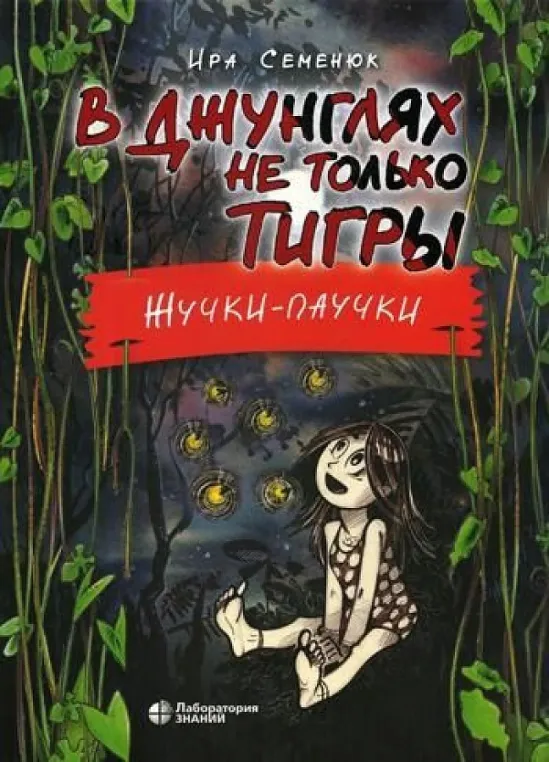 Semenyuk I. In the jungle not only tigers. Bugs. - M.: Laboratory of Knowledge, 2020. - 144 p.
 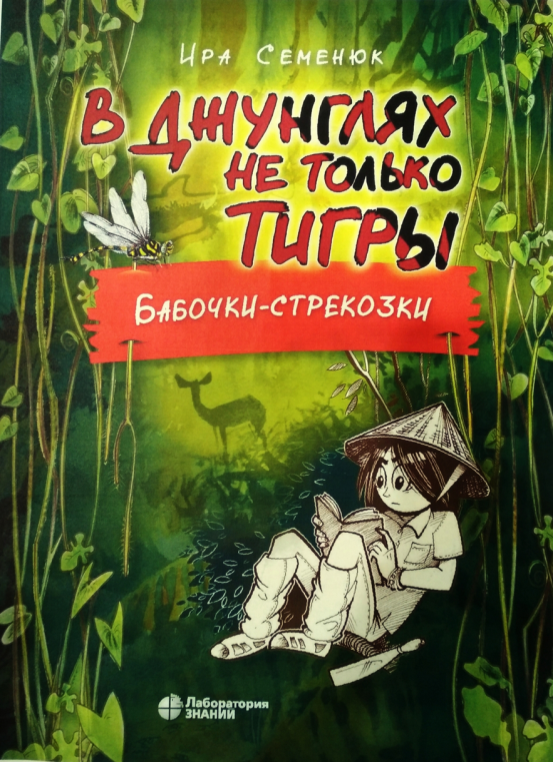 Semenyuk I. In the jungle not only tigers. Parrock butterflies. - M.: Laboratory of Knowledge, 2020. - 120 p.
Spring there is dry; It is wet, but stuffy with pre -heating stuffiness; However, at the beginning of summer, the humid season finally comes into its own: leaves bloom on the trees, the birds are occupied by nesting chores, and the entire forest, and especially the litter - is the sheet duddy that lay on the ground for several months - is filled with life. Cockroaches, termites, ants, scolopenders, lizards, frogs, delicate planarias and predatory peripatus ... Whoever is not in opada, until the termites and mushrooms destroyed it in a matter of weeks.
Ira was interested in pollinates - their participation in the economy of the tropical forest, in a frantic cycle of substances and the energy of this community. However, I made a reservation: Ira was interested in everything, from termites to crocodiles and monkeys, and although she got into the tropics for the first time, Ira looked like Mowgli, who finally returned to her native element. It was so obvious that I collected all my poems written by that time and gave them to Ira with the dedication: "A girl who was able to accept as a gift." Indeed, a few years later, on the material collected in Vietnam, Ira defended her dissertation 1 and now lives and works in the tropical forest is almost unlimited - mainly in Kattien, but takes part in expeditions to other areas of the country.
Ira is not only an enthusiastic naturalist, but also a talented artist who creates works in different styles, and the books of the series “In the jungle not only tigers” are made up so that they show different (although not all) the facets of the author’s work. First of all, these are, of course, the drawings of “bugs-wrappers”. Ira is a master of scientific illustration, this can be seen from her publications in academic publications, but drawings of insects and other creeping animals that entered the scientific-popular trilogy are not literal copies of representatives of arthropods. Here, not the accuracy of the details is put on the first place, but the artistic expressiveness, although Ira as a specialist knows what to allow some image of the image, conveying the impression of the animal, and not just its anatomical details, but in which there is no, otherwise the drawing will cease to correspond to the signature.
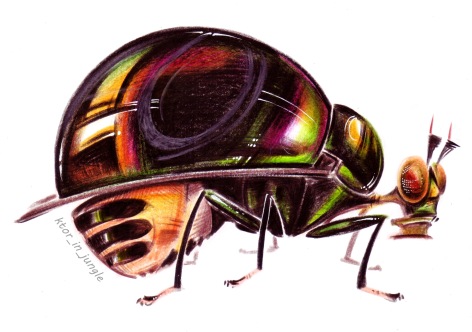 Female fly. CELYPHIDAE (National Park Fotsnya)
 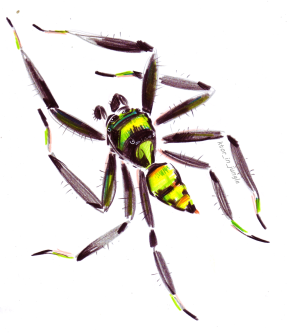 Male spider Phintella vittata (National Park Kattien)
 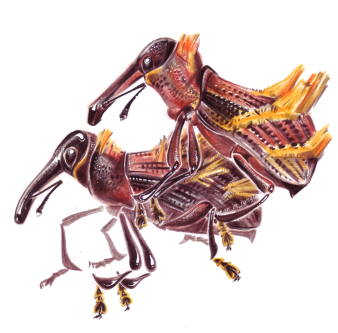 Alcidodes sp. (National Park Chuyansin)
Characters: crawling and flying
The first book tells about insects of the five detachments - about grasshoppers, dragonflies, fluids (sticks), butterflies and moths, Osah and bees and, finally, about flies. The second book shows various bugs, as well as spiders, scorpions and their relatives, multi -bed and freshwater crabs, freely walking through the forest. In the third book, we should again talk about insects - cycades, cockroaches, mantis, bugs and others.
I must say that I am waiting for the third book with special impatience, since it is precisely the tropical forest by cicadas, cockroaches and bugs. Cicadas yell so that you involuntarily bend to the ground; The cockroaches are so large and expressive that they want to collect them as gems, and sometimes - dutifully give way; And the bugs deceive all the time, then imitating the bees, then hiding under a cloak of garbage ...

But so far we will look at those animals who are already lucky to be on the pages of published books. Among them are many acquaintances - whom I myself was surprised to examine in the forest, tried to take pictures, but I did not bother to determine. In the books of Ira, every living animal corresponds to the label, as in the museum window: the Latin name, the Russian name, the name of the family, brief information about the lifestyle. Although only a few lines are allotted for this, Ira chooses the most important thing that is known about her heroes, and more detailed information cannot be found often in the special literature.
While we are talking about the “apartments” occupied by insects in the tropical forest, I nod, recalling where and when I met with them, but when Ira moves to the description of the diet, behavior, the development of these animals, I turn from an expert on the tropics into a timid student: I need to be a specialist to know these subtleties, but I still studied in the tropics of birds, not “bucks”. The book also has information that cannot be found in scientific works. For example, how to tear off a bug, desperately clutching claws into your skin; Which grasshoppers (few) can, on the contrary, can calmly hold in your hands and how to cook delicious freshwater crab soup.

According to the carefully selected collection of insects, the author of the author, the author of the author, a girl with delighted eyes, a character of fascinating manga about her adventures in the tropics, which went into the book of Ira from her pages on social networks. Ktor introduces not only bizarre “bucks”, but also with the culture of the Vietnamese, with the peculiarities of working in the tropics, sometimes difficult - for example, when you have to explore the forest in the season of storms and rains.
Botanical sketches and landscapes
Carefully fling through the books, you notice that they are not only about bugs-fours. There are many plants on the reversals, and all of them are not only beautiful, not only recognizable, but also carefully etiquette. The image of plants is a special art, and not all drawing zoologists decide to write flowers and leaves. Here I am ready to confess to the heresy: although the drawings of arthropods are accurate and informative, although Ira’s books can be used as a guide to insects of the tropics of Southeast Asia, its plant drawings are of greater value to me. Then Ira enters someone else's territory. It is interesting when the plant begins to draw plants. Immediately visible the difference in techniques: the branches, the inflorescences, and the fruits are captured fluently, the artist in tension - he out of habit waits for the object to run away from him. But the accuracy of the eyes and hands worked out on zoological objects manifest themselves here. This fluidity and accuracy are unique: artists without biological education often neglect the species features of plants, if without distorting, then without trying to convey them, and botanists usually meticulously write out details, so that they obscure the overall impression. Oddly enough, the council will sound, I recommend Ira’s books to those who are engaged in botanical illustration - not as a role model, but so that they know: this is also possible. By the way, Ira rarely shows her botanical illustrations, meeting with them in the book for me was an unexpected discovery.

Finally, there is another layer in Ira’s books - landscapes drawn by watercolor. If you try to find successful landscapes of tropical nature, you are unlikely to succeed. In any case, I did not succeed. Other artists, the most famous, will have either separate color spots approaching abstraction, or paintings overloaded with details, or attempts to look at the tropics through the prism of ethnic art, or involuntary covers of the canvas with green color of different shades. You can let the fog, shadeing the mountains and individual trees, you can break the monotonous forest with the ruins of Buddhist temples or bamboo huts ... But just take and draw (or photograph) tropics rarely. And Ira succeeded. And the tender spring -color of the young foliage, and the Sepia of protracted rains, and the forest in the instant light of lightning, and the lull, and a flurry, tearing the wide leaves of the banana, and the dancing light passing under the dense canopy through the ruptures in dense foliage ... All this was more accurately conveyed than the most sophisticated camera, but in complete accordance with the impressions of those who were lucky to visit in Tropics.
* * *
I don’t know when I will return to Vietnam, but Ira’s drawings return me to a familiar forest inhabited by gibbons and birds-noso. If in fact Ira accepted the tropics as a gift, now she gives it more than generously.
Pavel Kvartalnov , Cand. Biol. sciences
Ira Semenyuk illustrations are published with the permission of the author
1 "Trophic and topical specialization of the diplopa diplopa (Diplopoda, Myriapoda) as a mechanism for maintaining the species diversity of taxi." - Ed .