
Translated material
Light hand | Colta.ru
By the 90th anniversary of the birth of the composer Nikolai Karenikov (1930–1994), the publishing house Ivan Limbach publishes a collection of his memoir prose “Topic with variations”. Colta.ru publishes Olga Sedakova’s preface to the book.
These charming short stories (or outbreaks of memories, or jokes in the ancient sense of the word) do not want to aggravate with introductory reasoning. They are written with a light hand. They are completely free from the ill -fated “writing”. They do not have all the heavy “writing” furniture: descriptions, landscapes, interiors, portraits of actors - at all, and this is amazing! How to refrain from not saying a few words about the appearance of Federico Fellini or Maria Yudina, Heinrich Neigauz or Dmitry Shostakovich, whom you saw so close in such entertaining turns? But Nikolai Karetnikov is not distracted from the plot of his short stories. He is not distracted by generalizing thoughts (they are left by the obsessed reader), for retreats, lyrical or historical. Everything happens quickly, begins at ease and ends, as a rule, with an unexpected paradox, the final pointer ( it is most remembered most). The purity of the genre. This is not laconicism: in a laconic letter, we always hear something stretched, but here is simplicity and ease. This is just a brilliant art of the story. Nikolai Karetnikov, who chose the most strict system of composition in music - serial dodecafonia, and in his verbal compositions, where, as he warns, the author “did not come up with a single word”, holds the whole in his mind. This means, in particular: the thing (verbal just as musical) has the beginning, end and volume. You can be a “writer” and very little to know about these three fundamental properties of art. I will pay attention to one detail: the art of heading. Having read the name of any of the short stories of this book-for example, “Sentimental Journey”, or “It has begun ...”, or “Mumu (imitation of Turgenev)”-we expect something completely different than what the author will tell. But having finished reading and returning to the name, we suddenly read the title differently - and, accordingly, otherwise we read the episode itself, which we were told. As if another mirror was brought to the mirror.
Yes, these stories are written with a light hand. Almost all of them are lit by a smile and full of comic. Neither resentment in the era, nor her denunciation, nor, on the other hand, the heavy singing in front of the “great” contemporaries (really great, without quotes) are heard in them. But the topics on which N. Karetnikov writes his light verbal variations are in reality heavy and without exaggeration terrible topics. How terrible the fate of Tenor is and, probably, the great tenor - Ivan Kortov, who served his life on Magadan (“five rubles in gold”). We heard and read many such stories of life and almost got used to this plot. Another nightmare of the era is less described: when the family of friends (namely you personally, the narrator) is considered the informant and accept in this capacity, but it turns out after many years (“time was like that”). But in the "phenomenology of the era" (as he called his stories of the brownies) there is another black hole. It can be called the policy of re -education of art. When I first watched the French documentary “Forbidden Notes”, he made the strongest, comparable impression on me. Why, what if the fight against dissonances, seconds and septims turned out to be the work of the party and government? It was, as we know, nothing more than an episode of total ideological censorship, which everyone was already tired of listening. But the fact that political censorship is included in the area that should not have been interested in it in any way, and pay the state to musical intervals for this, the possibility of creative work, the right to teach (or soul and gift - in case of consent to the proposed conditions), this does not cease to amaze. The fact that ignorant and dumbasses are given unlimited power over professionals and geniuses - this does not cease to amaze. Nikolai Karetnikov studied just during the great struggle against dissonances. He did not have to hear his most significant and mature works - he was the first or one of the first to write in dodeconon technique, and this was outside the permitted. Until today, it is primarily known as the author of movie music. Few people are ready for such a creative fate. Many gifted people lack the strength to endure it (I know this from the people of my generation, the poets of Samizdat, excommunicated from publicity). Karetnikov talks about his own walks on official torment, about the lessons that the bosses gave him (which is worth one story about the “right to tragedy”!), As if from afar, from where all this cruel nonsense, which was required to accondition, does not mean anything. Phenomenology of time.
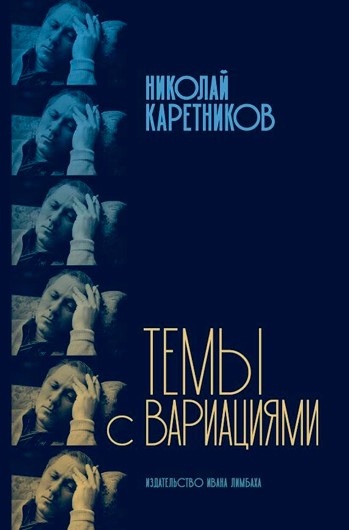 © Publishing House of Ivan Lumbach
I will not dwell on many other Karetnikov topics . I recall only two, the most important, without which the phenomenology of time (generally speaking, several times) would be flawed. The first of them is free, gifted, enlightened people who, in this dead air, seem to build nests around them, where the former and always new light shines, where the wind of independence, mind and inspiration blows. We, the inhabitants of this era, know how much it meant to meet in the youth of at least one such uninhabited, not re -educated person. He discovered the taste of freedom and personal dignity to you. Maybe there is a better image here: not a taste, but a certain tuning fork that you were given to you and with which you could always glorify what is happening. Nikolai Karetnikov gives these other people, as it were, in instant pictures, in short episodes, in their situational - and most often funny - words that his memory recorded. In the world of universal Soviet education, they are antididactic. They themselves are ready to study (a story about how G. Neigauz accepted a new Vienna school). Karetnikov connects these teachers and older friends with the tradition of pre -revolutionary Russian intelligentsia. With the same tradition, with its inheritance, he connects his friends of another generation - Alexander Galich and Father Alexander Me. Karetnikov, as already mentioned, generally avoids generalizations, but here he allows himself a general observation, very interesting and unexpected: these other people were distinguished from others, the ability to admire and enjoy it. And this is true: no one, it seems, is not expressed truth. The Soviet man, the Soviet artist was obliged to be awake and optimistic, but the simple joy of being was as if they were amputated. Nobody taught them the necessary skill: to relax the muscles of the soul. Vigilance and mobilization - what is the joy of being?
Having mentioned the name of Father Alexander me, I touch the most important thing for the book by Nikolai Karenikov (and the most important for me) topics: the history of faith (in this case, a personal coming to faith) in Soviet times. N.S. Khrushchev and the sixties (who began in the late fifties) argued about many things (see the story “Manege”), but in one they certainly converged: in combat atheism and anti -lricalism. The young avant -garde poet offered a blue -eyed monk an alternative to his boring, lean life:
Eh, in a squat,
So that the heels are in heaven!
It hurts the girls to the paddles
On blue eyes.
The proposal with which young N. Karetnikov was going to turn to the young and blue -eyed (“The eyes of the color of the coloring of the Vasilka”), the priest was probably not so dashing (the short story “began ...”). He wanted to return the “stray from the way” to the world of modernity, in the twentieth century. In the temple during the cation, he decided to "attack him", "look directly into his eyes", "confuse and call for doubt." He stood for this in front of the “suitable icon”. The history of his appeal is amazingly described by Karetnikov. The young priest, on whom he “attacked”, embarrassing with a direct look, “looked into my face quite calmly, quietly. Then, in his eyes, the expression flashed with a barely noticeable instant pain and immediately disappeared, his gaze was again bright. ” A successful young composer, “the author of the already two symphonies, the Komsomol of the Moscow Union of Composers” - so describes himself to the then brings - realized that something had happened. He saw "such a deep, pure, true humility, the existence of which I never had and could not have the slightest concept." It is precisely noticed: “And I could not have” - where? Everything around was different. The narrator burned out with shame, he "wanted to get rid of himself and all his loudly and empty motives." "Get rid of yourself!" What Karetnikov tells is called repentance and appeal in the church language. You don’t decide that it would be good to repent and return to the “Fathers Vera”-something completely unforeseen strikes you in the heart, and you understand that the past is over. Everything will be different. Karetnikov himself calls this meeting the "first lesson", from which "the training of the soul began." Yes, such or close to this entailed to the faith and church of those whom it overtook in this era of warlike atheism, which was no longer imposed on people, as in previous generations, but was absorbed from the air, as they say, with mother’s milk and the first children's songs. The world of quiet and meek power, some inexplicable mercy and subtle spiritual science. This world was filled with rare then acting temples, in which the mainly simple old women stood at the services. There, the soul could breathe with its other air. Metropolitan Anthony Surozhsky, whom we then read on samizdat lists, loved to repeat that one cannot believe in God until you see him in the eyes of another person. This happened to Nikolai Karetnikov. I hope that such meetings are possible now that now this can lead to the church faith, because it is precisely why his soul misses - although on the public surface of the modern church nothing like such a young stooped father, perhaps you will not see.
It’s sad to talk about the past as the past: it was, now something else. It is even more sad to say that this past germinates again in the present, like the dragon’s teeth sown in our fields. The book of Nikolai Karetnikov, written by his light hand, is not about the past. This is her liberating joy. This is a rare evidence, a kind of "our patent for nobility." The latest Russian literature left us an impressive image of a gifted and enlightened person of the era (rather, already the 70s ), the heir to the old Russian intelligentsia-a broken, who betrayed himself and who left his head to the sea of cynicism. Nothing but cynicism is left in this position. I mean the protagonist of the Pushkin House Andrei Bitov. Probably, this image is very representative statistically. The book of Nikolai Karenikov allows us to meet another and “atypical”, rare: a person who has retained the soul and dignity in the air where it is almost impossible. Perhaps a miracle, like everyone else.