
Translated material
The EU approved the programs of post -crisis support for the economy for 540 billion euros
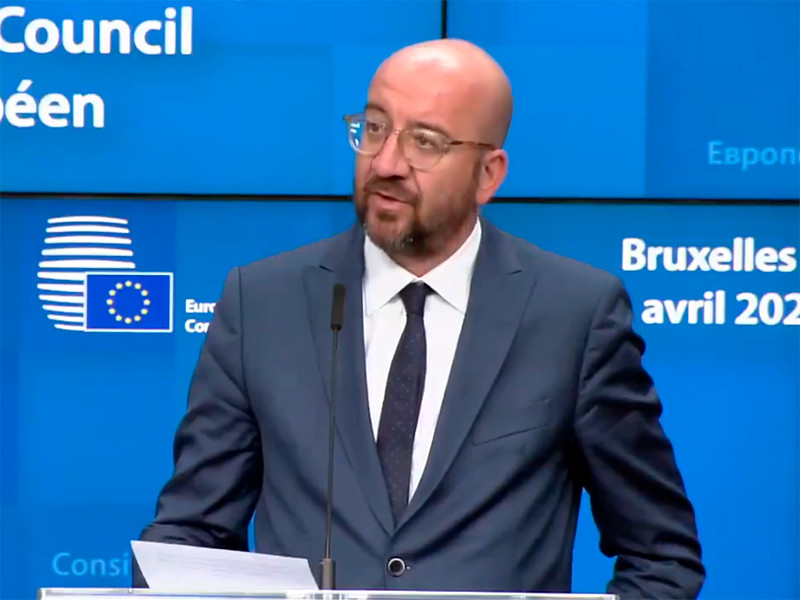
The heads of state and governments of 27 countries of the European Union approved the “road map” of the EU Economic Restoration after the Covid-19 crisis, said the head of the European Council Charles Michelle.
“It defines four priority sectors of actions. This is a fully functioning single market. Unprective efforts in the field of investment. Global actions (against coronavirus). A well -functioning management system,” Michelle said at a press conference on Thursday evening in Brussels after the end of the EU virtual summit. His words are given by Interfax .
He also announced the approval of three safety programs designed to support states, enterprises and workers for a total of 540 billion euros.
“We asked that this package could work on June 1, 2020,” the head of the European Council emphasized.
The leaders of the countries of the European Union instructed the European Commission to develop the parameters of the future long -term fund of the restoration of the European economy, which suffered due to the pandemic of coronavirus. “We all agreed that the issue of creating a recovery fund is urgent. We asked the European Commission to analyze the needs [countries and sectors of the economy] and make relevant proposals,” added Charles Michelle.
According to him, the fund will support the countries and sectors of the economy, which have suffered most of the quarantine measures during the pandemic of coronavirus. However, he did not call specific amounts. Germany, the Netherlands and a number of states are opposed to the release of pan -European securities, the so -called coronabonds that would allow money to attract money to the general warranty obligations of all community countries.
Before the Summit, the chairman of the Euro Group Mariu Senten called on the EU leaders to complete the coordination of the long -term recovery fund of the European economy as soon as possible, which should supplement the short -term economic recovery program for 540 billion euros, created by the European Investment Bank and the European Stabilization Mechanism (ESM, the Zona Euro Stable). Senten warned that the economy needed help in the shortest possible time to ensure the beginning of recovery.
Italia and Spain will receive almost half of the allocated funds, which faces default
This assistance program includes three main packages. Firstly, the European Commission has already created a Sure program with a volume of 100 billion euros for paying targeted compensation to employers so that at least some of them abstained from the dismissal of their employees. Secondly, the European Investment Bank, for its part, announced the allocation of a preferential lending program for 200 billion euros to support small and medium-sized enterprises. Thirdly, another 240 billion euros should be attracted in the form of the borrowed funds of the country of the Eurozone through the European stabilization mechanism: this money can be used as structural assistance to the most severe states (Italy and Spain) to keep them from the default.
This program is a mechanism of short -term assistance designed to provide an initial impulse for the restart of the EU economy, TASS reports. For a full restoration, the EU summit announced the need to create an additional long -term tool for supporting the economy. According to sources, its volume will be from 1.6 trillion euros to 2 trillion euros, the duration of the validity of at least seven years. Money to this fund will be partially involved and redistributed through the EU budget, for which states will have to increase their contributions to the general budget of the community.
As the head of the European Central Bank, Christine Lagard, said at the summit, a pessimistic script evaluates the economic decline in the EU at 15% in 2020, which is an unprecedented annual indicator in the history of the community.
In turn, the head of the European Commission Ursula von der Lyeen at a briefing reported that the EU member states should increase their contributions to the community budget from 1.2% to 2% of GDP for the next two to three years to finance the restoration of the economy after the Pandemia of the coronavirus.
The head of the EC emphasized that the EU budget for 2021-2027 must be fully adapted to the consequences of the pandemic. According to European sources, the issue of forming a new budget, which member countries could not solve before the appearance of coronavirus, will now become even more difficult. The budget was to be approved in December 2019.
Ursula von der Layen also noted that all 27 European Union states have already allocated over 1.8 billion euros of assistance to its enterprises.
At the same time, von der Layin emphasized that "all EU countries have various economic opportunities," therefore these inconsistent individual state -friendly packages can create a "tremendous imbalance in the functioning of the Unified EU market if they are not stabilized at the European level."
The head of the European Commission added that all EU states and institutions of the European Union (the European Commission, the European Central Bank and the European Investment Bank) allocated a total of 3.3 trillion euros to support the community economy in the context of the pandemic.
Under normal conditions, the community has very strict standards for the provision of the Estabosian to enterprises, because if one of the countries begins to support their companies, they will receive a serious competitive advantage over partners from other European states operating in the Unified market. Therefore, each program of the state of state from the government of any country of the EU is carefully studied and often deviates to the European Commission. However, in the context of the Pandemia of Coronavirus, the European Commission began to almost automatically allow any national measures to help business, as a result, it is difficult to even evaluate how different the conditions for restarting the economy in relatively prosperous Germany and weak Italy may be.
The European Union prepares the nationalization of enterprises in exchange for the state
Brussels completes work on a bill, which should allow the EU states to fully or partially nationalize enterprises in exchange for help from the state. This was reported on April 23 by the Spanish newspaper Expansion with reference to the working version of the directive, which can be adopted in the coming days.
It is meant that states will be able to enter the capital of large and small companies to help them avoid bankruptcy against the backdrop of the pandemic of coronavirus and the global economic crisis.
According to the Spanish publication, the minimum threshold for the state’s entry into the capital of the company may be the amount of assistance in the size of 100 million euros. At the same time, Germany and France believe that the lower threshold should be raised to 500 million euros.
According to the publication, the working project explains that these steps are aimed at "guaranteeing that the contribution of these companies to the proper functioning of the EU economy is not at risk."
At the same time, Spain belongs to a new extent with caution, since different EU member countries have different opportunities to save their own enterprises, which will lead to a violation of a competitive environment.
On March 19, the European Union stated that he intends only to provide assistance to companies to facilitate their position, mainly due to state guarantees on loans, subsidies for wages and delayed taxes. However, a little more than a month later the EU position has changed a lot, and now we are talking about nationalization, which should help avoid a “large number of bankruptcies,” writes Rossiyskaya Gazeta .
At the same time, individual countries have already begun the nationalization of individual companies. So, back in mid -March, the Minister of Transport of Italy Paola de Mikeli announced that the National Alitalia air carrier (49 percent belongs to Etihad Airways) can switch to state balance.