
Translated material
Antidononics and parasites
Online premieres: Russian Horror “Sputnik” and the Bi Bi Bi -Tester “genuine story of the Kelly gang”: to watch or not?
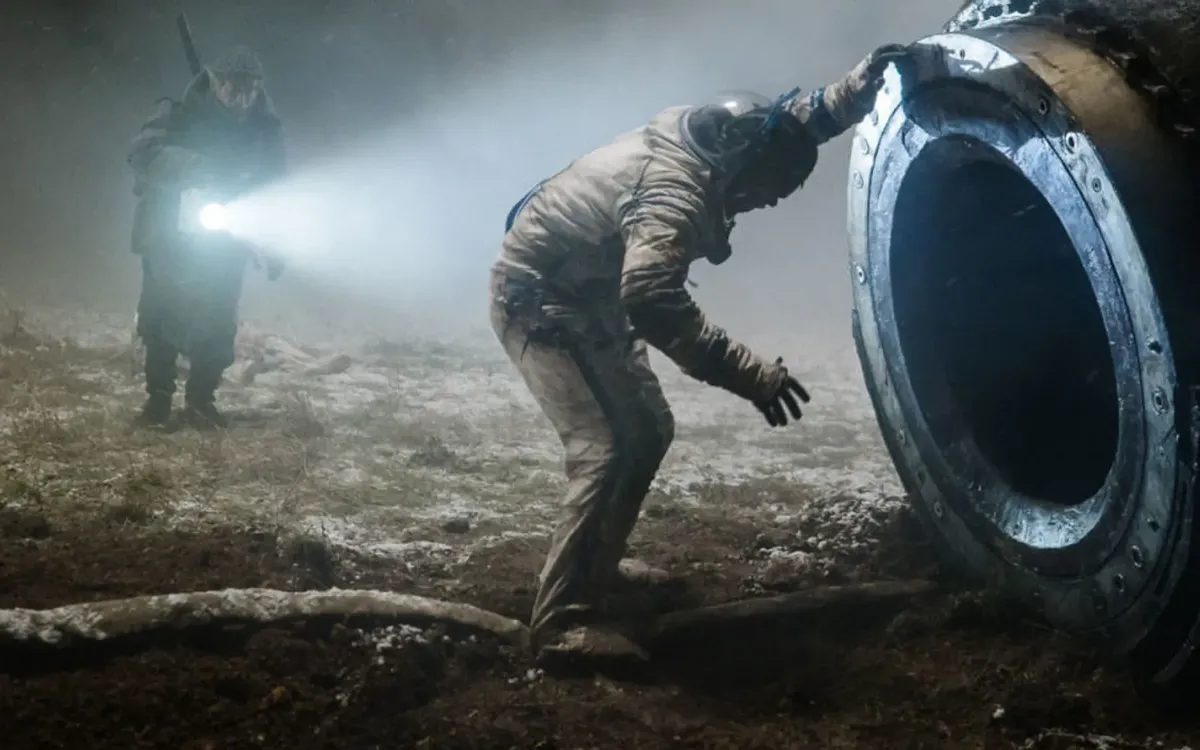
Parasite
The film by Yegor Abramenko and the scriptwriters Oleg Malovichko and Andrei Zolotarev “Sputnik” can be considered as a continuation of the Bondarchuk trilogy (here he is in the role of one of the producers) with monosyllabic names of previous chapters: “Attraction”, “Invasion”.
1983. Two Soviet astronauts begin the descent to the ground, singing their native hit “Million Scarlet Roses” ... But then they knocked on top.
The survivor Konstantin Veshnyakov (Peter Fedorov) will be on the basis of the Military Institute in full depending on the gray -haired colonel Semiradov. The echo of the surname of the Semi -City at the character of Fedor Bondarchuk is unprofitable, in it the service of the weapon has long turned into mania. Neurophysiologists are examined amnesia of the “Returned”: the traditionalist (Anton Vasiliev) and the innovator Tatyana Klimova (Oksana Akinshina knows how to justify even the most impossible circumstances), of course, under the close supervision of the military. It turns out that Veshnyakov brought in his body a squalling unknown creature of a tubular form, in fact, a cosmic parasite.
When you watch a movie on quarantine, coronavirus optics involuntarily arises. The landed astronaut is sick of blood, earthlings are touching him - I want to immediately wash my hands, although the infection does not penetrate through the screen.
However, a biological, cosmic science fiction with an elements of a horror, the action of which, in fact, develops in a closed space, will look especially acute in isolation (the film will also be released on the screens, but after the abolition of quarantine). “Aliens” or “it” here go here, of course.
And the xenomorph, which is burdened with the Hero of the Soviet Union, is not just dangerous, he is a devourer of people.
The "satellite" was made, in general, firmly, although sinning with scenario defects. Yes, and the melodramatic lining of children's and youthful injuries of the main characters is excessively pedal. But there is in the film that grew out of the author’s short film “Passenger”, the genuine environment of the Soviet country. With the killed walls of the walls, convicts in the quilted jacket, rustling radio, the smell of linoleum and stewed cabbage of the orphanage, blue tracksuits, hard sneakers and ... spilled in the air with fear. With the motto "If the hero means is ready for sacrifice."
This is a clash of the disappeared into oblivion, already in its own way of a fantastic reality with space foreign lives-the most convincing in the picture. And the heroes here, as in good science fiction, like Azimov or Strugatsky, are not fighting the universe and not so much with each other (the theme of militarism is the most uninteresting here), but with themselves and with a fear that does not necessarily come from space.
"The true story of the Kelly gang"
“The genuine story of Kelly’s gang” Justin Kurzel is a film adaptation of the novel by Peter Carrie, who received the Buker Prize in 2001.
What is common between the Kurzel’s film about one of the famous robbers from Kelly and Joker? Both paintings are hymns to the Avengers, who turned the madness into rock and roll retaliation. Kurzel, completely refuting the name, which he himself proposed, warns his story with a titer: you will not see anything like the real story of the Kelly gang.
Ned Kelly, Bushrainger and a robber of banks, hanged in 1880 at 26, managed not only to become famous, but also to become a national hero along with the first Australian commander John Monash. How do you like it?
The nicknames of the “killer child” and “little butcher” stuck to the future Nationalger in childhood. They say that for the first time he killed a man at 12 years old. But for the Australians, he also
A folklore character like cruel Robin Hood.
Not only the killer of 16 policemen, but a symbol of resistance to police officer and colonial regime. Not just a robber of banks, but a noble robber who burned the embedded, freeing the poor from the bondage of debts.
However, the director does not romantic Kelly, he dismantles the myth and the real story of the bandit, folding from the fragments of his biography and fiction of his gloomy ballad. There are three verse in it: “boy”, “man” and “monitor” (as the robber calls himself, the Vargan Iron Barnya in front of the battle with the police-this “armor” with bullets is still stored in the Victoria State Library in Australia).
For filmmakers, the story of Kelly is a magnet, more attractive to other comics. It is no coincidence that she is so fond of filming. The eminent killer was played by Hit Ledger (Gang Kelly), and Mick Jagger (Ned Kelly). And now the British George McCay. His nit upon is cruel and infantile: Kurzel shows how, anger (Russell Crowe) wakes up anger, in an offended, impressed, disgusting boy, whom his mother sells an experienced criminal Harry Power (Russell Crowe). As a reckless, desperate character of the avenger is formed from injuries and love for a cruel mother. The young gang goes to business in women's dresses in order to stun, knock the soil from under the feet of an embarrassed enemy.
“If you wear a dress for battle, they will think that you are crazy,” says his younger brother Dan. “Nothing scares a person like madness.”
Thus begins a steep descent in a criminal life, into a fog with spreading bloody spots of madness. In the world in which he is trying to keep power with the help of a dress, a pistol and home -made armor. Kurzel thickens the feeling of carnival in battles of local significance between bandits and uncontrolled keepers of the law.
Antidononkhot in home -made armor, thugs in women's dresses and violence as the only way to pay with the vile world in which a militarized police is associated exclusively with terror.
The evil and disturbing film of Kurzel gives the viewer the scope for the polar attitude to the acts of Kelly and his criminal “Boys-Bend”: from monstrously criminal to revolutionary ones. Some of the experts even saw in the film a critical portrait of the people and countries formed by violence and cruelty.
Kurzel charges the screen of Pankovskaya energy of the hero. The image suddenly flickers unevenly, as if suffocating, or with a gang in fluttering dresses rushing through the homeless expanses and wastelands, past the trees scorched by the sun. And at one iconic moment, the picture narrows to a narrow strip of light in pitch darkness - we look through the slot in the helmet of Ned Kelly. The whole world turns into this thin trembling strip.