
Translated material
When quarantine will be removed in Russia, we study options on the example of European countries
In the fifth week of hard quarantine in Moscow, it is difficult to ask any other questions except one: when will this end? For the final email newsletter on this difficult week, we decided to study how the restrictions in the countries where Coronavirus came earlier is gradually removed-it comforts that this is already happening in half of Europe.

We made the main business media in the country, now we are doing better-subscribe to the email newsletter of The Bell!
Like ours
This week, the number of new Coronavirus patients in both Russia and Moscow stopped demonstrating exponential growth - three days in a row, from Tuesday to Thursday, it was consistently reduced. To argue that Russia passed the peak or entered the plateau, early, warns the authorities - but even officials begin to carefully talk about the prospect of removing part of the quarantine restrictions. More than half of the countries of Europe, where the epidemic began earlier, had already begun to do it.
It is impossible to draw conclusions on the basis of data for a week, any specialist in statistics will confirm. The Russian authorities do not also make them - neither Moscow nor federal ones. Sergei Sobyanin on Thursday, when the number of cases fell the third day in a row, said : “We didn’t even go through the middle of the journey,” and promised that there would be no messages until May 1.
The “non -working days” regime operates in Russia until April 30. Dmitry Peskov on Friday said that there was no decision on his extension yet. But the regions already have the right (depending on the epidemiological environment) to expand or reduce the list of establishments that are allowed to work.
The possibility of mitigating quarantine measures in Russia, albeit in a theoretical manner, today was first spoke by Deputy Prime Minister Tatyana Golikova, who heads the federal operational headquarters to combat coronavirus. “The population is tired of restrictions. Of course, it is important to evaluate when we can weaken restrictive measures, ”she said. The head of Rospotrebnadzor Anna Popova, however, noted that this should not be done for at least another two weeks.
Rospotrebnadzor has already announced a plan for returning to work for catering enterprises - however, with an open date. The first should open venues with an area of up to 50 square meters. m and landing no more than ten people (restaurateurs, however, say that this will not save them). Also, the agency today called the conditions for the opening of hairdressers, dry cleaners and non -food stores in the regions - in compliance with these measures, the enterprise "can resume work in the coming days."
Like them
In order to better understand at what point we are, we looked at how the quarantine is softening (or does not occur) in two countries - Germany, where the quarantine softening plan is considered the most daring in Europe (not counting Sweden, which quarantine has not entered), and the UK, where the growth rate was most reminiscent of the current Russian ones, and no one is going to mitigate quarantine.
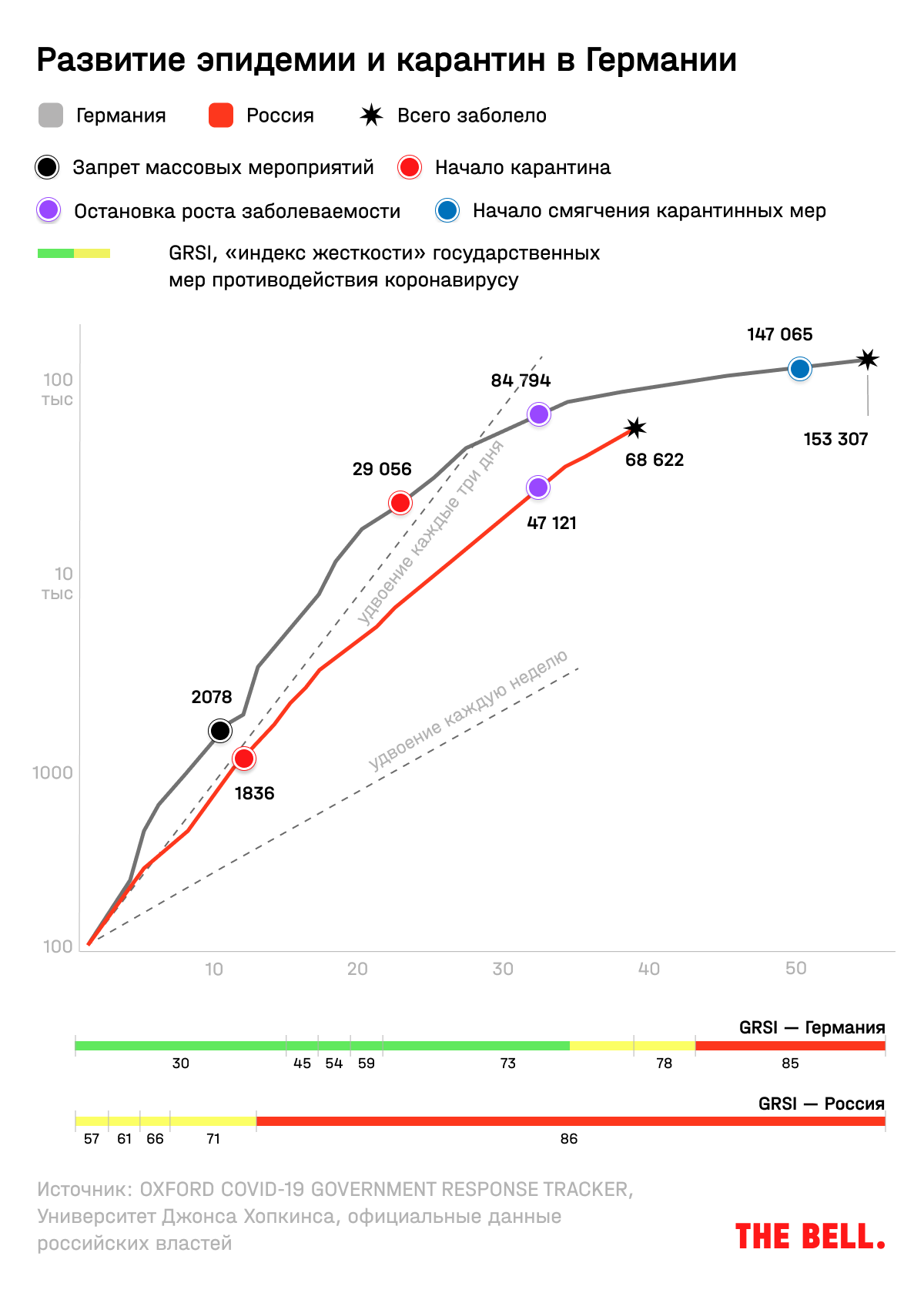
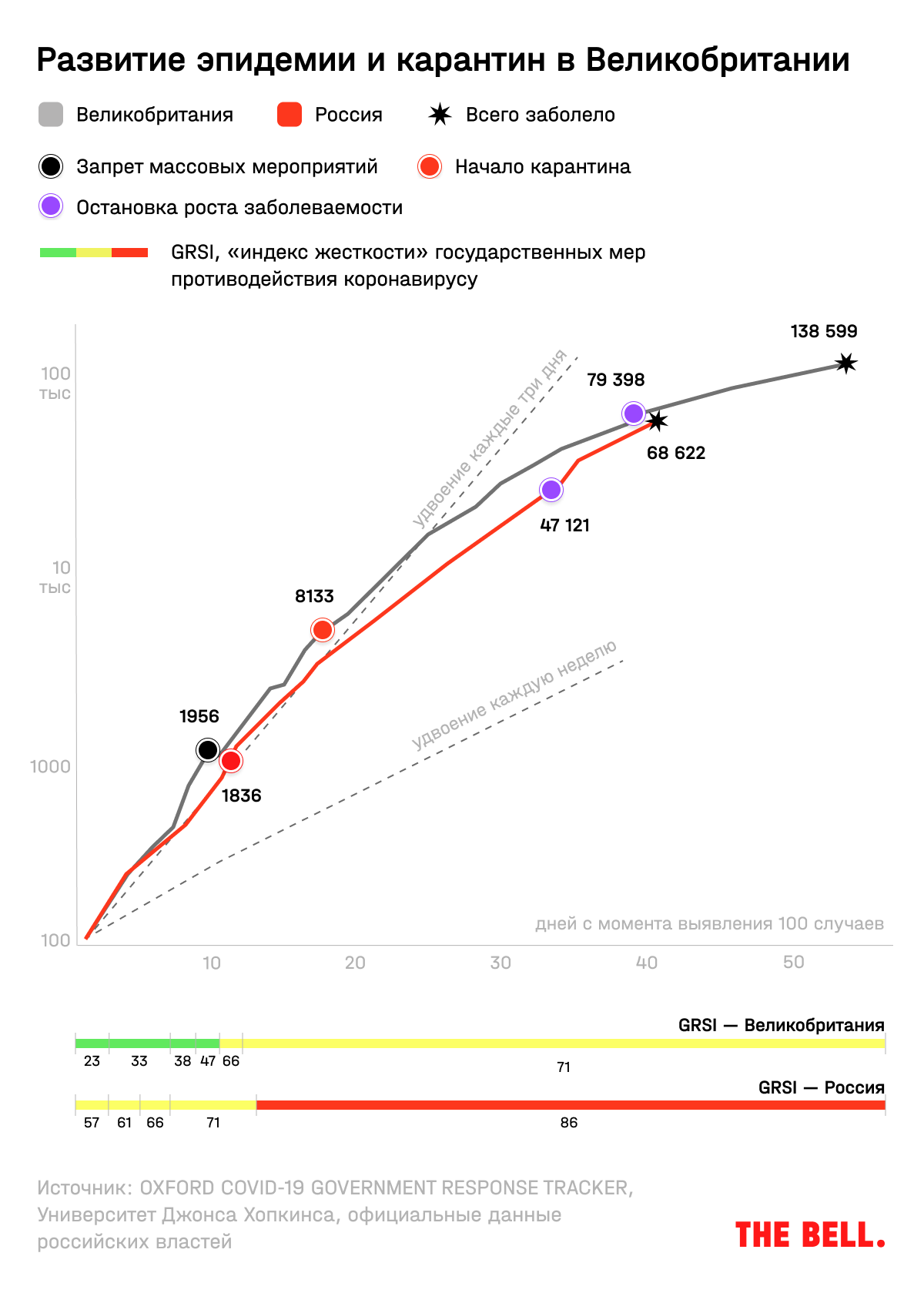
The countdown for each country begins from the day when the number of cases exceeded 100. In addition to the number of sick people, the dates of the introduction of quarantine measures and their stiffness, which are conducted by the Blavnik control school at the University of Oxsford, on a 100-point scale (0-lack of restrictions, 100-maximum level) are applied to the schedule. The dotted line on the graph shows exemplary lines of exponential growth: doubling the number of sick every week and every three days.
Germany
Germany is considered an exemplary country to combat coronavirus in Europe, but only in terms of mortality - 5.6 thousand dead for 160 thousand sick (fifth place in the world). The first restrictions in Germany began to be introduced two weeks after the number of cases reached 100. According to Oxford estimates, these measures were much softer than Russian.
From March 12 to 23, mass events were banned in the country, closed kindergartens, schools and universities, shops (except for grocery and pharmacies), restaurants, fitness clubs, beauty salons and brothels. The companies were ordered to transfer the maximum employees to the remotes, and from people they demanded to observe a distance of 1.5 m and not gather in groups of more than two people.
The maximum set of measures was valid for a month. The number of new cases of infection in Germany has ceased to grow from April 2, and from April 20 they began to enter into force. The work of non -food stores with an area of up to 800 square meters has already been allowed. m, bicycle stores and car dealerships, from May 4, will partially resume the work of the school, hairdressers will open (but only for cutting and using protective equipment). People still cannot gather more than together and come closer to each other than 1.5 m. In some lands, it is forbidden to be in public places without a mask - for example, in Saxony for this they introduced a fine of 50 euros.
On April 30, the German authorities will summarize the first period of quarantine softening and discuss further steps.
United Kingdom
The figures of the daily growth of sick in the last five days in Russia are most reminiscent of the numbers in the UK from April 3 to 8. In Britain, the first hundred cases were revealed on March 5, and the growth of the daily number of sick people ceased on April 10 - but no restrictions have been lifted so far.
On March 16, they began to introduce social distance measures in the UK, and Lokdown announced on March 23: you can leave the house only for going to the store, playing sports on the street alone or with a family, traveling to work is allowed only if it is impossible to work from home. All shops and enterprises of the service sector, except for food, are closed.
Initially, quarantine in Britain was introduced in three weeks. Both citizens and the authorities hoped that it would be possible to at least weaken it, but on April 16, a week after stabilizing the number of new sick people, the government announced the extension of the Locdown for three weeks. Foreign Minister Dominic Raab (he replaced the prime minister Boris Johnson, which was sick with coronavirus) said that the abolition of quarantine would lead to a sharp increase in infectivity.
That in other countries
In general, in Europe, more than half of the countries, including Italy and Spain, have already gone to some extent in Europe, in each of which more than 20 thousand deaths have been recorded.
In Italy (193 thousand sick, 26 thousand dead), Prime Minister Giuseppe Comte, until the end of the week , should present a plan of the phased dicking of quarantine, starting on May 4. On this Tuesday, the number of recovered in Italy for the first time exceeded the number of new sick. The work of stores can be resumed from May 11 or 18, and then to remove restrictions on the movement of people. Since mid -April, bookstores and laundries have already been working in the least affected regions.
In Spain (220 thousand cases, 22.5 thousand dead) a plan for the complete removal of quarantine yet, but from this Sunday, the authorities for the first and a half allowed the children to walk on the streets accompanied by adults. Until now, children could only accompany parents on campaigns in a store or bank. The Spanish quarantine regime is considered the most tough in Europe.
In Belgium (44.3 thousand sick, 6.7 thousand dead), the government was supposed to publish a “road map” of quarantine removal on Friday late in the evening. From May 4, the work of non -food stores and partially - schools, playgrounds and open sports grounds can be resumed. On weekends, it is supposed to allow people to gather companies up to 10 people (but this should be the same people every week), on weekdays - up to two.
The Switzerland government (28.6 thousand sick, 1578 dead) today allowed medical clinics to carry out procedures as usual, resume the work of hairdressing, cosmetic salons, and household goods. Gathering companies more than 5 people is still prohibited.
In the Czech Republic (7.2 thousand sick, 214 deceased), the government in mid -April presented a five -stage quarantine remission plan. On April 20, farm markets and car dealerships resumed work in the country, yesterday - borders were opened , from April 27, shops with an area of up to 200 square meters will open. m, from May 11 - up to 1000 square meters. m. The final point of the plan is June, when hotels and restaurants open.
Partially soften quarantine Denmark, Norway, Poland, Albania, Austria, Slovenia and Bulgaria.
In France, the Netherlands, Portugal (22.8 thousand sick, 854 dead), Greece, Hungary and Ireland, no specific measures to mitigate quarantine are planned.
A visual map of the mitigation of quarantine measures in Europe can be seen here .
In all countries that soften quarantine, this is accompanied by mass distribution of masks to citizens (in public places in most countries they must be wearing), as massive testing and strict observance of social distance.
What's next
The main fear of opponents of quarantine softened is that the second wave of the epidemic will follow the removal of restrictions. Now in most countries that weaken quarantine restrictions, the dynamics of the epidemic either on the plateau or decline.
In part of the countries-for example, Norway and Germany-the basic reproductive number (the number of people who infects one patient on average) already in the beginning, in the middle of April fell below 1: if you hold it at such a level, the epidemic over time should come to naught by itself. But a week after the first measures to weaken quarantine in Germany, the value increased to 0.9. Angela Merkel previously warned that with a value above 1, the German healthcare system would begin to experience difficulties.
At the end of March, the British authorities said that the COVID-19 basic reproductive number in the country dropped below 1, and the French scientists appreciated it for France at 0.5 this week-but the restrictions in both countries are not going to shoot.
The only way to prevent the occurrence of a second wave is to identify and isolate the sick as soon as possible, writes The Economist. The preservation of basic restrictions - social distance, restrictions on the number of buyers in stores, a ban on mass events, wearing masks - inevitably either before the start of mass vaccination (until 2021 it will not be), or before the formation of a collective immunity of 40-60% of the population. In Europe, on March, the share of people with immunity was estimated at 1-15%.
Did you like the material? Subscribe to the email newsletter of The Bell "Results" for which it was prepared, can be here .