
Translated material
Whether quarantine works - we tell you on the example of California
The first study of the influence of Lockdown on California data showed that early restrictive measures can reduce mortality by 3–9 times and the benefits grow exponentially. At the same time, each saved life “costs” the loss of 113-300 jobs, writes Econs.

We made the main business media in the country, now we are doing better-subscribe to the email newsletter of The Bell!
How California introduced quarantine
California was the first to introduce hard quarantine in the United States: from March 19, residents are forbidden to leave home, with the exception of urgent cases (they include the purchase of products and medicines, care for relatives, short walks and work trips - for employees of those companies that are recognized as significant, all the rest are closed, like beaches and other public places). Outside the house, people should keep a social distance of 6 feet (about 1.8 meters). Violators face a fine of $ 1000 or imprisonment for 6 months.
As of March 19, according to the State Health Department, California confirmed 1006 cases of coronavirus infection and 19 deaths, with a population of about 45 million. The day before the introduction of Locksuan, Governor Gavin News turned to President Donald Trump with a request to send the US Navy’s floating hospital to the port of Los Angeles, The largest city of California, to reduce the load on hospitals - incidence, he wrote to the president, doubles every 4 days, and, according to the calculations, 56% of the population, or 25.5 million people will fall ill in the state after March 27).
California is one of the most densely populated states in the United States, the country leading in the number of infected in the world. The population density in California is comparable to New York (as of April 22, he is in fifth place in the world in an absolute number of deaths from coronavirus after Italy, Spain, France and Great Britain). California is also one of the most urbanized states - 95% of the population live in cities. All this means that the risk of the rapid spread of the disease in the state is very high.
However, by April 9, California was the sixth among the 50 states of the United States and the Colombia district at the lowest rate of growth in new cases of infection. And with the lowest pace of this growth among the most densely populated states. The mortality rate by this time in the United States grew to 5.07 per 100,000 people, in California it was 1.34 per 100,000 people. It is also the lowest level among the most densely populated states.
The introduction of hard quarantine at a relatively early stage helped to slow down the rate of spread of the disease and reduce the mortality rate of California, Joseph Sabia, director of the Center for Economics and Health of the State University of San Diego and a researcher at the International Institute of Labor Economics (IZA), and its co-authors came to the conclusion .
Quarantine and health
The estimates of sabia and co-authors built on different pools of data showed that in the first three weeks of Lokdown, from March 19 to April 9, thanks to the hard quarantine measures, California reduced the number of cases of COVID-19 infection by about 145–233 thousand, preventing more than 1800 to almost 5,000 deaths. On April 10, California confirmed 19,472 cases of coronavirus, the number of dead from it is 541. Thus, early and strict insulation measures allowed to reduce the incidence of 7.4–12 times, and mortality by 3.3–9.2 times.
Scatures in estimates are associated with different combinations of data obtained by the method of statistical modeling of the situation in the “synthetic California”, which would not introduce mass insulation on March 19. The dynamics of incidence and mortality in real California was compared with "synthetic". For modeling, researchers used data on different US states, similar to California (in the level of urbanization, population density, a similar rate of inconcension of incidence and mortality), which applied different types of individual restrictions that declared quarantine at different times after California or never declared it by April 9. Scientists also took into account the Safegraph index, showing the level of self -isolation of Americans according to their smartphones.
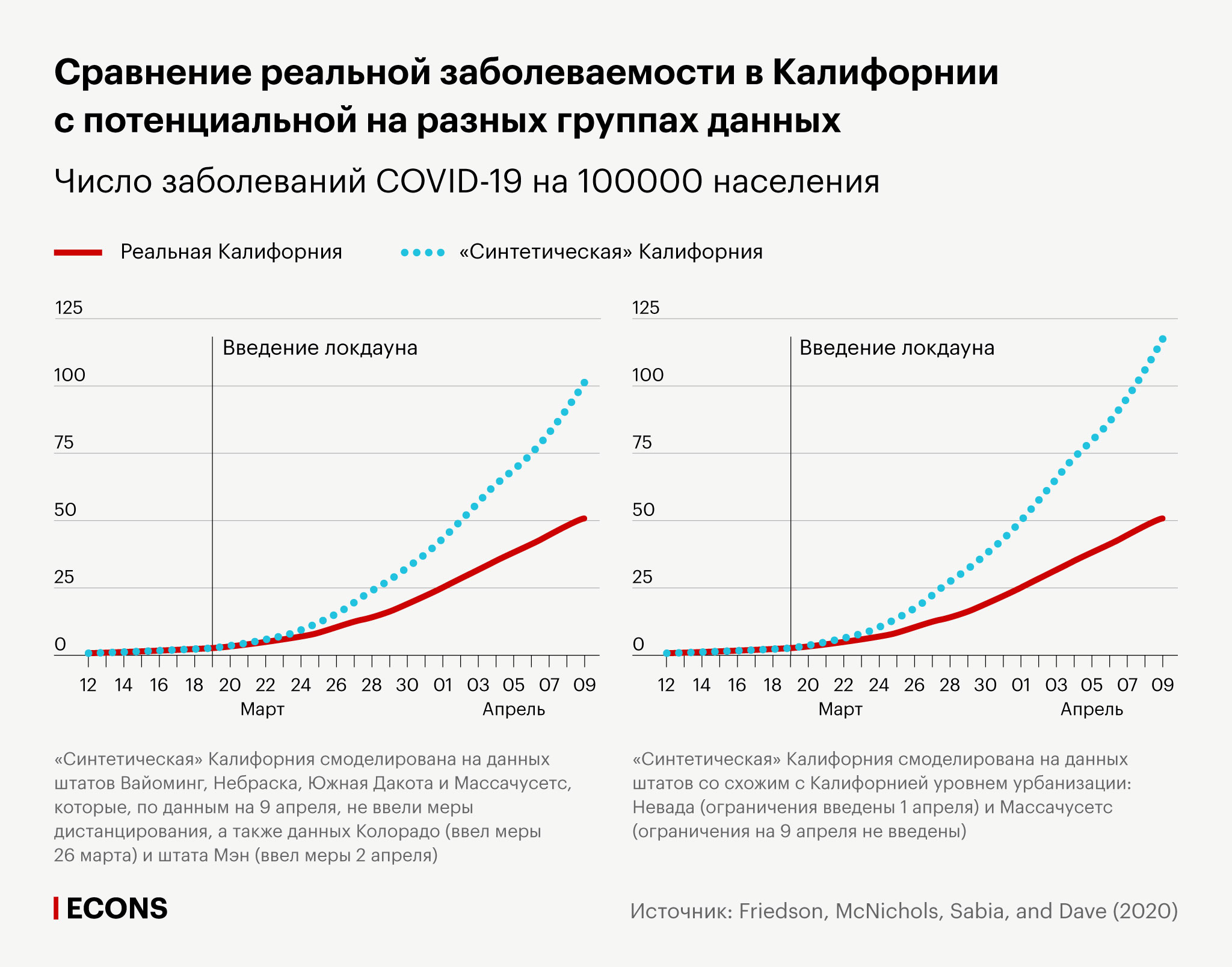
According to calculations, until March 19, the situation in California and in Synthetic California developed almost the same. After March 22 (that is, after 5 days, during which on average the virus is manifested in the diseases) the number of new cases in California began to decline in comparison with the control “synthetic” state: at first there are less by 20 cases per 100,000 population, by March 30 - by 29, and by April 9, by almost 20,000 cases of disease per day.
Modeling shows that the benefits of hard quarantine for public healthcare are increasing exponentially, the authors of the study note. Data on the advantages obtained also mention any claims to the introduction of the Locksuan and show the importance of the early term for restrictive measures, they conclude.
Quarantine and economics
The measures taken by the authorities of the state of California seriously restrained the spread of the epidemic, but the cost of large economic losses, which researchers illustrate on the example of a reduction in jobs.
Over the three weeks of Lokdown, the number of appeals to the state -wrapping fund has increased by 2.17 million. If we assume that all these appeals are associated with the restrictions introduced to restrain the pandemic, it turns out that in three weeks, from 9 to 15 lost jobs, from 437 to 1132, it took every prevention prevention from 437. The result of the result of an average weekly growth of appeals for unemployment benefits in Synthetic California, the result decreases by about 70%. That is, one prevented case of infection means a loss of 2 to 4 jobs, and each saved life is dismissal from 113 to 300 workers, Sabia and his colleagues calculated.
This choice will be the key in the decisions of politicians about when to cancel strict restrictions and weaken social distance measures, Sabia concludes . In the absence of a vaccine or effective treatment of Covid-19, politicians in the short term will encounter difficult solutions regarding the extension of measures that prevent or postpone the incidence and at the same time cause economic instability and poverty, he noted.
Part of the economic losses may be temporary, the authors of the study believe, since with the removal of Locksuan and a reduction in the threat of infection, fallen demand and consumer expenses will increase, and this will partly restore the labor market. In addition, incentives that guarantee support to people will help to reduce the scale of economic disaster. The federal government of the United States will send 5.5% of GDP for direct payments to the population, including $ 1200 to each adult and $ 500 children.
By the beginning of April, the obligatory home regime for its citizens introduced more than 90 countries, about half of the world's population was in isolation. In the United States, the predominant right to introduce quarantine does not belong to the federal, but local authorities - to the first persons of the state, a local or territorial government. Following California from March 20 to April 9, 39 more states and the district of Colombia introduced similar quarantine measures. At the end of March, Trump urged Americans to adhere to social distance until April 30: not to gather large companies, work from home, suspend schools and unite national efforts in the fight against coronavirus.
The Governor of California on April 14 said that there are no exact deadlines for changing the insulation regime in the state. The decision about this, the message says, will be made on the basis of scientifically based data and six indicators, such as the ability to develop therapy for the treatment of the disease, the ability of the healthcare system to cope with the leaps of incidence, the ability of organizations and children's institutions to maintain social distance.
Also read on the website Econs.online :
What is the difference between the banking markets of Russia, Kazakhstan and Belarus
Former chief economist of the World Bank Pinelopi Goldberg - about what will happen to world trade after a pandemic
Can remote work increase productivity
Bell Club
How to save money and earn during a crisis and pandemia
On April 30, Bellclub will hold an online conference on investments and asset management in a new crisis. What to do with money when blood is pouring in the markets? Are there any protective assets in the era of pandemia? What can you earn if you are not afraid to take risks? Is it time to run from Cyprus, and if so, where?
Our guests:
- Alexey Savatyugin, auditor of the Accounts Chamber, Professor NIU High
- Alexander Kudrin, main strategist of the investment company "Aton"
- Alexander Zakharov, Partner Paragon Advice Group
- Natalia Smirnova, independent financial adviser
The meeting moderator is Elizabeth Ossetian, the founder of The Bell and the project “Russian Norms!”. Time: April 30 at 19:00. Registration is here .