
Translated material
Church of the great synthesis
Ten years ago, I worked as the editor -in -chief of one Orthodox site. Once, Vladimir Yakunin, the then head of the Russian Railways and the chairman of the Andrei Pervoznan Foundation, together with the director of the Kremlin museums Elena Gagarina, was given a press conference on the discovery on the Spasskaya and Nikolsky towers of the Moscow Kremlin of the walled icons. The icon of Christ the Savior on the Spasskaya tower and the icon of Nikolai the Wonderworker on Nikolskaya were shot by the Bolsheviks during the assault on the Kremlin, they were painted over in the 30s , then they were considered lost, and after almost 80 years they found under the initiative of the Andrei First-Called Foundation. Yakunin solemnly announced the beginning of restoration.
I sent a correspondent there and asked me to ask a question how the faces would be adjacent to towers with red stars - a symbol of the power that shot and walled them. After some time, the correspondent called and began to be indignant that I set it up. Yakunin and Gagarin answered with a chorus with a chorus: “And when was it the last time you saw the stars? The Kremlin towers have long been a symbol of Russian statehood - eagles! ” The editorial office was a few hundred meters from the Kremlin, and we all ran to look at the towers: the stars were in place. This incident got into the NTV report that day with a comment that the question is political, and between the two towers with the icons there is also a mausoleum with unlimited Lenin and columbarium in the wall.
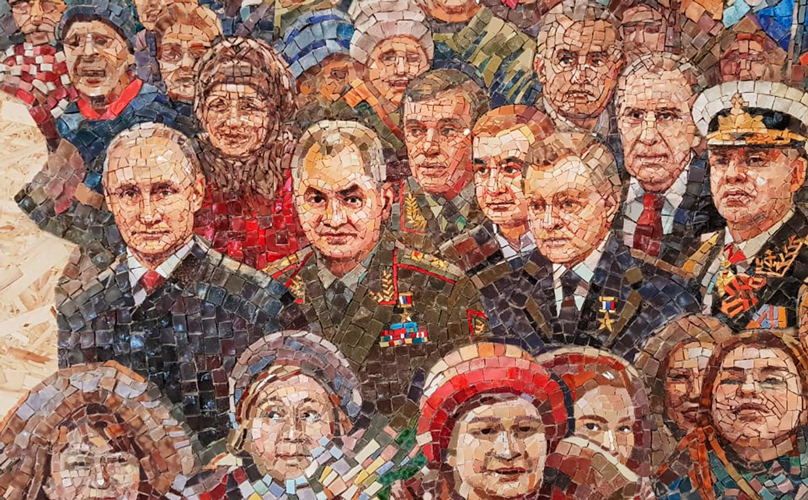
Ten years later, an Orthodox church was built in the Moscow Region, where not only red stars, but also a sickle and a hammer, and red flags, and even Stalin are depicted on stained glass and mosaics next to the faces of the saints, the Virgin and the Savior. There are also mosaic images of Vladimir Putin, Sergey Shoigu, Valentina Matvienko and “polite people”, as well as the inscription “Our Crimea”. This is the main temple of the Armed Forces of the Russian Federation in the Patriot Park in Kubinka. He was supposed to be solemnly consecrated to the 75th anniversary of the Victory on May 9, 2020, but now the opening was postponed to once after quarantine. And the photos of the mosaic leaked to the Internet through someone who sent them to the editorial office of MBH-Media . They say that some of them have not yet been mounted and is in the workshop, and not in the temple.
The rector of the church, Bishop Klinsky Stefan and the chairman of the Artistic Council for the construction of Archpriest Leonid Kalinin, began to comment on the media that the image of historical characters on frescoes and mosaics was a tradition and since Stalin was at the Victory Parade, why not? Judging by their stories and those photographs that appeared in the open access, on the walls of the temple a comic book based on the military history of Russia is depicted about its version that the Russian military-historical society adheres to-from victory to victory: the Battle of Kulikovo, the Troubles, the War of 1812, the Kursk arc, Stalingrad and further the “unquestioning annexation of the Crimea”. Moreover, stylistically this comic is somewhere between pop art and socialist realism. A very innovative decision for the Orthodox Church. However, in a commentary for the Vedomosti newspaper, historian Sergei Brun compared this aesthetic solution only with magnets on the refrigerator .
In history, you can really find anything - images of rulers and donors in the temple painting, and battal scenes with weapons on icons, and temples - monuments of battles. But still, firstly , icon-painting style has conventionality, these are not photographs from which these mosaics are taken in the coolest form. Secondly , the rulers were usually depicted in relation to the saints and Christ, like the pious praying people and anointed. And the monuments that were built, first of all, in memory of those who died in the wars, for prayers for the deceased, so as not to forget at what cost the won battles were. In addition, an endless search for precedents and analogies demagogically leads away from a conversation about the present. And in the present one should not treat this Khaki color temple as an Orthodox, Christian. This is a monumental aesthetic embodiment of another religion - the civil religion of victory.
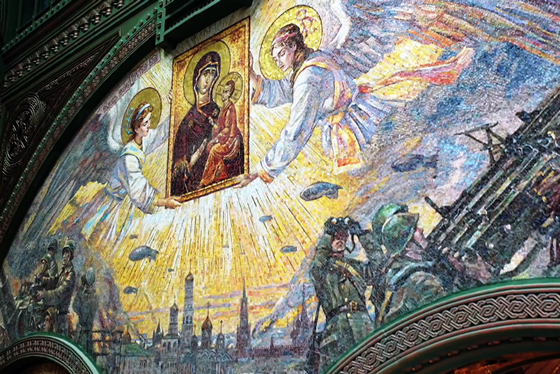 © RIA Novosti interior decoration of the main temple of the Armed Forces of the Russian Federation in the Patriot Congress and Exhibition Center in the Moscow Region
In 1995, on the 50th anniversary of the Victory in the Great Patriotic War in Moscow, the previous memorial complex was opened on Poklonnaya Gora. This is also, like Patriot, a memory park. And he reflects the spirit of his era- the 1990s , although he was founded during the years of stagnation. On the one hand, it captures the Soviet tradition of the memorialization of war: an obelisk, eternal fire, large cold museum halls, weapons. On the other hand, a cheerful, slightly cynical perestroika eclecticism: the goddess Nick next to George the Victorious. There are attempts to rethink the war not in the heroic, but in the tragic register - the sculptural composition of the Tsereteli “The Tragedy of the Peoples” and the Red, Bloody Higher of Fountains. The religion is separated from civil memory, multicultural and tolerant - there is a small, modern, bright temple of George the Victorious, similar to a candle, and there is a memorial mosque and a memorial synagogue with a museum of the Holocaust. They are open to the 850th anniversary of Moscow in 1998 in memory of the people of all religions that died in the wars-in line with the tradition and law on freedom of religion. Nowhere are the images of neither Yeltsin, nor Luzhkov, nor Stalin. But in Putin's Russia, the Poklonnaya Mountain remained somehow unclaimed, with its multiculturalism and variability it contradicts the new sacralization of victory.
The concept of "civil religion" was introduced by Jean-Jacques Russo back in the 18th century. He needed to justify that he would hold the nation together, to rally it in the absence of God's anointed - the monarch and his sacred power. In the Russian Concept, the civil religion is supported by the state, consists of certain values and rules that imply loyalty to their country, but at the same time in private life, citizens can adhere to any beliefs. This is a determining thesis that everyone who studied the civil religion in the future, in particular, the American sociologist Robert Bell, who in the middle of the 20th century described in detail the phenomenon of civil religion in the United States. Bella believed that in the formation of such a religion in America, the civil war played a large role, when death in the battlefields for the homeland found sacred meaning, began to be perceived as a sacrifice. It is important that the civil religion does not contrast itself with the “real” religions, but as it were built over them, absorbing their symbolism and images.
Civil religion is one, equal and mandatory for everyone, while in private life you can believe in anything, but observing the ritual of loyalty. This ritual in our case is borrowed from the "real" religion - Orthodoxy. Through a recognizable form - images, actions, words - a civilian cult legitimes, encodes itself as a religion. But this is nothing more than a form.
On the other hand, the philosopher Walter Benjamin also wrote about similar mechanisms. In his unfinished essay “Capitalism as Religion”, he, being a left -handed, used the Marxist conceptual apparatus, but formulated that he rhymes with the concept of civil religion: “Capitalism is a religion of a pure cult, without dogma. <...> In the West, capitalism <...> developed in relation to Christianity parasitically - in such a way that in the end, in fact, the history of Christianity is the history of its parasite - capitalism. "
The cult without dogma refers to much more ancient plots - the religious system of Rome, which prescribed rituals, but did not regulate what to believe in. At the same time, the authorities interpreted relations with the gods and watched that citizens did not insult them (something reminded?). The French historian John Shaid in his classical work “Rome Rome” wrote that the Romans, unlike the Abrahamic religions, did not have a religious dogma, but there were myths and “one of the favorite forms of myth was history”.
History as a myth is captured in mosaic comics on the walls of the Temple of the Armed Forces of the Russian Federation. Above the jubilant crowd in the Crimea of 2014 is the Virgin, extending its cover. Above the 1945 parade with Stalin, the face of the Kazan icon was revealed, while the marshals of Victory in noble orders rejoice about their own, they do not come to the Mother of God, who for some reason illuminates the rays of the spotlights, no one looks at her.
In the cult of the Great Victory, the defeat is equated with sin. The victims are accepted only if the military campaign was crowned with success. For which in their history the military could repent in a Christianly or simply think, deleted-there is neither the Soviet-Finnish war, nor the introduction of troops into Czechoslovakia, nor Afghanistan, or even more so Chechnya. The story is complex, the myth is built.
But the creators of the temple seem to believe in numerology. At least, the numbers are present in all descriptions: in the iconostasis of 48 icons - according to the number of months of the war, considering the Japanese (so to calculate the number of icons - in general, outside the mosaic - 2644 square meters - according to the number of full cavaliers of the Order of Glory, the height of the temple is 96 meters, because 960 is considered the year of birth of the Equal -to -the -Aporal Prince of Vladimir, The patron saint of President Putin, and so on . This, of course, is pure magic, not even paganism.
Paradoxically, pagan religious forms, mutating, survived to this day and fight again with Christianity, using it as a tool in this struggle. In Rome, Christians were persecuted precisely because Christianity was not a religion in the ancient sense. The ancient martyrs refused to express loyalty to the cult, even when, by swearing it publicly, it was possible to believe at home anything, and died for it. Now Orthodoxy itself turns into this form of expression of loyalty.
But what is loyalty? What is behind the cult of the Great Victory, what does it symbolize for modern Russian authorities? It was precisely why today it would never have occurred to anyone to make excuses for the coexistence of stars with icons. The mission of Putin is the reconstruction of the continuous, consistent and triumphal Russian history.
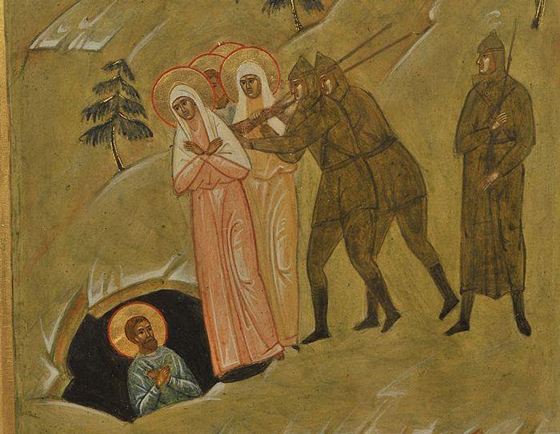
All the vague perestroika and nineties “Russia that we have lost” - Holy Rus' and the Orthodox Empire - opposed the USSR. You should have been either for one or another. For white or red. The Communists are Orthodox antagonists. The victims of repression are canonized , so it is impossible to read the martyrs and their persecutors at the same time. It was a matter of morality. The Bolsheviks destroyed the temples and killed people, Encavedeshniki are depicted as tormentors on icons. The descendants of the emigrants of the first wave come like angels from heaven. But what about Gagarin, the atomic bomb, the Olympiad, constructivism, the equality of women, after all? Absolutely impossible?
Then Putin comes, returns the anthem of Alexandrov. For twenty years he sewed this spraying fabric. And he succeeded. What was redeemed by blood spilled by the Bolsheviks is a great victory.
In the historical myth on which the civilian cult of the Great Victory is based, the pre -revolutionary Russia is the thesis, the Soviet Union is an antithesis, and modern Russia is a synthesis. Say, the Immortal Regiment is the Palimpsest of the Pervomaisian demonstration and the procession with banners. And the “bloodless accession of Crimea” is a great symbol of this synthesis, an updated victory, a sign that God accepted the victim and favors.
This is no longer eclecticism, but a formed civil religion. There is no dogma in it, adherents should not confess their faith, fulfill the commandments, enter into personal relations with God: the myth of collective, plastic and appeals only to feelings, power can interpret it as you like. And the temple here can only be one, general, and not as on Poklonnaya Gora. You just do not need to consider it Orthodox.