
Translated material
A WHO representative in the Russian Federation believes that during the pandemic there may be several plateaus
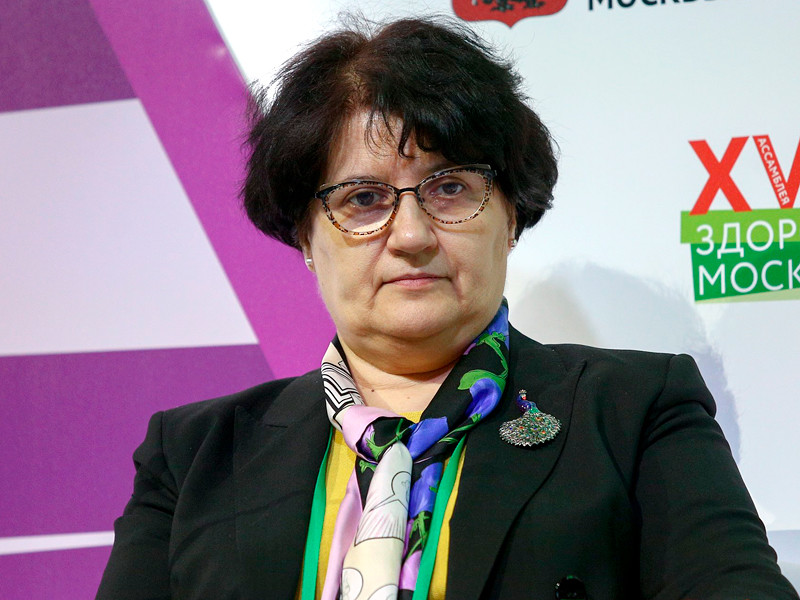
The representative of the World Health Organization (WHO) in Russia Melita Vuinovich on Thursday during an online meeting with an intrafraction group of the first deputy head of the Duma United Russia Adalby Shkhagosheva expressed the opinion that during the pandemic of the new coronavirus there may be several plateaus.
“Any epidemic goes to the plateau,” she noted, clarifying that the fight against coronavirsom is complicated by the lack of immunity in people. “So, unfortunately, it may happen that there will be no one plateau, they will go like a sinusoid.”
Melita Vuinovich also believes that the line for the incidence of coronavirus in the Russian Federation, and in Moscow in particular, "is aligned, but this is not a plateau in any case."
Adalbi Shkhagoshev, in an interview with TASS correspondent, noted that Vuinovich emphasized the role of the Ministry of Health of the Russian Federation and the “organizing the work of power as a whole” in the fact that the country managed to avoid a jump in mortality in the conditions of the pandemic, and the statistics on deaths are moderate. “If now the growth of the sick is 5-7% per day, then it used to be 20-25%. This suggests that we are going to some plateau. It is about the fact that the line is aligned,” the deputy added.
He also said that earlier on the State Duma website a section was launched about the support measures available to Russians in the conditions of the pandemic. The section is designed to become an aggregator of official information about the measures of state support for citizens and small and medium -sized businesses during the fight against the spread of coronavirus.
On April 29, the Governor of the Moscow Region Andrei Vorobyov announced that the region had entered the plateau along the coronavirus. “We went out on the plateau ... Probably, this is a plateau. Regarding growth-this is 5-7%. I think that we will stand on it (on the plateau) for some time. Then the decrease will continue,” Vorobyov said on the air of Russia-1.
In Russia, according to the Federal Operational Headquarters to combat coronavirus, 106,498 cases of infection were registered, 11,619 people recovered, 1,073 people died.
Restrictions can be loosened since mid -May, it is considered in the
In connection with pandemia, the restrictions introduced in Russia can be gradually weakened after May 12, if the growth rate of the infected begins to decline. This was stated in an interview with TASS, a representative of the World Health Organization (WHO) in the Russian Federation Melita Vuinovich.
“The first condition: the number of new cases is constantly falling. <...> The coming two weeks are now key so that the spread of the virus ends, so that the number of new cases of infection is constantly falling, and we could say: yes, now it is possible to consider what measures it could be weakened. May 12 is a logical date,” she said, answering the question of the terms of a possible gradual weakening of restrictions.
Vuinovich noted that 2,800 - 3,000 people are still infected in Moscow daily. “It is necessary that this number is constantly reduced. Then it will mean that the number of people passing the virus has decreased. This must be controlled,” she emphasized.
To remove restrictions, the corresponding plan must be developed, in each region you need to evaluate the risks, the representative of the WHO added. “This does not mean that everything needs to be discovered immediately, because there will definitely be a surge in diseases. It is important that the entire population understands: all measures - physical distance, hand disinfection, prevention at the workplace - will be very important for us to cope with coronavirus, otherwise this chain will begin again,” she warned.
Vuinovich warned that after weakening of restrictive measures, either a decrease or an increase in the number of infection with coronavirus would be observed. "Now in many countries it is studied how to weaken measures to limit people's movement, physical, social distant, greater isolation. WHO has created a leadership - criteria that should be taken into account when the issue of weakening these measures is studied," she said. “And then one element, namely, the potential of the health and public health system, sanitary and epidemiological supervision is very important in order to understand when new cases appear, when new cases appear. Identify them, test, find contacts and isolate them for 14 days. "
In this case, the WHO representative continued, it will be possible to quarantine a certain small group of people and thus "prevent the distribution of quarantine to the whole society, the country." “But this period will be difficult, because the movement will go forward or backward, so we must learn to live with this virus,” Vuinovich emphasized.
According to her, a low number of cases of severe coronavirus infection is the result of good preparation of the Russian healthcare system. “I must honestly say that this is the result of the preparedness of the general system and healthcare and sanitary and epidemiological supervision. This is a joint work,” she emphasized. According to her, an important role was played by the rapid creation of Russia for its tests, wide testing of the population for coronavirus, early diagnosis and the beginning of treatment.
“The healthcare system immediately accepted everyone to itself: there were no significant cases of a person for a person who went over for five, six, ten days and only when he could no longer breathe, he went to the hospital,” the WHO representative said.
“We can say that Russians have a good enough immunity and health status,” Vuinovich added.
Earlier, the head of Rospotrebnadzor Anna Popova said that the severe form of the disease with a coronavirus infection is recorded only in 5% of cases.
Russia was also able to protect the elderly population from mass infection with coronavirus, said Vuinovich. “In the Russian Federation, only 15% of the sick are people over 65 years old, and if you look at other countries, there are a huge number of sick, the disease grew like a fire among this vulnerable part of the population. So [in Russia] the virus could not hit the most vulnerable. It turned out thanks to the early measures that were taken,” she said.
Vuinovich noted that for the older generation, insulation played a large role. “She, of course, has its own minus, but nevertheless, a large defeat in the virus in this group of people managed to avoid. At the same time, there are a lot of boarding schools that are now on quarantine. Also an unpopular measure, but she saved these boarding schools from infection,” continued the representative of WHO.
She cited the situation as an example in some European camps, where high mortality is observed in cases where the virus was entered into the nursing homes. “This part of the population should be paid attention to, because in the future they will be vulnerable. This does not mean that they must be completely isolated, but it is necessary to very rigidly apply infectious control measures so that these people are practically protected from the possible penetration of the virus into their teams,” Vuinovich said.
Russians must continue to adhere to precautions even after the removal of strict restrictive measures, said Vuinovich. “For some time, you need to understand that you should be next to your loved ones or acquaintances without very close contact, you just need to observe the distance. Do not come very close to people with whom you do not live together. This is the first step. Perhaps this will be preserved before creating a vaccine or the appearance of a significant layer of people with immunity,” she said.
Vuinovich also noted the need to adhere to standard hygiene standards, like washing hands. She added that such a measure of precaution as wearing a mask also reduces risks, but so far it is not yet known as much as. “And, of course, we must follow the recommendations of healthcare and the systems of the sanitary and epidemiological supervision of your country. These recommendations are not to make people an uncomfortable life, but to absolutely prevent a massive disease,” concluded a WHO representative in the Russian Federation.
On April 28, President Vladimir Putin extended the non -working period until May 11 inclusive. He also instructed the government and Rospotrebnadzor, together with the State Council, to develop a plan for the phased removal of restrictions and exit from the self -isolation regime. The head of state emphasized that in each region restrictive measures must be weakened, given the epidemiological situation.