
Translated material
Online, anti -globalism, surveillance
How will we live after a pandemic? Futurologists from Finland designed a visual radar
What will be the new world when it all ends? Economists, sociologists and political scientists from different countries are building their predictions, the accuracy of which is now very difficult to assess. A team of researchers from Finland working on the Futures Platform project (the future platform) presented their version of vision.
They summarized the results of their research in the form of a visual instrument-a Covid radar. All trends caused or, conversely, weakened by the flash of the virus are divided into six categories:
health;
work and lifestyle;
industry and production;
services and consumption;
economics and trade;
society.
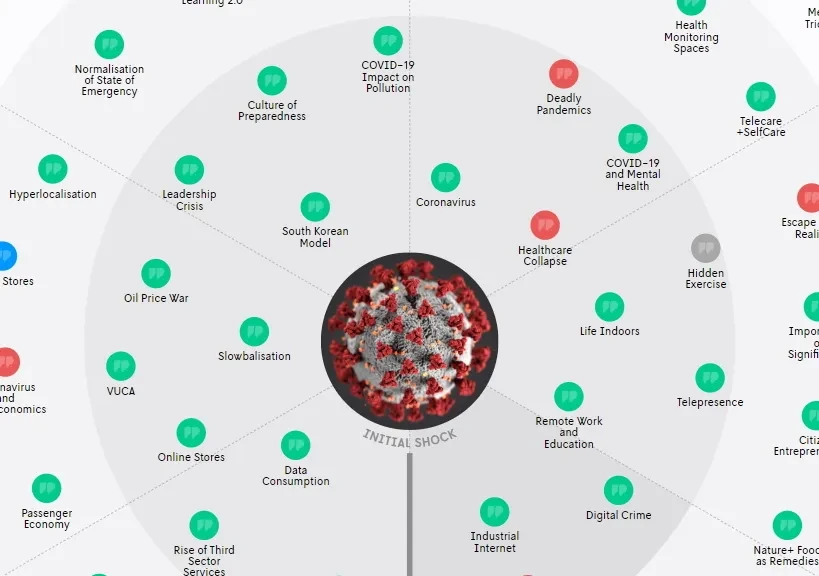
Each trend is in one of the three radar sectors. Internal - movements caused directly by the course of the epidemic, the middle one is what is expected at the intermediate stage of weakening the epidemic, and the external - what will happen after it declines.
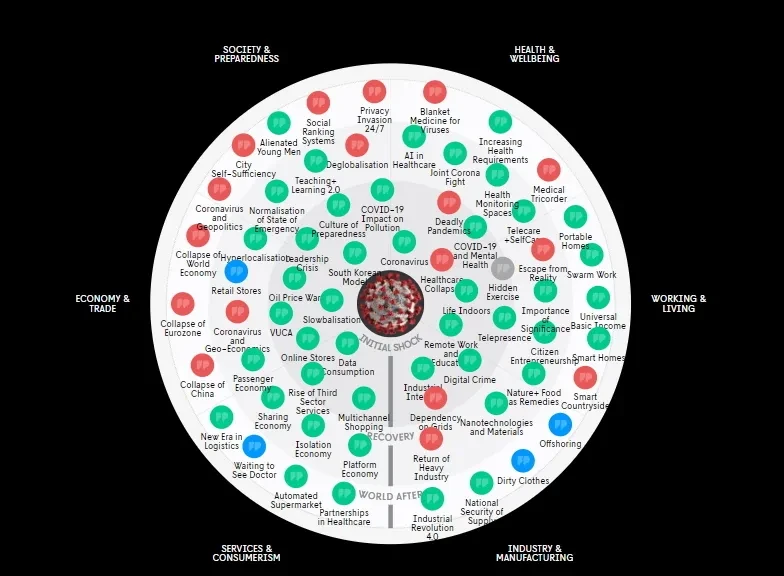
The degree of probability of each trend is marked with color:
green - trends that are actively gaining strength,
blue - which, on the contrary, are slowly dying,
Gray - the future of which is incomprehensible.
Red - trends that gain strength, but so far too carefully to talk about them with confidence.
A team of six futurologists works on the radar, as they call themselves. All researchers are with an economic education. According to the head of the Tuomo Kuoza team, it is the laws of the economy that offer the most convenient model to analyze the future.
A team of six futurologists works on the radar, as they call themselves. All researchers are with an economic education. According to the head of the Tuomo Kuoza team, it is the laws of the economy that offer the most convenient model to analyze the future.
The authors explain
- There is a market life cycle, which suggests that the product goes through several stages: creating, going to the market, sharp growth. At some point, growth slows down, for example, because the product appears better, and then demand falls. It looks graphically like a S-shaped curve, ”explains Tuomo Kuoza. - The same model is applicable to most social phenomena and trends. Regarding each trend, we determine at what stage of the life cycle it is located: emergence, sharp growth or deceleration. We combine this model with the Hype Cicecial analysis ( the technique proposed in 1995 by the research company Gartner In order to distinguish a hype around the product from its real commercial viability. - M.E. **).A good example is online stores. They appeared in the 1990s and went through the first stage of the Hyp-Cicel: there was a great interest in online stores, large investments were poured there. But the market, technology was not ready - and this bubble burst. The real growth of online stores began after 2010 with the advent of Amazon. This is the second stage of the Hype Cycel, which is associated not only with interest, but also with real growth. And this happens with many trends: at first there is a large stir, but there is no real development, it comes later. Our task is to determine whether the trend can become truly viable.
Work on the radar consists of three stages.
The first stage is the artificial intelligence: a special bot, which, by keywords, collects and analyzes tons of information published by the media, scientific publications and research centers. Its task is to identify new trends and track changes in already discovered trends.
At the second stage, the Bot's results are generalized by the Futures Platform team.
The third stage is consultations with third -party experts from different fields: sociologists, political scientists, and representatives of industries.
We discussed with Tuomo Kuoza, the head of the research group, those trends that can change our everyday life.
Life via the Internet
The most obvious change in coronavirus is the transition to the Internet of many spheres of life that previously assumed personal communication. No wonder Zoom shares-platforms for online conferences-from the end of January to the end of April, more than doubled. It turned out that with his help you can do a lot: study, communicate with the client, get a doctor’s consultation, play sports.
“This trend existed before, but Koronavirus gave it a powerful incentive,” says Tuomo Kuoza.
And before the epidemic, some companies partially or completely switched to remote work, universities offered online courses. The Internet has its own restrictions. It is clear that you can transfer office employees to the remote, but not production. The same with education, researchers say: universities are already actively mastering the Internet, and this experiment is difficult with elementary school - young children need a teacher and discipline, which cannot be provided in the online format.
This trend, according to the economist, has a sequel - people will continue to leave home less often. Tuomo Kuosa offers not to perceive this literally: of course, there are forms of activity, and there are many of them that cannot be transferred to the Internet or do not want to.
“We are talking about the emergence of a new culture, new types of online service,” says the economist.
- When a lot goes on the Internet: work, physical activity, meetings, counseling. This is a completely new type of economic relationship that we are now starting to observe. ”
Such a way of life, researchers note, have many consequences. For example, this will partially reduce the transport flow in cities and can affect the real estate market: an increase in online workers means that fewer people will choose housing depending on the place of work.
Growth of personal entrepreneurship
Speaking about the consequences of the crisis, almost all experts predict bankruptcy of part of large and small companies and, as a result, an increase in unemployment. Researchers of Futures Platform agree with this, but in an attempt to see a more distant prospect suggest that this will lead to the construction of new types of labor relations, one of the options is an increase in entrepreneurship, the emergence of entrepreneurs/hired workers in one person.
“As a result of the crisis, many have lost their jobs, the number of jobs is reduced, while people need to somehow earn money,” says Tuomo Kuoza. - New forms appear - in particular the economy of freelancers. The number of standard labor contracts may decrease, a new, more entrepreneurial approach to work appears. At the same time, a person does not necessarily work for himself - but in this system he may have several employers, each of whom he devotes part of his working time and is engaged in the management of his resources and taxes. ”
Such a system has its disadvantages, the most obvious - the lesser protection of the freelancer. On the other hand, Kuoza notes, the rejection of permanent work and the transition to contract employment means greater flexibility in the relationship of the employee and the employer.
Hyperlocalization
One of the likely trends at the world level is a decrease in globalization. At the level of individual cities and even the Tuomo Kuoza areas, the desire for hyperlocalization awaits. The epidemic related to it restrictions in movement and lack of resources showed that a model, at which at any moment you can purchase a product produced anywhere in the world, does not always work. “This means that individuals, like individual administrative units, will strive more for self -sufficiency,” says Tuomo Kuoza. - And this involves the growth of products "from the local manufacturer." This trend also originated before the epidemic, but intensified because of it: people are more and more striving to buy local products, sometimes even made by those whom they know personally. In such an economic model, money circulates on a narrower circle. ”
Attitude to personal data
In the storage and processing of personal data of citizens, there are nothing new. The attitude has changed with the crisis-at least in democratic countries the need to share with someone, including the state, was perceived as a violation of rights. Not without reason several years ago, the European Union adopted a binding general data protection regulation for its members, the main task of which is to limit the possibility of using personal information to the third parties.
“During this crisis, many states began to use systems for tracking their citizens more actively,” says Tuomo Kuoza. - There are many new tools that allow the state to do this. People are supervised in real time. For example, data on our health cease to be our property. And we suddenly find us ready to accept this, as it helps us to fight the epidemic. ”
Emergency situation as a norm
Unlike the previous ones, this trend is not designed for a long perspective. But over the next year or two, the epidemic is unlikely to exhaust itself completely, even if all countries pass the peak, and the spread of the virus will slow down-which means that you will need to remove restrictions very carefully and slowly. Perhaps some restrictions will be removed and returned again if the figures of the infected are again begin to grow. “And at this time, measures designed to mitigate the blow can become the norm,” says Touuo Kuoza.