
Translated material
Leave alive
Why in 1949, Stalin needed not to apply the death penalty to Japanese prisoners of war engaged in bacteriological weapons
Epidemic - plague, typhoid, smallpox ... These terrible companions of mankind have always carried more lives than any war, even the most bloody. But if some were terrified by the very thought that terrible illnesses could be put into service of the army, then others really tried to do it. Sometimes unsuccessfully ...
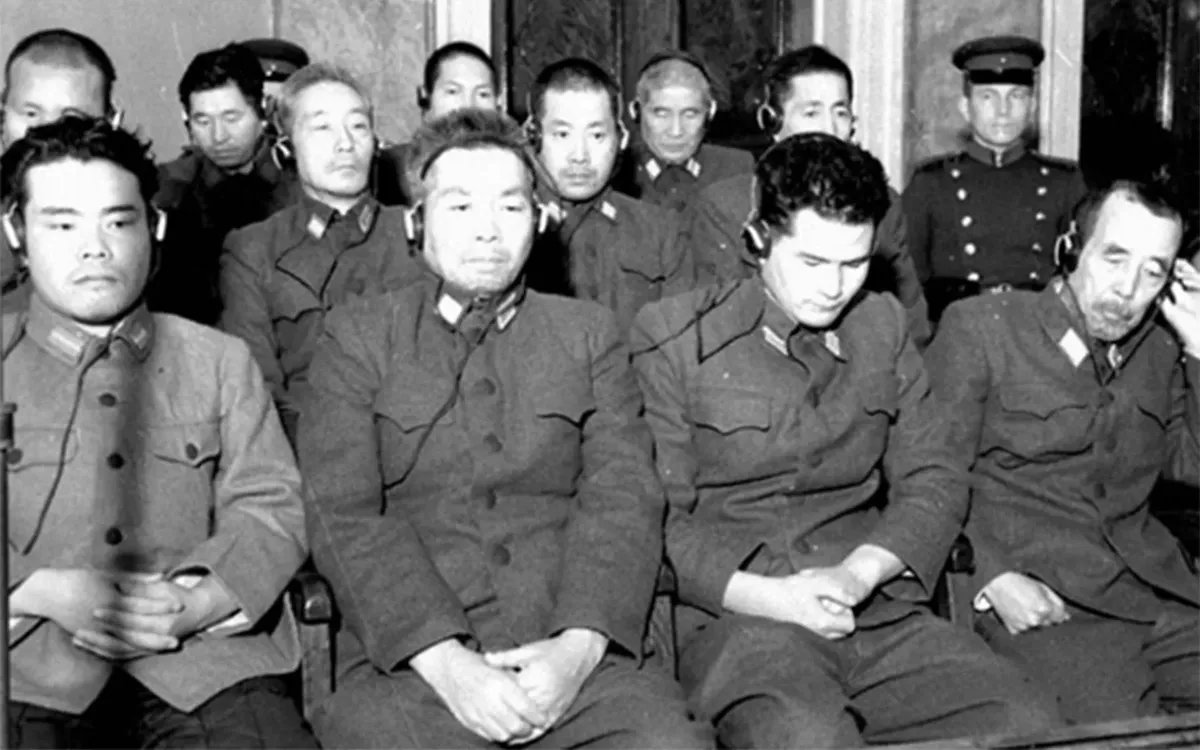
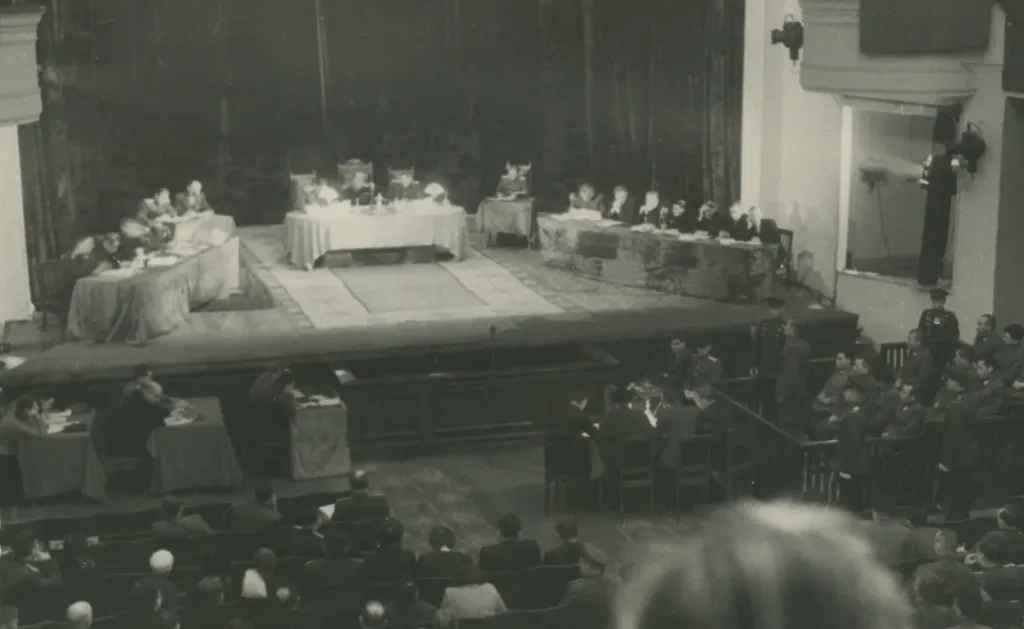
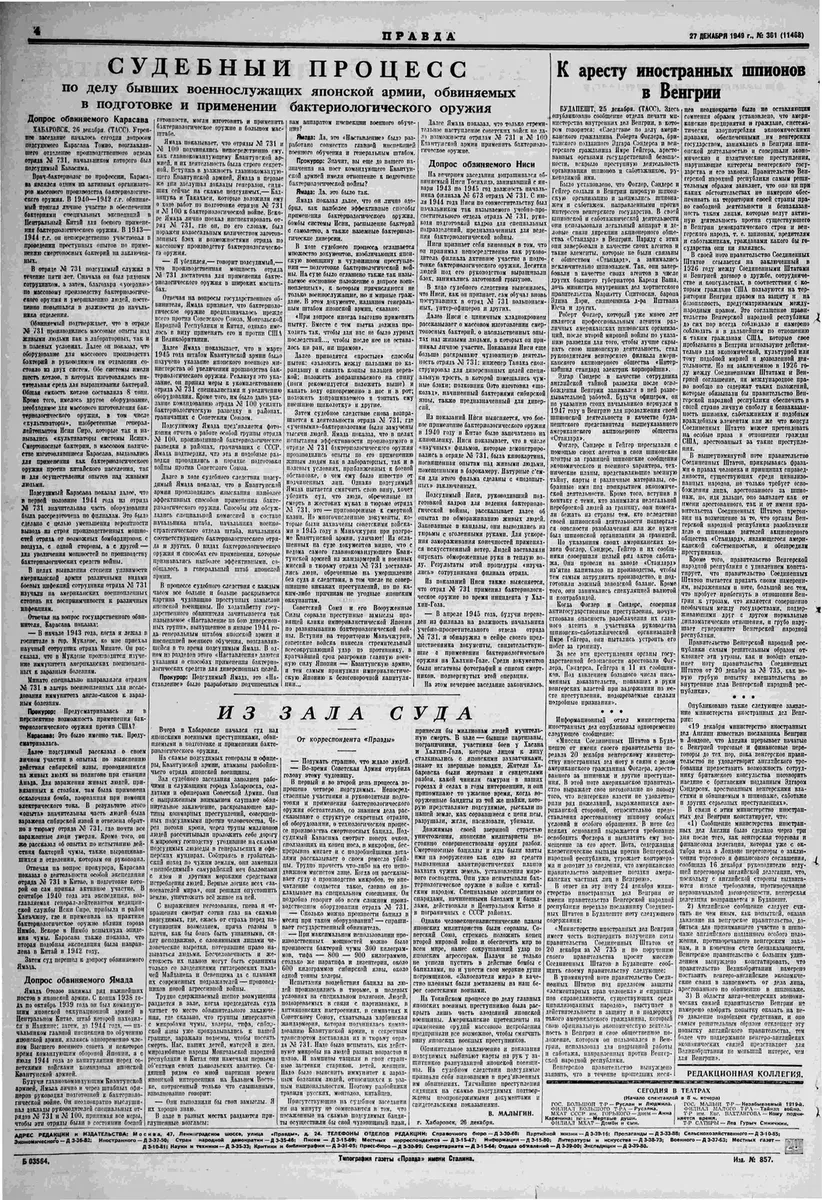
At the end of December 1949, a not quite ordinary process took place in Khabarovsk: the military tribunal of the Primorsky Military District considered the case against former Japanese military personnel accused of war crimes - the development of bacteriological (biological) weapons and its trials in people. 12 people sat on the bench of the defendants: five generals, lieutenant colonel, two major, lieutenant, senior non-commissioned officer, corporal and laboratory assistant without rank. The composition of the defendants at first glance is heterogeneous and somewhat strange, but each had one or another attitude to combat bacteriology, the mechanic of which was shown both by the general's eye and the eyes of the most ordinary laboratory assistant.
The case itself was listened to from December 25 to 30, 1949 in the district house of officers at as if open court hearings, although in reality there were no free access: only specially and carefully selected party members, Komsomol members and trade union activists were allowed to be on special tickets. Foreign correspondents, of course, were also not allowed. True, the reproduct was brought to the street through which the meeting was broadcast. So
Hundreds of people stood around the house of officers for hours and listened to the broadcast, regardless of the cold.
As was supposed to be at all Stalinist “open processes”, the defendants were willingly admitted, repented and asked for condescension. Of course, in order to avoid surprises, everything was carefully stipulated in advance, including at the highest level: the indictment ahead of time was subtracted and adjusted by Stalin, and the verdict was also approved by him personally before the start of the process. The report of the Minister of Internal Affairs of the USSR Sergei Kruglov dated to December 9, 1949 is entitled to Stalin: "On the provision of draft convictions and a sentence in the case of the Twelve military personnel of the Japanese army, accused of production and the use of bacteriological weapons."
Isi Siro and "Soviet trace"
The Japanese military really tried to work out the production and combat use of plague causative agents - bubonous and pulmonary, various types of typhoid and paratyphones, anthrax, cholera, sappes. And they really conducted inhuman trials in public, which were then killed. The “founder” of Japanese military bacteriology is considered the lieutenant general of the medical service of Isia Siro. He was born in 1892 in the village of Tija-Ossato in a rich landowner family and, as sources report, already during his studies at the school hit teachers with his outstanding abilities. For example, he could learn the entire textbook overnight. After school, he entered the medical faculty of the Imperial University in Kyoto, successfully graduated from him and went to military service. The chemist and ecologist Lev Fedorov in his book “Soviet Biological Weapon” wrote that at the turn of 1926-1927, Isia Siro came to the conclusion that it was biological weapons that gives significant advantages to “those countries that would have it, taking into account the fact that the leading countries of the world in those years tried to avoid orientation on this type of weapon.”
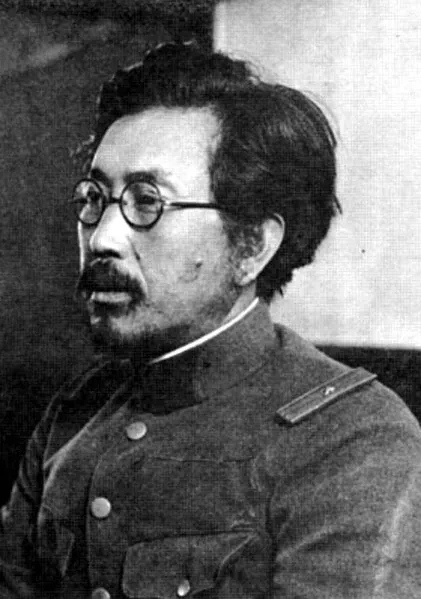
Siro finally inflamed the passion for the biological weapons of Icia after his long foreign tour: from April 1928 to April 1930, he made a grandiose “scientific and publication” trip to European countries, visiting the Soviet Union and the Soviet Union. Where I got acquainted with the state of Soviet combat chemistry and combat bacteriology, simultaneously making interesting and productive acquaintances with a number of leading Soviet specialists in the bacteriological war and chemical weapons. Undoubtedly, during this part of his tour, he talked with both the head of the military chemical department of the Red Army, Jacob Fishman, and with Ivan Velikanov, the “founding father” of the Soviet school of bacteriological weapons. And who else was he to meet here, given the circle of his professional interests?
It was during his foreign tour that Isiah Siro was convinced that in the minds of Europeans, the horror associated with the memory of the medieval epidemics of the plague, and therefore forcing European countries to put some taboos on experiments on the use of plague bacteria for military purposes. Here is a Japanese officer who gives hopes and concluded: you can successfully fight using the bacteria of the plague - from it Europeans (and Americans) simply does not have a means of protection. It was combat bacteria, Isi Siro believed, that could become the overall weapon that Japan would give a strategic advantage.
The visit to the USSR, undoubtedly, also played a role in the design of this concept: at least from the mid-1920s, the Soviet military has very actively experimented in this area. Lev Fedorov found documents dated 1926. In March of that year, Jacob Fishman reports to the highest leadership of the Red Army on the works "on the use of microbes in the war." It was an attempt to tame a anthrax, creating “fighting” bacilli on its basis. In May of the same 1926, Fishman reported on the successful tests of anthrax on animals, saying that "in parallel with these tests, work began on the combat use of microbes." In another report, the main combat chemist of the Red Army reported: “Bacterial broth may well be used in artillery bombs, aerobes, etc. And it will be a means of the force of action superior to this day. ” And since 1928, large -scale preparations for an offensive biological war have unfolded in the USSR.
Of course, all this was secret, but when professionals (the same bacteriologists) frantically enthusiastically conducted a conversation among themselves, something interesting, and slip. In any case, from a trip to the USSR, Isia Siro made the main thing: there are actively developing biological weapons. The rest was already not difficult to conceive, because the choice of funds from the "fighting" bacteriologists at that time was small: the plague, cholera, typhoid, SAP, Siberian ulcer, smallpox ...
The possibility of turning around in this field in Icia Siro appeared after 1930, when he headed the Department of Immunology at the Military Medical School in Tokyo. Then he came to a firm conviction: if vaccines and other means of protection against biological weapons can be developed in the territory of Japan proper, then the means of attack - both developed and experienced - only for a stranger. Therefore, the development of the actual biological weapon of Icia Siro took up only since 1932, having achieved permission to create a special center at the headquarters of the Kwantun Army in occupied Manchuria.
The process on the knee
A lot is known about the horrors that were created in the “detachment No. 731” by Lieutenant General Issie Siro, and there were enough terrible descriptions in the process. There were many horrors at the trial, but the sentenced sentence simply impressed with its relative softness. Generals of Yamada Otodzo (in Soviet documents are held as oscilo), the former commander of the Kwantun Army, the head of the medical department of the Kwantun Army, the lieutenant of the medical service of the Kajitsuka Ryuji, the head of the veterinary service of the Kwantun Army, the lieutenant general of the veterinary service Takahasi Takaatsu and the head of the production department of the detachment No. 731, Major General of the Medical Service Kavasima Kioshi received 25 years of imprisonment, head of the sanitary service of the 5th Army of the Kwantun Army, Major General of the Medical Service of Sato Syunzi-20 years, lieutenant colonel Nisi Tosihide-18 years old, senior non-commissioned officer Mitomo Kadzou-15 years old, Majors of Karasawa Tomio and Onoue Masao-12 years old, lieutenant. Khirazakura Dzensaku-10 years, Kurusim Yuji nurse laboratory assistant-three years, corporal Kikuchi Norimitsa-two years.
Purely formally then there was no death penalty in the USSR: it was canceled according to the Decree of the Presidium of the Supreme Soviet of the USSR of May 26, 1947, but there was a secret directive, according to which in special cases the death penalty could be applied. In addition, the Japanese were judged in accordance with Article 1 of the Decree of the Presidium of the Supreme Soviet of the USSR of April 19, 1943 “On the measures of punishment for the German-fascist villains guilty of the murders and tortures of the Soviet civilian population and captives of the Red Army, for spies, traitors from among Soviet citizens and for their accomplices”, which provided for a hanging. True, the same decree stated that only “German, Italian, Romanian, Hungarian, Finnish fascist villains were subject to punishment - there were no Japanese on that list. But who was interested in such legal “little things”:
They would like to hang Japanese generals and orderlies - they would hang it. So, they were needed exactly the living ...
The process itself took place in a clear hurry: military judges were in a hurry to pronounce the verdict before the New Year. What was explained by the reason for the very specific: “by the numerous requests of workers” in the USSR, the use of the death penalty was again restored. The corresponding decree of the Presidium of the Supreme Soviet of the USSR was issued on January 12, 1950. But, of course, the judges and prosecutors knew perfectly well that such a decision was already made, because the matter did not delay: the issuance of death sentences did not enter into their task, since “upstairs” had their own, purely practical considerations regarding those Japanese military ...
If you look closely, in all this matter you can see many oddities, inconsistencies, roughnesses, stretches, not to mention the fact that the materials for the process seemed to be sculpted in a hurry, on the knee. Formally, the beginning of the preparation of the process can be counted on April 23, 1949, when the Minister of Internal Affairs General General Kruglov in the official note No. 1717/K reported Stalin, which “as a result of agent and investigative measures conducted by the USSR Ministry of Internal Affairs for the study of prisoners of Japanese contained in the camps of the Ministry of Internal Affairs, more than 200 former employees of the so-called anti-epidemic detachment No. 731 were identified. And its branches, which, under the cover of water supply of the Kwantun Army, were engaged in the finding of bacterial agents and methods of their use in the war against the Soviet Union and China. ” In the same place, General Kruglov, as it were, made an offer: “The USSR Ministry of Internal Affairs considers it appropriate to conduct an open trial of the anti -epidemic detachment over the leadership workers,” and the cases of ordinary detachment workers are already considered at the closed court of military tribunals.
Of course, the actual idea of organizing such an important process could not belong to the minister-this was not in his competence, but that was exactly what the design of the leader’s wishes, expressed by him earlier in one form or another, looked.
Kruglov continued to work on the design of the existing material and the collection of additional. On September 28, 1949, he sent a memo for Stalin the next note: “On the identification of“ anti -epidemic detachment No. 731 ”among Japanese prisoners of war, conducting experiments on the creation of bacteriological weapons over Soviet and Chinese citizens.” The document also attached a draft resolution of the Central Committee of the All -Union Communist Party of Bolsheviks and the Council of Ministers of the USSR on the organization of the open trial of employees of the “detachment No. 731”. But for some time, Stalin is still thinking, since the go-ahead was given only three weeks later: the first real interrogation was dated October 20, 1949, on the same day a group of translators was reply for Khabarovsk. However, the intensity of interrogations is relatively small, and in November there is a lull at all: only five interrogations-executions for that month were recorded in accessible materials. On November 13, 1949, the Politburo of the Central Committee of the All -Union Communist Party of Bolsheviks adopted the Decree “On Japanese Prisoners”, according to which it was necessary to notify the Government of Red China “About the presence of several hundred prisoners of war and interned Japanese in the USSR, which, according to the Soviet bodies, are exposed to commit crimes against the peaceful Chinese population”, and therefore can be transferred to China to attract to attract to attract to attract accountable. But something did not grow together there-they changed their minds to the Japanese to the Chinese.
And on November 22, 1949, on the table of Stalin, a document was laid for the signatures of the Minister of Internal Affairs Kruglov, Prosecutor General Grigory Safonov and Minister of Justice Konstantin Gorshenin “On the end of the investigation in the case of Japanese generals and officers who served in the anti -epidemic detachment No. 731”. In fact, it turned out to be far from the end, the investigation, in fact, only unfolded: the most intense “interrogation day” was listed on December 6, 1949-that date was marked as much as eleven interrogation-executions! In fact, everything was sculpting on the knee precisely then: on December 9, Stalin finally submitted a draft indictment and sentence, while the last interrogation was carried out day later - December 10.
Without names and witnesses
The Japanese system of bacteriological war detachments was quite extensive and branched, however, the process spoke only about the so-called “detachment No. 731”, which was created by the lieutenant of the medical service of Isia Siro, and “detachment No. 100”-they were commanded by Major General Vakamatsu Yujiro. Only two places of dislocation were named: “Squad No. 731” - Pinfan station, which is 20 km from Harbin, and even his landfill at the Anda station; “Squad No. 100” is a place of Mogaton near the city of Chanchun. The indictment said that the detachments “had a dense network of branches attached to units and formations of the Japanese Kwantun Army,” and no more refinements. Some detachments of “us” and “he” in the central and southern China are also called under the leadership of the major general of the medical service Sato Syunzi-and that’s all.
While according to Soviet documents, in the process not submitted, there were many more such “combat bacteriological” formations in the Japanese army. Some of them took place under the sign of “water supply and prevention management” (sometimes they write “water supply and fighting and combating epidemics”), and there were at least six: in Harbin, Nankin, Kanton, Singapore and two in Beijing. These units “on water supply” were given the army of each direction, they were not obeyed not at all the notorious Isi Siro or some non-existent center (headquarters) of the bacteriological war, but only to the army command of the place of deployment.
So Isi Siro is only one of at least six main “combat bacteriologists”, and not the only and main one. Like not the only “detachment No. 100”, which took place under the sign “Department to prevent the disease of combat horses”. It is also necessary to add a whole network of the so -called “anti -fiction institutions”, which also engaged in the business quite combat: the development of combat strains of the plague, the methods of their use and, of course, the expulsion of the anti -fingered vaccine - it was necessary to protect their soldiers.
But in court it was only about two specific formations, and they did not stutter about others. Although it can be confidently argued that by that time in Moscow they precisely had extensive information about the Japanese biological warfare system.
Purely the aspects of the purely legal aspect:
For all the terrible descriptions of experiments on people, the evidence base was absolutely no!
Not a single evidence: material, material, and documentary - not a single clearly and really undeniable. What is there, not a single name of the victim or the victim, there is not a single real testimony and not a single real witness: not to be seriously witnessed by the Japanese interned, giving sincere indications for themselves! Which, moreover, in this case, it was simply impossible to verify or at least confirm: only the “Queen of evidence”, beloved by the Stalin Justice, is nothing more.
The defendants of the Khabarovsk process are undoubted villains, but only none of them committed crimes either in Soviet territory, against the Soviet troops or at least individual Soviet citizens. True, a certain “soldier of the Soviet Army Demchenko” appears in the materials of the process, but nothing is known about it at all: neither a name-outcome, neither from any part, nor when and how the Japanese were in the period when there were no military actions. A certain lieutenant of Yamagisi Kenji testified that he ordered the Red Army soldier to torture, but then "he decided to physically destroy him and for this purpose sent him to the 731st detachment ...".
That's just a Japanese officer was not accused of a soldier’s death - he passes only as a witness. При этом если японец хотя бы запомнил фамилию солдата, то вот представители следствия вообще не смогли ничего отыскать про него — если, конечно, таковой был… В остальном же и вовсе фигурируют лишь абстрактные и не поименованные «советские граждане, оказавшиеся по разным причинам на территории Маньчжурии и задержанные японскими пограничными и полицейскими отрядами». О чем и поведал на допросе некий майор Иидзима Ёсио, сделавший — тоже лишь в качестве свидетеля — чистосердечное признание: отправил на верную смерть около 40 советских граждан. Опять же, ни имен, ни конкретных обстоятельств и дат. Какие либо документы на сей счет вообще отсутствовали: нет ни единой бумажки о советских военнослужащих или гражданах СССР, попавших к японцам и ставших жертвами экспериментов. Все — исключительно со слов японцев-свидетелей, удивительно добровольным образом признающихся в совершении преступлений, которые и доказать в принципе невозможно! Нет и свидетелей из числа местных жителей: ни китайцев, ни маньчжур, ни монголов, ни корейцев, ни хотя бы харбинских русских! Всех уничтожили? Но даже немцы — со всей своей педантичностью — и те так наследили, что и улики нашлись, и свидетели, и документы. А тут — пустота…
Это вовсе не значит, что ничего подобного не было, но говорит лишь о том, что никаких доказательств не добыли. А может, и вовсе не искали? Ведь очевидно же, что копать надо было не в октябре-декабре 1949 года, когда стахановскими темпами и методами стали опрашивать нужных пленных (получая от них нужные показания), а когда все свежо было, по горячим следам, сразу после развала Квантунской армии, захвата лабораторий и пленных. Но поиск свидетелей, улик и их документирование советскую военную юстицию тогда отчего-то не интересовали. Не было указаний?