
Translated material
“Young Yakushev undressed. He played with them in the doctor "
The executioner of the NKVD ended his career as a head of the Ministry of Defense
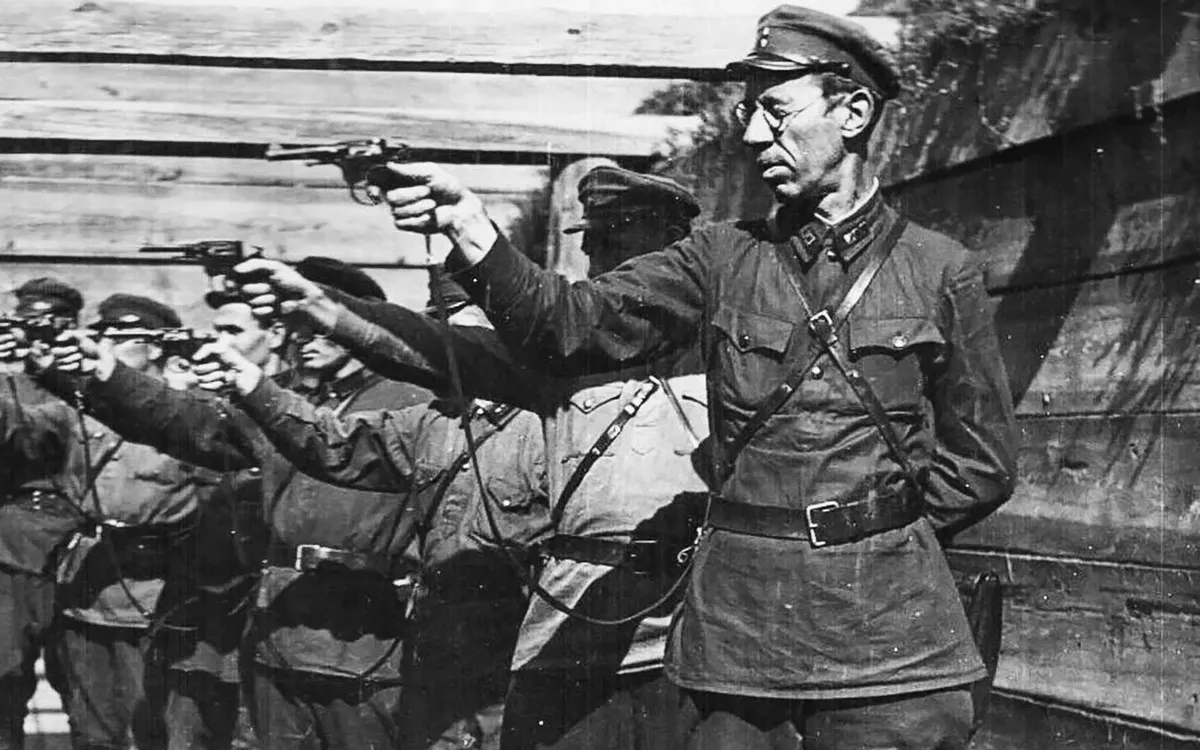
Konstantin Boguslavsky, historian, St. Petersburg
On the results of research
-Yesterday, on Facebook, I published one of the gloomy documents that I have ever met. These are the materials of the military tribunal of the Kyiv Military District of 1939, when a group of ghouls-chekists from the NKVD of Zhytomyr for “violations of socialist legality” fell under trial. On dozens of pages of business, Soviet Chekists vying tell the tribunal about the technology of torture and executions.
Their leader was a certain Yakushev Lavrenty Trofimovich.
This is how the exploits of Comrade Yakushev is described by his craft colleagues:
Defendant Tymoshenko:
“... it was like that with women ... I brought a party of women, Grishin told Lebedev that Yakushev was interested in whether young women, Lebedev told him their age, and he went to Yakushev.
When I later started women, Yakushev and Grishin were already in the room, there was also a form. Yakushev ordered the first to undress, examined her all, then the form ran up, like a doctor, began to stop her, and then led her with Sosnov. I told Yakushev that it was difficult to load naked, and he replied: "There are few of them, it doesn’t matter."
So young women undressed, but a couple of old women came across - they did not undress, but shot ... "
It was about the fact that young women had undressed before the execution and Yakushev and colleagues played with them in the Doctors.
Further, Tymoshenko continues:
“... there were no Lomov there, there were sticks and copper pipes that the convicts beat. This was introduced under Yakushev when Martynyuk told how he did. With sticks, all the authorities beat convicts, including Grishin beat the convicts, but for what they beat, I don’t know. Not everyone beats. Martynyuk said so:
"To make no noise, several times with a stick - and is silent." Then they began to beat ... "
How did the “business” ended and what is the fate of the sadist and the pervert of Yakushev?
He received 20 years of camps from the military tribunal, but in October 1941 he was released and sent to the NKVD motorized rifle brigade.
Further, Yakushev is the deputy head of the intelligence department and deputy head of the operational group of the NKVD of the partisan detachments of the Kalinin Front, the captain of state security.
Deputy Head of the Intelligence Department and Deputy Head of the Operational Group of the NKGB Partizan Brigade Vishnev (Vitebsk region), Lieutenant Colonel of State Security.
Since 1948 - manager of the Ministry of Armed Forces of the USSR, Colonel. Next-the head of the control and audio inspectorate of the economic department of the Ministry of Armed Forces of the USSR.
And finally - the head of the inspection of the economic department of the Ministry of Armed Forces of the USSR.
A good career for a person who played in a “doctor” with women who go to the execution, beating a copper pipe on the head of the convicts “triple” and leaving home with the bales of things just shot prisoners.
But that's not all. Under the curtain of life, he became a writer. I released two books for children and youth about the exploits of scouts.
Performers
"Special merits" of only three commandants
On November 29, 1936, the central Soviet newspapers published a small information note: the CEC of the USSR of the SSR decided to award “for special merits in the struggle for the strengthening of the socialist system” by the Order of the Red Star of 18 state security officers.
None of the names of the awarded said anything to the ordinary layman, they were not reported about their special merits. Meanwhile, the awarded were a kind of special caste of Soviet Chekists
- They were executioners, death sentences.
On May 15, 2015, the President of Ukraine was signed and entered into force the Law on Decommunization. All archives of state security organs were open and accessible to historians, researchers and ordinary citizens. In this article, I will try to introduce readers to biographies only three representatives of such a rare profession based on documents received in the archives of Ukraine.
Ivan Nagorny
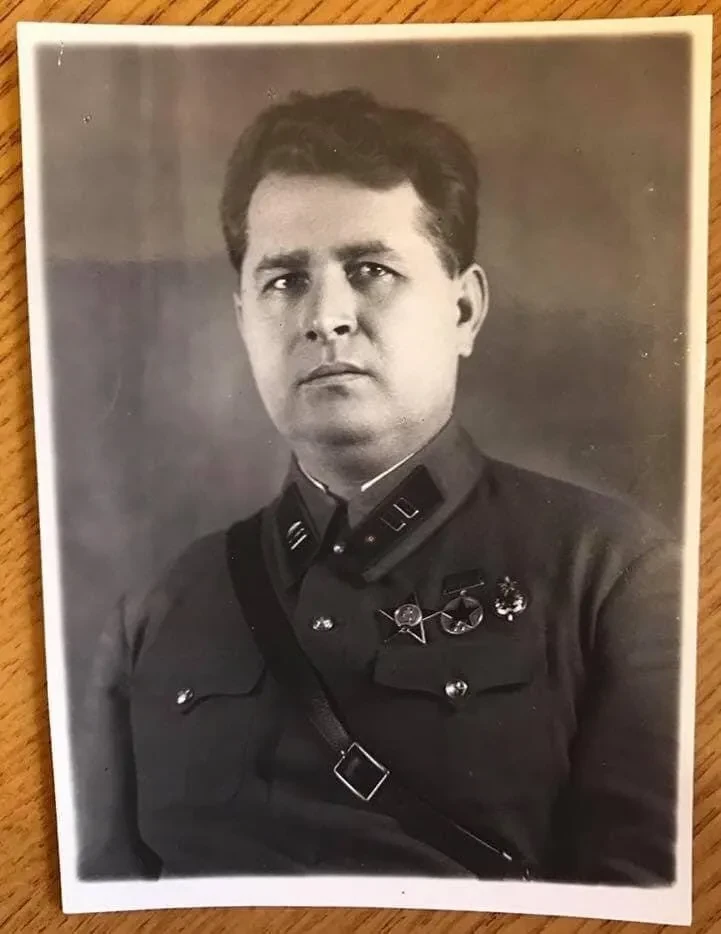
In the list of the Red Star awarded by the Order of the Red Star, he is listed at number 7. A little more than more than a month before the entry of the assigned with the list of awarded, or rather, on the night of October 22, 1936 in Kyiv in the presence of the prosecutor Vyshinsky and the chairman of the military board of Ulrich, the younger lieutenant of state security, Ivan Nagorny Supreme Court of the USSR over 37 convicts.
The personal file of the Chekist of the Nagorno is now stored in the SBU archive in Kyiv.
Ivan Grigoryevich Nagorny was born in 1902 in the village of Dergachi in the Kharkov region in a peasant family, Ukrainian. Education - 4 classes of a rural school. He worked as a locksmith. In 1917, as part of a working squad, he went to the front to fight with the White Guards. Five times wounded. He graduated from the service in 1922. In the prison system, the GPU-NKVD worked from 1926 to 1941.
A rural guy with four classes of education shot 37 people on an October night of 1936. Who were these people? All of them were defendants in the so -called "The affairs of the professors." One night 10 professors and 27 teachers of Ukrainian universities were shot. Among them:
Professor Rappoport-Daryin,
Professors of philosophy Nyrchuk and Rozanov,
Lechtman is a researcher at the Institute of Jewish Culture,
Lozovik is a professor at the ancient history of Kyiv State University.
In 1937, Nagorny became the head of the ICB prison of Kyiv, and this purpose coincides with the beginning of a large terror. Kyiv archives that are now open, the puffy volumes of instructions for the execution of “higher punishment” and a huge number of acts signed by Ivan Nagornoi on executed citizens. To investigate and calculate all the acts signed by Nagorno is a rather laborious task, but it is obvious that we can talk about many thousands of personally shot “enemies of the people” by the sentences of the “triples” and “doubles”. According to the statistics of the SBU archive, in Kyiv and the Kyiv region in 1937-1938, 18,519 people were shot. Of this amount, approximately 70% of the executions took place directly in Kyiv, they were produced by a team of 3-4 executioners, the leaders and main performers of which were Nagorny and his colleague Alexander Shashkov.
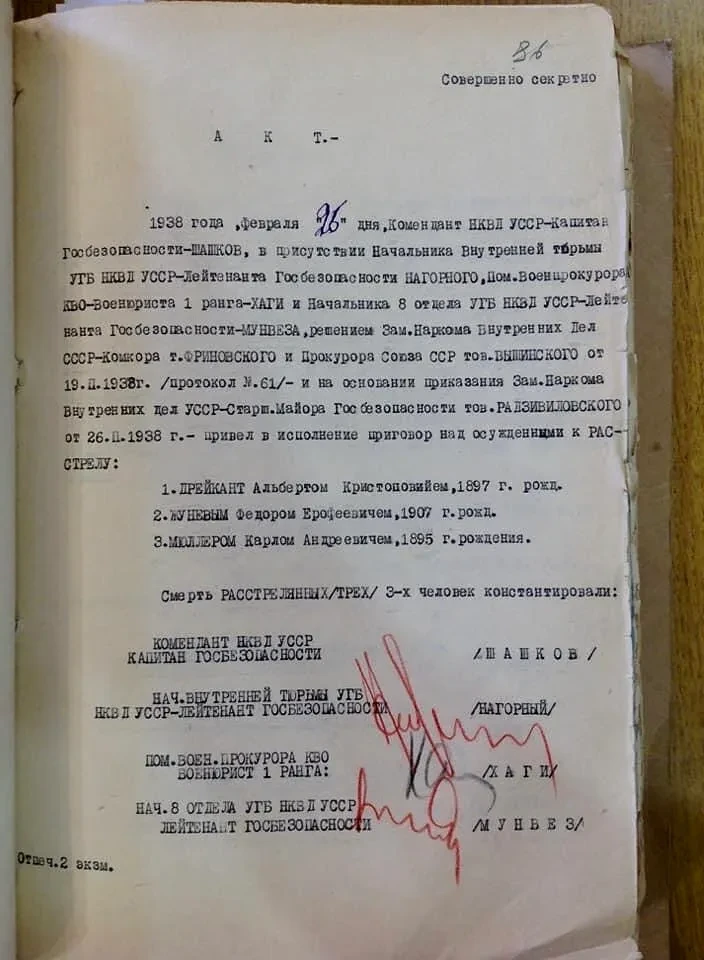
After the end of the Great Terror, Ivan Nagorny became a defendant in an unpleasant criminal case: in case of random circumstances, it turned out that the members of the shooting team abducted, assigned or sold things of the convicts they extended. One woman whose husband was arrested by the NKVD, and at that moment she was already shot (which she, of course, did not know about), went to the Kiev commission and saw her husband’s things on sale. A criminal case was opened. However, the Nagorno managed to get out of the water dry - he was not convicted of complicity in these crimes.
From the protocol of the interrogation of the accused Starzhinsky
Question. List in detail all the things that you were mined.Answer. During the five -month period of my work by the driver on the above car, I managed to get the following things: ten men's coats, three military overcoats, more than ten pieces of costume jackets, doh, watches, boots, linen and a number of other things that I currently cannot remember.
Question. What things did you get from Nagorno?
Answer. Personally, Nagorny gave me a doha, a clock, a military costume, a knot of linen. As he said: "This is a bonus for a good job."
Question. Did you get all the things through the shops or did you leave a part for yourself?
Answer. All the things I have indicated, with the exception of boots, two coats, a military costume, a doch and the clock that I left for my use, I set off through a store of random things.
How and where Ivan Nagorny completed his life path, it is not known for certain - it is listed as missing in 1941 during the defense of Kyiv. A colleague of the Nagornoi in the parade in Kyiv, Alexander Shashkov, also died at the front, but his fate was established. During the war, the state security major was appointed head of the Special Department of the 2nd Shock Army, was seriously wounded and shot at the exit from the encirclement on June 25, 1942. He was buried on the territory of the memorial of the 2nd Shock Army in the Novgorod region. Together with him, his son, Nikolai Aleksandrovich Shashkov, Soviet Vice Admiral, who died in Moscow in 2004, was lifted into the grave.
Naum Turbovsky
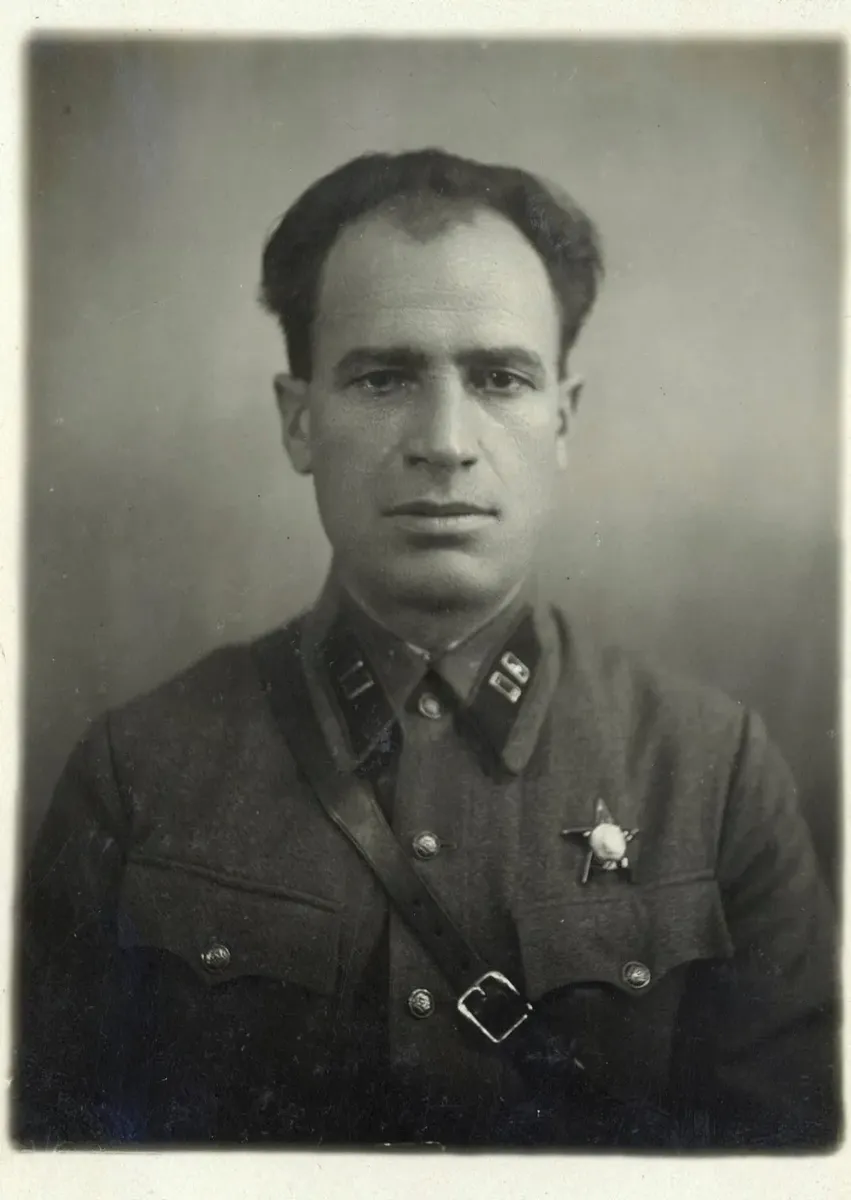
In the State Archive of the Security Service of Ukraine, personal file No. 814 of the NKVD of the Ukrainian SSR Naum Tsalevich Turbovsky is stored. In 1937-1938, Turbovsky was the main executor of death sentences in the Dnipropetrovsk region. In total, 13,573 people were shot in the region during this period.
The future commandant of the Dnipropetrovsk Department of the NKVD Naum Turbovsky was born in 1896 in the town of Khodorkov Skvirsky district of the Kyiv province. More than half of the inhabitants of the town were Jews. Education - three classes of a Jewish school. He worked in a grocery shop. From 1915 to 1917-service in the tsarist army in the 60th Siberian Rifle Regiment. After the revolution - in the Red Army. He participated in the battles against Petlyura, Denikin, Makhno and Hetman. Employee of the Cheka since 1920.
There were seven children in the Turbov family, their fate was different. Brothers Naum Mendel, Nakhim and Moses emigrated to the USA before the revolution, sister Manya also emigrated to the USA in 1920. Brother Matvey died in the battle of 1918 in a partisan detachment. The fate of Basi's sister turned out to be tragic - in 1941 she remained in Kyiv and was shot with other Jews in Babi Yar.
By the beginning of the great terror, Naum Turbovsky approached the convinced communist, a Chekist with a huge experience in practical work, a reliable performer. In 1936, he was appointed commandant of the UNKVD of the Dnipropetrovsk region, and a year later - the head of the prison of the UGB Dnepropetrovsk. An interesting fact: after secondment to Kyiv in 1938, he even lived at the address: Chekistov Street, 5.
The personal business of Turbovsky contains a unique record from a historical point of view.
In the certification sheet about the assignment of the next title, the number of those executed by him personally is indicated.
From the personal file of Turbovsky
He knows his work well. He skillfully organized the protection and isolation of the internal prison of the UNKVD, the delivery of the arrested for interrogation, which largely contributed to the success of the investigation. Comrade Turbovsky carried out a lot of work on the execution of sentences to the highest extent on the enemies of the people, participants in the military-fascist conspiracy, spies and saboteurs.Personally, over 2100 sentences are executed ...
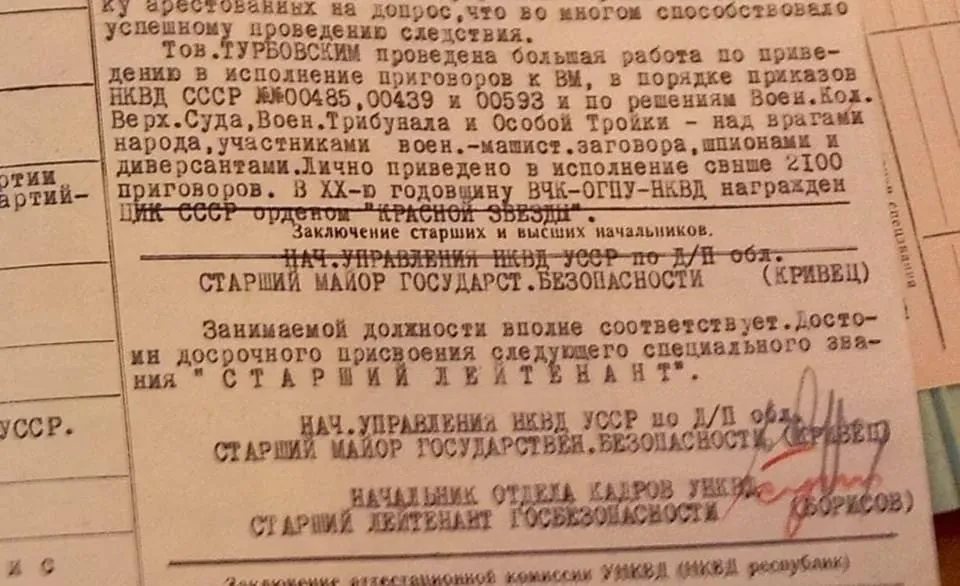
The certification sheet with this entry was dated December 7, 1937, and the post of chief of prison and the main “performer” of Dnepropetrovsk, Turbovsky held until July 11, 1938. It can be assumed that he increased his personal account of executed citizens during this time by several thousand people.
The quarry of Nauma Turbovsky successfully developed: he was not affected by repressions, he was awarded government awards, held the war in the rear and in 1947 he resigned with the rank of lift of state security. He had a wife, also an employee of the MGB, and two daughters. The date of death of Turbovsky is unknown.
Artem Green
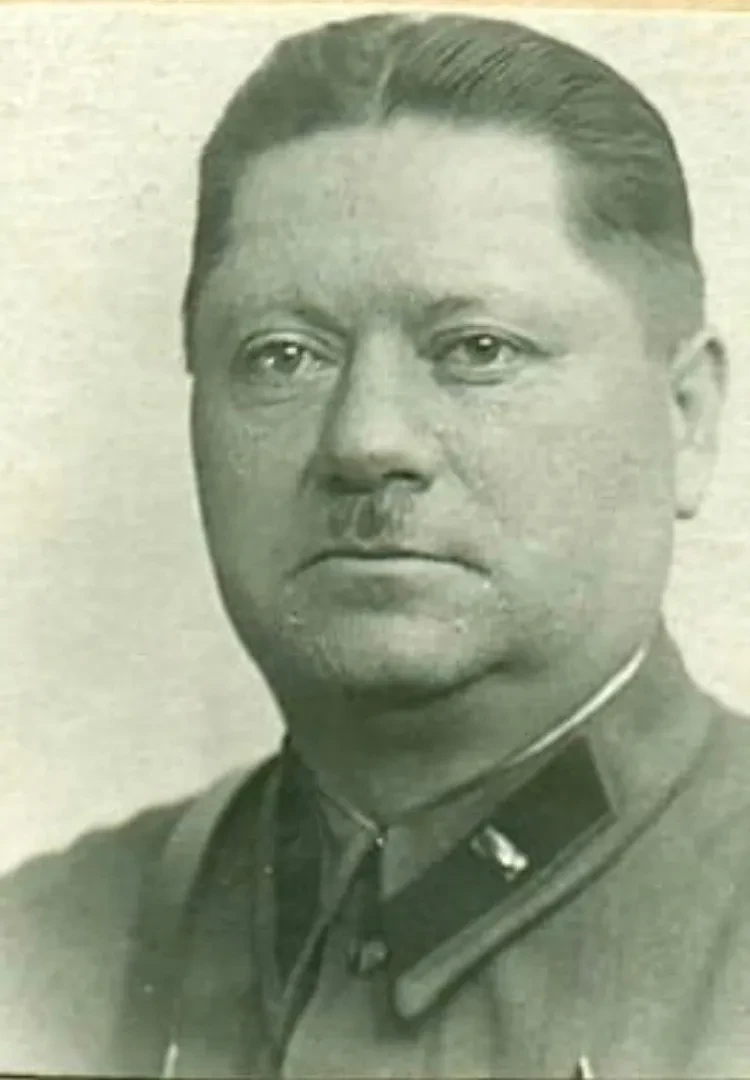
The commandant of the NKVD department in the Kharkov region, the state security lieutenant Artem Petrovich Green looks a clear leader among all Soviet executors of death sentences.
The 15 volumes stored in the SBU archive contains about 6,000 acts of execution with its personal signature.
Probably, one of his colleagues in craft shot more “enemies of the people”, but in this case we are talking about acts that really existing and accessible in archives.
Artem Petrovich Green was born in 1891 in Nikolaev in the family of a carpenter. In 1904 he graduated from an elementary school, in 1904-1912 he worked at the Nikolaev shipbuilding plant by the boiler room, in 1912-1914 - in Odessa in the same position. In 1914 he was drafted into the army. Private, non-commissioned officer. Since 1917, he was a fighter of the union of front -line soldiers (Nikolaev), since 1919 - in the service of the Cheka, the company commander, the commander of the battalion. In 1923, he was the commander of the GPU convoy regiment (Vinnitsa), in 1923-1925 - the commander of the GPU division (Chernihiv). In 1926-1933 - at work in the central apparatus of the GPU of the Ukrainian SSR. In 1933-1936 - head of the economic department of the CEC of the Ukrainian SSR, in 1936-1938 - the commandant of the NKVD of the Ukrainian SSR in the Kharkov region.
The memoirs of the commandant Zelene were found in the testimony of the former employee of the Kharkov NKVD Mitrofan Syryatnikov, who was interrogated in 1990 as part of the investigation of the Katinsky execution that began then.
From the testimony of Syryatnikov
“I recall that when I delivered the arrested to the basement, I had to see that the commandant of the green, whose revolver was in his hands, entered the room, where the arrested. After a while, we cleaned the corpses from the same room. I can’t remember now exactly when shoots and burials at the Jewish cemetery took place. However, they did not take place every day, but, obviously, as they accumulate the defendant, sentenced to the highest degree of punishment. Burials in the Jewish cemetery occurred until mid -March 1938.Then a new burial place was organized, which was located in the forest park along the Belgorod highway towards the mountains. Belgorod, in the forest, about 1.5 kilometers from the village of Pyatikhatka, about 200 meters to the right of the road ... "
The originals of documents on executions taking place in the Kharkov NKVD during the Great Terror period are preserved, and we can assess the scale of the activities of the team of the commandant of the green:
On May 21, 1938, Green and his assistant foreman Vinokurov were shot by 80 people ,
May 22 - 36 people ,
May 23 - 106 people ,
May 25 - 144 people ,
May 28 - 43 people .
In total, from 1937 to 1938 , 10,475 people were shot in the Kharkov region.
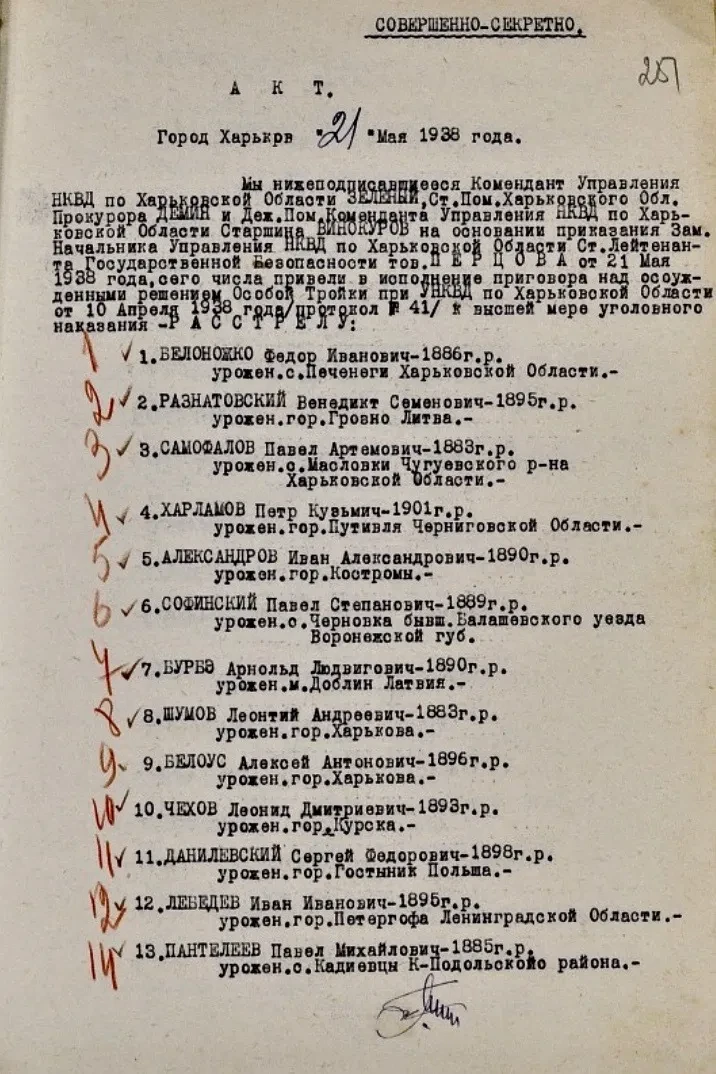
Ukrainian archives store many documents with the personal signature of the commandant of the green. This is one of them:
TOP SECRET
November 15, 1937
mountains. Kharkov
Head of the Jewish cemetery in Kharkov
Comrade GorbachevAt the same time, I prefer the “98” (ninety -eight) human corpses that I suggest that you accept and betray the Earth in the presence of representatives of the commandant’s office of the UNKVD in the Kharkov region.
NKVD management commandant in the Kharkiv region
/GREEN/
On December 19, 1937, “For exemplary and selfless fulfillment of the most important government tasks”, Artem Zeleny was awarded the Order of the Red Star. In the same list of awarded was Naum Turbovsky.
In the second half of 1938, Green fell under the investigation, as in the case of Ivan Nagornaya, with the assignment of things executed, but managed to avoid punishment and was transferred to the Arkhangelsk region, where he headed the guards of one of the camps. In 1941, he was drafted into the army, the service was held in the commandant's service of the Special Department of the Volkhov Front.
He died on June 1, 1942, was buried in the area of Malaya Vishera.
Konstantin Boguslavsky, historian, especially for "New"
PS
The author thanks the Archive of the Security Council of Ukraine for the help in the preparation of the material
From the editorial office
For several years now, Konstantin has been developing an infinite, as it turns out, topics - topics of the crimes of the Stalin (and later) Chekists. In domestic archives, this information is known to be classified - from humanistic reasons: it is unlikely that the descendants of the executioners will be pleased to know why their grandfathers, with the portraits of which they go to demonstrations of the “Immortal Regiment”, received their orders. Such are we now have ideas about humanism and humanity ...In addition, terrible numbers and facts, whether they are available and published, do not allow us to continue to say that state security officers were honest and disinterested that they did not spare themselves a duty to the homeland, that the mass terror, who reigned in a huge country for decades, was unfortunately justified by the “excesses of performers” and crawled into the authorities and crawled into the authorities and crawled into the authorities a few traitors and spies. That the “Yezhovo excesses” were exposed at the end of the thirties, and Beria who exposed them did not commit any crimes anymore ...
But documents from the archives of the former KGB in Kyiv, Tbilisi, Chisinau, Tallinn, Riga, etc. They have become available and, I assure you, are no different from the documents stored in Novosibirsk, Yekaterinburg or Kazan. So for a long time, researchers of the history of our “organs” do not go to Moscow, but to the capital of the “Russophobic” countries - our former fraternal republics.
Konstantin Boguslavsky travels to Kyiv.
A year ago, “New” printed his article about the “Uman case” - the process in the case of employees of the local department of the UNKSD of Ukraine. Now we have agreed that for the new documents we have obtained in Ukrainian archives, we will also provide a place on the pages of our newspaper.
Pavel Gutionov, "New"