
Translated material
Grebnevik-Cannibal
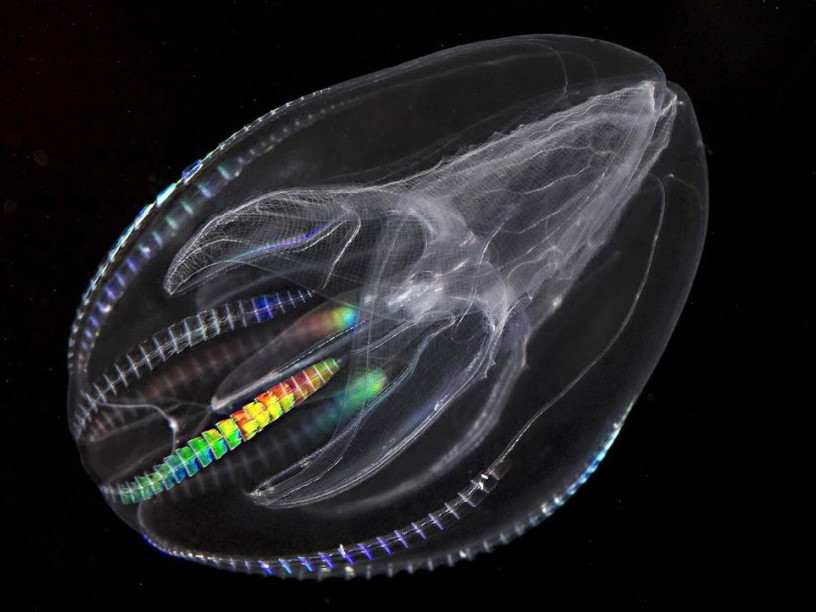
Researchers from Denmark, France, Spain and Germany discovered that the Grebneviks of Mnemiopsis Leidyi , destroying all available food resources, live for several weeks, eating their own larvae. This facilitates the further spread of the species.
Grebneviks are marine animals that look like a jellyfish, but constituting an independent type. They swim in the water column with the help of cilia, located on their gelatinous body in rows resembling crests, hence the name of this group of animals. Almost all Grebneviks are predators, they feed on zooplankton: small crustaceans, jellyfish, mollusk larvae, claws, eggs and fry of fish and other animals, there are species specializing in hunting for other rowers. With the exception of two species, all Grebneviks are hermaphrodites.
The translucent body of the Grebnevik Mnemiopsis Leidyi has a length of 7 to 12 cm, and its diameter is about 2.5 cm. It is able to survive with wide ranges of salinity (from 2 to 38 practical units of salinity) and water temperature (2–32 ° C). The usual region of its habitat is the water of the Western Atlantic, but Mnemiopsis Leidyi received sad fame when he was imported into the Black Sea (first marked in 1982). It is suggested that the invasive look got there in the ballast water of ships. As often happens, having fallen into new conditions, the species, in the absence of natural enemies, has multiplied significantly. By 1989, the density of the Grebneviks in the Black Sea reached a record level - about 400 copies per cubic meter. The main food of the crest in the Black Sea was the Ikrinka and the young anchose (Hamsa). As a result, the amount of fish was sharply reduced, the damage to the fishing industry of Russia, caused by the Grebnevik, is estimated at 230-350 million dollars. It was possible to restrain the spread of Mnemiopsis Leidyi in the Black and Azov Seas by transferring the beroe ovata from the Atlantic ocean, which fits other Grebneviks. As a result, now the self -regulating system “Predator - Victim” has been established in the Black Sea waters.
In 1999, the Grebnevik fell into the Caspian Sea through the Volga-Don Canal, where he also had a destructive effect on the local ecosystem. In 2006, he was first awarded in the North Sea and in the Danish straits, and a year later he penetrated the central part of the Baltic Sea and was even seen in the Gulf of Gdan.
At the end of summer, Mnemiopsis Leidyi has a period of rapid propagation (“flowering”), when each individual releases hundreds of eggs and spermatozoa into the water. In two weeks, the offspring of one adult crest can reach 12 thousand. An increased population usually completely destroys zooplankton in the surrounding waters. It is during these periods that the Grebneviks cause the greatest damage to ecosystems.
Researchers who monitored the spread of the Grebnevik in European waters were surprised by his ability to survive rather long periods, when there are very few suitable prey. In the Baltic, the Grebneviks are found 58 ° north latitude, where the times of the Besorters are much longer than in the usual habitat along the Atlantic coast of North America (42 ° C.S.). Grebneviks cannot stir nutrients in their body for a long time. Grebnevik larvae are not able to survive the cold and hungry winter in the Baltic Sea, they die after three weeks of starvation. Therefore, the mass reproduction of Mnemiopsis Leidyi in the fall seems to be a meaningless waste of resources. However, “flowering” is also observed in the Baltic. And M. Leidyi populations are able to survive most winters in areas of their current distribution in the waters of Northern Europe.
The authors of the study analyzed the composition of the Grebneviks and their usual production in the waters of the Kilsky Fjord in August and September 2008, that is, before and after flowering. They found that during the period when the number of rowers decline, the ratio of adults and larval individuals changes - the larvae disappear faster. Scientists suggested that adult Grebneviks go to cannibalism and eat their own larvae when there is no other available food.
Researchers discovered an adult crest, capturing two larvae of their species. Finally, the hypothesis was confirmed during a laboratory experiment, when scientists were grown in the aquariums of adult Grebneviks and their larvae. The subsequent analysis showed that the larvae eaten provide about 4 % carbon and 2.5 % of nitrogen in the body of each adult crest, which gives adults much higher concentrations of nutrients than in the control group, where funny crustaceans were offered as food.
“As far as we know, we first received unambiguous evidence that adults M. Leidyi eat their larvae,” the researchers concluded. “Since larvae cannot survive in winter in the northern parts of the range, our study shows that the main function of M. Leiidyi larvae is to collect and storage of energy and nutrients for adults.” According to researchers, cannibalism after “flowering” gives adults an influx of nutrients that they need to continue growth for several more weeks in conditions of food deficiency, which allows them to become even more competitive predators in the cold waters of the Baltic. At the same time, the “flowering”, as a result of which the amount of potential production drops sharply, allows the Grebnevik to supplant other competitors.
“In a sense, the whole population of the Grebnevik acts as a single organism, and young people supports adults during stress from a lack of nutrients,” says one of the authors of the work of Thomas Larsen. “In general, this allows the Grebneviks to persist during extreme phenomena and periods of low food consumption, spreading further than climatic and other conditions usually allow.”
The study is published in the journal Communications Biology.