
Translated material
Draw me a "plateau". The oddities of Russian statistics Covid-19
On Monday, several messages appeared on social networks at once, the authors of which pay attention to the oddities in the Russian statistics of the spread of coronavirus infection. So, in the Krasnodar Territory, the number of new identified carriers of the virus practically does not change since May 4, when it amounted to 96 people. Since then, this figure froze in one place: on May 5 and 6 in the region, 97 infected were revealed in the region, on May 7 and 8 - to 99, May 98, 10 - again 99, May 11 - again 98.
The first attention to this phenomenon was paid the coordinator of the movement in defense of the voter rights "Voice" in the Krasnodar Territory David Cankia and the opposition politician Leonid Volkov.
Let us somehow fix that messages of the so-called “operational headquarters” are just fakenus in its pure form, and quoting them without mentioning that this is inaccurate data is wrong, dishonest. pic.twitter.com/m6cttf1NPF
- Leonid Volkov (@leonidvolkov) May 11, 2020
On the government website of official information about coronavirus in Russia, you can also find other regions in which the number of new identified cases of infection surprises with its immutability. According to Leonid Volkov, such "islands of stability" may indicate the inaccuracy of the data. According to the commentators of the Volkov post, they can also correlate with the election results in these areas and republics, where votes often take place with a large number of violations, and their results indicate the unconditional support of the “necessary” candidates, for example, representatives of United Russia.
Here are a few more regions with a strange "frozen" statistics of new cases of infection:
Lipetsk region. On May 5, 47 caronavirus carriers were identified here. May 6 - 46, May 7 - again 47, 8 and 9 - 49, 10 and 11 - 48.
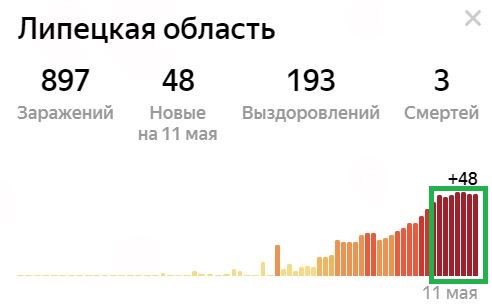
Another schedule (like the previous one, it was built by Yandex on the basis of official data from the Russian government) shows a daily increase in new coronavirus infected by coronavirus in the Kursk region . This region was repeatedly called Russian experts as a place of frequent manifestation of "electoral anomalies" when the election results aroused suspicions of their artificial fit. From April 15 to April 25, the number of daily new confirmed cases of coronavirus infection ranged from 22 to 44 per day. On April 26, an increase in infected by one and a half times - 67 people was recorded. Since then, every day this number remains stable, not dropping below 65 and not increasing more than 74.

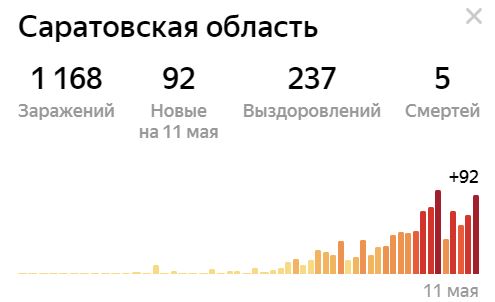
For comparison: here is a graph showing the fluctuations of the daily number of new identified carriers of the virus in the Saratov region:
But St. Petersburg:
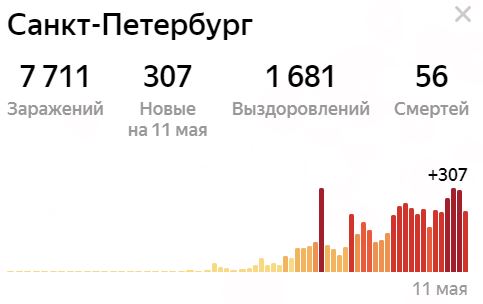
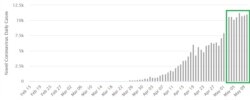
According to Facebook, a physicist and a specialist in political geography Sergey Shpilkin, in the schedules of suspiciously “stable” regions, there are not enough at least minimal data dispersion, that is, fluctuations that would be characteristic of the real state of statistics reflecting. According to one version , the goal of possible manipulation of data may be a reluctance to report a sharp increase in the incidence of coronavirus. Instead, officials preparing reports for the federal headquarters can smoothly “stretch” the accumulated number of identified infected ones - for example, so that it does not exceed 100 new infected ones per day, as in the Krasnodar Territory. Other commentators admit that the stable number of new cases of infection can be caused by a limited number of tests available to the regional authorities. One way or another, in general, data on Russia can really indicate the achievement of a “plateau” in the number of new infections of new infections of the virus daily: from May 3, when 10,633 infected were identified during the day, this number did not fall below 10 102 people (May 5) and did not rise above 11,231 (May 7).
And what about the statistics of deaths from Covid-19?
There are still more questions to the statistics of the dead in Russia: the country has one of the lowest in the world of the dead from Covid-19 in terms of the number of detected coronavirus carriers. The number of active cases of coronavirus is constantly growing, according to this indicator, Russia will soon reach the second place in the world. You can compare Russian statistics with the British: there and there, about 220 thousand infected are registered, but 2 thousand people died in Russia, and 32,000 in the UK.
Russian state media and officials explain this phenomenon differently. Thus, the Russia Today reports with reference to the official representative of the WHO in Russia Melit Vuinovich : the low mortality rate from the Covid-19 in Russia may be due to the fact that "epidemiological measures were able to protect the most vulnerable group of the population-people over 65 years old." The director of the Central Research Institute of Epidemiology of Rospotrebnadzor, Academician of the Russian Academy of Sciences Vasily Akimkin believes that the low mortality rate of patients with coronavirus in Russia is explained by "early diagnosis and the detection of infection in people who do not have symptoms."

The “Russian phenomenon” may have another explanation: on May 8, the English -language publication The Moscow Times drew attention to the official website of the opposition to the spread of coronavirus in the Chelyabinsk region. From the numbers published on it, it follows that during the pandemic 3 people in the region died of Covid-19 and another 7 infected ones-“from the underlying disease”, while the Covid-19 was recognized as “related”. Several interlocutors also told Radio Liberty that their relatives and acquaintances with confirmed coronavirus as a cause of death instead of the Covid-19 recorded other diseases.
In different countries, they really consider the dead from coronavirus differently: somewhere, everyone who was identified (regardless of the "fundamental cause of death) is found somewhere, somewhere the authorities try to be more selective. Nevertheless, examples of the same striking contrast, as in comparing mortality in Russia with mortality in other countries, where the number of infected people are close to Russian (for example, Spain or France).
The real mortality from the Covid-19 may reflect a comparison of the general statistics of the dead in a particular country over the same months of 2020 and previous years. The first method of The New York Times resorted to this method, which found that the total mortality rate in 17 countries, as well as in Turkey and the city of New York, sharply increased in March-April 2020 compared to mortality in the same month a year earlier.
On Sunday, May 10, the same publication The Moscow Times noted that according to official data of the Moscow government, mortality in the Russian capital over the past April 20% exceeded the average monthly mortality in the same month over the past 10 years. According to official information, in April this year 11,846 people died in Moscow. On average, annually over the past 10 years in April, 9866 people died in Moscow. From these data it may be followed that the statistics of the death of patients due to coronavirus can be higher than the official information of the Moscow authorities, the publication says. As of today, in Moscow, a little over 1000 people died from Covid-19-this is half as much as the difference between all dead in the city for April 2020 and dead in April in previous years.