
Translated material
Native man
Who will receive help from the state faster: the population or Igor Sechin?
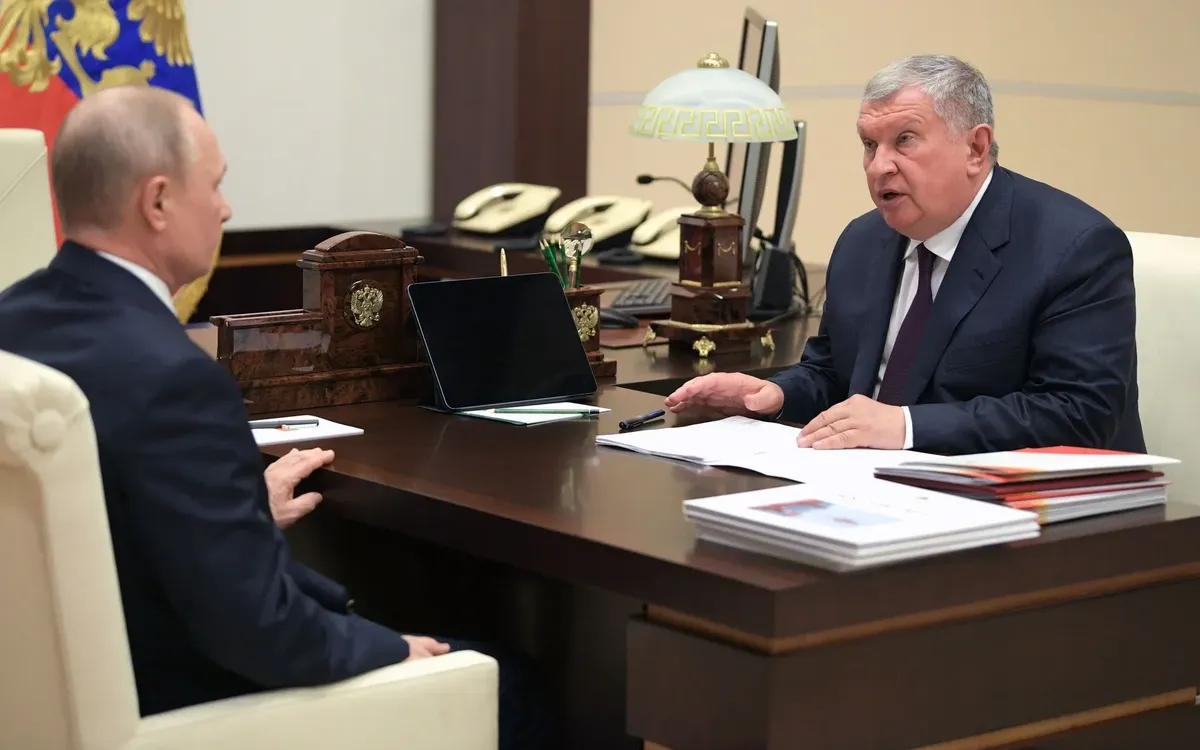
So, the former state oil company Rosneft (after a favorable exchange of Venezuelan oil assets for a package of its own shares, the share of the state in the company decreased below 50%) once again asked for help from the state.
By the way, during the period when the Rosneft’s control package belonged to the state, it consistently absorbed private oil companies Yukos, TNK-VR and Bashneft (however, the last privatization was a completely clear case of the theft of state assets-flagrant even against the background of how the privatization of other oil assets of the former USSR passed).
Further one could say a lot of vivid emotional words about Rosneft, her leadership, to remember even her extravagant spokeswoman, together with everyone to shake the gratitude of the reader, who, along with the whole people, did not receive direct financial assistance from the state of money sitting on a bag of money during the epidemic and quarantine.
But we will try to be objective and, above all, remember that we are talking about a company that pays 3.6 trillion rubles of taxes per year.
Let's start with that simple thought that if Rosneft did not absorb the private oil companies mentioned above, then the size of the help she required would be many times less than it is required now. And private traders would either cope themselves, or would take on certain obligations in exchange for the help of the state - for example, to lower the prices for gasoline prices to the constitution. However, this is excluded, because in Russia, gas prices can only rise, because:
In the retail value of gasoline, more than 60% are taxes;
When the cost of oil is growing, the retail price of gasoline is also growing, because the price of oil still plays its own, albeit a small role in the formation of the cost of gasoline;
When the cost of oil falls, the tax component in the price of gasoline does not decrease, but is growing because the budget is empty, and it is necessary to compensate for the drop -down expenses.
Yes, and suffering from oil companies, as the head of the government Putin directly explained to us in 2009, we must help in a difficult period for them, because before that they filled the budget as much as they could.
Perhaps private oil companies would abandon the help of the state at a difficult moment when tens of millions of Russians are sitting without work and salaries. Or, as a private “Surgutneftegaz”, they would have accumulated a huge, size of $ 46 billion (in the middle of 2019) cash reserve. Or even would have turned, but the state would refuse them.
Well, that's enough science fiction. They would turn and receive. Although, possibly, in a smaller volume than Rosneft, because in her case “how not to please your native man”? And on the other hand, remember how many “native men” were in the state apparatus at the same Yukos? At the "Alfovites" from TNK-BP?
It can be assumed that companies with large foreign participation would be more difficult to seek the state manner, but the share of BP Russian Investments Limited on the capital of the Rosneft NC is also very significant and amounted to 19.75%as of March 1, 2020.
What specifically asks the state Rosneft this time?
The main thing that Sechin asked was to reduce the tariffs of the state “Transneft” to pump oil according to its oil pipelines: “The key question is for us also is to bring transport monopolies to the current market prices in accordance with the tariffs of the market. If in 2008, say, the cost of oil in rubles was about 1100 rubles, now 1200 are comparable values. But earlier the tariff was 822 rubles per ton of pumping, and today - more than two thousand: 2100 rubles. "
Transneft's net profit in 2019 amounted to 179 billion rubles, a free cash flow - 93 billion rubles, the company shook 513 million tons of oil and oil products, receiving revenue of 1.064 trillion rubles. In 2018, Transneft's net profit amounted to 224 billion rubles, in 2017-186 billion rubles, in 2016-232 billion rubles, even in the crisis of 2015, the company received a net profit of 143 billion rubles, in 2014-196 billion rubles.
In general, Transneft is not in poverty and some margin of strength has, having recorded more than 960 billion rubles of net profit over the past five years.
But Sechin also cunning in the above quote, indicating the cost of a barrel of oil, and the tariff for pumping is already leading per ton. Since there is 7.3 barrels in a ton of Russian oil, in reality, mathematics looks like this:
Rosneft sells a ton of oil for 8760 rubles and of them pays 2100 rubles for pumping. That is, the share of the tariff for pumping in the cost of a ton of oil is 24%.
However, there are two “but” at once.
Firstly, the “$ 16.5) “ Rosneft ”was far from such a low cost of a barrel of oil (1200 rubles) was far from always, but only in the last month , until the decades it was three to four times higher. And even with the huge tax seizure that until recently existed in the oil industry, it should have accumulated some reserves, albeit not $ 46 billion, like Surgutneftegaz.
The actual absence of such reserves is already a question of the development strategy chosen by the company.
Secondly, such a low sale cost of Russian oil lasted a few days, now Russian oil is more expensive.
In principle, Transneft will ultimately receive much greater losses if Rosneft, and with it, the rest of Russian oil companies will be forced to sharply reduce the pumping through its oil pipelines due to the loss-making of sales, than if she is ordered to reduce their profits from the Kremlin.
Also, Rosneft, reporting on the beginning of search and exploration drilling in the Taimyr part of the Vostok-Oil project, asked to transfer taxes on exploration for a period with higher oil prices.
As we recall, the Kremlin’s rate that oil will grow quickly enough, in a matter of months after the presidential elections are held in the United States in early November. But even if this does not happen, in a situation where taxes even interfere with exploration, it is probably worth considering a decrease in taxes - otherwise, production in the future may seriously decrease.
The fact that, according to the Deputy Minister of Energy of Pavel Sorokin, the Taimyr part of the Vostok-Oil project will be profitable at an extremely low taxation level (a new 5th group for the payment of added income and tax deduction for the construction of infrastructure) and the selling price of oil in $ 35-40, we will leave outside our analysis.
Well, as usual, Sechin asked for money - however, on credit: “This is the availability of lending on the terms that are now adopted by the Central Bank. These are ruble loans within the limits that are our banking system ... If there was the possibility of increasing limits on the creditor, this would greatly help support our investment programs, including even some new ones, bearing in mind that in the prospect of two or three years we will still overcome the crisis, and it will be necessary to provide the market with new hydrocarbons. ”
It is not easy to understand from this quote what specifically was talking about, but, apparently, Rosneft asks to lend it in large volumes and with an interest rate equal or close to the current rate at which the Russian Central Bank loans Russian banks.
Now this rate is 5.5% per annum, but the leadership of the Central Bank of the Russian Federation has already stated that in the near future it could lower it to 4.5%. The Central Bank of the Russian Federation can be loaned at such a rate of the Central Bank of the Russian Federation only by redeeming Rosneft bonds, or lending to its subsidiaries.
It is clear why Rosneft money in the context of a very large fall in revenue-in December 2020 and January 2021, it will need to repay the releases of exchange bonds in aggregate by 800 billion rubles. On the other hand, it is gratifying that Rosneft in the near future does not have very large currency payments, otherwise we would risk taking the second edition of 2014 with the devaluation of the ruble.