
Translated material
I believe that it hurts you
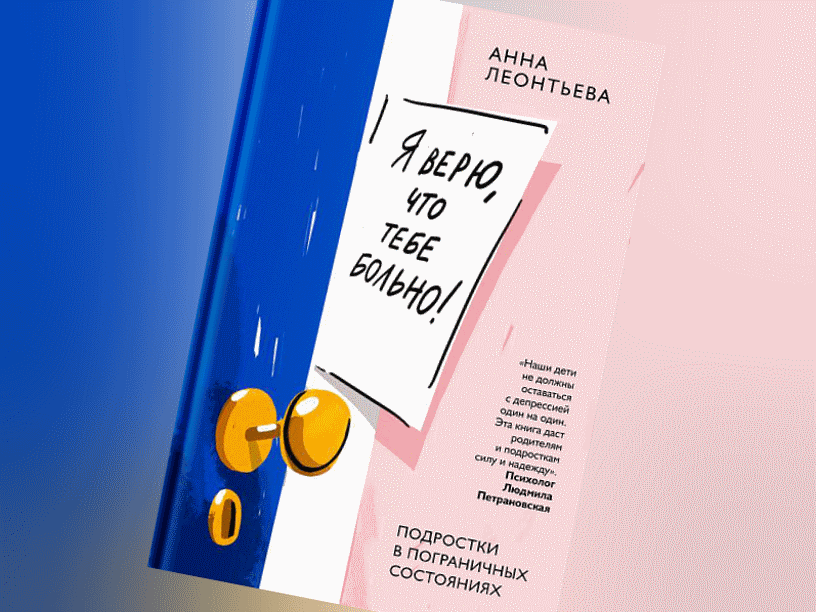
The publishing house "Nikaya" published Anna Leontyeva’s book “I believe that it hurts you. Teenagers in borderline states ”, in which she honestly shares the history of the struggle against the clinical depression of her daughter.
How to recognize parents that trouble happened to their child and he, despite the outwardly prosperous life, is internally crushed? How not to depreciate the mental pain experienced by a teenager and help him in time? In addition to the personal story of the author, the publication contains the opinions and advice of qualified specialists for parents, whose children experience a difficult life stage. They will calm adults, give them determination on the battlefield for the health, calm and happiness of their child and will help to establish close and trusting relationships with him in this difficult period.
The book raises complex and extremely important topics: how to competently respond to the depressed, oppressed state of the teenager and the appearance of suicidal thoughts in him; How not to devalue his torment and treat with attention and understanding of his pain; How not to lose the trust of your child and maintain close and trusting relationships with him.
We offer to read a fragment of the book.
In anticipation of my first -born, I collected and published a wide variety of materials about motherhood, natural birth, infant age, “harvesting” the child after childbirth (my profession of a journalist helped me). All this information was needed not only to readers: I wanted that when the baby came out of me, I had a clear instructions for growing it. By pieces, according to fragments, I collected the information that can now be fully found in good psychologists, experienced midwives, wise mothers. Of course, the first time is still one on one with a child-and there were no grandparents nearby-this is the time of the confrontation of you and your little man of a huge number of tips coming from outside of the seemingly solid sources: pediatrician doctors, your older relatives, books (in the 90s, which were the childhood of all my three children, these were the books of Dr. Spock, carefully brought, as they were carefully brought. rule, mother or mother -in -law) ...
The first and, fortunately, the last advice to which I only followed once, “from Dr. Spock and others like him,” “let him shout”. This experience was so captured in my memory that I am still ready to sob when I remember that day. It was so. Tormented by unusual continuous communication with the newborn, I once decided to “let him shout”, as a spell repeating to myself: “Let him understand that I can’t always come right away, he is fed up, he will be dressed, but we have already walked ...”
I went out into the kitchen and, with an independent look, began to brew tea under the growing infant muttering, in which bewilderment was heard by my sluggishness. When the bewilderment of my awakened baby began to become concerned, and then into a clear fright, I felt that I did not really understand where exactly the boiling water for brewing. When notes of despair were heard in his screams - I caught myself standing at the door and almost scrapping her nails. I must say that it has broken down quite quickly: the level of stress from my strange educational impulse far exceeded compatible with life. When I finally picked up in my arms and put a wet, red and frightened child to my chest, it looked at me with an unforgettable expression of grief and reproach - otherwise I can’t convey this look and sob before a new immersion in my warmth ... I am still glad that after that I threw the books of Dr. Spock and blocked the broadcasting channel of useful tips in the format in the format, he can scream from it, he can scream from it. harmfulnesses ”,“ Do not accustom him to your hands, then you will regret it yourself ”and“ Feeding by the clock is the key to your future happy life ”...
I tell all this to emphasize once again: to understand that the problems of our children from there, from childhood, is painful, but necessary. The diagnosis is half the way to recovery.
When the child is only born, his consciousness is still as much as possible in chaos, it is defocused. He is in the world of images, fantasies, shadows. Gradually, consciousness begins to be structured. He begins to recognize her mother, her face. Life begins to acquire more and more specifics. A small child at the age of several months fixes his mother’s image, rejoices at her, and emotional contact with his mother at this age is very important for him.
The psychotherapist Konstantin Vladimirov spoke about such a rather terrible experiment: the mothers of 8–9-month-old children were given the task of playing with the child who sits in a stroller, and now the mother plays, fun-but at some point suddenly stops and makes a stone face. He just looks at the child - but with a motionless face. What happens to the baby? At first he is scared, begins to scream, tries to attract attention, then begins to cry, he begins a tantrum. And the task of the mother is to stay with a stone face.
What happened next? I must say that some mothers simply could not stand it. But those who continued this “game”, at some point, the children just ... freezed! This instinct is triggered here: "In order not to overstrain, so as not to die, so that theastors do not come to the cave and do not eat me - you need to freeze." And the child does it. He moves away from his mother and falls silent. And here the first fixation of depressive experience takes place. “The object that my psyche usually reacts to, for which it clings is the only support that is in my life-for some reason collapsed, this support is not alive. I don't know what to do. I scream - the support does not come to life. And then the only thing I need to do so that I do not collapse in my chaos - I have to go into the inner world. "
The child calms down not because he became better. He shuts up so that he is not eaten by conventional predators. The protection mechanism embedded in it is triggered. But at the same time, he is experiencing incredible horror. And here the first experience of total loneliness is formed. The psyche has such a function: in the case of some strong stressful situation, we move back a step back until we find the support. And if subsequently the child takes a step back and does not find support, the second step - there is no support and so on, then he goes into his very first phase, where he experienced this horror of intolerable loneliness, where he needed to freeze. Psychologists call this trusting children's injury.
I will not resist and give some very important quotes for the mother and for the baby from the book of Lyudmila Petranovskaya “The Secret Relief. Attachment in the life of a child ”on this subject:“ The idea of putting a child alone in something like a wooden cage would have seemed quite strange to our ancestors. How can you leave such a helpless cub alone? Yes, we do not live in a cave and not even in a hut, a baby from a beautiful nursery, in which everything is chosen in style and color, will not drag a wild beast into the forest and will not bite rats. But he does not know that! His instinct, for hundreds of thousands of years, grown by evolution for the sake of his safety, says one thing: either you are next to your adults, or write disappeared. The instinct of the mother, who has been adjusted to the instinct of the child as two thousands of thousands, as two complex details of one mechanism, repeats the same thing: do not leave him, do not let him scream for a long time, it is dangerous for him and for you. ”
“For him and for you” ... for you: of this non-trace to your own feelings, which are clearly laid in mothers by nature itself, can grow either anxiety and a feeling of guilt, or vice versa-the habit of moving away from the child, his needs, his pain and his cries. At a later age, this is expressed in the relationship "Let him copes himself, he is not small." For him: the presence of a mother or another permanent loving adult, ready to console in infancy, lays, as psychologists say, "basic trust in the world." That is, infant age forms in a child either a sense of strength of the world around him and its significance in it, or uncertainty in either.
“The despair that will cover him when he does not shout and falls asleep in exhaustion. Once he will cover, two, ten, and then this despair will settle inside and will remain with him forever, covering in moments of life difficulties the same irrational conviction that “everything is useless, no one will help, I am doomed” ”(Lyudmila Petranovskaya). Further, the torn connection can lead to more severe pathologies of the relationship: when the parent or parents do not at all understand the seriousness of the problems and level of the child’s pain. In the most extreme case, when the parent knows how to seek obedience to his teenager through “strong” words and a tough attitude to his misconduct, a sensitive child may not withstand the future horror of moral destruction (even imaginary) for misconduct or error (an incessant exam, a broken vase - anything!) From the parents and leave: from the house or from life - it all depends on the moment and on his state at that moment!
Unfortunately, no matter how bitter to us, parents, read it - the trustful children's injury exists, and yes, it could be that we unconsciously inflicted it for the child. But - I want to write this in huge letters: it’s never too late to start work on its cure! Many parents with bitterness can say: we have lost this moment, we did not communicate enough in childhood, listened poorly, we were few together, and now everything is hopeless, the formation of the psyche has ended. No, psychologists are categorically against such conclusions.
Formation never ends! For a huge number of people, a large and significant event can be new relations with parents. If the parent asked a seventeen-year-old child with whom he did not really have contact: what does he need to help him now? .. If he had given the child to know that he was crying at night because of his problems and does not know how to solve them ... He tried to talk, share what is happening ... told about himself at his age, he asked: “Is it like you feel?” Such a new beginning of a relationship, such a contact, conversation, interchange of experiences, confidence in any age will give the child a powerful margin of safety. He, no doubt, will be less than if it had been done from the very beginning, but he will be. Forty -year -olds and older people often go to a psychologist in order to pull out a grain of understanding from their parents - and they cannot, alas! This follows a very practical and at the same time optimistic conclusion. You can start establishing relationships with yourself and with your child in his seven years, and in his seventeen, and in his forty.