
Translated material
Alexander Ageev. Hunger 34
When I worked in the "Banner", people who wanted to make me pleasant said this: "I always begin to read your magazine from the end." At the end of the magazine, the “observer” was located, a bibliographic review that I invented and led the last six years. But generally speaking, this phrase (like this habit is to leaf through the magazine from the end) - from the category of "common". At the end of any magazine, as a rule, every little thing is unloaded - not only a bibliography, but also letters of readers, a chronicle, and obituary, and congratulations, and all kinds of marginal, incomprehensible genre texts that the editors do not know where to stick.
And among readers, as among swimmers, there are those who immediately dive (in the depths of a long novel, for example), and there are also who are kneaded to the shore for a long time, try the water with a heel and generally love beaches with a gentle bottom so that you can slowly and carefully enter the water. Such here are the gnaws of a magazine book from the end, where relative shallow water.
Well, of course, professional critics "enter" into the magazine mainly from the black move - literary life is shown in the very least, specific information is presented there, the texts of friends and enemies in the workshop are printed there. In a word, there is what the magazine makes a magazine - an independent unit of the literary process, and not the operational parallel of cheap book publishing.
I also have this workshop reflex, but nevertheless it is stronger than his bibliographer’s habit-before starting to reflexively leaf through the last pages, I still run through my eyes. And there is only one exception to this rule - “New World”, where, first, with a mixed feeling of envy and annoyance, I read the heading of Andrei Vasilevsky “Periodic”, and then I look into the content.
Now I will explain both envy and annoyance.
The first has, so to speak, historical and biographical nature, although it does not fit into this framework.
But in order: the Znamensky “observer” I conceived somewhere at the end of the 94th year, when the review departments disappeared from almost all the “thick magazines”, except, except, perhaps, the marginal “continent” and the conservative “new world”. But the “New World” then for some reason destroyed the simple and logical two-part scheme of the bibliographic department that he got from Soviet times: “Book Review” (lengthy reviews with names) and “Briefly about books” (reviews without names). And he somehow languidly tried to experiment on a suddenly empty space: then the “mirror” cutters of the foreign book about Russia and the Russian book abroad suddenly were launched (with the full shallow of the rest of the bibliography), then they disappear without a trace and an incomprehensible “Book Regiment” occurs (an arbitrary list of recent books, of which the fifth is irrelevant) The stripes of the section “Briefly on Books” are given to one reviewer, well, other gripping and jumping, testifying at the same time and about the desire to come up with something like that, and about the vague, non-focus of this desire.
I, after the observer and composing long, detailed reports on the authorities with “pictures” (specific sketches of the content with arithmetic calculations and the distinction between the “spheres of influence” of the department of criticism and their future department), immediately decided: this will be a classic tough scheme (which the book publishing boom was not fully complored Rubric as an acute seasoning for a compulsory, traditional dish. Among these headings there was to be some completely informal, free, subjective-authoric (of course, he would not have entrusted anyone-he would write himself).
“Westification” and the comprehensive, very viscous discussion of the “observer” project went to the banner for almost half a year (to say “yes” or “no”, for some reason there was little decision of the editorial board - they made a general meeting of the journalistic team), and during this discussion it was not the most last person of the editorial office that it was categorically said: “The Ban was not and there will be no copyright rubrics!”
Well, in a word, when I finally sent the first issue of the “observer” to the set, the 5th number of “New World” for 1995 , in which the “periodicals” of Andrei Vasilevsky first appeared for the first time, was released. I opened this heading, and almost yelled like Ostap Bender: "I took a girl! Right from the stall!"
It’s not that this was exactly what I dreamed of while I was pouring over my project, but I was looking for somewhere nearby. Hence both envy and jealousy, but also the recognition of championship and merit.
I will say without a shadow of irony: Andrei Vitalievich then made an extremely rare in journalistic practice (generally very conservative, despite the external vanity) the discovery of a new genre, I’m not even afraid to say that this is the only real “know-how” in large-format literary journalism of the 90s.
I don’t know (did not ask), whether Vasilevsky immediately understood what universal machine he came up with, or was gradually imbued with (judging by the dynamics of the development of the heading - rather the second) significance of his discovery, and now this is not important.
How is this section arranged? Like all ingenious, very simple: "The reader's notebook" ("Readers Diary") is made by the public. Moreover, it doesn’t matter whether this “diary” is genuine or directed: the name of the text (novel, story, articles, memoir publication, reviews, collection of poems by ETC.) plus a few words about it; sometimes a quote; Sometimes (even before the Internet there was a case) - a link to other texts of the same author or on the same topic. Sometimes - without words (author, the name of the text and the place of publication themselves form a certain expressive "statement").
I repeat once again: brilliant! The capacity of such a heading is almost infinite, the geography of coverage is not limited by anything (periodicals in Russian are published on all continents), the freedom of utterance is complete, there are no obligations to the reader. The author wants - he writes a serious analytical paragraph about a small article in a marginal newspaper, and wants to - about the long novel of a famous writer, says two seemingly neutral phrases:
" Oleg Smirnov. Month of Kolevev. Roman. -" Our contemporary ", 1995, # 1 - 2.
Military prose. To the 50th anniversary of Victory. "
Someone will read these few words literally, and someone will see the author’s attitude: here is a novel about which there is nothing more to say. This attitude is not imposed (sometimes in such cases it is, and sometimes not, that is, you can’t build a pattern), it is impossible to make any complaints, but some flickering meaning is still generated. Someone "accepts" as a radio, this wave, someone-no. Pure work!
But no one forbids the author to give a direct assessment, use all the gradations of the irony, enter into a polemic, destroy the ideological or aesthetic enemy with his own words, and simply give a classic, impassive annotation. The genre allows everything!
I’m not saying what a find this section was for the magazine. After all, "periodicals" is the simplest and effective tool of influence. Sooner or later (this quickly turns into a habit), all authors of newspapers and magazines are being looked in (besides “just readers”) (and this is a powerful reference and, most importantly, broadcasting group) in the hope of finding their name. Looking for themselves, willy-nilly get acquainted with Vasilevsky’s opinion about everything in the world. And all this in homeopathic, rapidly soluble and easily digestible doses, without stray and boring! No, a fairy tale, not a genre!
And the inconsistent Glory of Kuritsyn, who recently arranged the “Vasilevsky design” , was in vain so frivolously staring about the “notes”, building the heroic-idyllic biography of the hero:
"Gradually began to write notes in the magazine (for some reason it seems to me that I saw his review in the legendary youth issue" New World "for April 1974, but the biography says that Andrei is published from the 76th), then it was quickly cooled, finding a genuine recognition of a bibliographic short note in a flying genre: his section of the period of the" period "in the" period "in the" period " "New ME" is one of the samples of the genre; thanks to Andrei, in recent years, all sorts of cute nonsense like "Our publications 10 years ago", which gives the magazine a cozy home aura ... "
Slavik is generally a light man, for him for two years there, two years here - no difference. It was in that "legendary youth issue for April" that Vasilevsky was printed, only the number was for the 1976th, and not for the 74th.
Wow, by the way, was a number:
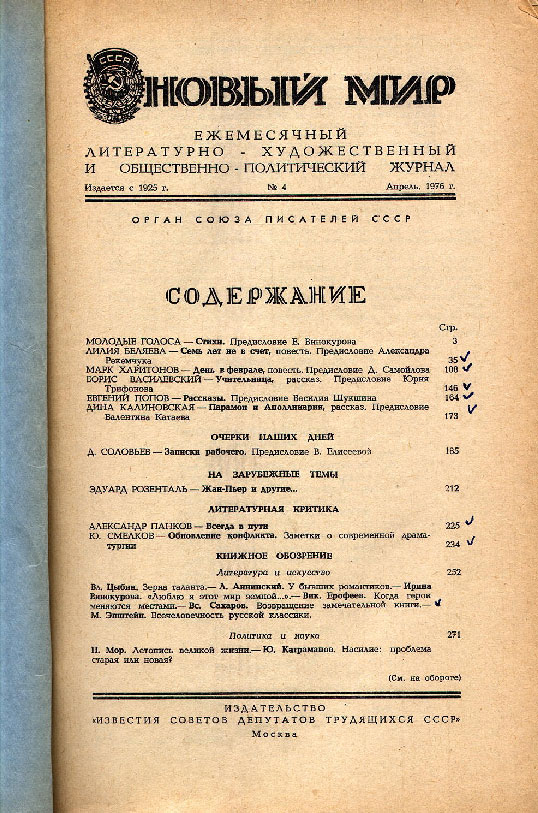
And Evgeny Popov, and Vik. Georof, and Mikhail Epstein, and in “Young Voices” - the current deputy Bunimovich and Olesya Nikolaev on the same page with Sergey Bobkov (son of Philip), and Alexei Didurov, and Evg. Blazheevsky, and Victor Korkia, and Grigory Kruzhkov. And a bunch of all sorts of remaining in the unknown.
And Vasilevsky’s review (Slavik, I suppose, was remembered by the prose writer Boris Vasilevsky) on the book of Sergei Mnatsakanyan - she is on the second page of the content, I will not scan.
Yes, and the April number for the 74th was also not bad, for nothing that they turned it out exactly during Solzhenitsyn’s expulsion:
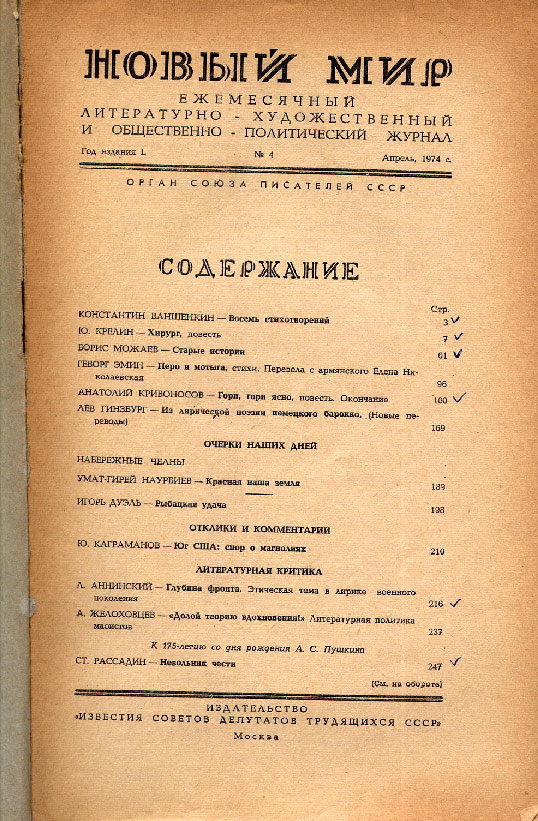
But Vasilevsky really was not here.
Well, okay, this is so - I arranged an intermedia with pictures, because I do not like the current approximation and sloppiness. We "stood" there.
And now we can say about the annoyance, which, along with envy, I experience, reading the Novomirov "periodicals".
Unfortunately, to invent a perfect tool is one thing, and using it at the level of its perfection is slightly different. This should be why some people construct aircraft, and the figures of the highest aerobatics make completely different on them.
Over the years, the freshness of the perception of "periodicals" has passed, the novelty and versatility of the genre itself ceased to obscure the contents. And it became a little to catch his eye: less and less short phrases with a flickering meaning, more and more quotes, and some (this is the 9th Kugl!) Takes half a half-year. More and more "conservative" didactics on the most unexpected topics.
And the most annoying one is a frank tug of blankets on itself, that is, on the magazine "New World". It is clear, of course, that the editor -in -chief must promote his journal, but would have sorry for the invented genre! In any convenient and inconvenient case, it is impossible to translate the arrow towards the "New World". Here's how in the last "periodical":
Victor Astafyev. Two stories. - "Banner", 2001, # 1 "Trophy gun" and "Cruel romances" - new stories of the famous prose writer. See also his stories "Prolette Goose" ("New World", 2001, # 1), "Pioneer - all an example" and "Wenk is judged" ("Moscow", 2001, # 1).
This is the most “see” - the leitmotif of the “periodicals” of recent years. And when to make such a link there is no way (the author of the publication is not printed in the "New World"), Vasilevsky is jealous and unfair:
Andrey Dmitriev. The road is back. The story. - "Banner", 2001, # 1. The story of a nanny with a camp tattoo on the forearm.
Need to prove?