
Translated material
Elena Kalashnikova. Evgenia Katseva: "German
Evgenia Aleksandrovna Katseva - translator from German, member of the Public Council of the editorial board of the magazine "Banner", the first cavalier (together with Solomon Apt) "Honorary Cross for Merit in the field of science and art of grade 1" (Austria). Among her translations are Andersch, Belle, Brecht, Bekher, Grass, de Broin, Kafka, Muzil, Frisch ...
Start: Family, Study, War, "New World"
Elena Kalashnikova: Your family had something to do with literature?
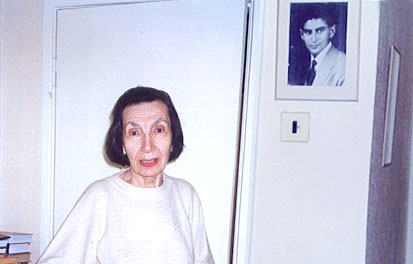 |
| Evgenia Alexandrovna Katseva. Photo by E. Kalashnikova |
Mother was a housewife. Of the three children, I am the youngest. In the 20s in Belarus, hunger began and in 1924, my mother moved to one of her sisters, who lived with her family in Ukraine, in a Jewish colony. In 1929, my mother joined the first collective farm, at the age of 8 it became a collective farmer, I can still milk a cow, work on Earth.
When I graduated from a four -year -old, I was sent to Lugansk, to secondary school, to another mother’s sister. Until 11 years old, I did not know the words "mother" in Russian, they spoke Yiddish in the family. A little time passed, and during the control, all the students looked at me: in difficult cases, I gave a sign where to write "and", where "e". In 1937, I graduated from a decree with a gold certificate, at which time a decree was issued - graduating from school, they can enter any university in the country for “excellent”. I sent documents to the University of Leningrad, to the Russian branch of the Faculty of Philology.
E.K.: By this time did you already know German?
E.A.K.: She taught at school, but knew only a few words and a comic count about our German teacher.
At the beginning of the 4th year, I got married, my husband, a graduate of the Faculty of History, received a referral to Mordovia. I wanted to quickly pass summer exams for the 4th year and go to him. I had one exam on Sunday, June 22. I remember that day very well - the beautiful weather, I stood at a tram stop, was going to go to Shchedrynka - the library to them. Saltykova -Shchedrin, when I heard a message about the war that had begun.
The husband went to war, he was an officer in the reserve, commanded a anti -aircraft battery. The university was evacuated to Saratov, and I remained - I was afraid that the letters would be lost - and became the political instructions of the Air Defense team. In November 1941, she entered the party as a candidate. Somehow they called me to the party committee, the senior lieutenant took the girls for special radio currencies of the Baltic Fleet, then to land them through the front line to the occupied territory. He said to me: “I'll think about it,” and gave the other girls the address, and I decided to go with them. I was one of the first 12 mattress girls in the Baltic Fleet. Then she worked with the first prisoners of war: she did not know the language, but she understood the prisoners (the remnants of the Jewish were preserved in her head), she could not convey anything to them - she did not want them to find out that I was a Jewish. Of the captured German officers and soldiers who were ready to fight on our side, they created the National Committee "Free Germany", and I had to teach their radio dealer in German.
In May of the 45th I ended up in Germany, on the coast, then near Berlin. I had to be demobilized, but since by that time I spoke freely in German, I was offered to stay in Germany and work in one of the units of the Soviet military administration to participate in the creation and work of the German press. Later everyone who helped restore and create a new culture was called "cultural officers." The same thing happened in the administrations of the allied occupation authorities.
I willingly stayed, I still had nowhere to go - I was not at home, my husband died.
E.K.: What happened to your mother?
E.A.K.: She died in January 1941. The rest of her relatives was shot near Lugansk - the place is called an acute grave.
In 1948, I met Simonov in Berlin, he told me: "When you return to my homeland, if I am still the editor-in-chief (at that time he was the editor-in-chief of the" New World " ), I will gladly take you to work."
The next year, I arrived in Moscow with two suitcases and numbers of Simonov’s phones. 1949 - the time of struggle against cosmopolitans. True, my Jewry was balanced by the fact that I am a participant in the war and a member of the party, besides, Simonov was busy for me.
E.K.: What did you do in the "New World"?
EA: I was the editor of the criticism department, then, already under Twardowski , I became the head of the criticism department, worked there until March 1953. At the height of the story with the “killer doctors”, “New World” printed Roman Vasily Grossman “for the right business”, and a defeated article immediately came out in Pravda. Tvardovsky was summoned to a meeting of the party bureau of the Writers' Union, he took me with him. The meeting lasted 6 hours, everyone forgot about Grossman and rushed to the criticism department. The next day I filed a care.
Then I worked in the "questions of literature" (32 years!), In "Banner" (7 years), from where I went to free bread in 1995.
About translation: Writers - acquaintances in Berlin
E.K.: When did you start translating?
E.A.K.: When I was the head of the criticism department in the New World, I came across the book of Johannes Behera Protection of Poetry. It was an relevant book, and for us relevant. The author wrote about non-conflict, about varnishing ... with Becher, as with many other writers, I met in Berlin when I was a "cultural officer." I made a selection for the "New World". Then she began to translate other authors.
E.K.: Which author or which work was the most difficult for you to translate?
E.A.K.: The Soviet translator always had two functions: to transfer and break through the work into a seal.
I have a happy fate: I translated only what I like. On vacation took some German-speaking book with me. For this, a late Frisch was suitable, for example, “Montok”, “Blue Beard” ... And from vacation I brought a ready -made translation. If I really like the book, then I must convince the publishing house that the reader will like the book. From the fact that I translated, everything was printed.
E.K.: Which of the writers is the most interesting or close to you?
EA: I recently wrote memories in German. The first part talks about my life from birth to this day, and the second is called "Men of my life" and is dedicated to my beloved writers - this is Franz Kafka , Henry Belle , Gunter Grass , Max Frish , Peter Weiss ... I love Frisha very much. All of them were familiar with each other and were very good about Kafka. When I wrote my book, I saw something Freudovskoye in this.
EK: Who, in your opinion, is the best domestic translators from German?
E.A.K.: Nina Fedorova, Mikhail Rudnitsky, Solomon APT, Seraphim Channel, Sofya Friedland, and very, very slightly others.
Portrait of the "most important man" donated by his niece
E.K.: How did you come to Kafka?
E.A.K.: In 1964, the magazine "Foreign Literature" printed his novels "Transformation" and "In a correctional colony" translated by Solomon Apta. I then worked in the journal "Questions of Literature" and prepared for printing an article by Dmitry Zatonsky , dedicated to this writer. I took up Kafka, after reading the "Diaries" , I realized that "disappeared." She began to make a sample for "questions of literature", just a one -volume was released, where the "process" and the novels were printed.
One functionary said: "The whole world was buzzing: Kafka, Kafka ... We saw him from afar and the reader saw: Kafka is crazy. We will no longer print him." The works of Kafka in the Soviet Union imposed a ban. For the publishing house "Art", I nevertheless prepared the writer one -volume, where part of the "diaries" , "letter to the father" , some novels were supposed to enter. Then they notified me that the press affairs committee deleted Kafka from the plan as an publishing house inappropriate for the profile.
But the manuscript of the book was already walking in the hands, and in the books of our large literary critics there were from there quotes with footnotes "print with the kind permission of the translator E.A. Katseva."
E.K.: What do you like Kafka most of all?
EA: "Diaries" and "Letter to the Father".
E.K.: How fully exists Kafka in Russian now?
E.A.K.: In 1999, a four -volume person prepared by me in the publishing house "Symposium". It included all the artistic creation, completely “diaries”, completely letters to Max Broda, Milena Yesenskaya. The only exception is letters to Felitsa Bauer. But for their full publication, one more volume would be required, the thickest. However, I did not want to fight for him. I don’t really like Felitsa - not without reason Kafka was engaged to her twice with her, but never married, she was just an addressee of his letters. He in many ways invented her image, from the letters it is clear that he understood the degree of her intellectual development. For example, he loved Russian literature, especially Dostoevsky (although in the content of his work closer to Gogol ). In one of the letters, he writes to her: "I just read an amazingly interesting book about Dostoevsky , I do not send it to you, it will be difficult for you to understand and read it boring."
By the way, the “letters of Felitsa” are now completely translated - Mikhail Rudnitsky.
Compiler
E.K.: You are one of the few translators involved in the preparation of collected works. How did you become a compiler?
E.A.K.: I compiled collected works of Kafka, Frisch, Grassa, Durrenmatt, Musyle's Small Music (love novels, two plays, from diaries, journalism); Bella's one -volume, Crysta Wolf, Hesse and others.
The more I was engaged in any writer, the more I wanted to fully introduce him to the Russian reader. She began to compile collections of their works, selecting existing best translations and ordering translations of their works that were not yet published in Russian.