
Translated material
The case will not limit yourself with vodka
Gaaga began to arrest Russian assets for yielding Yukos
As it turned out, Russia did not appeal the decision of the European Court, which in January 2020, among other things, decided that the ex-head of Yukos Mikhail Khodorkovsky and the former head of the international financial holding Group Menatep Ltd (GML) Platon Lebedev in the framework of the second criminal case were convicted of acts that were not crime (oil embezzlement and legalization). Strasbourg on January 14, 2020 then recognized the article 7 of the European Convention (“No one can be convicted of committing any act or inaction, which, according to the national or international law, was not a criminal offense”).

And although this decision automatically entails the cancellation of the sentence, for some reason, representatives of Russia did not turn to the Great House of the ECHR to appeal it.
It looks strange: it would seem that the decision of Strasbourg beats according to the reputation of the entire domestic state machine, including investigators, security forces and judges who for years have tried to prove the notorious theft of Yukos oil by themselves and the legalization, arrested and persecuted people (and continue to pursue, quietly “investigating” a large maternal case of the Yukos), stamped sentences) In Russian courts, accusations about Yukos in the heads of unconscious viewers of the NTV, the first and second channels, are being filled.
Either Moscow did not expect that the 7th article of the Convention (and this is really a rarity) would be recognized at all and was confused, or the authorities were so occupied by a long-term and exhausting proceedings in the Hague (a dispute with Yukos shareholders of 50 billion dollars for the expropriation of assets) that they forgot about Strasbourg.
Apparently, everything together - well, and the fact that Russia, in principle, did not find legal grounds to challenge the decision of Strasbourg.
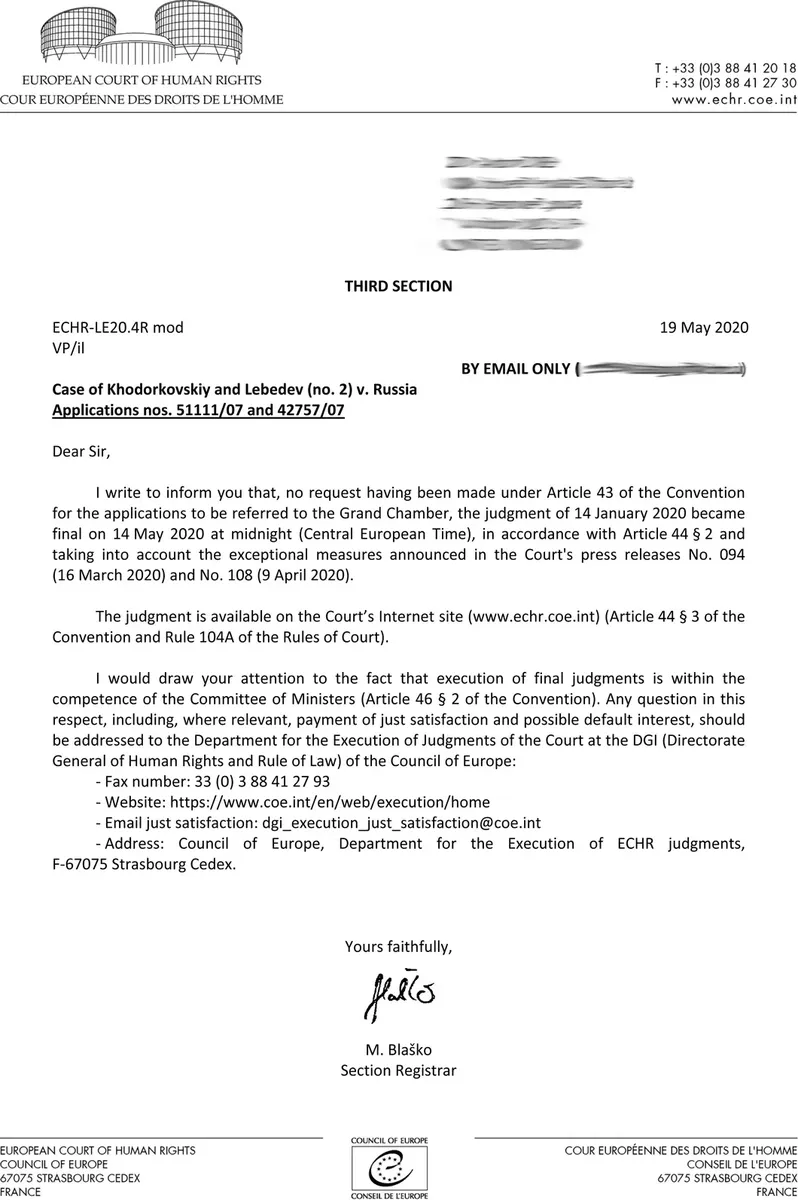
One way or another, on May 19, 2020, Strasbourg notified the parties that the January decision of the European Court in the second case of Khodorkovsky and Lebedev entered into force on May 14, 2020, as emphasized, “at midnight” - that is, exactly 4 months after his adoption. And it was also emphasized that the Russian government has never attempted to appeal it (the document is at the disposal of the editorial office).
What does it mean? This means that to rest in any jurisdiction that the Russian authorities did not agree with the decision of the ECHR, the Ministry of Justice will not be able to.
If they had not agreed, they would appeal. No one interfered.
What else does it mean? That Khodorkovsky and Lebedev needed 13 years (they filed a complaint to Strasbourg back in 2007) to prove that there was neither theft nor legalization.
And this also means that the head of the Supreme Court Vyacheslav Lebedev, who, by law, is obliged to introduce a submission to the Presidium of the Armed Forces in connection with the newly discovered circumstances - the decision of Strasbourg - is now in some dead end. Alas, he would not be able to catch the fact that Moscow, alas, would not be able to cling to the decision. Moreover, somehow you need to get around the 7th article rarely recognized by the ECHR.
But there is confidence: the Sun will certainly come up with something, as he always invented, in cases with the cases of Yukos.
Unlike Strasbourg, at another point in Europe - Hague - the pressure of Moscow has not yet weakened. There, the Ministry of Justice still speaks about the crimes of Yukos and is trying to appeal unprofitable decisions. We are talking about the “illegal privatization” of the company in the 90s (therefore, they say, the shareholders of Yukos do not have the right to compensate for the selected assets), “tax care” and again about “legalization”. Only about theft of oil - not a word.
In the Hague case, the Ministry of Justice of Yukos was still not stolen, but was sold, otherwise how can you pay or not pay any taxes from the stolen? This selectivity of Russia in international disputes with Yukos (when in one trial we are talking about theft, and in another about taxes) it began not yesterday and not today and was called “schizophrenia in the law”.
However, as in the European Court, the point in the case of “$ 50 billion” has already been set. In February of this year, the Court of Appeal in The Hague finally confirmed the right of Yukos shareholders for a record amount of compensation: taking into account the penalties accrued to Russia, it amounted to $ 57 billion.
The dispute, I recall, lasted several years, Moscow, which did not want to pay, endlessly appealed decisions in the Dutch ships. The Court of Appeal in the Hague for Moscow was the last chance, but he was lost. On May 7, 2020, in order to execute the verdict of the court and ensure the payment of compensation to the shareholders of the Yukos, the Gagos court arrested Russia's assets abroad. The first in line for arrest, as you know, were the famous Russian vodka brands "metropolitan" and "Moscow". The copyright holder of trademarks is the Russian Federal state enterprise Soyuznotnodimport.
In general, the case ended prosaically - vodka. Ahead of the arrests of other Russian assets (there are a lot of them). Maybe it is worth stopping at this, start negoting and executing a court decision? But neither in the Ministry of Justice, nor at the very top, the topic of arrest assets has not yet been noticed.
On the Ministry of Justice’s website, only the second week a press release is hanging that on May 15, 8 days after the arrest of the first Russian assets, Moscow filed a cassation appeal to the Supreme Court of the Netherlands about the February decision of the Hague court.
What introduces a little into a stupor: the decision of the court in The Hague is final, and the Ministry of Justice cannot understand this, but obviously makes a good mine with a bad game.
Moscow can complain about the decision of the Hague, of course, as much as you like, at least the rest of your life, but you will have to pay compensation for illegal removal of property today. And the case with one vodka, alas, will not be limited.