
Translated material
Bridges to nowhere: David Greber about useful and useless work
Fragment of the book "delusional work"
What is “real” and “fake” work? Is the work of the clerk in a large investment bank greatly different from work in the warehouse of clown noses? The answers to these and other non -obvious questions are the American anthropologist and activist of the anarchist movement David Greber is looking for “delusional work” on the pages of his book, one of the chapters of which is published by Gorky today.David Greber. Delusional work. A treatise on the spread of senseless work. M.: Hell Margin Press, 2020. Translation from English Armen Aramamyan and Konstantin Mitroshenkov
When someone calls his work meaningless or useless, he always relies on some kind of implied theory of value-the idea of what is a standing occupation and what is not. It is extremely difficult, however, to find out what this theory consists of in each case, not to mention to offer a reliable measurement system that will say that the work of X is more valuable or useful for society than the work of Y.
Economists measure value by what they call “utility”, that is, how much product or service helps to satisfy desires or needs. Many apply a similar principle to their work. Do I bring any benefit to society? Sometimes the answer is obvious. Anyone who builds a bridge considers it a worthless task if it assumes that the bridge will be useful for those who want to cross the river. If the workers are building a bridge that is unlikely to use, then they will most likely come to the conclusion that they are engaged in delusional work. This happens in the case of the famous "bridges to nowhere", the construction of which is sometimes sponsored by local politicians in the United States in order to attract federal money to their districts.
Nevertheless, there is an obvious problem with the concept of utility. When we call something useful, we just mean that it allows you to get something else. If you buy a dress, then the usefulness of the dress is partly that it protects you from natural elements, and also guarantees that you do not violate laws prohibiting walking along the street naked. However, mostly its usefulness depends on how much it suits you or raises your mood. So why does one dress succeed, but not another? Economists usually say that this is a matter of taste and, therefore, is not included in their competence. But if you take a few steps back, then ultimately any usefulness turns into this kind of subjective problem, even if it comes to something relatively simple, like a bridge. Yes, the bridge can facilitate people from one shore to another, but why do they want to overcome this path? Visit an elderly relative? Play Bowling? Even if they just go to the store for groceries. No one buys products just to maintain their physical health: people also express their personal taste, support a national or family tradition, prepare for a booze with friends or a religious holiday. We cannot discuss such things using the language of "needs". Throughout the most part of the history of mankind (and today it is still relevant for a significant part of the world) the poor draw into huge debts to local usurists, because they believe that they need to take money to arrange normal funerals for parents or a wedding for children. Did they have such a “need”? Obviously, they are firmly convinced that yes. And since there is no scientific definition of what “human needs” is actually (except for the minimum body of the body in calories and nutrition, as well as several other physical factors), such issues will always be subjective. To a large extent, need is just the expectations of other people. If you do not arrange a normal wedding for your daughter, then this will be a shame for the family.
 Most economists came to the conclusion that it is pointless to judge what people should want; It is advisable to simply accept as the fact that they want something , and to judge how effective (“rationally”) they satisfy their desires. Apparently, most employees agree with this. As I already noted, people who considered their work meaningless almost never said something in the spirit: “I am doing a selfie stick. Selfie sticks are stupid. People should not buy stupid things like a selfie stick ”or“ Who needs a couple of socks for two hundred dollars? ” Even a couple of exceptions were indicative. For example, take the story of Dietrich, who worked in a company selling goods for holidays (mainly local churches):
Dietrich: For several years I have been working in the store of gifts. I can only say that it was complete and absolute nonsense. What is true degradation, you only find out after you spend most of the working time, stirring between the boxes with clown noses, sneezing powders, plastic fuepers for champagne, cardboard figures of basketball players and other useless trinkets and trifles. Most of the time we simply sat in the backyard of the warehouse, doing almost nothing and reflecting on the absolute uselessness of what we were doing. This went on a year after year, while business became more and more unprofitable.
Moreover, our salary checks were bright red and clown noses were depicted on them. This very amused all banking employees - as if their own work is much more significant!
You can talk for a long time about why Dietrich considered these goods so insulting. (What is bad to blow a little?) I suspect that the reason is that Dietrich himself came to the realization that he works for suppliers of one -day trash. After all, these goods have always been considered one -day trash, these are anti -lane things done only to be in the garbage dump, it is a mockery of “real” objects and “real” values (even the money was comic). Moreover, trinkets do not at all reject the “real” values in the name of something specific; They have no real challenging what they allegedly laugh at. Thus, we can say that this is not even a genuine mockery: this is a mockery of a mockery, reduced to something so devoid of any subversive content that even the most boring and tedious members of society joyfully accept it “for the sake of children”.
Little in depresses more than forced fun. However, stories like the one that Dietrich said is rare.
When workers assess the social value of their work, in most cases they, with some variations, occupy the same position as Tom, the artist in special effects: “I consider it useful to the work that satisfies the previously existing need or creates products or services that people have not thought about and which somehow improves their lives.” This is fundamentally different from the “work on the idea of beauty” that Tom is engaged in: he must manipulate images of celebrities in order to make the audience feel unattractive, and then sell them a medicine that really does not help. The agents for telephone sales sometimes expressed a similar concern, but again, for the most part, they were engaged in just fraud. There is no need to turn to a complex theory of social value to explain that the bad thing is to persuade pensioners to buy a subscription that they cannot afford, for magazines that they will not read. Few condemned the tastes and preferences of customers; It seemed to them that the very aggressiveness and dishonesty of their actions were proof that they offer objects that had no value.
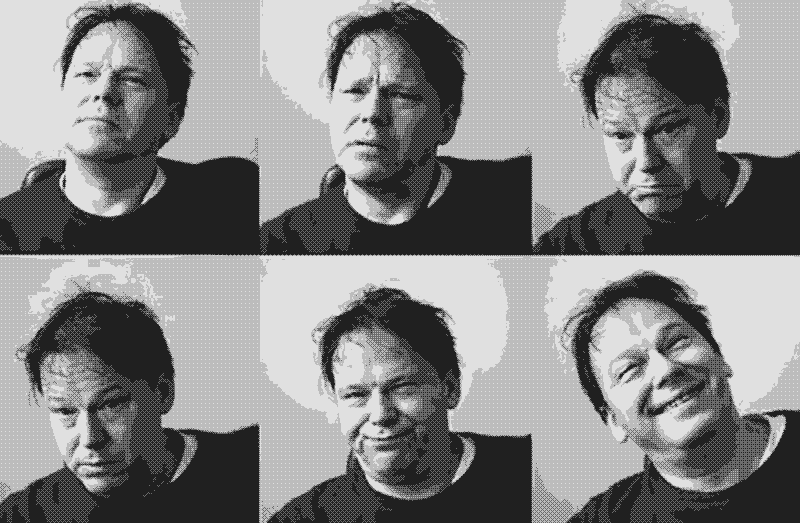 David Graber
Other objections are based on much more long traditions of social criticism. Take Rupert, a bank employee who claimed: “It is obvious that the whole sector does not add any value, and, therefore, all this is nonsense”, since the financial sector simply “assigns labor through usury”. The labor theory of the value to which it addresses is rooted at least in the European Middle Ages. It proceeds from the assumption that the true value of the goods determines the work spent on its production. So when we give money in exchange for a loaf of bread, we actually pay for the human efforts that were spent to grow wheat, bake bread, pack and deliver loaf. If some loaf of bread is more expensive than others, then this is either because their production and transportation takes more labor, or because we believe that the quality of some of these types of work is higher (more skills, skills, efforts) than in the case of other loaves, and, therefore, we are ready to pay more for the final product. Similarly, if you are engaged in fraud and deprive other people of their condition (which Rupert, in his opinion, did, working in an international investment bank), then you really steal a real, productive work that was invested in the creation of this state.
Of course, for a long time such arguments were used to criticize the order of things in which some people can be said to live due to the efforts of others. But the very existence of delusional work creates certain problems for any labor theory. Indeed, to say that all value is determined by the labor expended is obviously not the same as saying that any work produces value. Rupert believed that most bank employees were not at all loafers; On the contrary, he believed that most of them worked rather diligently. The only thing is that all their work, in his opinion, was to search for cunning ways to assign the fruits of real labor, which other people are engaged in. But then the question arises before us how to distinguish the “real” work that creates value from its opposite. If a haircut is a valuable service, then why is the provision of consultations about the investment portfolio - no?
However, the sensations of Rupert cannot be called unusual. It is possible that he formulated them with the help of the labor theory of value, but it is obvious that he expressed embarrassment, which many financial workers and related areas experience. He was probably forced to turn to such theories due to the fact that the dominant economic doctrine simply did not provide him with much choice. Among modern economists, the opinion prevails that since the value is ultimately subjective, such sensations simply cannot be confirmed. Therefore, everyone should refrain from judgments and act on the basis that if there is a demand for this product or service (including financial services), it is obvious that they have value for someone, and that’s all that you need to know. As we have seen, until some point, most employees, in principle, agree with economists-at least when it comes to tastes and preferences of the masses. But when it comes to their own work, experience often clearly contradicts the idea that in such matters the market can always be trusted. In the end, there is also a demand for work, and if the market was always right, then one who receives forty thousand dollars for playing computer games all day and gossiping with old friends in WhatsApp should have admitted that the services that he provides for the company, playing on a computer and gossip, really cost forty thousand dollars. Obviously, this is not so. Thus, markets cannot always be right. It follows from this that if the market could be so spoiled by the area with which the employee is best familiar with, then it can not simply obviously assume that the market can be trusted in assessing the true value of goods and services in those areas about which he does not have first -hand information.
Anyone who is engaged in delusional work or knows the people who are engaged in it, aware that the market is not an impeccable arbitrator in the issue of determining value. The problem is that such an arbiter does not exist at all. Value issues always cause certain difficulties. Most people agree that some companies could not have existed with the same success at all, but such a position is based on a kind of intuition, and not on a clearly formulated idea. If you try to formulate what the matter looks like from the point of view of the predominant, unspoken common sense, then I would suggest that most people, apparently, adhere to a position that combines the views of Tom and Rupert. According to this position, if a product or service satisfies demand or otherwise improve people's lives, then they can be considered really valuable; If they serve to create demand, forcing people to feel fat and ugly or driving them into debts and then charged interest, then they cannot be considered valuable. It sounds quite reasonable. But this still does not give an answer to the question of what it means “to improve the lives of people”-and everything else certainly depends on this.