
Translated material
Why are Belarusian nationalists the most peaceful in Eastern Europe?
Maxim Samorukov reviews the book “The rise and fall of Belarusian nationalism”: carnegie.ru
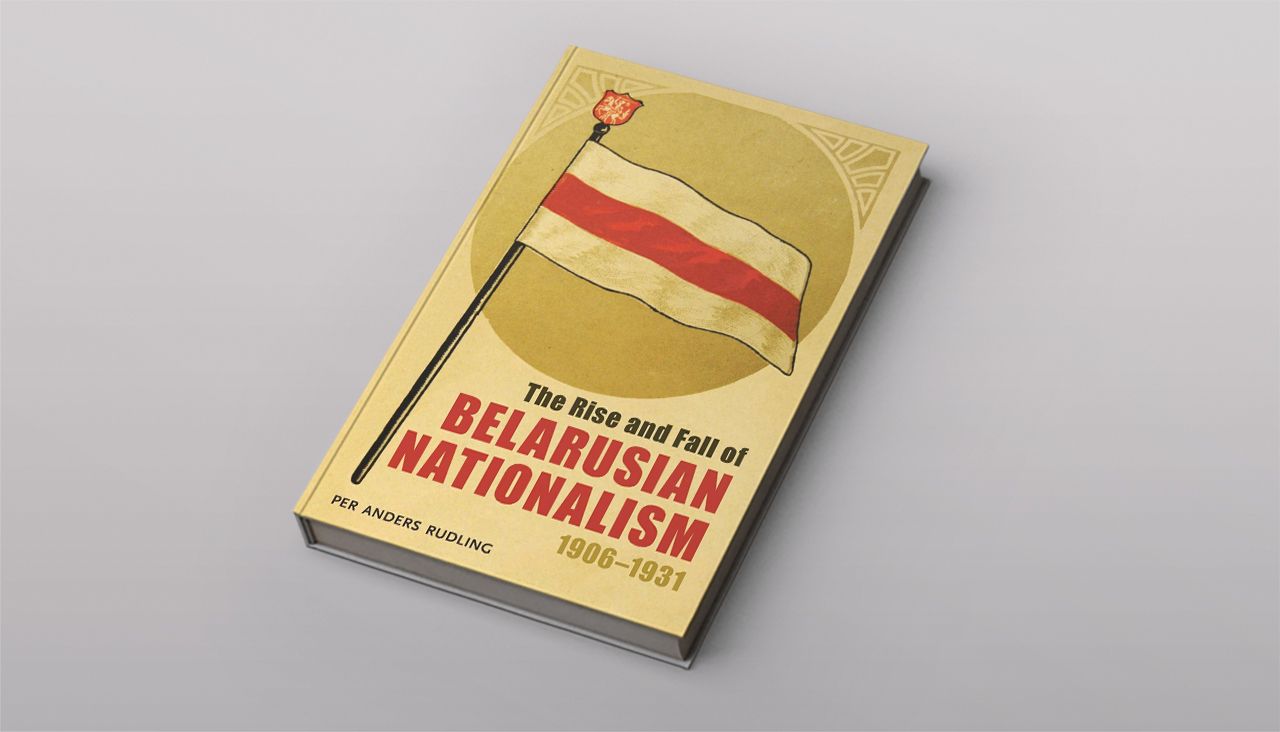
In the book “The rise and fall of Belarusian nationalism, 1906–1931”, the American historian of Swedish descent, Pers Anders Rudling, talks about who, when and how he came up with the Belarusian national project - and why he survived, despite the fact that he appeared several decades later than Ukrainian or Lithuanian. In a review of this book for Carnegie.ru, Maxim Samorukov explains why it was precisely the birth of Belarusian nationalism that made it weak - and at the same time the most peaceful and civilian in Eastern Europe. With the permission of Carnegie.ru "Medusa" publishes this review.
Belarusians are more often accused of that their nation is artificial and invented. This accusation, on the one hand, is true, and on the other, it makes sense, because all the nations were invented - just at different times and under different circumstances. It is these circumstances of the initial stage of the construction of the Belarusian nation that the Anders Rudling describes in his book “The take -off and fall of Belarusian nationalism, 1906–1931”.
As can be seen from the name of the book, Belarusian nationalism really appeared late even by the standards of not the most advanced western outskirts of the Russian Empire. But this delay did not prevent him from achieving his main goal - to create his own national state.
The two main reasons for such an unexpected success that Rudling allocates, universal and work not only for Belarus. The first is that the best help in creating new nations is the front line. And the second - that the national idea may seem arbitrarily ephemeral and far from reality, but the fact that it is formulated makes it extremely tenacious.
Weakness and dignity
The Belarusian national project was not easy, lagging behind several decades from neighboring Ukrainian or Lithuania. Most of all, the project was prevented by the fact that he had almost nothing to cling to either in the past or in the present of the late Russian Empire.
Different tribes of future Lithuanians could not understand each other's adverbs, but obvious differences from what the neighboring Slavs say, made it possible to easily create a sense of community. It was much more difficult to highlight the Belarusian language in the sea of Slavic dialects, which smoothly flowed from one to another - from Polish in the West to the Russian in the East.
With a religious community, it did not work out either. The Greekatolic Church on the lands of future Belarus was canceled under Nicholas I, in 1839 - long before the appearance of the first Belarusian webers. Local residents had to choose either Catholicism or Orthodoxy, and both denominations were clearly associated with other national projects - Polish and Russian.
To give the historical legitimacy of the Belarusian nation, one could turn to the Grand Duchy of Lithuania, who once existed in this territory. The most part of both the population and the elites in this feudal state made up the Eastern Slavs, and Oldruisian was used as a written language, which, if desired, was easily dubbed by the ancient Belorosa. But the neighboring tribes of the Baltic managed to sex earlier and appropriated the word “Lithuania” to themselves, and with him Vilnius, the Grand Dukes and the centuries -old history of statehood.
But most of all it was prevented by the fact that, unlike Ukrainians or Lithuanians, none of the parts of the future Belarusian nation was inside the borders of neighboring competing empires. In recent decades of the 19th century, when the flow of ideas and publications in Ukrainian went to the Russian Empire from Austrian Galicia, and in Lithuanian - from East Prussia, future Belarusians were forced to observe the imperial ban on local dialects.
Although it cannot be said that local residents were especially worried about such prohibitions. These lands were one of the least industrially developed and urbanized parts of the Russian Empire. If anyone lived here in a few cities, then these are Polish landowners, Russian officials and Jewish merchants and artisans. And only lastly - immigrants from nearby villages, who were not at all up to patriotic magazines and circles of national culture.
As a result, the Belarusian national movement appears only after the 1905 revolution, when the imperial authorities had to remove many prohibitions against local nationalisms. Its leaders are rare immigrants from Belarusian villages, who happened to get into educational institutions in large cities of the empire, often far from Belarus. There they face Ukrainian, Lithuanian, other nationalists and decide that they also have the right to come up with something of their own.
They expressed their own in the publication of several magazines still in a non -standardized Belarusian language and the appearance of the first political party - the Belarusian socialist community. Something like the Socialist-Revolutionaries with a slight national specificity, which, however, did not prevent the party from having the main priority of the interests of local peasants, and not a nationalist agenda.
By the beginning of the First World War, only a few thousand people were recruited in the entire Russian Empire, who realized themselves with Belarusians. From the point of view of Belarusian nationalists, this should be sad, but from today it is clear that it was this weakness that gave Belarusian nationalism many positive features.
For example, Belarusian nationalism is almost the only one in all eastern Europe, whose classic narrative does not include anti -Semitism. Belarusians almost did not live in cities, so they did not have to compete with city Jews and come up with ideological justifications for this competition.
The same can be said that competing empires did not participate in the Belarusian national construction before the First World War. On the one hand, the lack of imperial support slowed its development. On the other hand, it helped in the future to avoid deep schisms inside the Belarusian nation and made it possible not to turn the anti -Russian, anti -Polish or anti -German narrative into the basic principles of national identity.
Who will explain the first
At the beginning of the twentieth century, Belarusian nationalism was so peaceful and small that it could well remain in history a marginal and episodic phenomenon, as, say, the nationalism of Mazurov - the Polish -speaking Protestant inhabitants of Eastern Prussia. But from the obscurity of Belarusians, the First World War and the sluggishness of the Russian Empire saved.
In 1914, neither in the Russian Empire, nor in Europe there was not a single school with teaching in Belarusian. By December 1917, there were already 1300 such schools, and 73 thousand children studied at them. These schools were opened by order of General Ludendorf in that part of Belarus, which by the end of 1917 was occupied by German troops.
That is, Germany during the hardest war on two fronts and without a preliminary plan was able to find enough resources to organize a system of fairly mass primary education in Belarusian in Belarus. If the Russian Empire in a peaceful pre-war time opened the same number of schools in Russian there, then the further history of the region would most likely go completely differently. But St. Petersburg had neither desire nor resources to explain to the illiterate Belarusian peasants who they are and to whom they should experience political loyalty, so during the war, completely different people explained to them.
The Germans were going to use Belarusian nationalism not against the Russians, but against the Poles. But this was no longer important - the foundations of the national infrastructure were created, and then it is almost impossible to roll such things back. National ideas very quickly master the masses, especially if these masses are the first generation of competent ones and are not burdened by parental knowledge about the world.
In November 1917, when the part of Belarus had not yet been occupied by the Germans held elections to the Constituent Assembly, only 160 out of 35 thousand people voted for Belarusian nationalists. A little later, in December, at the first All -Belorussian Congress in Minsk, Belarusian nationalists were unable to gather 900 participants, as they planned, so they were forced to reduce the quorum to five hundred.
In March 1918, the Rada, elected by this Congress, declared itself to be a government of independent Belarus, having no real management tools, except for the mercy of German troops. But this was not so important, because people in the Rada perfectly understood that in the business of national construction, symbols often turn out to be much stronger than reality.
The first Belarusian state, unlike Ukrainian, Lithuanian or Polish, did not even recognize the Germans. The Belarusian People’s Republic (BNR) existed only on paper and in the heads of a small group of people. But ultimately this was enough.
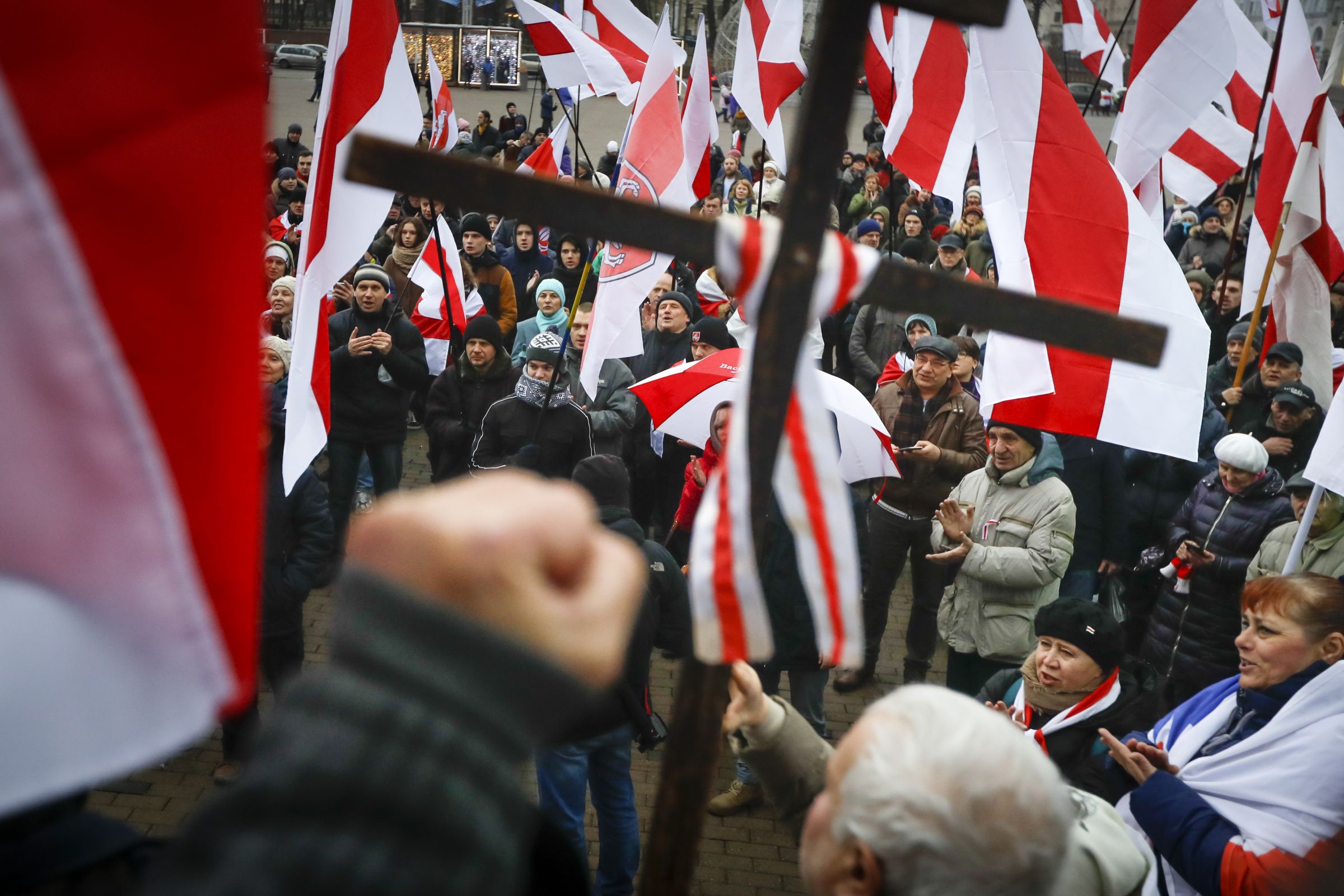
There were no mail in the BNR, but there were own brands - with the name of the country, inscriptions on Belarusian and other national symbols. There were no their army, police and border guards, but there were borders drawn on the map, which are not much different from the present. There were almost nothing of the real state institutions, but there were a flag, coat of arms, anthem and history about the Belarusian national character.
The ephemeral BNR lasted only a few months, dissolving in the air at the end of 1918, along with the defeat of Germany in the war. But thanks to its empty proclamations about Belarusian nationalism, they recognized in Moscow and Warsaw, and when in 1919 the Soviet-Polish war began in this territory, each of the parties was ready to support the appearance of the Belarusian nation in order to use it against the opponent.
Export nation
Initially, the Bolsheviks did not have special plans for Belarusians, many in the party’s leadership were even sure that such a nation did not exist. But the BNR and the war with Poland convinced the leadership in Moscow that the creation of a separate Belarusian Soviet Socialist Republic could be very useful to win over the Poles and, in general, the export of the revolution to the West.
And then, according to the covenants of Rimorjimeno, having created a Soviet one, but Belarus, it was necessary to create Belarusians for her. Belarusian rooting is one of the most rapid projects of national construction in history. Starting almost from scratch, in just a few years she achieved amazing success.
In 1929, only one purely Russian -speaking newspaper and not a single magazine remained in the republic. In 94% of schools, the training was in the Belarusian - only 15 years before that there was not a single Belarusian school at all. By 1928, Belarusians were provided with the entire pyramid of the education system in Belarusian, transferring to the University of Belarusian in Minsk. Although back in 1925, there were only two teachers who knew the Belarusian at this university, and only 40% of students considered themselves Belarusians. These proportions quickly changed - I had to either learn the language, or say goodbye to work/study.
The school curriculum in Belarusian, dictionaries, scientific vocabulary, the Belarusian Academy of Sciences, a state apparatus working in the Belarusian - all this was created in just a few years. And most importantly, the nation was provided with their own historical narrative, heroic and centuries -old. Belarusian national communists, with the help of the ideas of earlier boots, built a continuous direct Belarusian history by a millennium ago. The Polotsk principality, the Grand Duchy of Lithuania, who rebelled against the tsarism of Kalinovsky and the apogee of the whole process - the formation of the BSSR.
There were almost no Belarusians among the old Bolsheviks. Belarusization was carried out by immigrants from pre -revolutionary left -wing circles, who joined the new government, seeing the opportunity to realize their left -nationalist ideals. In the second half of the 1920s, almost all the leaders of the Belarusian national movement, who will return to the USSR from Poland and Lithuania, fascinated by the successes of Belarusization, will gradually join them.
The opinion and preferences of local residents in the process took into account last. According to the results of the war, the Soviet-Polish border passed much east than the Bolsheviks hoped, and at first the BSSR was very small, approximately like the current Minsk region. To increase the viability of the republic in 1924, Vitebsk and Mogilev were attached to it, and in 1926 - Gomel.
Even Soviet ethnography, sharpened to fight with Great Russian chauvinism, considered these areas mostly Russian -speaking, but the party decided that in fact, not Russian, but Russified Belarusians live there, therefore can be annexed. Before joining Vitebsk and Gomel, about 5% of the inhabitants spoke in Belorussian, and after they were given only a few months to transfer the entire state apparatus to Belarusian.
For the Soviet leadership, there was no secret that the locals were dissatisfied with the transfer and many of them did not understand the new Belarusian language, based mainly in Western Belorian dialects. But direct text reported that foreign policy considerations here are more important than popular discontent.
Frontontal determinism
Unlike the USSR, Poland, who also received many potential Belarusians, was not going to help them realize this potential. On the contrary, the Polish authorities saw in Belarusians the most suitable material for polonization. Therefore, Belarusian schools were actively closed, and many Belarusians have not given Polish citizenship for years so that they would not vote in the elections.
But in Poland, geopolitical logic worked for the Belarusian national project. The right -wing Belarusians were actively supported by Lithuania, who hoped that they would help her take away from Poland Vilnius. Left - the Soviet Union with its reunification of the Belarusian nation in the BSSR and the export of the revolution to Europe.
In the early 1920s, thanks to Lithuanian support in Poland, a Belarusian rebel detachment of several hundred people was even created and armed. True, at first the teams in it still had to be given in Russian, and for a significant part of the composition, the Belarusian language courses were needed.
The peasants were attracted not so much by the national agenda, so the USSR managed to achieve more than the Lithuanians. At the peak of the Left Party, the Belarusian workers' and peasant gramades totaled 150 thousand people, while almost all its leadership was in parallel in the Communist Party of Western Belarus-a structure organized and funded by Moscow.
After the state farm of Pilsudski in 1926 and the establishment of an authoritarian regime, the Polish state begins to act more effectively and the space for local nationalisms is quickly narrowing. The Belarusian parties dispersed, the media closed, and activists went either to the Polish prison, or to Minsk, which becomes the main center of Belarusian cultural life.
By the end of the 1920s, Belarusian nationalism begins to disturb Moscow. The USSR is gradually moving from faith in the export of the world revolution to the regime of the besieged fortress, and here, at the most vulnerable border, nationalists-attackers of dubious reliability are filled with a whole republic. In the early 1930s, almost all the leaders of the Belarusian national movement will be destroyed-both those who had stupidity to return from Europe, and those who were with the Bolsheviks from the very beginning.
After the First World War, Belarusian nationalism achieved unthinkable success due to its front -line position. Very soon, already by the beginning of the 1930s, he was defeated on both sides of the front for the same reason.
Weakness or citizenship
However, 15 years of national construction cannot be canceled. The accelerated change of generations, the rapid spread of literacy and urbanization made Belarusization irreversible. In addition, the Soviet government had claims to insufficiently loyal figures, and not to the very project of the Belarusian SSR.
The nationality of the “Belarusian” was institutionalized and made inherited, the republic retained formal attributes of statehood, their own ruling nomenclature and even included in the ranks of the founders of the UN. To the collapse of the Union, the country will already be provided with many of the people needed for an independent state - first of all, millions of people who consider themselves Belarusians.
We can say that the Belarusian ethnic nationalism turned out to be much weaker than in neighboring Ukraine, Poland or the Baltic states. Nationalists will probably say this with regret. But weak ethnic nationalism is a drawback perhaps for the national boys of the line of the XIX -XX centuries. And in the XXI century everything works differently.
Due to its “weakness” and “belated”, Belarusian nationalism turned out to be unique in Eastern Europe. It is not aggressive, far from anti -Semitism and other xenophobia and does not contain obsession with mythologized grievances from the distant past, which still do not allow constructive relations with neighboring countries.
Что плохого в «слабости» белорусского национализма, которая позволяет белорусам ставить социально-экономические вопросы выше, чем вопросы чистоты языка, веры, крови? При такой сложной истории сильный этнический национализм мог бы привести к тому, что жители Гродно ненавидели бы жителей Гомеля за то, что те неправильные белорусы, и наоборот. А все вместе они могли бы ненавидеть русских, поляков, литовцев. Учитывая геополитическое положение Белоруссии, такой сильный национализм скорее подрывал бы, а не укреплял белорусскую государственность.
Благодаря редкому стечению обстоятельств белорусам удалось выработать невиданную в Восточной Европе вещь — национализм, в котором гражданского гораздо больше, чем этнического. Опросы подтверждают, что белорусы ассоциируют себя прежде всего с государством, а не с кровью, религией, местом рождения. То есть это открытая, инклюзивная нация, и когда Лукашенко называет Белоруссию восточноевропейской Швейцарией, Минские переговоры по Донбассу тут не единственное основание.
К сожалению, книга Рудлинга не переведена на русский язык. И на белорусский тоже. Зато в сети можно найти негативные отзывы на нее белорусских националистов, недовольных тем, что автор препарирует их национальный проект без должного пиетета. Одна из самых непонятых и недооцененных стран Восточной Европы пока такой и останется — даже для собственных националистов.
Read also on carnegie.ru
- Без декоммунизации и УПА. Что принесет смена главы Украинского института национальной памяти
- Большие Владимиры для малых народов: зачем ставить фэнтези-памятники персонажам из Х века
- Враг у ворот истории. Как историческая память стала вопросом безопасности
Maxim Samorukov