
Translated material
Optimism according to graphics
What Russian economic statistics are silent about and what is silent about

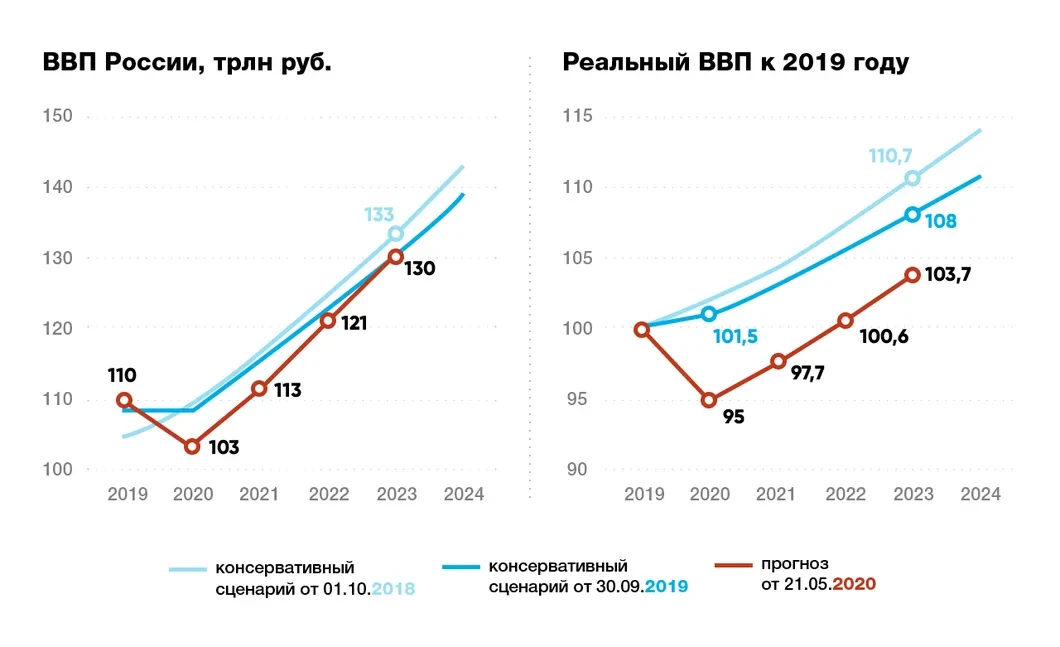
Behind the dry figures of statistics, interesting details of the relationship between sectors of the economy are sometimes hidden. Official forecasts - as well as any other - need to be treated with a large degree of skepticism. They often have more declarative or summed up to a certain figure than applied. As, for example, the prognosis of Russian GDP reduction by 5% in 2020 is a round figure, less than expected in many other countries, but far from reality. Nevertheless, even in official forecasts, you can track hidden trends and expectations, for example, comparing a more fresh forecast with the previous ones.
The real sector
On May 26, Rosstat submitted the first data on the dynamics of the Russian economy in April 2020. A month of non -working days reduced retail volumes by 23.4 % in real terms by April 2019 (21 % in nominal terms). Paid services to the population dropped by 38 %immediately. The situation was better in industrial production: -6.4 % in real terms and -16 % -in the nominal.
If consumer prices rose by 3.1 % per year, then manufacturers in April decreased by 10.4 % compared to last April, including almost 50 % fell in the oil and gas production sector.
These figures generally confirm the assessment of a decrease in nominal GDP by 27 % - to 6.3 trillion rubles in nominal terms. In April, real GDP could be 15–20 % lower than a year ago, taking into account a decrease in the general price index (due to oil and gas). The consumer sector creates approximately half of the value added as part of GDP.
In May, we will see recovery in the consumer sector, but in industrial production a decrease in economic activity will continue. Including due to the OPEC+transaction, which is valid only from May 1 and limiting the volume of oil production by 10-17 %.
The Ministry of Economic Development (mayor) is still expected to reduce GDP by only 9.5 % in the II quarter and by 5 % for the entire 2020, followed by recovery of about 3 % per year. The numbers look too optimistic for this year and conservative for the future restoration of the economy.
Conservative forecasts became basic
A week ago, the Ministry of Economic Development presented the main parameters of the forecast of socio-economic development until 2023. The department produces such long -term forecasts annually - they are necessary for drawing up a budget for the next and next three years. In addition to purely calculated functions, from forecasts you can track how the state’s assessments change by the prospects of the Russian economy and the direction of its development.
Similar long-term forecasts of the Ministry of Economic Development published in the fall of 2018 and 2019, except not until 2023, but until 2024.
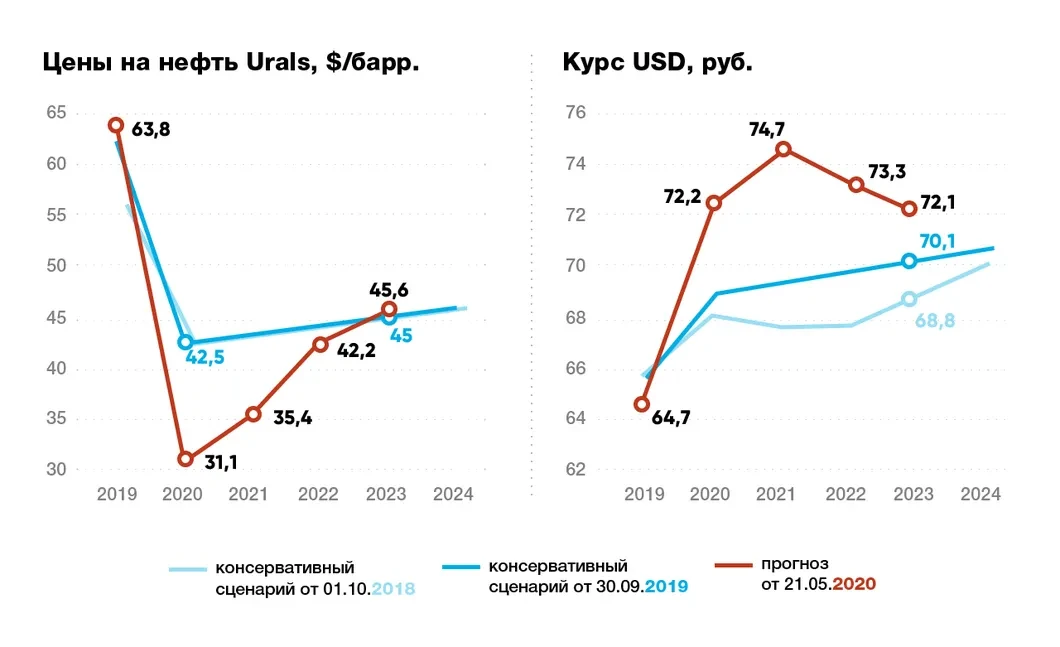
If you look at conservative scenarios from long-term forecasts in 2018 and 2019, then the key numbers in them are very close to target values from fresh forecast. The nominal GDP in 2023 is 130–133 trillion, oil prices are $ 45–46 per barrel, the rate is 69–72 rubles. For the US dollar. Thus, the last conservative script has now become basic, but from the point of view of real indicators, the current forecast implies a significant lag even from conservative assessments in the past.
Real GDP will be 4–7 % lower in 2023-about 5 % that the Russian Economy in the expectations of the mayor in 2020 will lose.
Rowing course
It looks strange that the US dollar rate at the same oil prices and inflation increases from forecast to forecast. In 2018, the average rate for 2023 was expected less than 69 rubles, in 2019-70, and in the last forecast-already 72 rubles. With oil $ 45.6 per barrel - even higher than at the current price of $ 35 per barrel.
The problem of the Russian state is that it itself creates expectations to weaken the ruble exchange rate and contributes to the savings of residents in foreign currency.
In the conditions of a floating course, you need to be consistent as a Bank of Russia, and avoid forecasts of the course, and even more so its long -term weakening. In the calculations, it is enough to use the current ruble course - the benefit of the budget rule reduces to a minimum the dependence of the trade balance and the rate of the ruble on oil prices.
Outflow of capital or amending the budget rule?
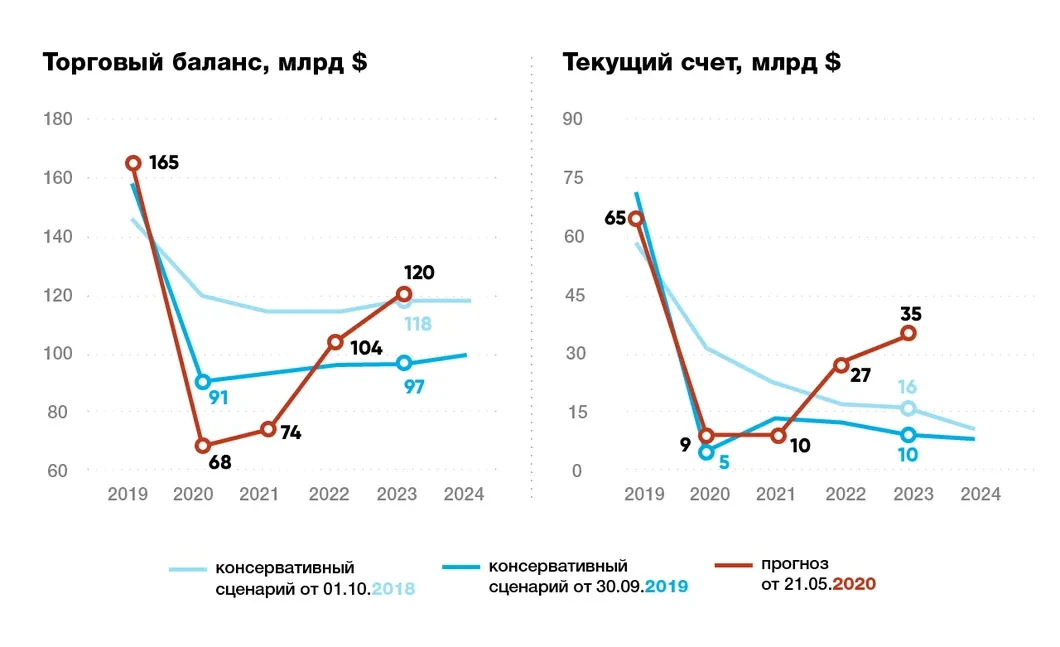
Significant changes have been evaluated by payment balance. The mayor involves an increase in the outflow of capital compared to past estimates.
Approximately $ 20 billion in 2023 will be larger than the trade balance and current account, which means either the corresponding increase in foreign savings of residents, or a decrease in oil price in the budget rule and the resumption of foreign currency purchases in the Federal Tax Service at a lower oil price. In the current rule, the cut-off price should grow from $ 42.4 in 2020 to $ 45 in 2023. As if we are being prepared for a new budget consolidation according to the model of 2015-2017.
Anchor on the neck
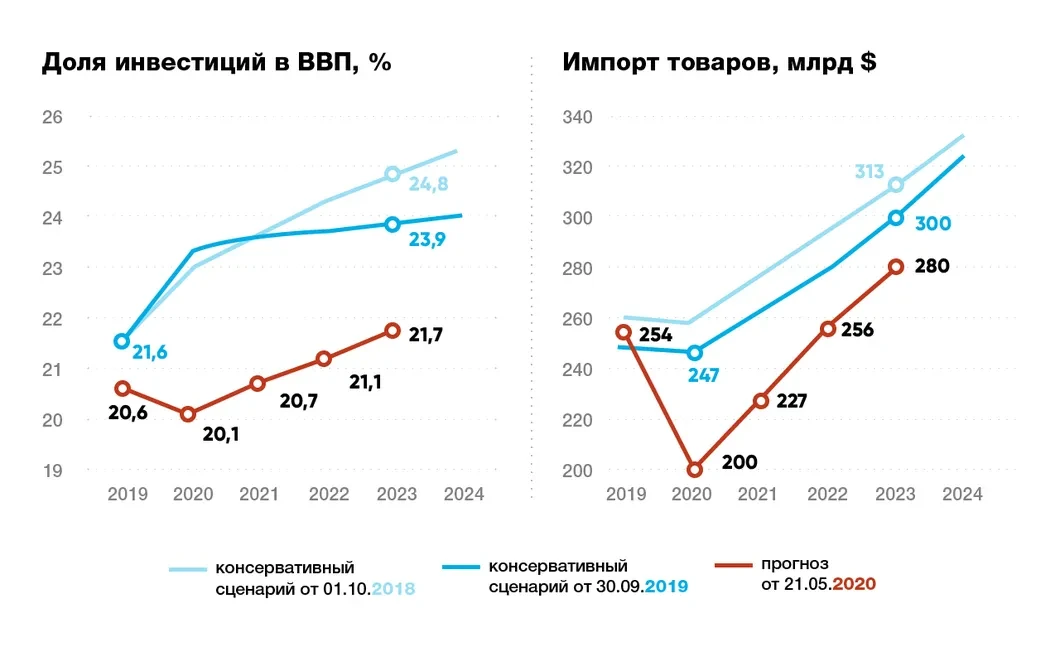
Savings of the budget and state expenses for infrastructure will affect the volume of investments in GDP. The previous Minister of Economic Development Maxim Oreshkin called for increasing the share of investment in GDP from 20 % to 25 %, but the era of investment growth did not begin. In the new forecast, we see 21–22 % of the share of investment in GDP compared to 24–25 % in past conservative scenarios.
Import of goods is also expected less-$ 280 billion against $ 300–313 billion in 2023, which is reflected in the difference in dynamics and investment and real incomes of the population.
The current Minister of Economic Development Maxim Reshetnikov recently eloquently noted that "the federal budget is an anchor that supports the economy."
True, the numbers say that this year the anchor has not yet been lowered, and for the future - they have already been hanged on the neck.
The Minister supports a cautious approach to the deficit and budget expenditures in the future: “We will need [financial] resources, including next year.”
Probably, for economic development, you should be less careful. The sovereign state is financially not limited in expenses, especially when it comes to restoration of the economy.
It is not the amount of debt that is important, but who will increase it - the private sector or the state, and how this debt is transformed into real investments and well -being of people.
In the banking sector without change
The Bank of Russia published operational data on the development of the banking sector for April 2020. Previously, a preliminary assessment of the execution of the federal budget was published. Budget and banking statistics are interconnected-which goes to the budget or comes from the budget, is reflected in someone else's accounts.
If the budget deficit amounted to more than 1 trillion rubles in April, the corresponding assets and liability should be reflected in the assets and liabilities of banks - an increase in liquidity and at the same time deposits of legal or individuals.
Here it is necessary to make a reservation that the budget deficit was calculated with the exception of the issue of rubles from the Bank of Russia by 1.06 trillion, credited to other income from the Sberbank shares of shares.
We are surprised to find that neither assets nor passes of banks even taking into account the strengthening of the ruble and foreign exchange revaluation in April have grown.
What happened to state money in April, when the ruble liquidity of banks (0.7 trillion) and deposits of legal entities (by 0.6 trillion) decreased? One third out of 1 trillion is converted into foreign currency as a result of daily operations of the Bank of Russia with the Federal Tax Service. Part of the foreign currency received went abroad, part - to the accounts of legal entities, and individuals withdrew $ 1 billion from their foreign exchange deposits in cash.
About two -thirds of 1 trillion of budget infusions went from banks in cash. The population of the second month actively takes away its funds from banks. In March, the volume of cash outside the banks increased by 0.57 trillion, and in April - immediately by 0.67 trillion. In total, from the beginning of 2020, the volume of cash on the hands increased by 1.3 trillion rubles.
Usually, at the beginning of the year, the volume of cash outside the banks is reduced after the New Year holidays, but now we are observing the opposite tendency. What is this: the consequences of an unsuccessful announced interest tax on deposits, a new heyday of the shadow economy or “New Year” accumulation of cash for the period of self -isolation?
In addition to revenues from the budget, new rubles were created by a loan of legal entities. Organizations increased the debt on loans by 0.6 trillion, but spent both new money from loans and a comparable amount from their deposits. Pure debt of organizations grew by 1.2 trillion, which corresponds to net money savings of individuals: +0.67 trillion - cash rubles, +0.45 trillion - ruble deposits and 0.13 trillion - reduction of loans arrears.
Organizations at the expense of their debt financed all savings of the population. But where are the budget deficits? It turns out that 0.6 trillion has not yet reached the recipients and remained in the accounts of budget organizations in banks.
It is amazing that the banking sector still feels good - the delay and reserves for possible losses grow slowly, and the profit and capital increase. The further development of the situation in banks depends on how promptly and in what amount budget funds still reach the victims.
Viktor Tunyov , Managing Director of the Criminal Code of Agidel, author of Telegram channel Truevalue