
Translated material
Rare alimony
With a record level of divorces in Russia, it is almost impossible to receive payments for a child. Research "New"
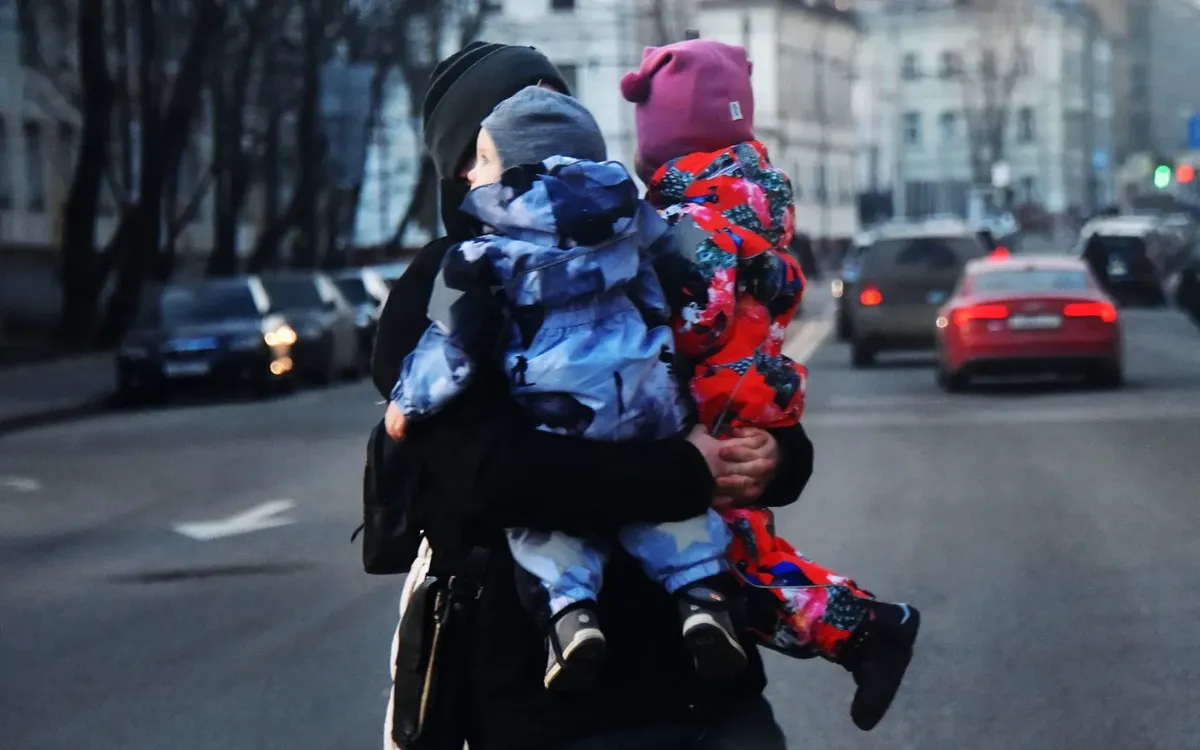
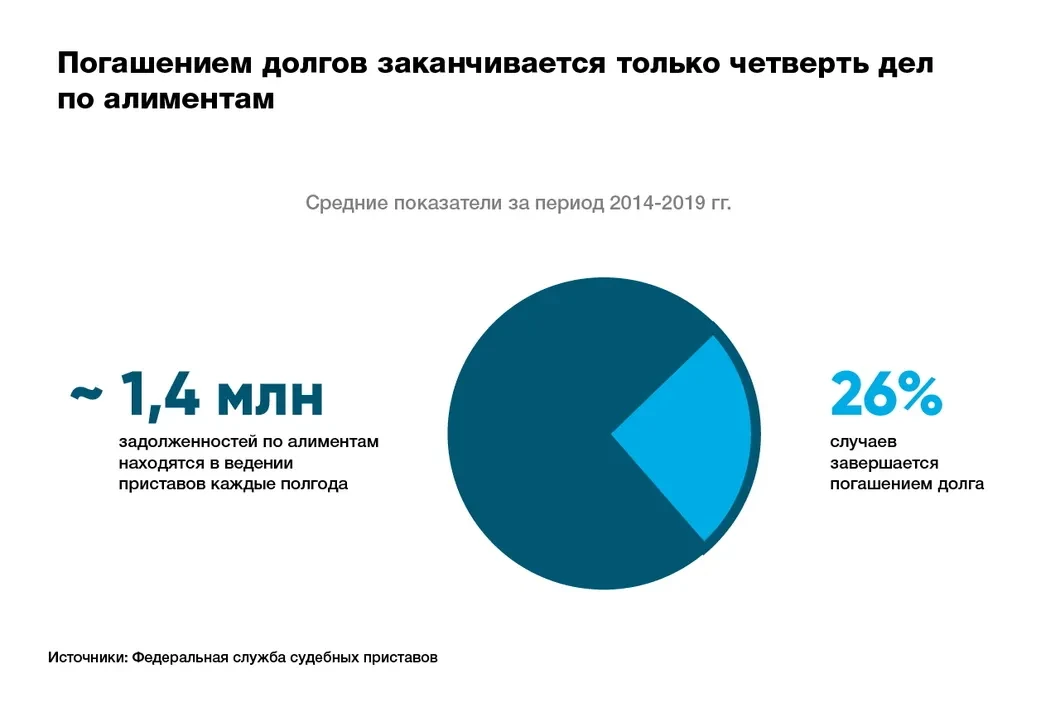
Russia is one of the world leaders in the number of divorces per capita. There are 17 million families with children in the country, in every third of them only one parent brings up children - often without financial assistance from former spouses. The jurisdiction of the Federal Bailiff Service on an ongoing basis has more than 1 million debts for alimony. At the same time, the bailiffs manage to recover less than 10% of the total debt. Non -payers - as a rule, men - easily evade the legal requirements of former partners or pay symbolic amounts of several hundred rubles per child. The Novaya Day “New” was understanding why it was almost impossible to achieve fair alimony in Russia and is there a way to rectify this situation.
Access to the data of the study
We collected all statistics on alimony in an open repository on GitHub. You can use them for your research.
Loner country
Robia from St. Petersburg sued alimony two years ago and won the case. Nevertheless, the only amount that she managed to receive from a civil husband was 21 rubles with a penny. She handed over the number of his card to the bailiffs - they rented everything that was on her.
In addition to alimony, the ex -husband has another debt to Roya. With the whole family, they had an accident - the husband was driving and escaped with concussions, the child suffered greatly. “He owes me for treatment. The court appointed him to pay 600 thousand rubles - the child was removed the spleen. I believed, waited, thought, somehow he would help, but he did not help at all. I sued and I don’t receive a dime. ” Robia works at McDonald's and before quarantine worked as a cleaning in a beauty salon near the house.
The total debt of her husband to maintain their child is approaching 800 thousand rubles.
Last year, Robia went to the bailiffs personally - she asked to close the debtor to go abroad: “By that time, the debt had already hung more than 100 thousand on alimony, he had left without problems.” Now the man constantly lives in Kyrgyzstan, and the Russian bailiffs in front of him are still powerless.
As a measure of coercion, the bailiffs have the right to prohibit the debtor to travel abroad, but these restrictions are easy to circumvent.
“For example, we go to Belarus and fly away, where we want, from Minsk,” says Larisa Vdovin’s family law, lawyer in the field of family law.
- There is no control on the border with Russia, and on the departure from Belarus, the border service does not have a Russian bailiff base. That's all. "
Spouses who have joint minor children have the right to divorce only through the court. If there is no disputes - world, otherwise - district. Judicial statistics show that annually in Russia about 300 thousand such steam are divorced.
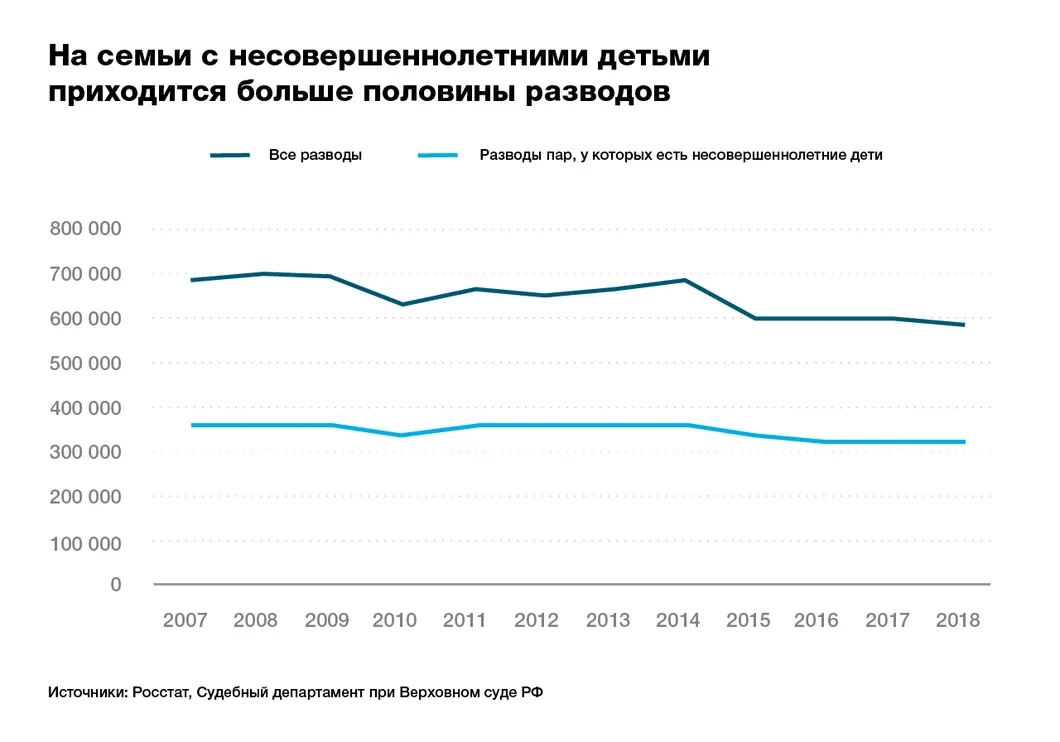
In general, in Russia, people are often divorced: the ratio of divorces to marriages in the country is one of the highest in the world.
In 2018, there were 4 divorces and 6 marriages per thousand population.
Families in which one parent is responsible for the child, and not a couple, sociologists call monoride. They insist on such a neutral formulation so that the term does not have an inferiority shade-as, for example, the more familiar phrase “single mother”.
According to the latest census, about 4 million families live in Russia, which were formed after breaking up parents and who have at least one common minor child.
To four million, it is necessary to add another 1.7 million families in which one of the parents passed away, and the cases in which the family was formed as a monorodic initially (every tenth newborn in Russia is recorded without an indication of paternity).
In total, families with children in the country are almost 17 million. Thus,
At least 1/3 of parents in Russia raise children alone.
These are several million women and hundreds of thousands of men who have decided the question for themselves for many years - how to provide their children if the second parent has abandoned their part of responsibility.
Undemail service
The mother of two children from St. Petersburg says that she filed for child support when her older child was 1 year old. The court ordered the ex -husband to pay a quarter of income in favor of his son.
“Now my child is already 15 years old. No pennies, no birthday congratulations, nothing. Given the fact that we even live in the same house. I am in the second entrance, and he is in the seventh. "
The woman says that she went to the bailiffs every month for many years - each time there was a new employee on the spot and said that so far she only delves into affairs. “Tired when the child was closer to the age of 7,” she says. I have already spat - you’ll choke on everything. ”
The accumulated debt on alimony is 400 thousand rubles: "You can buy a house for such an amount calmly in the region somewhere." Over the years, the man drank and sat in prison several times.
Family law lawyers are used to identifying the payer with the father. In practice, this is what happens, almost always their clients - mothers who raise children on their own. According to the FSCP for 2018, 4/5 of alimony debtors are men. Basically, the range of their age is from 30 to 42 years.
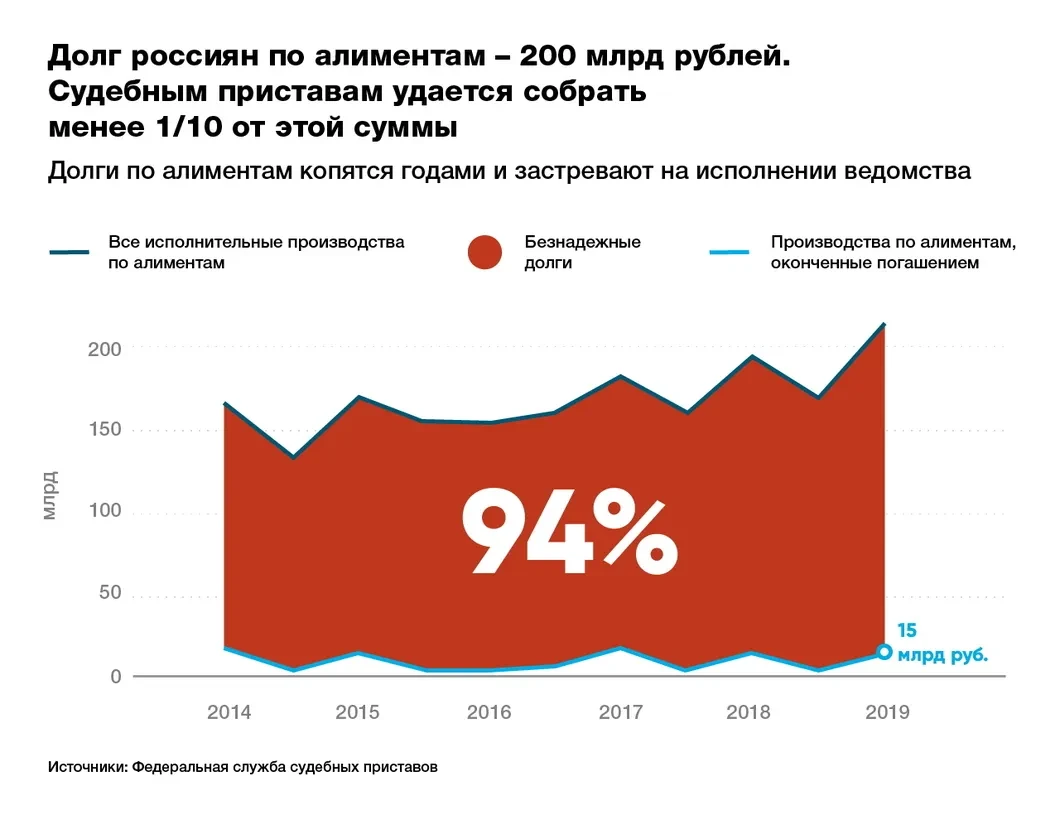
Every year, the Federal Bailiff Service manages to recover billions of rubles in favor of children. The press service of the department informed Novye that the total amount of alimony collected in 2019 amounted to 17.4 billion rubles, in 2018-15.2 billion rubles. According to open data from the FSSP, this amount is slightly less, but in general it is in the area of the mark indicated by the department.
The effectiveness of the bailiffs can be evaluated by drawing attention to the context. The total amount of alimony debts at the end of 2019 exceeded 200 billion rubles.
That is, the department manages to recover less than 10% of the total debt of Russians in alimony.
The amounts are accumulated for months, and the average debt for alimony is more than 100 thousand rubles.
The former bailiff Mikhail says that in his practice he was convinced: to force the debtor to pay child support is almost impossible. “Any debtor who wants to not pay child support will do it. Because there are a lot of all sorts of holes [in the laws], I will not specifically talk about them so as not to spread, ”he notes.
Low debt collection for alimony lawyers explain the ineffective work of the bailiff service ineffective work. There are several forced measures in the arsenal of the department. One of the main ones is the sending of copies of documents on the debt to the employer of the debtor. So, part of the wages automatically every month goes to pay off the debt and the payment of alimony themselves. 90% of debts recovered in the second half of 2019 for children were collected in this way. However, due to the wide prevalence of gray salaries in Russia, this practice is far from effective in all cases.
Odinochka father from Smolensk divorced his wife 1.5 years ago-they filed oncoming claims about alimony and determining the place of residence of their 8-year-old son. The mother of the child refused her demands and soon married again. Alimony on her part, by court order, amounted to 2900 rubles. “This amount is negligible. She was set to work for a minimum wage, ¼ income. I think these are fictitious numbers. Money comes regularly, but even if I lose it, I won’t be upset, ”Vladimir notes.
The way out of such situations is the recovery of alimony in the so -called "solid", that is, a fixed amount. However, in order to achieve such a calculation of payments, the plaintiff will need to hire a specialist. “We substantiate both the needs of the child and the payer's capabilities so that the amount of alimony is not ridiculous,” says lawyer Larisa Vdovin.
“People come to me, mainly women who have 1800 rubles per month, 3200, 2400. We are moving from the share that were once set to a firm amount and get 11–18 thousand per month per child.”
The lawyer believes that tiny alimony payments will be found much less often if the plaintiffs more often defend their rights: “Practice is that which consists of our appeals and our appeals by and large. Therefore, if you insist on worthy amounts, over time, I believe, practice will change everywhere. ”
Another instrument of bailiffs is the arrest and sale of the debtor from public trading. FSSP statistics show that it is rarely used. At the end of 2019, less than 2% of enforcement proceedings were in this state.
“Most often, debtors hide their property, resell their property, rewrite on acquaintances, relatives and friends,” says Mikhail, who worked for 1.5 years by the bailiff. For his practice, Mikhail arrested only a couple of inexpensive cars. “But in the end, no one bought them,” he complements. “Mobile phones, tablets are at all non -essential amounts.”
“I have one debtor who has four children from different women,” says Vdovina. - This is an wealthy entrepreneur - just an unscrupulous person. All his property is registered with his spouse. Moreover, he has decent alimony defined for children - 12-18 thousand each, and he pays 5, ”the lawyer notes. Four children exceeded a million rubles for a million rubles, but there is nothing to arrest.
High work of bailiffs also contributes to the problem. The former bailiff Mikhail says that in the peak of work at the same time he could have 350 debts at the performance, while he estimates the optimal amount of affairs for work at 70.
“I, in principle, knew 80 percent of my debtors. One could name me the last name of the debtor, and I could tell his story what kind of person it is: pays - does not pay, it works - it does not work, ”he comments.
Safe divorce technique
It is not worth paying attention to the number of divorces in Russia for the thesis about the crisis of family values. This statistics suggest that Russians need to learn how to competently divorce in order to maintain partnerships after parting and not become opponents. This is especially important in cases where there are minor children in the family - the law protects their right to care of their parents, regardless of whether they are a husband and a wife or not.
Russian parents have only three trajectories on which they can decide disputes about the joint maintenance of children after parting.
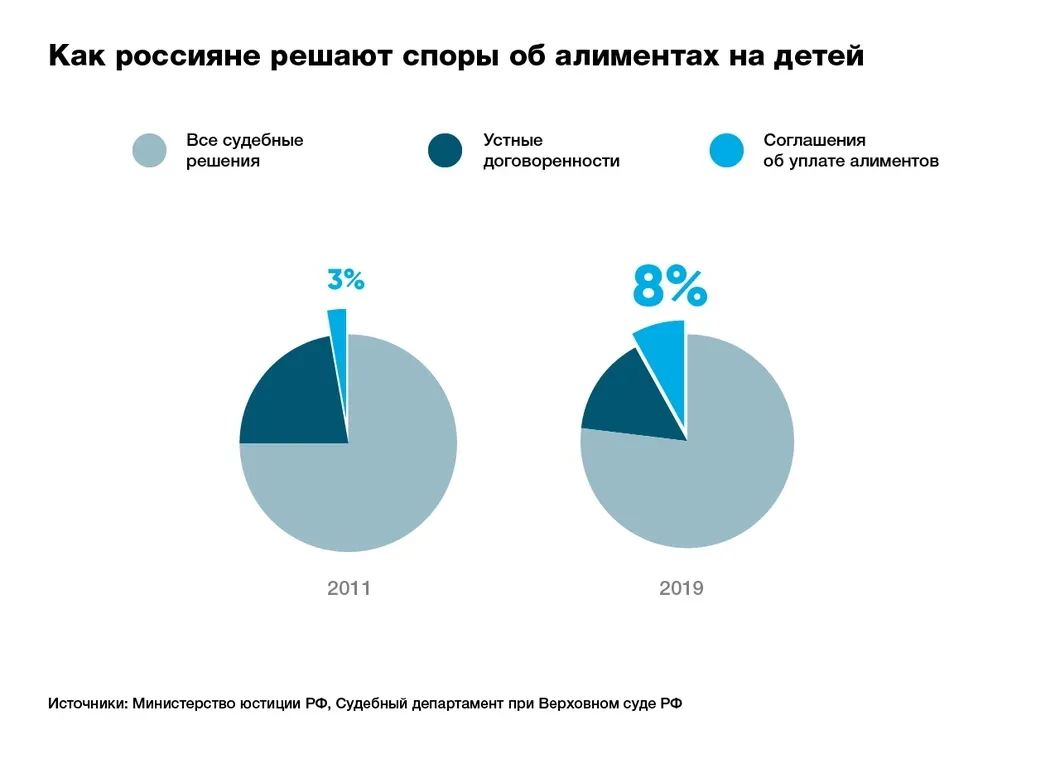
In addition to an obvious opportunity to agree orally, parents have the right to conclude a notarized alimony agreement among themselves. It will establish the amount and procedure for payments. The document has the power of the writ of execution - if the party who agreed to make payments has stopped doing this, then the applicant has the right to transfer the debt to the bailiffs.
Julia Polyakova lives in St. Petersburg, she has three children. She receives alimony to the eldest daughter - she is 12 years old. Even before the divorce, he and her husband at the notary concluded an agreement on alimony - for 5 thousand rubles a month. The first few years, the money was paid regularly - in cash, then the payments became less frequent and went naughty 2 years ago. “He saw a child once in 5 years, and when I scared him with a court,” said Julia. Payments have not resumed, the woman will turn to the bailiffs: "I generally planned to do this in May, but then nothing worked because of the coronavirus."
The third and worst scenario of the decision of the dispute about alimony is considered to be a court appeal. In the vast majority of cases (99% of decisions), considering cases of recovery of alimony, the judges take the side of the plaintiff, so formally a lonely parent is quite easy to defend the rights of his child. The problem is different: the very essence of the trial is to determine in the dispute of the winner and the loser.
Leaving the courtroom, parents part of the enemies - there is no reconciliation.
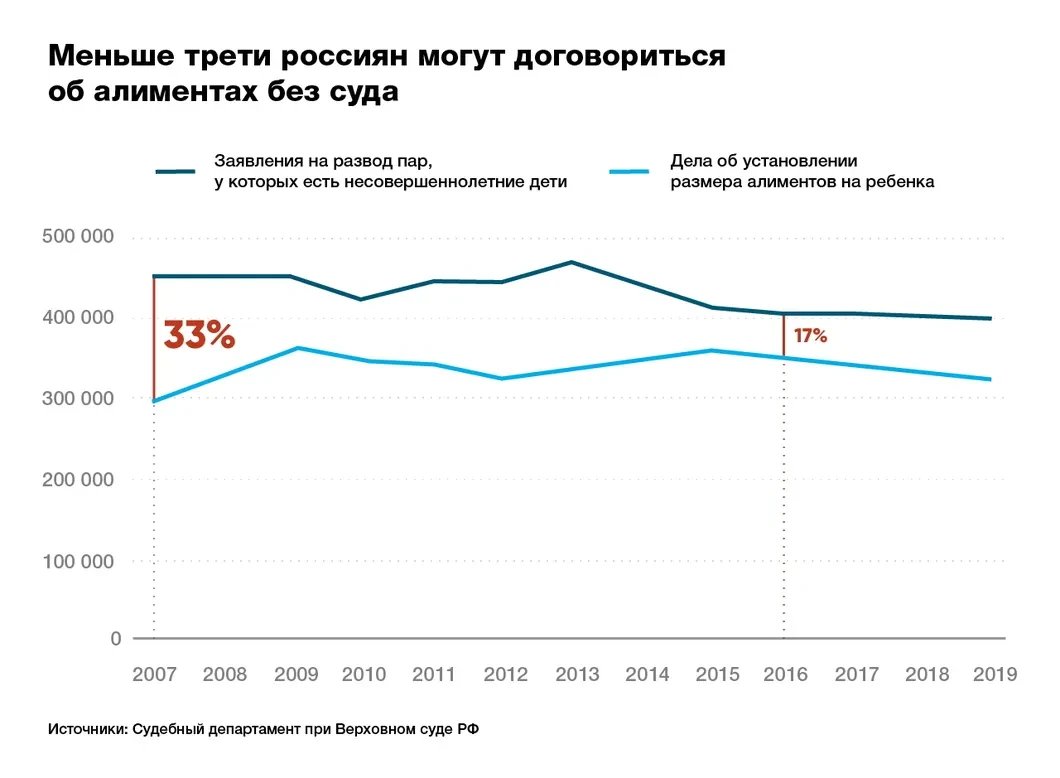
The situation is aggravated by the fact that now in Russia the disputes about alimony are considering the district court - in its competence there are administrative, civil and criminal offenses. Judges often do not have specialization, and the same person can conduct the case of murder, vandalism, theft and establishing the amount of alimony for the child.
This poorly affects the solution of family conflicts - the judges do not have the necessary preparation and they do not deeply delve into the subtleties of family relationships. In the USA, Great Britain and Australia, this problem is solved by the creation of family ships. In France - through the specialization of judges in family disputes and cases related to minors.
Lawyer Yuri Manukyan notes that in his practice, trials about alimony last for about 4 months. In his opinion, due to the restriction of ships during coronavirus, disputes will be decided 2-3 months longer. In addition, it happens that the courts leave cases without consideration without sufficient grounds. “We believe that the use of this tool will intensify now,” says Yuri. “The courts will take a small odds in time to consider cases, and the parties will receive court decisions a few months later.”
"Paid 500 rubles a month"
The general debt of alimony, calculated by hundreds of billions, looks paradoxical against the background of the fact that the repeated non -payment of alimony in Russia is considered a criminal offense. The punishment is determined in accordance with Article 157 of the Criminal Code of the Russian Federation, the maximum measure of restraint is the year of imprisonment.
Every year, under this article, several tens of thousands of people condemn. This is only a few percent of the debtors who are in the field of view of the FSSP. In theory, much more people should fall under the action of the 157th article of the Criminal Code-everyone who has repeatedly missed the monthly payment of alimony.
The point is not only the shortcomings of the judicial system. Women themselves, too, often do not want to bring the defendant to a fine or prison - this will not bring any benefit to the family. In the practice of Yuri Manukyan, there were several cases when the plaintiff, having not achieved the recovery of alimony, stated that the duty was repaid in order to protect the child’s father from criminal criminal record.
“They wrote a statement to the bailiff service that all monetary obligations were fulfilled, alimony was paid, and the criminal case was terminated if it was instituted at this moment. Subsequently, they spared about this, I remember, ”the lawyer notes.
“History with criminal liability is a two -edged stick,” says lawyer Larisa Vdovin.
- Returning to the criminal liability of a malicious non -payer of alimony, we create a serious restriction in further life to our own child.
If the child has a convicted father, then he is limited to admission to the public service, to the prosecution authorities, the judicial authorities, and so on. This measure is generally not clear who punishes. There is more harm from her than good. ”
A low number of criminal cases against debtors on alimony is also explained by a loophole in the law. This problem is recognized in the Ministry of Justice: “The criminal case may be refused in connection with the implementation by debtors without good reason for irregular and non -essential payments, the amount of which is significantly lower than the document established by the executive document.” The former bailiff Mikhail says that in his practice he often faced this: “Nobody paid 100-200 rubles a month with me, but they paid 500 or 1000.”
Mikhail notes that in 2016 amendments were made to the Code of Administrative Legal relations, and the first double ignoring payments became an administrative violation. “Most often, such debtors were assigned mandatory work-to paint fences and something like that. This is the so -called shot in the air. If he does not pay again, then he can be prosecuted. ”
The Ministry of Justice prepared a new version of the law, which should close the loophole. At the moment, the text is undergoing public discussion. In the State Duma of the Russian Federation there is another bill with amendments to the 157th article of the Criminal Code of the Russian Federation. It is proposed to take into account evasion and concealment of income and, accordingly, tighten the punishment - up to two years in prison.
The state will not figure it out
Solving a dispute about alimony through court is the most popular scenario among Russians.
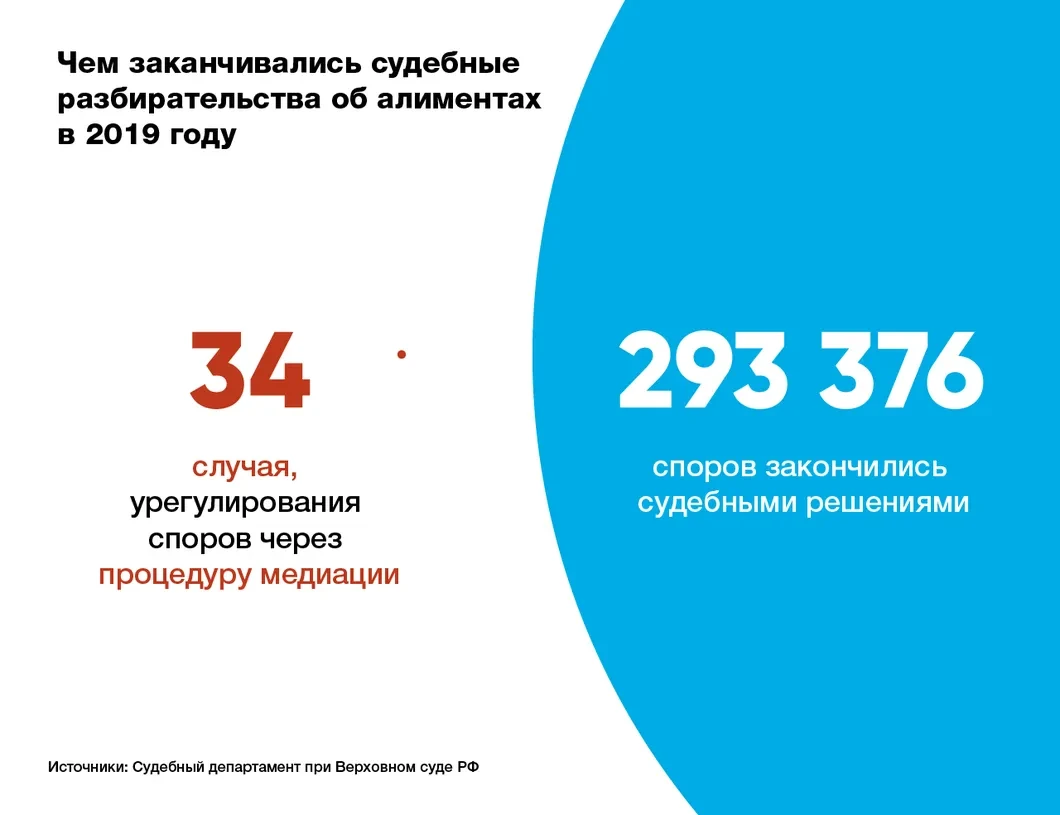
The problem was seen in this 10 years ago. Then the Federal Law on Mediation was adopted in Russia - an alternative method of resolving conflicts with the participation of an independent intermediary.
Mediation, which is also called mediation, is designed to help people avoid going to court even in serious disputes. The intermediary helps to negotiate, which have come to a dead end, and find a solution acceptable to both sides. Just what is so necessary for parents who are on the doorstep of the court on alimony.
Mediation helps reduce the load on the courts and improve the quality of conflict resolution. This practice began to be widely used in the USA and Western Europe in the late 1980s. Studies conducted by state and private organizations in the next decade have confirmed the effectiveness of mediation: it really helps to solve emotional disputes and achieve durable agreements.
Almost 10 years have passed since the adoption of the law on mediation. Family mediation for lawyers and district judges is still a wild and incomprehensible beast, which is better not to contact. Неохотно к ней прибегают и сами граждане.
«Что-то должно поменяться, — отмечает юрист и сертифицированный медиатор Лариса Вдовина. — Есть идея у плательщиков, что заплатить надо поменьше, надурить. Хорошо бы, чтобы неплательщик или плохой плательщик стал социально не одобряемым. Чтобы это было позорно для мужчины — не платить алименты.
А у нас сейчас наоборот — они между собой хвастаются: «Ты сколько платишь? 10? О, лошара. А я своей — 3».
И все аплодируют этому человеку, который смог уклониться. Поэтому какая тут медиация?»
Другая инициатива, которая много лет существует в российском законодательном поле, — создание специального алиментного фонда, из которого могли бы погашаться накопившиеся долги. В 2013 году идею прокомментировал Владимир Путин. К созданию алиментного фонда он отнесся скептически: «Мы вообще можем лишить мотивации людей заниматься детьми, но не всех, конечно, а некоторых: "А что там. Государство разберется. А как оно разберется?"».
С тех пор идея о создании алиментного фонда регулярно поднимается в Госдуме, однако ни одно министерство не выступило в ее поддержку. Только в материнских сообществах в социальных сетях время от времени высказываются идеи о том, что, если бы государство компенсировало задолженности по алиментам, то судебные приставы искали бы должников эффективнее.
Правительство предложило другую компромиссную меру: приравнять алиментных должников, которых судебные приставы не смогли разыскать в течение года, к безвестно отсутствующим. Детям в таком случае выплачивается пенсия по потере кормильца — около 5,5 тысячи рублей в месяц. Во многих случаях это почти в два раза больше положенных по суду алиментных выплат. Предложенные правительством поправки были приняты — Владимир Путин подписал закон в марте 2018 года. На сегодняшний день это единственная государственная мера поддержки одиноких родителей, в пользу которых накопился безнадежный долг по алиментам.