
Translated material
The holy martyr Onufry Gagalyuk
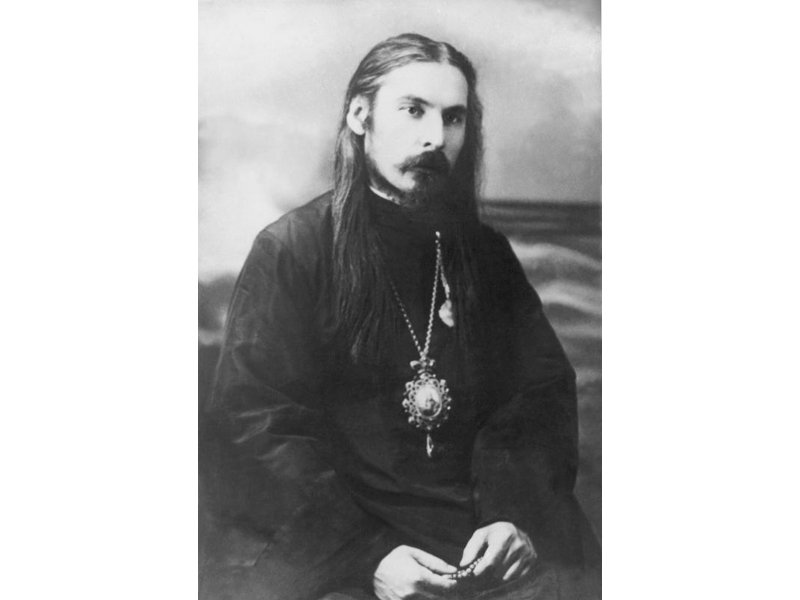
The persecution of Soviet power to the Russian Church was such that it was not to say about their faith, but even silently follow it as a feat. The new martyrs and confessors, glorified in the face of the saints did not come: believed, prayed and meekly went to their Calvarys.
“Polit.ru” recalls those who gave their lives for faith and by whose prayers the Russian Church is alive - even if almost nothing came to us besides the name.
Publications were prepared by Kirill Kharatyan (included by the Russian authorities in the register of foreign agents).
 The holy martyr Onufry Gagalyuk
Anthony Gagalyuk is the son of a forester from the posad of the Opole of the Novo-Aleksandria district of the Lublin province of the Kingdom of Poland. In 1894, when Anthony was 5 years old, his father died: he caught the peasants for illegal logging, they brutally beat him and burned the house. The widow and children of the forester gave a shelter in the nearest village. Comforting the mother, Anthony suddenly said "Mom, you do not cry when I will be a bishop - I will take you to me."
At the request of the mother, Anthony was accepted in a shelter in Lublin, his mother began to work in the same shelter as a cook. Anthony studied well, graduated from a parish school and was sent to the shelter to the city of Holm, to the Kholm Spiritual School. He went out of the school with honors and was admitted to the Kholm Theological Seminary.
In the year of the end of the seminary, a month before the final exams, Anthony Gagalyuk fell ill with pneumonia and was placed in a seminar hospital. The disease was seriously difficult, in the seminary feared for his life and served prayers for his healing. Subsequently, Vladyka Anthony told his mother: “I was in oblivion, and a wonderful old man appeared in front of me, overgrown with a large beard to the feet and gray long hair, covering Shimi with his naked body to the heels. This elder looked affectionately at me and said: "Promise to serve the Church of Christ and the Lord God, and you will be healthy." These words sowed fear in me, and I exclaimed: "I promise." The elder left, and from that moment I began to recover. Then peering into the icons of the saints of God, I noticed the features of the old man who appeared to me in the image of the Monk Onufry the Great. ”
At the end of the seminary, he withstood the final exams with honors, after which he successfully passed the entrance exams to the Petrograd Theological Academy.
When switching to the third year of the Academy, he was sent to Kholm Rus, to the Yablochinsky Onufrievsky Monastery to give lectures on theology in courses organized for a group of teachers. The task completed, but before leaving, he again fell ill with pneumonia. His condition was recognized as almost hopeless doctors. And so, as he later wrote to his mother, he was lying in Celia in oblivion, when suddenly the same old man appeared before his eyes, who visited him in the Holmes Seminary three years ago. The elder looked at him sternly and said with a reproach: “You have not fulfilled your promise, make it now. The Lord blesses. " Opening his eyes, the patient saw that in Celia a prayer service to the Rev. Onufry was serving, whose miraculous image stood near my bed. He wept from tenderness and told the archimandrite to Seraphim immediately that, upon arrival at the Academy, he would receive monastic tonsure.
On October 5, 1913 he was tonsured in monasticism in honor of the Monk Onufry the Great, after which he was ordained in Hierodeacon and Hieromonk in the same year. Cuts and ordinations were committed by the rector of the Academy, Bishop of Yamburg Anastasius.
Studying at the academy, he participated with other students-priests in missionary visits to the night houses, and, with the blessing of the rector, also served in the Church of the village of Mikhailovskoye near the Pargolovo station (now as part of St. Petersburg) of the Finland Railway. In 1915 he graduated from the academy with the degree of candidate of theology.
At the end of the Academy, he was appointed a teacher at the pastoral and mining seminary at the Grigory-Bizyukov monastery of the Kherson diocese. In 1918-1919, the monastery was repeatedly subjected to raids by various gangs, was defeated, many monks were killed. But the peasants of the nearby villages recaptured monks, including Hieromonk Onufry, and took Borislavl to the city. Here, the request of the parishioners Father Onufry was appointed rector of the local cathedral, and after some time he was erected to the rank of archimandrite by Bishop of Elisavetgrad Prokopius.
Then he was transferred to the city of Krivoy Rog, to the obedience of the rector of the Nikolaev Church. In his short service in Krivoy Rog, the old and young and young filled the temple to capacity.
In August 1922, the Cathedral of the Orthodox Bishops of Ukraine was held in Kyiv, at which Archimandrite Onufry was elected a candidate for a bishop for the Odessa and Kherson diocese.
On February 4, 1923, Hirotonisan in Bishop of Elisavetgrad, Vicar of the Odessa Diocese. Hirotony in the Kiev Pechersk Lavra was performed by Metropolitan of Kiev and Galitsky Mikhail and Bishop of Belotserkovsky Dimitri. He performed his first and last bishop’s liturgy at this department on February 6 in the Assumption Cathedral of Elisavetgrad (now Kirovograd) with a huge set of prayers.
Already 6 days after a categorical refusal to accept renovationism, he was arrested and moved to Odessa. In May, he was released with a subscription about leaving the Odessa region. Having been released, he began to serve in Krivoy Rog, where he also fought with renovationism, for which he was again arrested on October 16. He was moved to Kharkov, where on January 16, 1924 he was released at the exile, with a ban on departure from Kharkov. In Kharkov, Vladyka Onufry, Bishop of Elisavetgrad,, on behalf of Patriarch Tikhon, ruled on the rights of the diocesan bishop of Odessa and his Elisavetgrad dioceses. Vladyka takes care of the purity of Orthodoxy in his dioceses and throughout Ukraine, fought with the renovationists. He wrote articles of an apologetic, instructive and historical nature, which together was 1062 typewritten pages. In his sermons, Vladyka taught people to be always invariably faithful and devoted to the children of the Holy Church.
On December 9, 1925, according to the machinations of the Renovationists, he was again arrested on charges of “counteracting church schisms” and sent in a three -year link to the Urals. Initially defined in the village of Kudimkar. Here he was forbidden to read church prayers in the temple during a worship and sing on the Church, why the Vladyka dedicated to church writing all the time.
On October 25, 1926 he was exempted from the ministry of the Elisavetgrad bishop.
In October 1928, he was again arrested and transferred to Tobolsk, where he was kept in prison until January 1929. Then he was sent to the stage in exile in Surgut, on the Ob River, where he was until September 1929. In September of that year, when moving to Tobolsk, he was removed from the ship and sent to a residence in the deaf village of Uvat. However, in November 1929, he received a referral to free travel to Tobolsk. He was wounded by an unknown in the hand on the pier in Tyumen, and then, on the way to Stary Oskol, he was landed from the train at the Gorshnichnaya station and was planted for three days in the cellar of the continued house. He chose Stary Oskol, because after the end of the exile in 1929 he was forbidden to live in large cities.
On December 13, 1929, Bishop Onufry was determined on the Starooskolskaya department created on this occasion, joined the diocese department and received permission from local authorities to conduct only to the church in one church. Already the first service in the temple and preaching attracted the hearts of prayers to it, from the joy of communicating with him everyone cried. The bishop was evicted three times from the apartment. The activities of the renovationists ceased in his diocese, and three months later from the date of the arrival of the Vladyka, in March 1930, the existing temples of the diocese became up to 161.
In March 1933, he was again arrested and stayed in the imprisonment of the Starooskol prison for 2 weeks, after which he was sent under the escort to the Voronezh prison, where he spent three and a half months. In June of the same year, he was released and sent to Kursk. On June 27, 1933 he was exempted from ministry at the Starooskolskaya department.
In this regard, on August 11, 1933 he was appointed temporarily manager of the Kursk diocese, and on November 22 (or December 5) of the same year - the ruling bishop of Kursk and Oboyansk. Soon he was erected to the rank of archbishop.
The archbishop was provided for worship only one temple, traveling to the areas of the diocese to visit other churches of the diocese. As before, Vladyka was a zealous prayer prayer book and preacher of the Word of God. It also opened that he had the gift of insight and healing.
On July 23, 1935, he was arrested and imprisoned with a number of Kursk clergy. On December 9 of the same year, he was sentenced to 10 years in prison, and on December 15, he was exempted from the Office of the Kursk Diocese. From the Kursk prison, the architect of Onufry was an outbred den to the Oryol prison, and from there in March 1936 he was sent to the prison wagon to the Far East for punishment. After that, there were no news from the mistress, but a notice was received on the return of the parcel unarmed from his mother that the addressee in April 1938 was sent to the Annunciation prison of the Khabarovsk Territory. Against Vladyk Onufry, Anthony (Pankevva), and other clergymen, a new business was launched here.
Archbishop Onufry was shot on June 1, 1938 in prison of Blagoveshchensk.