
Translated material
Tattooed roses
At the Czech artist Kizyvkova, who had just moved to Norway, two paintings were stolen from the exhibition. The thieves managed to find from the recordings from the surveillance cameras: they turned out to be two cakes, accidentally broke into the gallery in broad daylight. One was called Carl-guard Nordland, and he appeared in court. He said that he stole the paintings because they were very beautiful, but at the same time it was so obdidban that he did not remember where they were ultimately. The paintings were never found, so the thief in a sense turned out to be vandal. The absurdity of the situation was that Kilkova was not recognized by the artist: "Picasso stole, for what?" She received this recognition as an advance, along with the reaction of a grateful viewer, albeit very specific.
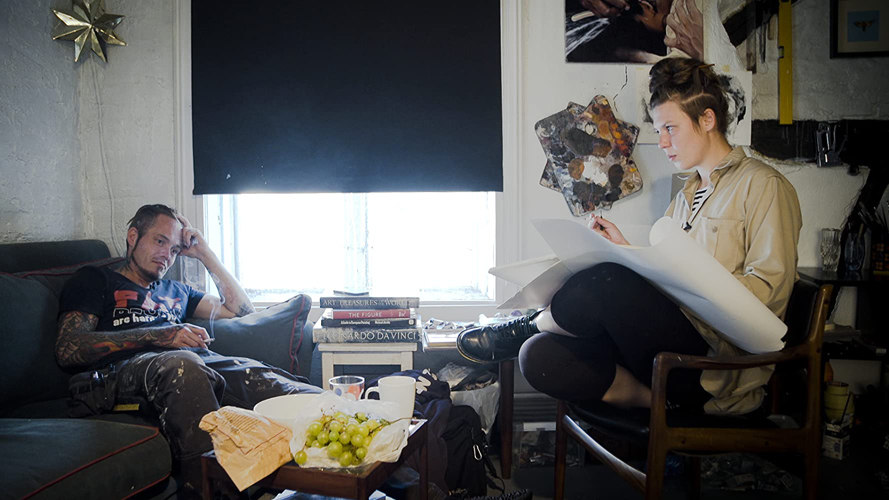
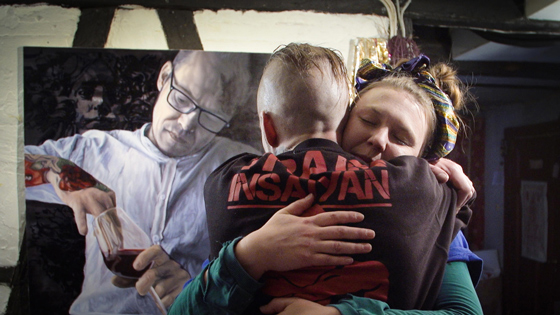
Kilkova offered the Carlus a deal: he will pose to her, she will refuse a court claim. And then, between them, an impossible friendship ensued. She not only draws, they still conduct sincere conversations. Karl-guard rubs her about a difficult childhood, prison and explains the meaning of tattoos, which is covered from head to toe (each rose is one year of unfortunate life). Kilkova works in the style of spontaneous photorealism, but her paintings turn out to be magical: she seems to reprogram Karl-Tertel . Again, stagnant and quarreling with a girl due to heroin, he falls into a car accident and finds himself in a hospital bed. Kilkova brings a picture to the hospital (“This is instead of a plasma screen for you”), as if imposing a new image. And, leaving the hospital, the Carl-Storeer begins to look more and more like his image: not a sinewy, moderately charismatic people's head, but a pretty decent man in horny glasses with pumped up biceps.
At the same time, this advance payment gives little recognition. There is nothing to pay for the rental of the studio, the galleries do not take work. She received her five minutes of fame, but did not work anything.
The relationship of the artist and thief is only one part of the story. Because they have a third participant. Not the accomplice of Karl-Tertel , who remained behind the scenes, but the camera and director Benjamen Ri himself, who shot the film for almost four years. For him and his heroes, this story unfolded in the present tense. That’s why the film seems to be very natural, the reflexivity in it does not protrude in any way, but the viewer all the time needs to make an amendment to the presence of the camera. For example, the catharsical moment, when Karl-Irtel for the first time sees his very first portrait and unexpectedly begins to cry. Sincerely? Stage? And so, and so? Ri in an interview says that he discussed with his heroes the playwright of the film and operator work. The question of how these people would communicate without a camera (and they would communicate at all) remains open.
 © Medieoprat wear
The director does not fall into the frame, does not ask questions behind the scenes, but the fact that he is there is emphasized by the structure of the film: one part was shot from the point of view of Kizyvkova, the other- Charles Taren . “She sees me well,” says Karl-guard , “but she forgets that I see her too.” The artist loses the advantage that the usual structure of the “portrait/model” relationship gave him. And now the social distance between the representative of the creative class and the criminal element is not so huge. His apartment looks no worse than her studio, and in this apartment there is suddenly a lot of some kind of painting and graphics in the framework, including a drawing of a famous German expressionist Kete Ketvits, perhaps even genuine. (From where all this came from, the film does not explain: the Carl-guard denies any connection with the black market of art.) The thief also knows how to work with his hands, and not only in the thieves' part: he is a carpenter, is fond of the reconstruction of traditional Norwegian wooden architecture. And Kizyvkova, as it turns out, has its own dark moments in the biography. She escaped from Berlin to Norway from the Abusivive boyfriend, which did not allow her to engage in art. And she still pulls into co -dependent relationships, as her partner remarks with a reproach.
The line between the artist and the model, the subject and the object in the film is erased. Almost like in the famous lacan bike about a tin can floating in water, which also looks at the one who sees it, who also has a look. But at the same time, this design forms a special place for the director-documentary, watching the artist observing his object. It is the director here that feels the most protected from the gaze of another: the objects of his observation are closed on each other and will not look at him in response.