
Translated material
The usual tool for repression. The case against Mustafa Dzhemilev
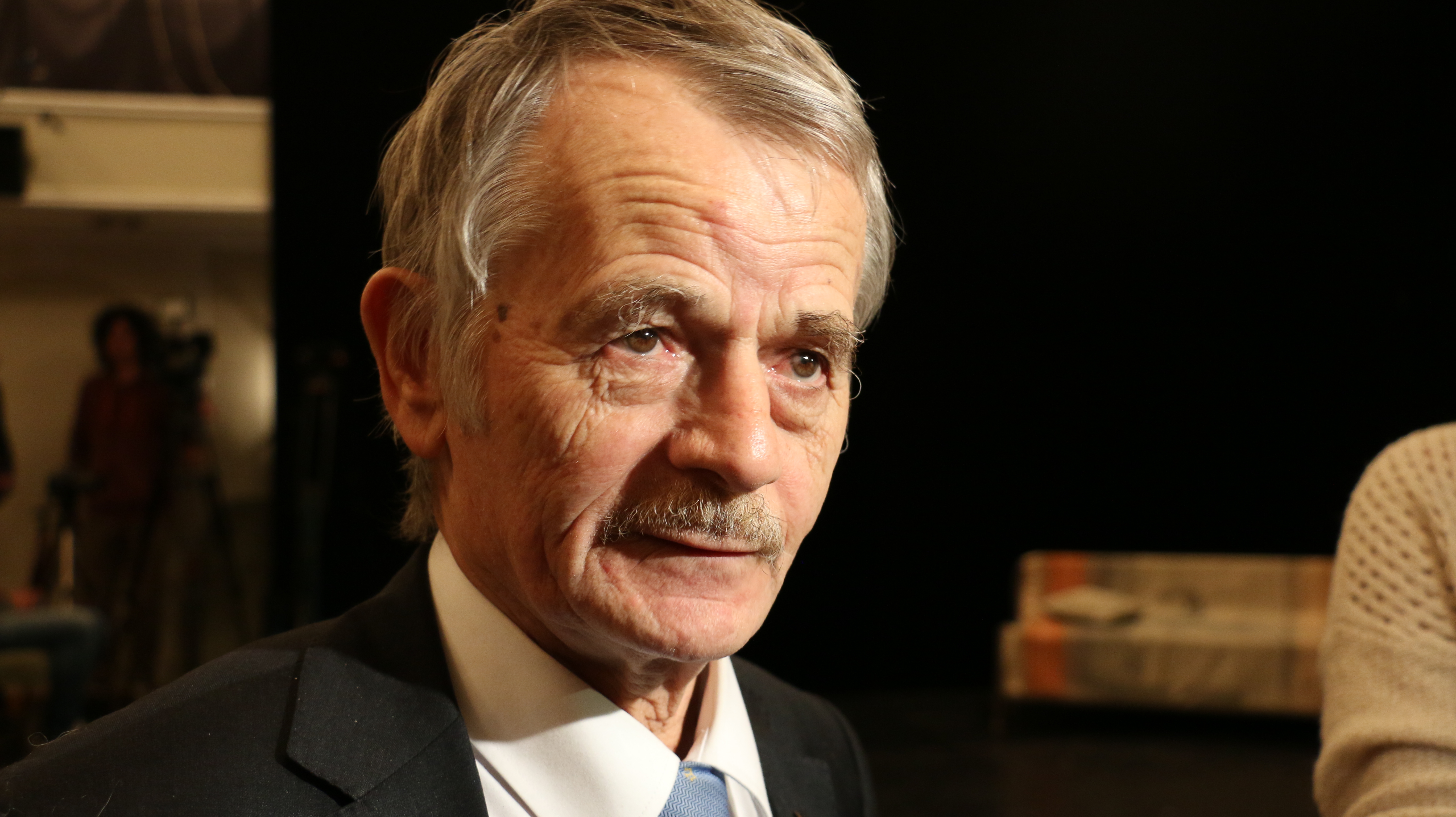
The Investigative Committee in the Crimea occupied by Russia transferred to the court the case of the People’s Deputy of Ukraine and the leader of the Crimean Tatar people of Mustafa Dzhemilev. He is accused of trying to enter the Crimea in May 2014, as well as the illegal acquisition of combat cartridges and careless storage of firearms, which led to the possibility of using it by another person. The transfer of the case to the court was not informed either to lawyers or the most accused.
Mustafa Dzhemilev did not support the annexation of Crimea by Russia and did not recognize the referendum on the status of the peninsula, for which the Russian authorities forbade him to enter the Crimea at first for five years, and then brought him to sanctions lists along with more than three hundred other citizens of Ukraine. In the USSR, Dzhemilev spent a total of fifteen years in prison. Criminal cases against him were started seven times. After the proclamation of the independence of Ukraine, Jamylev actively participated in politics. He held the post of chairman of the Mejlis of the Crimean Tatar people from 1991 to 2013. Since 1998, he has been a deputy of the Verkhovna Rada of five convocations. In an interview with Radio, Liberty Mustafa Dzhemilev said that he considers the case against him an act of intimidation related to his position:
Russia is such a state - does what wants
- This case was aroused back in 2016, in all these articles - illegal storage of weapons, an attempt to illegally cross the state border of the Russian Federation. From a legal point of view, what is happening, I understand, but from the point of view of practical, I associate this with a statement about plans to make a hiking peaceful march to the territory of Crimea from the mainland of Ukraine ( “Peace against violence and occupation. Marsh of dignity” , whose participants went to the Crimea, crossing the administrative border, was planned on May 2, but due to the epidemic of the coronavirus, was delayed. Now in the Crimea everyone is massively warned that if they approach the border, they will be held accountable, a kind of preventive work is underway. And at the same time, they aroused things against me again, the Refat of Chubarov ( the chairman of the Majlis of the Crimean Tatar people-an organization recognized in 2016 in Russia extremist.-approx. RS ), Lenura Islyamova ( Vice President of the Crimean Tatars and general director of the ATR television channel. -Apparently , it is apparently believed that this is the main organizers that these are the main organizers The upcoming march. But, as the lawyer Nikolai Polozov says (he got acquainted and copied all the materials, it is a large volume, 11 volumes with applications, videos) causes concern that on May 3, 2014, when about 5 thousand people came to meet us, they made a video of all events, and then they took everyone who was present there, and now they are allocated in separate production. That is, we can talk about plans for mass repressions, against several thousand people. But, again, this, apparently, is in the order of intimidation.
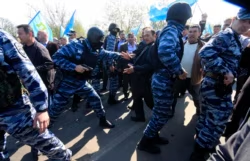
As for the storage of weapons, this episode does not fall under the jurisdiction of the Russian Federation at all, because we are talking about weapons and cartridges to it, which were before the occupation of Crimea. They cannot present this in any way, but Russia does such a state - he does what he wants. For all the articles that are incriminated to me, this is 322, part 3, an attempt to cross the border, 224, 222, in accordance with the Criminal Code, we are talking about the expiration of the statute of limitations. In any case, even if, say, from the point of view of Russian laws, I was held accountable, this does not imply criminal punishment. Nevertheless, they pompusively informed the whole world that they were brought to criminal liability, talk about the investigation, then about its completion, and now about transfer to court.
- You believe that the actions of the Investigative Committee are related to the preparation of the "march of dignity". At the same time, the Crimeans who want to take part in it are intimidated?
- They conduct very thorough massive training. May 3, although we then clearly said that we were putting off the march, they still pulled a huge amount of their army to the border. They came to the houses to activists, veterans of the national movement, and warned that if they go out to participate or meet those who are going to make a march, they would bear criminal liability. This continues now-in every case, everyone there warns that God forbid, if they show some kind of activity, then they will be punished, ”says Mustafa Dzhemilev.
The report of the Investigative Committee says that the basis for initiating a criminal case and transferring it to the court are two episodes. The first is connected with the arrival of Dzhemilev to Russia on May 2, 2014, when he was denied the entrance, after which he came to the administrative border of the peninsula and mainland Ukraine. "His further illegal actions to find in the Republic of Crimea were suppressed by employees of law enforcement units," the investigative committee said in a statement.

The second episode of the criminal case is associated with the events that happened long before the annexation of Crimea by Russia. On May 2, 2013, the son of Jamielev Haiser committed the murder by negligence, using the firearms of his father. Haiser Dzhemilev was convicted after Russia annexed the peninsula, he was serving a sentence in a colony in Astrakhan and was released on November 25, 2016.
- The second part of the prosecution concerns the weapon, we are talking about the situation related to your son. But we are talking about events that occurred in May 2013, when Crimea was not yet annexed.
- Yes. Firstly, they have a complaint that I have permission to carabiner, but there are no permissions to the cartridges to the carbine. They simply went into my house in my absence and did not find permission for cartridges. In accordance with Russian legislation, it turns out that separate permits are needed on cartridges and weapons. In Ukrainian legislation, this is not: if you purchased weapons, then you present this permission and you can buy cartridges in any store. The weapon was purchased back in the "gangster" times, in the 90s, and then, according to their logic, it turns out that I had to ask Russia's permission to purchase cartridges. Such is absurd.
- You think that the purpose of all these charges is intimidation. But maybe we can talk about limiting the possibility of movement?
- As early as April 19, 2014, they made a decision about this. When this resolution was read to me, they did not give it into my hands. But we managed to tear it out of their hands, photograph and spread it. So there was neither a seal nor a signature, just some kind of piece of paper taken from the computer that, in accordance with such and such an article of the Federal Law on Entrance and Departure, I am forbidden to enter the territory of the Russian Federation within five years. But then I pretended that I did not understand, I say: “But I was the last time in your Russian Federation from the colony in 1986 ... And in 2014, in March, I came to negotiations at the invitation of Putin. I am not going to Russia at all. Why are you?” And they say: "This is the territory of Russia." I then said: "Well, then you are big optimists that you think you will stay in Crimea for 5 years." I thought then that they would not be there for more than five years. And then 5 years passed. In November 2018, they published a large sanctions list, 360 people-political figures of Ukraine, who are prohibited from entering the territory of the Russian Federation, without indicating the deadline. And at the same time, they put me on the so -called international wanted list. I asked: "Well, if you are looking for me, why forbid you to enter? How can I come to you if you do not let me in?" They have no answer to this question.
- Recently, the authorities of Crimea annexed by Russia decided to nationalize the lands that belong to Ukrainian citizens. As far as I understand, you are a citizen of Ukraine and you have real estate in Crimea. How do you evaluate these actions? Does this mean that you will lose property?
- Yes, they said that the sections of people who were forced to leave the territory of Crimea or refused to accept Russian auswees, that is, passports, are in limbo. That is, when the authorities want, they can withdraw them. Although this is not provided for by the legislation of the Russian Federation, it is an innovation. And, in addition, I well remember that in 2014 Putin said that private property is inviolable, that is, no one will encroach on property after joining, as they call it. But now there is a violation of his obligations, ”says Mustafa Dzhemilev.
The lawyer of Mustafa Dzhemilev Nikolay Polozov believes that the actions of the Investigative Committee have a political connotation:
- According to the law, the prosecutor - after the approval of the indictment and transfer of the case to the court - must notify both the accused and his defender. This did not happen, and this is a procedural violation. Here, from this kind of procedural violations, which in the case are plenty of, we will form our position for further appeal to international instances. After all, it is quite obvious that the matter has a political reason, and in such matters in Russia everything is absolutely predictable. Many Crimean affairs in which I took part only confirm this thesis. The Russian authorities need a conviction against Mustafa Dzhemilev, primarily in order to demonstrate it at various kinds of international sites and talk about what criminals the Crimean Tatars. It was for this reason that the affairs of the Mustafa Dzhemilev, and against Refat Chubarov, and in relation to Lenur Islyamov, were renewed literally on one day. That is, there was obviously a political team to activate these cases. At the same time, as a rule, all these sentences are carried out with serious violations, both actual and procedural, and this gives quite wide opportunities for further appeal, including in international instances, for example, in the European Court of Human Rights. The plus of this case is that Mustafa Dzhemilev is not under the control of the Russian authorities, he does not sit in prison, and protection can maximize the potential of the case without looking back at the fact that, while in prison, the client may suffer from these actions. Therefore, we will defend ourselves harshly, record all violations and, of course, in the future we will count on the fact that these violations will be given a proper legal assessment by the European court.
- We are talking about two episodes that are completely unrelated to each other. Does these accusations have a reason? After all, including the allegedly illegal crossing of the border, which is not such.
It's about a political confrontation in which the Russian authorities use the usual instrument of repression - criminal cases
- Yes, that's how. The first episode is to charge the illegal crossing of the border, despite the fact that this border is unilaterally established by Russia and no international treaties that would legitimize it. The second point is procedural, and this I pointed out in my petition to terminate the criminal case that at that time, as of May 3, 2014, even under Russian laws there was no border there. The Decree of the FSB SK regarding the introduction of the border regime in this area was issued six months later, and the government’s decree in which the checkpoint was established, a year after the events. What border can we talk about, even if it did not exist there under Russian laws? As for the episodes that are charged with Bakhchisaray: the illegal acquisition of ammunition and the careless storage of firearms, which entailed grave consequences, this is the episode of 2013, and according to two accusations, the terms of prosecution were expired. On charges of careless storage of firearms, they expired back in 2016, and on charges of storing ammunition in 2019. And again, here we rest on fundamental violations by the Russian authorities of international law, when the law suddenly begins to have retroactive force when Mustafa Dzhemilev is accused of that until 2014 he did not comply with the Russian law on the turnover of weapons. How should it, living on the territory of Ukraine, should he comply with Russian laws? And why should he bear responsibility for this? It is quite obvious that the case has a serious political component. It is no coincidence that all the things that I said about, in relation to Dzhemilev, Chubarov and Islyamov, were resumed on the same day - March 26. Prior to this, cases were in the stage of suspension since 2016 and 2015. In my opinion, of course, the trigger to this renewal of the case was the statement of the Medzhlis of the Crimean Tatar people about the holding of the action on May 3-the “march to the Crimea”. And in reality, we are talking about a political confrontation in which the Russian authorities use the usual instrument of repression - criminal cases.