
Translated material
What is happening to the Okhtin Cape
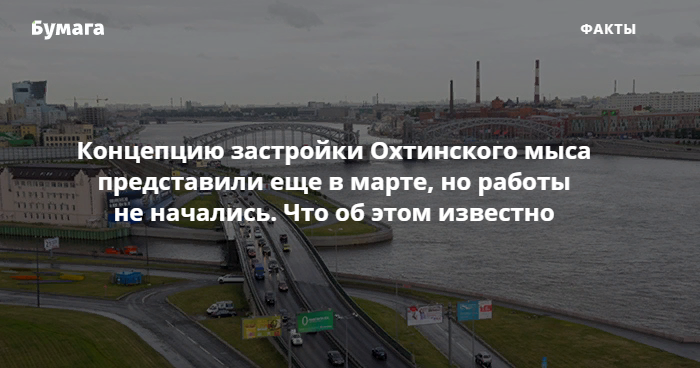
In March, Gazprom Neft introduced the architectural concept of the development of the Otinsky cape, but has not yet begun work. The company argues with city -defenders about security zones - over the past 14 years, archaeologists have found many remnants of ancient fortresses and products of the Neolithic era in the territory.
Activists believe that not all objects came under protection. Both the developer and the city defenders filed claims to the Supreme Court in order to clarify the boundaries of the security zone. "Paper" says what is happening with the Okhtin Cape.
The development of the cape has not begun. Both Gazprom Neft and the city defenders want to clarify the boundaries of security zones
Close -defenders want to clarify the boundaries of the security zone on the Oktinsky cape, determined by the order of the Ministry of Culture of March 6, 2019. The document has not been published anywhere and is not subject to disclosure. At the end of May, the deputy of the ZAS Boris Vishnevsky and activist Pavel Shapchits filed a claim with a claim to the Supreme Court of the Russian Federation with a request to recognize the order as invalid.
In early June, the same lawsuit filed with the Supreme Court and Gazprom Neft. According to Kommersant, this will give the company the right to vote in court if the claims are united. As Boris Vishnevsky later reported, the statements were really united. Thus, the city -defenders and Gazprom Neft will become soysters - although Pavel Shapchitz believes that in the court of their position on individual issues they may be dispersed. The meeting is scheduled for July 9.
The Gazprom Neft “Kommersant” said that they were hoping to receive the final assessment of the historical and cultural examination of the archaeologist Ayrat Sitdikov from 2018, on the basis of which they determined the guarded zone indicated in the order of the Ministry of Culture. Sitdikov’s examination is supported by icomos (the International Council for the preservation of monuments and attentive places) and the Scientific and Methodological Council for Cultural Heritage under the Ministry of Culture of the Russian Federation. Gazprom Neft wants the scientist’s conclusions to be updated. City defenders believe that the examination recognized only part of the entire heritage in need of protection.
After the trial, the company intends to start building. The representative of Gazprom Neft in a conversation with Paper explained that this lawsuit is “a desire to put the final point in the discussion around the security zones on the site owned by the company.
The city defenders filed another lawsuit - they believe that not all cultural heritage on Cape is under guard.
The city defenders decided to challenge the boundaries of the security zone established on the basis of the examination of Ayrat Sitdikov, and in the district court. They believe that now the law is protecting only part of the historical territory. In early March, the deputies of ZakSA Boris Vishnevsky and Nadezhda Tikhonov, together with the head of the Petersburg branch of Just Russia, Marina Shishkina filed a lawsuit in the Kuibyshevsky district court.
According to Vishnevsky in his telegram channel, on July 6, a meeting should be held at which Ayrat Sitdikov and archaeologist Petr Sorokin, who conducted excavations at Okhtinsky Cape from 2006 to 2010 and opposing Gazprom Neft, should be testified.
Gazprom Neft wants to build two glass buildings with offices, restaurants and public park on the cape
In March, Gazprom Neft introduced the concept of development and development of the territory of the Okhtinsky cape, on the site of which the company's headquarters will be built. The winner of the closed competition was the Japanese company Nikken Sekkei.
The Crystal Ship concept includes two glass 28-meter buildings interconnected. In the internal spaces of these buildings, green galleries will be placed. A public park will also appear on the cape.
The project provides for the public zone at the first level of the complex, which will include exhibition and conference rooms, restaurants, cafes, sports and medical center. At the transition between buildings, it is planned to place an open -air survey site.

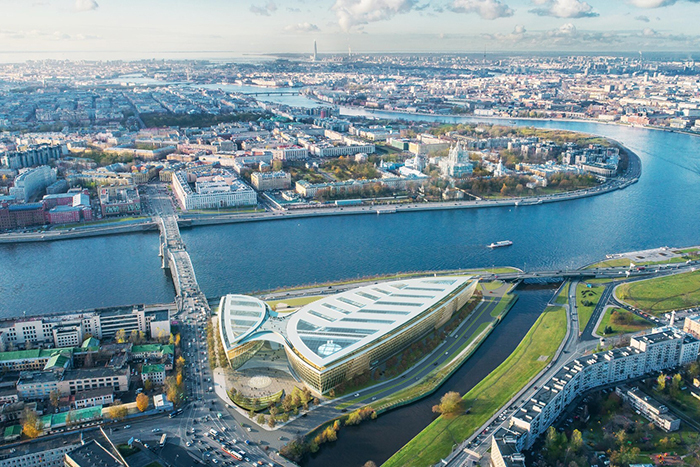

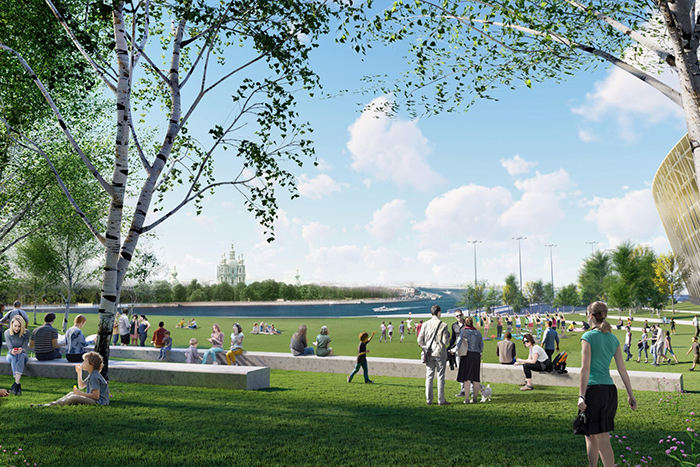
The rest of the complex will create a workspace for Gazprom Neft employees. There will be placed there the centers of technology development and management of international projects.
Gazprom Neft is positioning its project as a multifunctional public space, in the premises of which part of the employees will work. The company's offices are also located in business centers in Zoological Lane and on the Moika embankment. In 2020, Gazprom Neft plans to open its “digital” space in a separate building in New Holland - it will be occupied by developers in the field of artificial intelligence, robotics and unmanned vehicles.
Gazprom Neft owns a third of the protected territory. They promise not to conduct construction
As the “Paper” explained to Gazprom Neft, the company owned 4.7 hectares of land - that is, half of the Otinsky cape. The identified security zone occupies 2.4 hectares: a third is located on the territory of Gazprom Neft, the remaining 1.6 hectares belong to the city.
Gazprom Neft claim that the development will not affect the guarded territory of the Okhtinsky cape. Monuments intend to improve and “integrate” into the public park zone.
At the same time, according to the assessment of the archaeologist and opponent of the project, Peter Sorokin, they were mainly taken under the protection of the zone not excavated by archaeologists, and 80 % of the territory of the cape are occupied by unprotected archaeological objects. According to Sorokin, these areas are facing development. Gazprom Neft reply that they are guided by the restrictions established by the state.
The Gazprom Neft “Paper” said that the current project from Nikken Sikkei is a sketch architectural concept that requires a detailed study. Including yet to determine the dimensions of the building under construction and the adjacent park zone. According to preliminary estimates of the company, the development and improvement of the cape will take from four to five years.
The dispute over the cape began back in 2006. Garbonical defenders proposed creating a museum there
Gazprom planned to build Okhtinsky cape in 2006: they wanted to build Okhta Center there. However, after the archaeological work, many city defenders opposed the skyscraper in this part of the city. Mass protests were held in St. Petersburg, as a result, the building was built in Lahta.
Smolny later discussed the draft museum and exhibition complex “Defense and Blockade of Leningrad” on Cape, but they refused it due to a lack of funding.
In 2013, the initiative group, which included scientists and public figures, compiled the Okhta Declaration, which completely prohibited the development of Cape due to the uniqueness of archaeological finds on its territory. The declaration was signed by about 5 thousand people: scientists, politicians, city -defenders, journalists, cultural figures. They supported the idea of Peter Sorokin, who proposed to equip an archaeological park on the territory of excavations on the Okhtinsky cape. However, experts from the museum sphere did not support this idea, as they doubted that the exhibits would retain their outdoor air.
By June 11, more than 4.8 thousand people signed a petition , in which they demanded to revise the results of the competition for the development of the Okhtinsky cape and hold a public discussion. The author of the petition, the architectural critic Maria Elkin, believes that the complex from Nikken Sekkei is not suitable for St. Petersburg, as it "is associated with the financial centers of Asian countries." According to Elkina, a landscape park should be placed on the Okhtinsky cape.
During excavations on the Okhtinsky Cape, the remains of the fortresses of Niennshants and Landskron were found, as well as other historical relics
Several sections of the Oktinsky cape have the status of a monument since November 2019, that is, construction on them is prohibited. On this territory there are the remains of the Novgorod fortifications and fortresses of Nienshants, the fortress of Landskron of the XIII - XIV centuries and the Old Russian settlement.
Archaeologists found products from birch bark, amber, clay, wood and stone of the Neolithic era on the cape. Among the finds are also Swedish coins and underwear decorations of a later period.
Until the mid-1990s, factory workshops worked here, after their closure, the territory is empty. Okhtinsky cape is located in the development zone: buildings are allowed here no higher than 33 meters.
Read here an interview with “Papers” with Peter Sorokin, in which the archaeologist told what the significance of the cultural heritage found on the Okhtinsky cape during excavations is.
Photo on the cover: Alexander Koryakov / "Kommersant"