
Translated material
People on the moon. The main answers
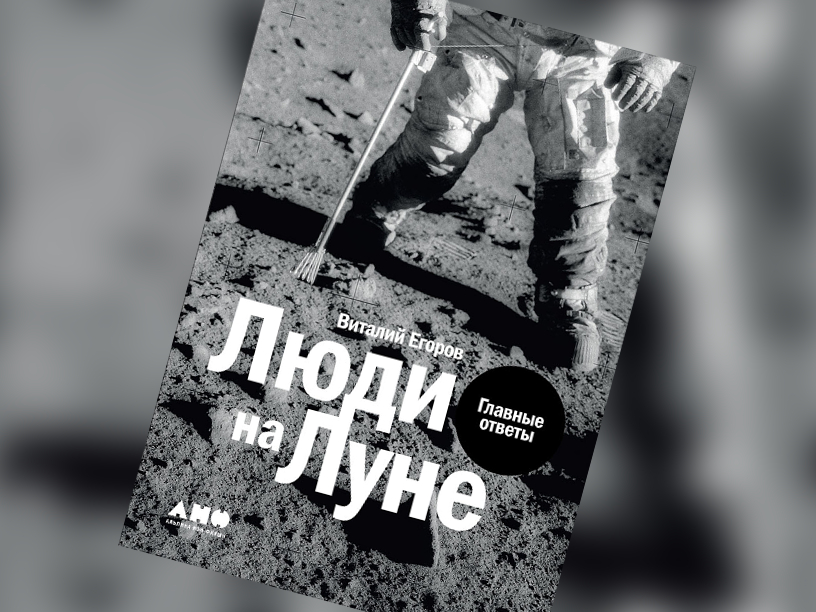
The Alpina Non-Fixes Publishing House represents Vitaly Egorov’s book “People on the Moon. The main answers. "
Against the background of technology of the 21st century, the flight of man to the moon in the middle of the last century to our contemporaries often seems implausible and raises many questions. On the main ones - about lunar fakes, about the technical equipment of flights, about the state of astronauts - answers in this book. The author is driven by not the desire to convince us that the Apollo program is a failed fact, but a great desire to share carefully proven new facts, unknown images and interesting details about a person’s flights to the moon. The diversity and fascination of information in the book will not leave indifferent a single reader. Was there a toilet on a spaceship? How are wet wipes and cosmic radiation related? How many meters can you jump on the moon? Why do people not fly to the moon today? What is included in the new Artemis program and why is it important for the US presidential election? What technologies and knowledge of half a century ago will help a person return to the moon?
We offer to read the fragment. Books
Why are the stars not visible in the pictures from the moon?
Brief answer: shooting on the moon was carried out in daylight conditions, and the stars are much faster than the surface of the moon. Nevertheless, the stars were repeatedly removed during the Apollo program: from the surface of the moon through the telescope installed in the shade of the lunar module, and from the shadow side of the near -moon orbit.
In numerous pictures and films taken by astronauts on the moon, there are no stars at all. Despite the fact that there is almost a vacuum on the surface and we see a black sky, no other light sources, except the sun and earth, are not noticeable in the moon sky. Moreover, on many modern shots from space, removed from the International Space Station, an absolutely black freezel sky.
This completely contradicts our expectation, because it is known: the higher the mountains, the more stars can be seen in the night sky. No wonder large astronomical observatories are built as high as possible in the mountains. And all our experience suggests that in space there should be an endless starry sky that everyone saw in Star Wars, Aliens, Avatar and many other films and cartoons, which have grown in more than one generation. Cosmos without stars seems to us fake, but reality does not always correspond to our expectations.
If we talk about the usual daytime pictures of Soviet and Chinese descended devices and lunar drives, then there are no stars.
Shooting through the same Illuminator of the ISS: “during the day”, when the station is illuminated by the sun, and “at night” - in the shadow of the earth. Roscosmos, NASA
Sky (left to right) over the Apollo 17 lunar car; against the background of the solar battery "Lunokhod-2" (visible white dots are noise); On the panorama of the Luno Road Yutu 2. NASA, Roscosmos / Geokha RAS, CNSA / CLEP
Of course, the stars in space are visible, and you can find in the memoirs and interviews the numerous enthusiasm of astronauts and astronauts about beauty and countless stars. The orientation on the stars was part of the standard APOLLO ship control products, for which there was specially sectant on the ship (a tool for navigation by stars).
The telescope installed on the lunar module allowed the astronauts to determine the location of the landing site on star maps.
On many spacecraft, star sensors are installed for navigation and orientation during the flight. Star sensors are simple cameras, in the memory of which bright stars and constellations are recorded, helping to determine which direction the device is deployed.
That is, not only astronauts, but also cameras are quite capable of seeing stars in space. The ISS crew likes to shoot and lay out a series of pictures with polar radiance, light of earthly cities, flashes of lightning in the clouds and, of course, stellar spaces of space.
At the same time, some astronauts and astronauts claim that they did not see the stars, but with the clarification that we are talking about observations with the naked eye and in the conditions of daylight.
Night Earth (own glow of the atmosphere), Venus, Moon and Stars - a look with the ISS. NASA
Why are the stars visible in some pictures, but not on others? Why does someone see the stars in space, but someone-no? The answer lies in the difference in the brightness of the sun and stars, as well as the conditions of observation and shooting.
For the first time, this effect was described by Yuri Gagarin during his flight into space. His observations are recorded in the transcript of his report from the orbit.
On the sunny side:
And now, through the Illuminator, the Sun passes through the Illuminator. A little harsh of his light. Here the sun leaves the mirrors. The sky, the sky is black, the black sky, but the stars in the sky are not visible. Maybe the lighting interferes. I switch the lighting to the worker. The light of television interferes. Nothing is visible through him.
He discovered the Light Filter "Gate". I see the horizon, the horizon of the earth floats. But the stars in the sky are not visible. The earth's surface, the earth's surface is visible to the porthole. The sky is black, and along the edge of the earth, along the edge of the horizon, such a beautiful blue halo that is darker in remoting from the ground.
On the night:
Attention, I see the horizon of the earth. A very beautiful halo. First, the rainbow from the very surface of the earth, and such a rainbow goes down. Very beautiful, it has already gone through the right porthole. The stars can be seen through the "gaze" how the stars pass. A very beautiful sight. The flight in the shadow of the Earth continues. I’m watching a star in the right porthole now, it goes away from left to right. Asterisk left, leaves, leaves ... Attention, attention: ten hours, nine minutes, fifteen seconds. He came out of the shadow of the earth.
Since then, nothing has changed - from the night side of the earth or moon, you can calmly observe and photograph the starry sky. On the daytime side, the bright light interferes with which our eyes adapt, and you have to configure photo equipment.
In the case of space flight, the nightly time is considered the moment of the observer in the shade of the cosmic body. Outside the Earth’s atmosphere, “at night”, suitable for observing stars, any shadow can be considered, even from a spaceship, provided that the observer or the lens of the camera or telescope does not fall into direct or reflected sunlight.
In the near -Earth orbit, polar radiance, lights of cities, flashes of lightning, comets, planets and stars are visible at night - when the shadow of the earth blocks sunlight. For shooting stars at night, a co -lens is best suited, that is, the one that can capture and focus on a film or a photo matrix a lot of photons of light. Also, modern cameras allow you to configure the photosensitivity of the photo matrix to the high values of ISO 24,000 or even more. In the 1970s, photographers had a much more modest choice of film with a photosensitivity of 32 to 250 units. The color film of Hasselblad cameras Apollo had a light of 64–160 units, i.e. the film was designed exclusively for daytime shooting in bright lighting conditions.
The starry sky observed by the ISS crew on the shadow side of the near -Earth orbit. NASA
Even if you take an unique lens and a film with low photosensitivity, the stars can still be removed if you put a long exposure. The longer we project the light through the lens on a photo matrix or photophone, the less bright light sources we can remove. But all efforts will be wasted if there is a strong source of light in the frame: it will simply light the whole frame.
A bright source of light can be not only the sun. This is the lunar surface lit by sunlight, and the earth, and the sun -lit spacecraft and stations, and astronauts with astronauts. Therefore, even if there is a black sky on the day frame, there will not be necessary stars at all there. In addition, in space - at least in a near -earth orbit, even in the moon - sunlight is even brighter than us on Earth, by about 30 %.
Cosmonaut Roscosmos Oleg Kononenko, illuminated by the sun against the background of the Black Heaven. Roscosmos
In conditions of bright lighting, on the contrary, it is necessary to reduce theperture of lenses, reduce photosensitivity and reduce exposure. This will deprive the possibility of capturing weak light sources, such as stars, but it will allow you to remove brightly lit objects.
All landings under the Apollo program passed in the morning, when the sun illuminated the surface at an acute angle. All photographic equipment was tuned to the appropriate conditions, and a photograph was selected for daytime shooting with low photosensitivity. Astronauts were shot with cameras fixed on their chests, so they could not use a long exposure to shoot stars.
Despite all the difficulties, Apollo astronauts have repeatedly carried out astronomical observations.
Venus (point in the center), which was seen and photographed during the exit to the surface of the moon of the crew Apollo 14. NASA
The lunar module Apollo 14 managed to get to a series of photographs with the Earth and Venus. Also, the crew of Apollo 16 was able to photograph the planet Venus, ascending over the horizon, from the surface of the moon - the third most important object of the lunar and earthly sky. Although its brightness is very inferior to the sun or earth in the moon sky and it is more like a very bright star, but not a single star can compare with Venus in brightness.
The western part of the constellation Swan, the North America Number (top right), the nuclear power of the veil (below on the right) in the shooting of Far Ultraviolet Camera / Spectrograph from the moon surface Apollo 16. NASA, Thomas Bohn
Jupiter, part of the constellation Sagittarius and zodiac light in the shooting of Apollo 17 from the near -moon orbit. NASA
The Apollo 16 expedition was prepared more thoroughly for astronomical observations. During this landing, the astronauts delivered a telescope to the moon, which recorded ultraviolet light from stars and near -Earth - plasms. This experiment was called Far Ultraviolet Camera / Spectrograph. Read more about him in the chapter "What photographic equipment was used on the moon?"
Apollo 17 astronauts held their shooting stars during an orbital flight around the moon. For astronomical shooting, a Nikon F camera was used with a 55 mm lens and the Kodak 3414 black and white film. The camera was fixed from the Illuminator of the command compartment. Astronauts experimented with excerpt and was shooting a night sky with stars, zodiac light, near -moon medium and lunar terminator (the boundary between the illuminated and shadow sides of the moon). They had to install a long exposure - from 2 to 40 seconds, and at the same time it was possible to remove only the brightest stars. In the pictures, the usual constellations are distinguishable, which allow you to determine the direction of the camera and a section of the orbit of the spaceship during shooting.
Apollo 17 astronauts also shot astronomical objects using an ultraviolet spectrometer located on the command module. During the flight from the moon to Earth, spectra of the clusters of the galaxies were obtained by Veronica and Virgo.
Experiment
To feel like a lunar astronaut and take a picture of the surface of the moon, as well as try to remove the stars anyone can. This will require a camera with advanced manual settings and preferably a telephoto lens or a good optical “zoom”. You will also need a tripod, although you can do without it, reliably placing the camera on some support or just on the windowsill.
The experiment can be carried out on any clear night when the moon is illuminated at least half. It is better to choose the moment when in the sky our natural satellite is drawn closer to any bright star or planet. You can choose the time using the Stellarium program.
The light of the moon that we see from the earth is the reflected sunlight. That is, we are shining the daytime surface of the moon, which is almost the same brightness as the Apollo astronauts observed. To photograph the moon with visible surface details - seas and craters, we will need to set the settings on the camera, which are usually used for daytime shooting, for example, ISO 200 and an aging of 1/250 seconds. This is approximately the same regime used by lunar astronauts and use modern astronauts in near -Earth orbit in the daytime. An attempt to remove the stars in this mode will not lead to anything: the frames will be completely black, and even processing in Photoshop will not give anything - the brightness of the stars is too small. To photograph the stars, we will have to increase either ISO or shutter speed.
If ISO does not change how it happened during the Apollo time, bright stars will begin to appear in the pictures when exposed about one second or more, i.e., the lunar day surface is 250 times brighter than visible stars. If you try to photograph the moon with such settings, then we get a white shining circle, because its entire surface will be lit with reflected light.