
Translated material
Ivan Goncharov
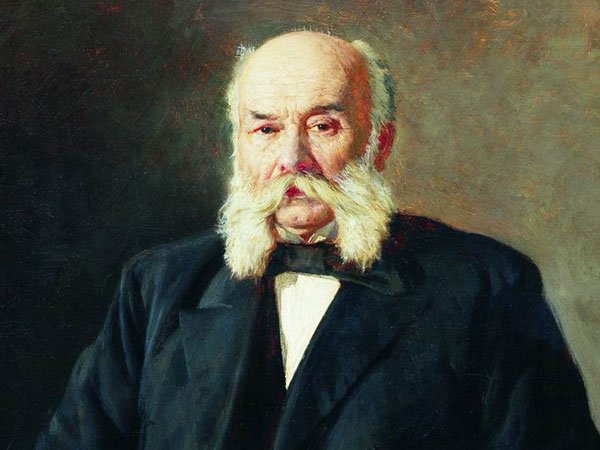
On June 18, 1812, writer Ivan Goncharov was born.
Personal business
Ivan Alexandrovich Goncharov (1812 - 1891) was born in Simbirsk. Father - Alexander Ivanovich, a prosperous merchant, a bakery and the owner of the candle factory - died when the boy was seven years old. The upbringing of the children was engaged in the mother of Avdotya Matveevna, nee Minerina, and the godfather Nikolai Tregubov - a retired sailor who told a boy a lot about sea swimming, and the future writer "eagerly absorbed his stories and was read out by travels." From 1820 to the summer of 1822, Ivan Goncharov studied at a private boarding house, and then his mother arranged him with his brother at the Moscow Commercial School. He studied there for eight years, but in the end he was able to convince his mother that the field chosen was not suitable for him, and in 1830 he was expelled from the school, in August 1831 he entered the verbal department of Moscow University. During the years of study, the university has a fascination with Goncharov literature.
After graduating from the university, Goncharov left for Simbirsk in July 1834, where until spring 1835 he served as the secretary of the office of the governor A. M. Zagryazhsky. Then Goncharov settled in St. Petersburg, where he became a translator in the Department of Foreign Trade of the Ministry of Finance. Goncharov gave his free time to literary classes, but did not dare to publish his works and drowned the stove with “kipas of scribbled paper”.
In 1844, Goncharov had the plan of the future novel “Ordinary History”. In 1845, the first part of the novel, which was then read and approved by M. A. Language and N. A. Nekrasov, read aloud in the House of Maykov. In 1846, the book was over, and Goncharov “with terrible excitement” asked to read the “ordinary history” of Vissarion Belinsky. Belinsky, according to I. I. Panaev, "was delighted with the new talent, who acted so brilliantly." The novel was printed in 1847 in the magazine "Contemporary", and the next year was published by a separate publication. After the success of the “ordinary history” of the pottery, it is decided to print an essay from the bureaucratic everyday life “Ivan Savich Zagrin”, and also anonymously published the feuilletons “Sveta Man”, “Letters of the capital's friend to the provincial groom” and the necrologist “V.N. Maikov”. In 1847, Goncharov had a plan of the Roman “Oblomov”, and in 1849 the head of “Oblomov’s Sleep Oblomov” with the subtitle “episode from an uncontrolled novel” was printed in the “Literary Collection with Illustrations”.
In the summer of 1849, Goncharov went on vacation to Simbirsk, planning to add a novel. However, the work went hard. In Simbirsk, working on the second novel, Goncharov also conceived another work - the future “cliff”. In 1852, Goncharov decides to enter the secretary to the admiral "Putyatin" who went to the round -the -world voyage. In October 1852, he hit the road on the frigate of Pallas. He visited England, South Africa, on the island of Java, in Singapore, Hong Kong, China, Japan. The beginning of the Crimean war changed the plans of Admiral Evfimiy Putyatin . The frigate along the coast of Korea rose to the mouth of the Amur. Goncharova at his request was transferred to the Schuna "Vostok", which delivered him to the port of Ayan on the shores of the Sea of Okhotsk. From there, he returned to Petersburg, having traveled all of Siberia and the European part of Russia. Goncharov’s travel essays were first printed separately in different magazines, and in 1858 they published a book called “Frigate Pallas”. ” In March 1856, Ivan Goncharov became the censor of the St. Petersburg Censorship Committee. At the same time, he had the opportunity to go on a long foreign vacation annually in the summer. In the first of these holidays, in the summer of 1857, Goncharov in Marienbad in seven weeks completes the Roman Oblomov. Since 1863, he has been served in the Council for Printing Affairs and the Council of the Main Directorate for Press Affairs and, as a “censor of censors”, oversees a number of periodicals. From December 1857 to the spring of 1858, Goncharov, maintaining the position of censor, taught Russian literature to Tsarevich Nikolai Alexandrovich. In 1869, Goncharov’s third novel “Cliff” was published. Prior to this, the writer published excerpts from the novel (with the subtitle “Episodes from the life of Paradise”): “Sofya Nikolaevna Belovodova”, “Grandmother”, “Portrait”. At the end of his life, Goncharov wrote an article “Million of Tear” - a critical analysis of the comedy “Woe from Wit”, as well as the essays “From the memoirs and stories about sea swimming” (later printed under the name “Twenty years later”), “Literary Evening”, “Servants of the Old Century”, memoirs “At the University”, “Notes on the Personality of Belinsky”, “In Homeland”. Ivan Alexandrovich Goncharov died on September 15, 1891.
What is famous
If the “ordinary story” made Goncharov a popular writer, then the Oblomov novel put him in a number of largest Russian writers. Turgenev remarked: “So far, at least one Russian remains - until then they will remember Oblomov,” and Lev Tolstoy wrote: “Oblomov is the most capital thing, which has long been long. Tell Goncharov that I am delighted with Oblomov and re -read it again. But what will be more pleasant to him is that Oblomov is not a random success, not with a bang, but a healthy, capital and non -reproach in the real public. ” Ilya Ilyich Oblomov became one of the "eternal types" of Russian literature. And immediately after the release of the novel, he began to receive a variety of estimates. Nikolai Dobrolyubov article "What is Oblomovism?" He talked about Bark psychology of Oblomov, who grew up on the basis of the serfdom of the psychology of the protagonist. The Slavophiles, for their part, came with the apology of Oblomovka, which seemed to them a poetic, "complete, artistically created by the world, entailing ... irresistibly in his fascinated circle."
What you need to know about
 Ivan Goncharov
The novel “Cliff” caused a stormy polemic. The liberal magazines appreciated him negatively, publishing the reviews under the titles: “Talented ineinability”, “Old Truth”, “Pseudonal heroine”, “Street philosophy”. Conservatives reproached Goncharov in excessive sympathy for the nihilists. Unlike the authors of the "anti-nigilistic" novels of the 1860s, Goncharov did not make a caricature from his hero Nihilist Mark Volokhov. On the contrary, Mark was shown as an interesting and largely attractive person. Goncharov twice tried to explain his position in the articles “The preface to the novel“ Cliff ”” and “The intentions, tasks and ideas of the novel“ Cliff ””, but did not publish them. Only ten years after the publication of the novel, in “critical notes” “Better late than never”, Goncharov spoke about his attitude to criticism of the novel and about the understanding of all three novels as a trilogy. “All of them are connected by one general thread, one consistent idea - the transition from one era of Russian life that I experienced, to another ...” he wrote.
Direct speech
“The author does not have the slightest hunt for anything in Oblomovka; No more thick or brighter paints are imposed on a single corner of the picture; Equally lit, she stands before the viewer, as a living, in all her bulges in amazingly captured details. Not these, however, epic perfection were the reason for the amazing impression, which at one time made “Oblomov”. The secret of his success - in the conditions of that era, in that passionate and unanimous desire to break all kinds of connections with the hated past, which are characterized by years that are directly following the Crimean campaign. It was necessary to make a bright embodiment of our apathy, a nickname was needed to designate our pre -reform inertia and inertness - and it quickly entered universal use, as soon as Dobrolyubov formulated it in his famous article: “What is Oblomovism”. Modern evidence boils down to the fact that resolutely everyone saw the elements of "Oblomovshchina"; It seemed to everyone that an explanation of the imperfections of our social system was found, everyone with horror turned away from the prospect of the same barren and ingloriously passing the life of the Goncharovsky novel; Everyone made an oath to destroy all traces of this similarity. In contrast to Oblomov, Goncharov brought the German Stolz. In his author’s confession, Goncharov admitted that Stolz is not entirely successful. “The image of Stolz,” he says, “is pale, not real, not alive, but just an idea.” It must be added that the idea, the representative of which is Stolz, is ugly. You can’t build the organizer of his fortune into the ideal. Every subtle-sensing woman, which, undoubtedly, is Olga, probably, would be able to recognize that Oblomova’s laziness is a hundred times more mental treasures worthy of hot love than in the vain, self-propelled filtering of Stolz. ”
Semyon Wengerov
“Goncharov does not just objectively depict the space crossed by a frigate making a round -the -world trip from St. Petersburg to Vladivostok - he declares that interest in the diversity of cultures, openness to the“ stranger ”is the real specificity of Russian consciousness. At the same time, the impression of the narrator observing a stranger to him the world intersects with the impressions of other people - for example, sailors. So, the space into which the author introduces us, on the one hand, changes as the Pallade makes its sea path, and at the same time all the time is given in the intersection of the points of view of its various observers. So, Goncharov claims that the sailor crossing almost the entire globe on the ship is in the “unchanged”, the small space of the deck or cabin, and in the unchanged environment not only the same sailors, but even the same ship dog. <...> The space of the ship on the Globe of Culture, as it were, personifies Russia with double division: on the world of sailors and marine officers. This space moves from the Western world to the Eastern world, in both cases preserving both its specifics and the ability to understand external space, not being fenced off from it. This space also includes a traveler, as if uniting all spaces - for he is internally identified with any of them. He gives, as it were, the highest point of view of culture. ”
Yuri Lotman
“Those who met only Goncharov occasionally or intended to find in it a living embodiment of one of his most striking images, willingly identified him with Oblomov, especially since his heavy figure, a slow gait and a calm, slightly apathetic gaze of beautiful gray-blue eyes gave a certain reason to this. But in reality it was not so. Under the calm appearance of Goncharova, an alarming soul took refuge from immodest or annoyingly luminous eyes. Oblomov’s main properties - thoughtful laziness and lazy idleness - there was no trace in Ivan Alexandrovich. The whole mature period of his life, he was a great worker. His correspondence could make whole volumes, as he corresponded with close acquaintances often and neatly, and his letters are represented by excellent examples of this epistolary family, which was familiar to people of the thirties and forties. This was a leisurely conversation between a person who not only wants to share his thoughts and feelings in detail and sincerely and tell about what is happening to him, but also to cause his interlocutor to a number of questions of the post -aligned attention and peaceful jokes for the same narrative. Modern man almost no longer knows such letters. ”
Anatoly Koni
11 facts about Ivan Goncharov
- The first publication of Goncharov was the two chapters from the novel by Eugene of Atar-Gul translated by him, printed in the fifteenth issue of Telescope magazine for 1832.
- In the first years of his life in St. Petersburg, Goncharov taught Russian literature and Latin to the sons of the academician of painting N. A. Maykov to Apollo and Valerian, the future poet and criticism. The Maykovs published a manuscript magazine, on the pages of which Goncharov’s works appeared: poems and novels “Dashing Broke” and “Happy mistake”.
- The prototype of Olga Ilyinskaya is called Elizabeth Tolstoy or Ekaterina Maykov.
- Many writers reproached Goncharov for serving in censorship. Herzen sharply spoke about this in the notes “An extraordinary story about the gon-cha-ro-zo-th-ppo-huh-hu” price.
- Working in a censorship department, Goncharov achieved the publication of some previously prohibited works by Lermontov. He also contributed to the emergence of some works of Nekrasov, Turgenev (including “Notes of the Hunter”), Smomyalovsky, Dostoevsky, Pisemsky.
- In 1855, Goncharov told his close friend Ivan Turgenev about the plan of the novel “Cliff” and dedicated to details of the future book. Subsequently, Goncharov suspected that Turgenev used his idea in the novels “Noble Nest” and “The day before”. The quarrel almost ended with a duel. In March 1860, the “arbitration court” was collected, which came to the conclusion: “... the works of Turgenev and Goncharov, as arising on the same Russian soil, had to have several similar positions, accidentally coincide in some thoughts and expressions, which justifies and excuses both sides.”
- In 1860, Goncharov was elected a corresponding member of the Academy of Sciences in the separation of language and literature.
- By the fiftieth anniversary of Goncharov received a letter from Russian women (more than a thousand signatures). Readers informed him: “Reading you, you not only enjoy, but also study: - From a grandmother, everyday wisdom; - Olga, how to love and tolerate disappointments with dignity; - Vera, how, "after bitter experiments, mistakes of pride and ignorance," do not lose heart, do not diminish, "and ascend in the way of a reasonable, conscious life."
- When in 1878, the servant of Goncharov Karl Trayut died, leaving the widow with three young children, the writer took care of them and helped them get an education.
- A few years before the death of Goncharov in the magazine "Bulletin of Europe" published the article "Violation of the will" , where he asked his addressees to destroy the letters they had. He himself shortly before his death burned a significant part of his archive.
- Goncharov was buried in the Alexander Nevsky Lavra in the new Nikolsky cemetery. In 1956, his ashes were transferred to the writer's bridges of Volkov cemetery.
Materials about Ivan Goncharov
Article about Ivan Goncharov on Russian Wikipedia
Goncharov in the fundamental electronic library "Russian literature and folklore"
Goncharov's works in the Moshkov library
The official website of the group for the preparation of academic complete works and letters of I. A. Goncharov, the Institute of Russian Literature (Pushkin House) of the Russian Academy of Sciences