
Translated material
The story of Victor Filinkov
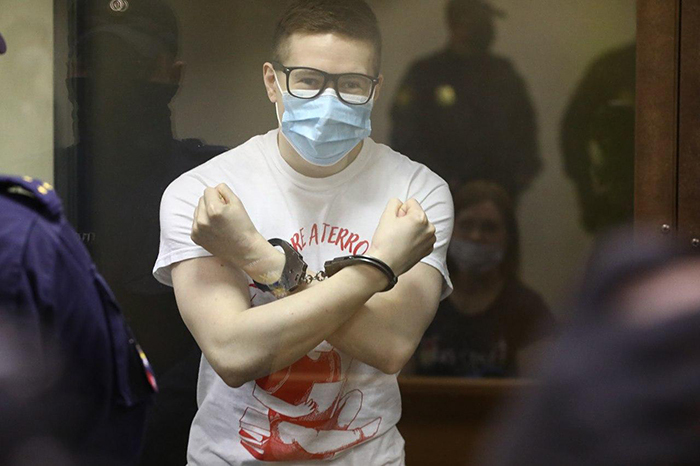
The Military Court in St. Petersburg issued the latest sentences in the case of a “network” - a community recognized as terrorist and prohibited in Russia. Victor Filinkov received the longest term among St. Petersburg defendants - seven years of a general regime colony. Victor is the only one who did not make a deal with the investigation and did not plead guilty.
"Paper" tells the story of Viktor Filinkov - an anti -fascist recognized by a terrorist. Read how he became interested in left -handed ideas, what he did before the detention and how he was connected with other defendants in the case.
"Nine requested years, this is probably a sign of respect for everything that I did"
On Monday, June 22, the 1st Western District Military Court announced the sentences to the Petersburg defendants in the case of the “network” to Viktor Filinkov and Julia Boyarshinov. They were found guilty of participating in the terrorist community (part 2 of Article 205.4 of the Criminal Code). Filinkov was appointed seven years of a general regime colony. Boyarshinov - five and a half years ( Julia was also found guilty of illegal storage of explosives, part 1 of article 222.1 of the Criminal Code).
Four days before the sentence, Filinkov played in court debate. The 25-year-old programmer announced inconsistencies in the charge version and, using the drawing, tried to explain why the PGP program is not suitable for conspiracy of the terrorist community, according to the prosecutor's office.
In his last word, Filinkov pointed out the unscrupulous work of the Ministry of Internal Affairs, the prosecutor's office, the FSIN, the SK, the FSB, the court and the legislative power, accusing them of the unquestioning execution of orders and the unwillingness to understand the case.
“Nine, [and not ten] requested years, probably this is a sign of some respect for everything that I did <...>” said Filinkov. - Everyone lamped, and I do not know how to get out of this situation.
"He established himself very well, never was such that he was unhappy with power"
Victor Filinkov was born in the city of Petropavlovsk of the Republic of Kazakhstan. Mother worked in a jewelry salon, his father was engaged in assembling medical equipment - he died when Victor was eleven, the older sister lived separately.
- Vitya was a long -awaited child. He grew up in love and care, he was surrounded by grandparents, aunts, uncles, we, ”Natalya Filinova’s mother tells “ paper ” . - He almost did not know the words “no”. He was a good and kind boy, but very honest, with character. Even in kindergarten, if he didn’t like something, he talked about it directly. Could anyone in the face say everything that he thinks. I asked him “Why is it so straight?”, And he replied: “It's true!”
According to Natalia, her son was fond of electronics since childhood: at the age of six he skillfully treated his sister’s computer and read specialized books, collected robots at ten, studied in adolescence, and won the Olympiads. Later, Filinkov’s special skills in programming will be confirmed by his colleagues for work in an IT company in court.
-He still did not go to school when he said: I will grow up and be a professor, earn a lot of money and buy KamAZ so that he also earned money. Apparently, I thought that the professors earn a lot, ”Natalya laughs.
After the death of her father, the family reduced expenses and moved to the apartment smaller, but Natalya claims that there were no serious financial problems. According to the wife of Victor, Alexandra Aksenova, he himself called his childhood difficult:
-He saw how mother and sister had to work hard-and even in a hard time, they did not have the opportunity to buy some culinary delights. I still remember that, from the words of Victor, in childhood he was very happy when he managed to buy butter. This is not hunger, but a certain level of poverty.
Victor is described as a sociable person with dozens of friends who often came to visit. According to his mother, he read a lot by a teenager - mainly technical literature and books from the school curriculum, sat on the Internet and played computer games.
Alexandra Aksenova says that in conversations with her, Victor mentioned his dislike for the education system in Kazakhstan and frequent disputes with teachers:
- The brightest in Victor is that he loves to argue very much. He knew how to defend his position if he was sure of her. But in the event that I was wrong, I was not afraid to inform about it. Although he did not like the device of the school system, he was far from stupid. His skate was the exact sciences. And he argued with the teachers of these subjects, because he simply knew more than them.
According to Victor himself, in high school he had long hair, which is why the school administration "tried to exert pressure." Around then, Filinkov formed anti -fascist and anarchist views.
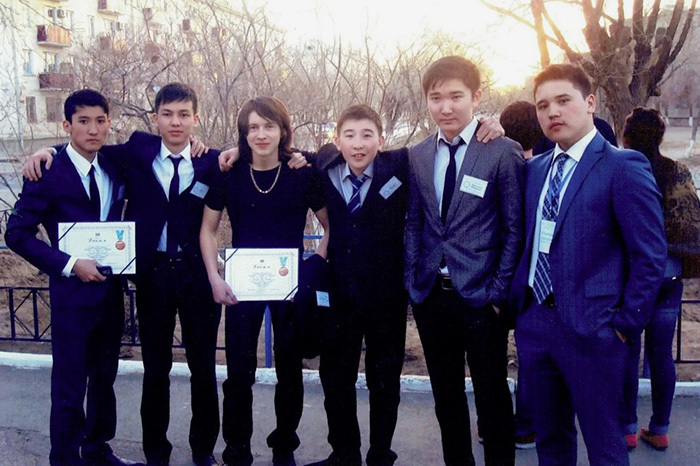
“Vitya is just at some point, in the classroom, he said that he was carried away by anarchism,” recalls Natalya Filinkova. - Apparently, I read it on the Internet, they wrote a lot about it. Then, just recently, [the journalist of Stanislav] Markelov and [Anarchist Anastasia] Baburov was killed - he influenced him, he wanted justice.
At the same time, Victor’s mother claims that they did not talk about politics. At the trial, Natalya Filinkova will say: "He has established himself very well, has never been to such a thing that was unhappy with power."
"A small party from the children of anti -autorite concepts"
In 2013, Victor graduated from the school and moved to Omsk-he entered the faculty of computer science and computing equipment of the Omsk State University.
Victor did not graduate. After 2.5 years, he quit his studies - “my mother was seriously ill” (Natalya asked not to disclose the diagnosis), and Filinkov began working in their specialty, earning 30 thousand rubles a month.
Victor was even glad to throw the university, anonymously told his acquaintance of those years: he complained that he was bored in the classroom. Soon, according to the interlocutor of the “Paper” , Filinkov realized that he had reached the “salary ceiling” in Omsk and thought about moving.
At the same time, Victor participated in human rights and anti -fascist actions, his wife recalls. In 2014-2016, Filinkov stood in pickets against reduction of health workers, supported trade unions and went to the rally of the memory of Markelov and Baburova.
By 2015, Victor was already a convinced anti-fascist, his acquaintances from Omsk say “paper” . According to them, Victor came to this himself, without reading “ideological literature” like the works of Kropotkin and Bakunin.
“We first met in the summer of 2015, he walked with friends on the university,” Filinkov’s close friend from Omsk tells anonymously “paper” anonymously. - We agreed on the common interests of sports and computer topics, began to be friends. There [in Omsk] there was a small party from the guys of anti -authoritarian concepts. Such a youth leftist environment, where everyone has clear concepts that racism - sucks, capitalism - sucks.
Filinkov’s friend says that they were “not one who builds communes and prepares a revolution”: the main goal was the horizontal community, where it is comfortable to coexist and help each other. The young man notes that they perceived such a model as an alternative to the state.
- He grew up in conditions of such social injustice. And he saw a certain attitude towards himself, as he was a citizen of the wrong country. How not to become an anti -fascist? - says Alexander Aksenov, with whom Filinkov often discussed life in Omsk.
According to Victor himself, by 2016, because of his views, he was attacked by nationalists several times.
As Aksenov and Filinkov’s friend told, in Omsk , on the basis of common interests, Victor met with Alexei Poltava, who later admitted to the murder of a familiar defendants in the case of a “network” from Penza. Victor knew little about the rest of the future defendants in the case, but he heard the names, says the interlocutor of “Paper” from Omsk.
“It is important not that we went to rallies or gathered a company,” Filinkov’s friend says about those years. - In principle, we simply lived on such understandings as anti -authoritarianism, anarchism, anti -fascism. And they were hanging out, of course: they rode on the great, on skate, and “Linux” butted, tried to program, listened to music, walked, climbed the roofs.
"We discussed a lot in Penza, including politics"
Victor met his future wife in the summer of 2015 at one of the anti -fascist concerts in Moscow: Alexander then lived in the capital, Filinkov was a passage there.
For a long time, Filinkov and Aksenov talked online, then called up, and in mid-2016 they decided to meet in Penza-the city between St. Petersburg, where the girl moved, and Omsk. Alexandra then communicated with anti -fascists and anarchists, including future defendants in the “network” case: I was friends with Dmitry Pchelintsev, knew Arman Sagynbaeva, Igor Shishkin, Andrei Chernov and Julia Boyarshinov, and was also familiar with Ilya Shakursky in absentia. Filinkov, according to him, he even knew some of them in absentia or saw once.
“My comrades met Vitk,” Aksenova recalled , “they were imbued with [sympathy], because he knows everything about everything.” They constantly came to him: “Vitek, help, help this, here the computer has broken, you need to find something, but how to do it safely”-and now Vitya sat, explained everything.
According to Aksenova, Filinkov liked Dmitry Pchelintsev, a shooting instructor and an anti -fascist, whom the FSB later called the creator of the Network terrorist organization. “It will not be a secret to anyone that one of the most well -read Penza guys is Dmitry Pchelintsev. He knows how to convey his thought, sometimes very romanticized and loudly, but talking to him is interesting, ”the girl says.
Filinkov’s lawyer Viktor Cherkasov insisted that Victor did not communicate with anyone in Penza, as he was “fascinated by his beloved.”
In September 2016, Filinkov found a job in the St. Petersburg startup. He and Alexandra began to live together, and then got married - in particular, so that Victor was given Russian citizenship.
In parallel, Filinkov met Sagynbaev, began to attend lectures on the provision of medical care. In 2017, Aksenova issued permission to purchase weapons: his young people stored in a safe in their common apartment.
In the same year, together with other anti -fascists, Filinkov visited an apartment on the 22 Bogatyrsky Prospekt, “there was just a meeting of friends, social projects, and mechanisms of interaction with each other were discussed. As described on ships, they also discussed sociological instruments that develop the culture of the discussion, ”says Aksenova.
When at the end of 2017 in Penza, bee and other activists disappeared, Filinkov and his wife found out what could happen to them. Aksenova decided to leave for Kyiv, and when in January information appeared about the detention of the St. Petersburg anti -fascist Julia Boyarshinov, Victor decided to fly to her.
Filinkov had a ticket to Kyiv with a departure two days after the detention of Boyarshinov. He told his wife that he was going to the airport, but he never got to the capital of Ukraine. Alexandra was looking for her husband for two days. Later it turned out that he was detained by the FSB officers. According to Filinkov, in those days the security forces tortured him with electric shock , knocking out confessions.
"The authorities poke a finger at me and say that I must prove that I am not a camel"
In the case of "Network", Filinkov spent almost 2.5 years in a pre -trial detention center. During this time, he several times declared pain in the body after torture, he found an intervertebral hernia and prescribed drugs due to the problems with the psyche.
According to the FSB, Viktor Filinkov in 2016-2018, together with other members of the “network”, acquired firearms and mastered the skills of its use, “mastered the practical techniques for the capture of buildings” with the aim of forcibly changing the constitutional system. Special services argue that the goal of the community in which Filinkov supposedly was an “armed overthrow of power”. In the indictment, Victor is assigned the role of a signalman.
The prosecutor's office believes that Filinkov announced torture in order to discredit law enforcement agencies in Russia. As evidence of such a strategy, the fact that Victor did not officially report torture before meeting with the Agora lawyer Vitaly Cherkasov on January 26. Cherkasov claimed that his client was in a state of shock and that he himself saw traces of blows.
Traces of torture were also confirmed by the members of the PMC. But Victor did not conduct an independent medical examination. Mother met with Victor only a few months after the arrest: according to her, then it was cold and her son was in a jacket - she saw only a scar on his chin.
When the court sessions began in St. Petersburg, Filinkov announced almost everyone about his innocence, denied the arguments of the prosecution. “Everything that I can say: no, is not true. The burden of evidence falls on the shoulders of the claiming one. But representatives of the authorities show their bias for 2.5 years, poke a finger at me and say that I should prove that I am not a camel, ”he said in the debate.
As Filinkov’s colleagues told in court, he openly spoke to some of them about his wife’s legal weapon, and he represented her as Olga - the FSB believes that this was her pseudonym for conspiracy. Filinkov himself, as the accusation says, had a “call sign” of Gene. Victor claims that he began to be called that in Omsk - because he sometimes laughed "like a hyena."
"This is in his character, he does not admit what he did not do"
Victor's close ones told “paper” that they understand why he refused to recognize, which theoretically could reduce the term ( according to Vitaly Cherkasov, after the detention of Filinkov was offered for 3 years).
“It's just in his character, he does not admit what he did not,” says Filinkov’s mother. - I know how he thinks: why a person, if he is right, should stipulate himself? I even, knowing him, did not dare to ask him to go to the agreement. My tongue would not turn, it is simply impossible.
Alexandra explains the decision of her husband with a “ prisoner dilemma ” from the theory of games. Two sides have a choice: to betray or cooperate with each other. The betrayal carries a greater gain for everyone, therefore it is assumed that rational players will choose betrayal, but if both betray, the amount of winning will be less than in cooperation.
“Relatively speaking, when all participants in the fabricated process do not admit guilt and insist on what they consider truth and truth, the chance is mathematically reduced that they will give the maximum deadlines,” says Alexandra. - There is a probability that the matter will simply fall apart. Because everyone will say what was really. But we are aggravated by everything that in St. Petersburg only three defendants.
Officially, other St. Petersburg defendants - Igor Shishkin and Julius Boyarshinov - did not declare torture. But after the first arrests, the members of the PMC learned that Shishkin diagnosed the fracture of the lower wall of the eye socket, numerous hematomas and abrasions. Boyarshinov said that in the pre -trial detention center the FSB officers came to him, and other prisoners threatened to rape.
In his last word, Filinkov said that he understood the guilt of Julia Boyarshinov and who collaborated with the investigation of Igor Shishkin (he received 3.5 years in prison back in 2019). Victor believes that they did not see another way out.
- He is an idealist. An idealist who sees the need for his figure in history, who takes responsibility for global processes, concludes Aksenova. - If there are no such idealists, then we will never get an example of how a person should act in such conditions. Maybe it will seem to someone that the actions and words of Victor are reckless and doomed to failure in advance-I will not argue. But this is a need to uphold our ideals.