
Translated material
"Snow Dragons" is already on the way. China really wants to become an Arctic power
The PRC is preparing to become one of the leading Arctic powers. Against the background of periodic statements by the Russian authorities about the importance of mastering the Arctic, China already has allies and potential partners. Vladimir Kuzmenkin discusses the possibilities that global warming of the Middle Kingdom.
The environmental disaster, to which the accident at the Norilsk Nickel CHP, caused a lot of various questions, including the sacramental "Why do we need all this?" Is it worth it to invest huge resources in the development of the territory, where, in addition to the rotational basis, you can’t live? Only the fact stops any discussion: a third of the world gas reserves are concentrated in the Arctic. Many countries want access to her wealth that cannot be attributed to Arctic. Even with the greatest desire. For example, our great friend and neighbor are China.
"Polar Silk Road"
There is an Arctic council - a respected organization uniting eight countries: Russia, USA, Canada, Finland, Sweden, Norway, Denmark and Iceland. It really wants to replenish a number of countries. And China, for example, even managed to get the status of a temporary observer. The very presence in the club is important, and the ability to influence the agenda is even more so.
China in every possible way demonstrates that his desire to participate in the international development of the Arctic is not a whim, but a thoughtful strategy. Actually, he even officially has it - was accepted in 2018. The White Book on China’s Policy in the Arctic, published by the State Council of the PRC, says the desire to develop trade as part of the Polar Silk Road initiative. The logic of China is understandable: the Arctic belongs to everyone, and not just circumpolar countries, which means that everyone can develop it and pumping resources. Another thing is that this is very few.
The phenomenon in the polar territories of China of the Arctic Council is not welcomed for obvious reasons, but he has extensive experience on what to do in such situations. Arthur Indian, who wrote the book “The Battle of the Arctic”, explains: “They do not want to be cut off from access to the Arctic, actively promoting the idea that Russia, which controls a significant part of regional resources, has neither technology nor capital for the extraction of these wealth. The Celestial Empire, of course, is only baking about his interests. ” Thinking about the development of the Northern Sea Route and gaining access to the wealth of the Arctic, China will show the whole world how much it is engaged in science.
Back in the early 1980s, the first research institute opened in Beijing, and nine years later, the Chinese Institute appeared in Shanghai. Science is in charge of the special department in the Arctic and Antarctic.
The hero is already there
To advance the idea to the masses, you need a hero. In the Soviet Union there was an epic of Chelyuskintsev, heroes of-pilots and Papanin with Krenkel, about which the whole country knew. In China, which very carefully studied the Soviet experience in many areas of life, there is such a hero too.
He was a senior researcher at the Research Institute of Television Devices at the Academy of Sciences of China Liu Shaochuan. He became the first Chinese who alone reached the North Pole on foot. In 2002, he walked from Beijing to Hatanga, where "hospitable Russians treated with fried venison and vodka." Vodka, according to the traveler, simply shocked him: "I even fell into a numb."
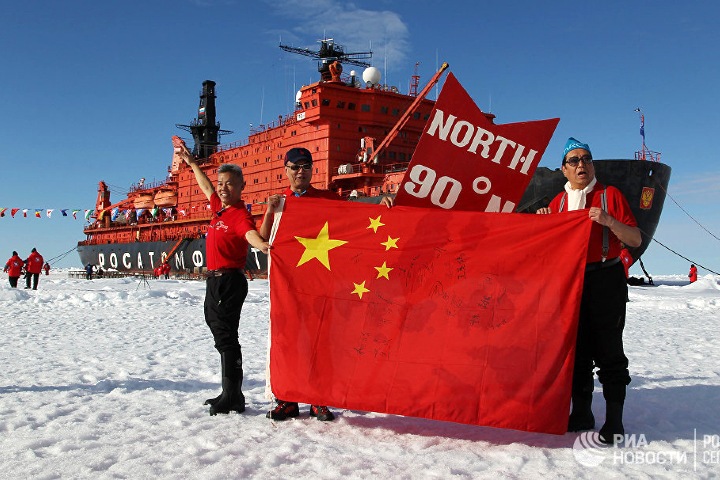
Further, the Russian helicopter of Liu Shachuan was thrown to the island of the Komsomol member. He started from Cape Arctic, grabbing a load with a total weight of 160 kg. The story of meetings with white bears and cracks in the ice can be omitted. The very fact is important that on the second attempt, the Chinese researcher reached the North Pole. In his homeland, this event was noted widely and delighted Liu Shaochuan promised: “In the near future, I will make an expedition to the Arctic again on foot. I have prepared red wine to celebrate Victory. ”
Is the Northern Sea Route an advantage of the Chinese economy?
In 2010, an employee of the Dalyansk University of Sea University of the University of Sea in 2010: “He who will receive control over the Arctic route will control the new path of the global economy.” Things have been going on for a long time, so no one was surprised by the appearance of Linda Jacobson’s work in the Stockholm Institute for the Problems of the World of the Work of Linda, called “China is preparing for the Arctic, free from ice”.
The explorer’s conclusion is as follows: due to global warming “trade routes will become shorter, and access to untouched energy resources will appear, which is why China decided to allocate large funds for the study of the Arctic.
What does the fact that Arctic ice continues to melt for the global economy? What will become easier to master natural resources is understandable, but this is clearly not the closest prospect. But a new impulse for shipping along the Northern Sea Route is no longer fantasy, but reality. After all, everything is already calculated. The path by sea through the Arctic from Shanghai to Hamburg is 6400 km. In short, than through the Suez Canal. Yes, and the pirates are not found here - only white bears ... The calculations continue. The Washington Post reported that the path of the sea from South Korea to Germany through the Suez Canal takes 34 days, and through the coastal Arctic waters of Russia - only 23 days. As a result, China expects 20 percent of foreign trade transportation by 2025 through the Northern Sea Route.
Everything is wonderful, but what about the ice?
Bring "snow dragons"
Russia is a world leader in part of the icebreaker fleet: both in quality and in quantity. But in China they doubt whether Russia will take it too expensive for wiring ships along the Northern Sea Route? The ships of the PRC themselves, of course, will not be able to go through ice-warming to such an extent will still not help.
Prudent Chinese were puzzled for a long time, and already in 1994 they had their own icebreaker. In the same way as their first aircraft carrier, he was born in Ukrainian shipyards. The ship created in Kherson was called the “Snow Dragon” (Xue Long) and was immediately sent on an expedition to the north. Since then, the world's largest non -aomatic icebreaker has brought more than one research expedition to the Arctic and to Antarctic. By the way, during one of them - in 2010 - Chinese polar researchers landed on a helicopter at the North Pole. In 2012, the icebreaker walked along the Northern Sea Route from Tsindao to Iceland, and in 2013 he tried to help the Russian vessel “Academician Shokalsky”, blocked by ice. He can take up to 100 researchers on board, has its own deep -sea descent apparatus. Until 2030, it will definitely be in operation.
Xue LONG Chinese used one hundred percent. His full twin, which was built at the Chinese shipyard, has already been launched. Moreover, Xue Long-2 will not be the last in the series-the institute of polar research needs new “snow dragons”.
Norwegian trace
In Antarctica, the first Chinese research station appeared in 1984, and now the fifth is being built. In the Arctic, there is only one Yellow River station - very close to Spitsbergen. It has been constantly working on it from 2003 to 20 specialists. They study the weather, ice and northern lights.
I would like more, so China does not hide its desire to buy an Arctic land. We are talking about a area of 217 square meters. km, put up for sale by private owners. It is here that there is coal - from 20 to 25 million tons, which is enough for stable production for 20 years. China is ready to restore both the mine and infrastructure to show that he is a full -fledged participant in the international development of the wealth of the Arctic.
Geography decides everything, and therefore China simply needs a strategic ally among the countries of the Arctic Council. Now both international and Russian experts consider Norway. It is Norway who advocates that China in the Arctic Council is granted the status of a permanent observer.
The representative of the Norwegian Foreign Ministry confirmed this position at the Arctic Frontiers International Conference. Norway would be very much averse to the financial assistance of China in the development of the Arctic. The rapprochement of the two countries was prevented by the fact that the Nobel Prize of the World for 2010 was awarded to the human rights activist and dissident Li Xiavikov. “Significant deterioration”, however, did not last long. And now the Norwegian Foreign Ministry states: “We have achieved a complete normalization of political and diplomatic relations with China. This opens up wide opportunities for cooperation. ”
Icelandic version
If not everything will grow together with Norway, China already has a spare option. Iceland survived a serious financial crisis, and therefore the idea appeared to repeat the script of Spitsbergen there.
Official structures, as usual, were not in business - the initiative was made by a millionaire, poet and athlete, a hot tourism enthusiast and one of the richest Chinese Juan Nubo. He simply invited the authorities to sell him 300 square meters. The island, which, incidentally, is almost a third of Hong Kong.
Officially, the millionaire-excesses from the Middle Kingdom intends to develop elite tourism and hotel business. But the methods of China’s penetration into other countries are well known, so a wave of protests went in Iceland and, in the end, the government of the country did not give a deal. Although he really needs money.
"Russians consider the Arctic their possession"
China will undoubtedly look for all new options for penetrating the Arctic to realize its strategic goals. There is an option that is not particularly talked about - possible close cooperation with Russia. The geopolitical picture of the modern world now clearly contributes to this.
And therefore, the commander of the US Navy in Europe and Africa, Admiral James Foggo last year, was thoughtful of this. It did without diplomacy: “It is important that Russia and China are nowhere to receive initiatives. They want all promising commercial projects - and the Northern Sea Route is also strategic - are not under the control of potential opponents of the United States. It is important for Washington that Moscow never won psychological victories anywhere. ”
The admiral noted that he observes the “significant joint activity of China and Russia”, and even everything is complicated by the fact that “the Russians consider the Arctic to their possession.”
In general, the phenomenon of “snow dragons” in Arctic expanses carries inevitable changes with it. What are they? The question remains open: even experts are not taken to judge this yet.
Vladimir Kuzmenkin